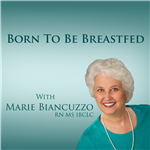
Born to be Breastfed

Born to be Breastfed

By Marie Biancuzzo, RN MS IBCLC
Download on the App Store

Born to be Breastfed episodes

  • Encore Are You Inclusive of the LGBTQIA Community? Think Again.
    Happy World Breastfeeding Week! Join in celebrating with all who protect, promote, and support breastfeeding throughout the globe! Yet, as you celebrate, recognize that there’s work to be done. This year’s World Breastfeeding Week theme calls us to focus on gender-equitable strategies for breastfeeding families everywhere. So how can we do that?
    Join Marie and her guest, Stephanie Brown, IBCLC for a lively discussion that addresses how clinical professionals exhibit helpful and unhelpful actions for the LGBTQIA community. Begin to become aware of how your attitude, your language, and even your clinical environment can undermine rather than empower parents, beware of how “othering” can creep into your messages, recognize how issues such as continuity of care and consent and body autonomy impact care. And, get Marie’s free handout at mariebiancuzzo.com to help you take actions to facilitate gender-equitable parental social protection.
    57 min
  • Winning a Scholarship to a 90-Hour Lactation Education Course
    Aimee Sing started out like so many others. She was hoping to complete a 90-hour lactation education course and learned about the annual Felix Biancuzzo Scholarship. Aimee envisioned hundreds of people applying, and having her application get lost in the shuffle. Yet, she realized that she stood no chance unless she applied. Join Marie and her guest, Aimee Sing, PhD, as they talk about her journey to becoming an IBCLC. In this episode, Aimee shares her realization that she wanted to move down a new career path, and how she needed her IBCLC certification in order to carry out her mission to improve breastfeeding and birthing support for women. Amy talks about the depth and breadth of what she now knows is not just meeting the requirements for the IBLCE exam, but also, building a strong foundation for her future practice in direct care and global advocacy.
    47 min
  • 7 Strategies to Reduce Stress for Your Upcoming Lactation Exam
    The mere thought of taking a comprehensive, career-critical exam like the IBLCE™ exam makes most people feel stressed, whether they’ve taken the exam before, or if they are a first-time test-taker. You might be wondering: What are the three main causes of test anxiety? What do the studies say about the relationship of the test-taker’s stress and their score? What do studies say about the relationship between decision-making and exam performance? Join Marie for this special episode where she describes seven strategies that are aligned with the science, her personal experience, and the experience of other test-takers over the past several years. And, if you haven’t already discovered this, Marie reveals how — for a very limited time — you can get access to her expertise for free! Don’t miss the unusual episode!
    46 min
  • Encore What You Need To Know About A New Baby Weight Tracking Tool
    No doubt, you’ve heard someone say that babies lose weight after birth but need to surpass their birth weight by 7 days, or 2 weeks, or 3 weeks. Similarly, you’ve probably heard that babies who have a 10% weight loss in the first few days require formula supplementation. But is this “decaphobia” justified?
    Join Marie and her guest, clinical pediatrician and expert researcher Dr. Ian Paul, who says that these numbers and assumptions have been based on anecdote, not evidence. Dr. Paul has given us the NEWT, i.e., the nomogram which represents the new and evidence-based standard to understand newborn weight loss. Whether you are a parent or a provider, you’ll learn the who-what-where-when-why of the NEWT, the research from 160,000 babies that propelled its inception, how it compares with expert recommendations, how weight loss in babies born by vaginal compares to cesarean birth, and how 36-weekers compare to 37-weekers. Don’t miss this exciting episode!
    55 min
  • Encore Breastfeeding After Sexual Abuse
    Sexual abuse affects more women than you may think. Some estimates suggest that it has happened to 20 to 25 percent (or more) of U.S. women. You’ve probably met these women. Survivors of sexual abuse come from all walks of life and all socioeconomic backgrounds, and the effects have a profound and life-long impact. For breastfeeding mothers, their supporters, and their health care providers, this raises a multitude of questions. How can sexual abuse impact breastfeeding? How can family, other mothers, and health care providers help? What can any of us do to be helpful and supportive of mothers who want to breastfeed after such trauma?
    Listen as Marie and her guest, Elizabeth Johnson, talk about how to have the conversation, and how to help. If you’ve wondered about “touching”, triggers, flashbacks, and more, this show will help you to develop a clearer perspective.
    43 min
  • Encore Skin-to-Skin Contact: Neuroscience or NurtureScience of Birth?
    After birth became medicalized, skin-to-skin care was assumed to be optional, irrelevant, or unimportant. But in truth, the skin-to-skin contact between the newborn, the mother and—yes, the father—is a critical component of the transition to extrauterine life for the baby, and the transformation of individuals into family units.
    Join Marie and her special guest, Nils Bergman, MB ChB, MPH, MD, as they discuss the “NurtureScience” to support the initiation and continuation of prolonged skin-to-skin contact. How and why does this critical period have a profound and life-long impact on the newborn? How long should skin-to-skin contact (aka kangaroo mother care) last? How do birth practices, especially skin-to-skin (or lack thereof) affect hormones, sensory stimuli, the limbic brain, and emotions? What is the effect of labor inductions? Whether you are the parent, the healthcare professional, or the “kangaroula”, you can create a transformational experience for the new family.

    58 min
  • Marie’s Online Lactation Exam Review: Frequently-Asked Questions
    Uh-oh. You see that lactation exam lurking around the corner. You’re huffing and puffing, wondering how you’re going to slog through the 105 subtopics that are fair game on that exam. It’s your first time. Or it’s your third time. Or you’ve failed before and you know that failing is a real possibility. Will Marie’s course work for you? Maybe! Marie has helped more than 5,000 IBCLCs from 6 different continents, and she can help you, too! Join Marie for answers to the most frequently-asked questions about her highly-acclaimed Online Lactation Exam Review course. Marie describes the course in terms of its content, methods (audio, video etc.), what is or isn’t required to complete it, access and availability, and how long it might take some people to complete it. Plus, Marie invites you to get your questions answered for FREE about anything related to the exam – and beyond – by signing up at MarieBiancuzzo.com.
    45 min
  • Empowerment: What does it mean?
    We talk about empowerment. We talk about becoming empowered, or empowering others. And for sure, everyone has a different idea of what “empowerment” is all about. But sometimes, we need to take a step back and look at some of the underpinnings of “empowerment.” What does empowerment really mean? What does it mean to be “intentional”? How does emotional intelligence help us to get the results we want? What the heck is the “motivational triad” in our brain, and why does it matter? Is it possible that limiting beliefs are holding us back from crushing our goals of reaching our dreams? Is seeking validation a good thing, or not? Join Marie and her guest, Becca Brown, a Certified Life Coach and host of The Military Wife Podcast. Whether you’re seeking better relationships or seeking a new career, Becca helps us to gain clarity about what empowerment really means, and how to make it work for us.
    41 min
  • Encore Baby Head Shape: Easy Innovative, Options You Need to Know Now
    Plagiocephaly (flat-head syndrome) affects as many as 47% of infants. If you’ve seen babies wearing helmets, you know how common this condition is. Maybe you’re wondering: My baby has an unusual head shape; does he need a helmet? Wait! Those helmets cost thousands of dollars and the cost is seldom, if ever, covered by insurance. Can you treat plagiocephaly without a helmet?
    Join Marie and her guest, plagiocephaly expert Andrew Dorough, DC, as they help you to realize you’re the only one who can find the best solution if your baby has a flat or unusual head shape. Is plagiocephaly just cosmetic? Should you do nothing and believe he will outgrow it? Should you do something now or wait until later…or doesn’t it matter? Does his head shape have anything to do with his continued feeding difficulties? In this episode Marie and Dr. Dorough will help you to follow your gut, ask the right questions, consider all of the treatment options, and understand how chiropractic care can help.
    1 hr 1 min
  • Happy IBCLC Day! A Glimpse of the Journey During the Pandemic
    The COVID-19 pandemic has seriously affected everything we do. That is especially true for healthcare professionals, those who work in hospitals, and IBCLC candidates who are sitting for the IBLCE exam. Join Marie and her guest, Melissa Bedward, MS, RNC-OB, C-EFM, to gain some insights into her journey to becoming an IBCLC; the ups and downs, the expenses and the rewards, and the subsequent real-life role of the hospital-based IBCLC as a helper, advocate, and teacher. Here’s your chance to get a complete behind-the-scenes glimpse of the IBLCE test-taking experience with home proctoring during COVID. What kind of preparation did she need for home-proctoring, and what was the 4-hour experience really like? What were some of her lessons-learned from the home proctoring experience? And, if she had it to do over again, would Melissa choose home-proctoring if on-site testing was a choice? Be sure to join Marie and Melissa for some insights that you won’t find anywhere else!
    36 min

About Born to be Breastfed

From the publisher's feed

Every new mother hears that breast is best. Many decide to breastfeed so their baby has the best. But soon after birth, the days are often fraught with sleep deprivation and conflicting messages from peers, family members, and health care professionals. Later, negative messages from the media and critical comments from family members and others may trigger mothers to question their decision. Feelings of inadequacy, intimidation and societal pressure to wean can cause mothers to give up breastfeeding before meeting their goals.

More shows like Born to be Breastfed

Breaking Banks by Breaking Banks - The #1 Global Fintech Podcast

Breaking Banks

190 Listeners

Getting In: A College Coach Conversation by Bright Horizons College Coach

Getting In: A College Coach Conversation

280 Listeners

Express Yourself! by Cynthia Brian, Producer, The Express Yourself! STAR On-Air Teen Team,

Express Yourself!

22 Listeners

The Soul of Enterprise: Business in the Transformation Economy by THRESHOLD by Ron Baker and Ed Kless

The Soul of Enterprise: Business in the Transformation Economy by THRESHOLD

94 Listeners

Civil War Talk Radio by Gerry Prokopowicz

Civil War Talk Radio

59 Listeners

Disrupt Yourself Live by Whitney Johnson

Disrupt Yourself Live

0 Listeners

The Sexy Lifestyle with Carol and David by Carol and David

The Sexy Lifestyle with Carol and David

112 Listeners

Cat Talk Radio by Molly DeVoss and Dewey Vaughn

Cat Talk Radio

67 Listeners

Fearlessly Authentic by Jodi Harrison Bauer

Fearlessly Authentic

29 Listeners

Men’s Therapy Podcast by Marc Azoulay

Men’s Therapy Podcast

27 Listeners