
Sign up to save your podcasts
Or

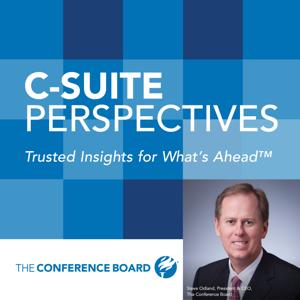


Find out why a 1-2% increase in annual electricity demand could create stress to the US electrical grid.
US electricity demand has been largely flat for 20 years, thanks to efficiency gains. But with rising power demand from AI, electric vehicles, and other forms of electrification, how can the US grid keep up?
Join Steve Odland and guest Alex Heil, PhD, senior economist at the Economy, Strategy & Finance Center of The Conference Board, to find out the current pressures on power generation and distribution, what kinds of investment are required, and how higher power demand affects US businesses and consumers.
For more from The Conference Board:
Power Playbook: How US Businesses Can Prepare For Electricity Price Pressures
US Power Surge: How Businesses Can Prepare for Electricity Demand Spikes from AI
Plugged In or Power Outage? Corporate Risk in US Grid Capacity
What does the latest Consumer Confidence Index reveal about the economy's true pulse amid a prolonged government shutdown?
In this episode, host Dana M. Peterson, Chief Economist and Center Leader of the Economy, Strategy & Finance Center, talks with Stephanie Guichard, Senior Economist of Global Indicators, both of The Conference Board, about the latest Consumer Confidence Index results and the ongoing federal government shutdown.
They discuss how Americans are feeling about the economy, inflation, and the job market; early signs for the 2025 holiday shopping season; and what the shutdown means for growth, data, and consumers.
Topics covered:
Why consumer confidence is holding steady despite uncertainty
Shifts in inflation expectations and buying plans
Insights on holiday spending and tariff impacts
The shutdown's effects on data, jobs, and GDP
What to watch for as policymakers debate next steps
For more from The Conference Board:
US Consumer Confidence
Forecast for the US Economy
Global Economic Outlook
"This is a self-inflicted wound on our economy," says former Congressman Ron Klein.
In this episode of C-Suite Perspectives, Steve Odland, CEO of The Conference Board, sits down with Klein to unpack the ongoing US government shutdown: what it really means, who it affects, and how it might end. Together, they explore the technical mechanics behind a shutdown, the political dynamics fueling it, and the ripple effects across the economy and private sector.
Executives should monitor the shutdown's downstream effects on consumer confidence, supply chains, and federal partnerships. Klein underscores that resolution will come—but the longer the impasse, the broader the economic and social toll.
For more from The Conference Board:
US Consumer Confidence
Navigating Washington
In just a few decades, corporate sustainability has grown into a core corporate function, particularly at publicly traded companies. What is the state of corporate sustainability in 2025, and how will it evolve in the coming decade?
Join Steve Odland and guest Andrew Jones, principal researcher at The Conference Board's Governance & Sustainability Center, to find out what "corporate sustainability" means, why most companies are embracing a hybrid model, and where sustainability leaders see the function evolving next.
For more from The Conference Board:
Structuring Corporate Sustainability for Business Advantage
Sustainability Under Scrutiny: Corporate ESG in an Uncertain Policy Environment
Survey: 80% of Corporations Are Reworking ESG Strategies Amid Policy Shifts
Learn what the latest research on US shareholder activism can teach CEOs and boards.
Activism has evolved from a niche effort to a mainstream investment strategy, with campaigns in the US quadrupling since 2018. Learn how activists are targeting not only small-cap firms but increasingly large S&P 500 companies, using sophisticated communication strategies and exempt solicitations to influence boards.
Join Steve Odland and guest Matteo Tonello, Head of TCB Benchmarking and Analytics at The Conference Board, to find out what's behind the surge in activism campaigns, how companies are being targeted, the increasing scrutiny of CEOs (including gender bias), and how boards can prepare and respond effectively.
For more from The Conference Board:
2025 Proxy Season Review: From Escalation to Recalibration
TCB Benchmarking
2026 Executive Compensation Event
In this episode of C-Suite Perspectives, Chief Economist Dana M. Peterson sits down with Associate Economist Allen Li to unpack the latest findings from The Conference Board Measure of CEO Confidence™ in collaboration with The Business Council. CEO confidence slipped slightly to 48 (down from 49), signaling cautious optimism among US business leaders amid ongoing tariff uncertainty and geopolitical risks.
Dana and Allen explore what's driving sentiment among Fortune 500 executives, from their views on the broader economy and their own industries to evolving workforce and investment plans. Despite a softer headline number, CEOs remain resilient — with many expecting only a mild slowdown, steady wages, and no imminent recession.
With official government data delayed due to the shutdown, this survey offers crucial real-time insights into how corporate leaders view the US economy, labor markets, and investment landscape heading into 2026.
For more on the Measure of CEO Confidence™, click through here.
The US and the EU are both cracking down on human rights violations in the supply chain. What should the C-Suite and board do to avoid not just regulatory penalties but also reputational damage?
Join Steve Odland and guest Andrew Jones, principal researcher at The Conference Board Governance & Sustainability Center, to find out what human rights means in a supply chain setting, the challenges of assessing multiple tiers of suppliers, and what boards should do next.
For more from The Conference Board:
Human Rights in the Supply Chain: Compliance, Governance, and Strategy
Human Rights: A Priority for India Inc. in 2025
2026 Corporate Citizenship Summit
The government shutdown affects much more than the federal workforce. How can CHROs guide their companies through this latest stressor?
The government shutdown has an impact on your private company, whether it's missing economic data, delayed regulatory action, or employees affected indirectly by a family member's furlough or job loss. How can CHROs lead their workforces through yet another stressful event?
Join Steve Odland and guest Diana Scott, center leader of the US Human Capital Center at The Conference Board, to learn about the psychological stress of the shutdown,how CHROs can give managers the right resources, and how to find alternate sources of economic data.
For more from The Conference Board:
Implications of Government Shutdown
Shutting Down the Economy? Impact of US Government Shutdown
For CMOs, the Market Stays Open During the Shutdown
Find out how business leaders and workers feel about the workplace amid uncertainty and cost-cutting.
Layoffs are on the rise, with 41% of organizations issuing them in 2025 compared with only 30% in 2024. What does this uncertain economic environment mean for human capital leaders as they try to shape resilient organizations in 2026 and beyond?
Join Diana Scott and guests Robin Erickson, PhD, head of human capital research at The Conference Board, and Matthew Maloof, researcher at The Conference Board Human Capital Center. They discuss why hybrid work is increasingly popular, how cost-cutting is affecting culture and more, and the pandemic's lasting effects on the workplace.
For more from The Conference Board:
The Reimagined Workplace 2025: Managing Uncertainty
Off-Site, Out of Mind? Overcoming the Downsides of Hybrid Work
How to Navigate the Reimagined Workplace in 2025
Find out what NATO is, how it functions, and why Russia's recent incursions could force the alliance to act.
Recent Russian violations of Polish and Estonian airspace have NATO considering a possible Article Five response, something last seen in response to 9/11. What are NATO's options, and what happens if the alliance fails to present a united front?
Join Steve Odland and guest Sara Murray, Managing Director for International at The Conference Board, to learn about NATO's origins and structure, why defense commitments have increased, and why NATO is approaching a red line with Russia.
For more from The Conference Board:
House Passes National Defense Authorization Act (NDAA)
Green Tanks? How Defense Spending Can Bolster EU Competitiveness Amid CBAM
Europe's Financial Independence Needs Derisking, Not Decoupling
From the publisher's feed

32,046 Listeners

30,701 Listeners

43,359 Listeners
8,731 Listeners
1,384 Listeners
1,712 Listeners
150 Listeners

5,441 Listeners

56,447 Listeners
3,979 Listeners
9,537 Listeners
9,070 Listeners
53 Listeners
334 Listeners
4,208 Listeners