
Sign up to save your podcasts
Or

By BBC Radio 4
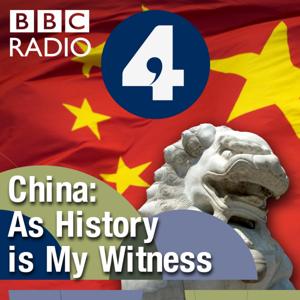
Carrie Gracie presents a series exploring what ten great lives from Chinese history reveal about China today
... more

4.3
3333 ratings


The podcast currently has 10 episodes available.
The most played episodes among Podcast App listeners.
Early in the 3rd Century, China's mighty Han empire collapsed. From the wreckage emerged three kingdoms and competing warlords with an eye on the throne. Centuries later their struggle was turned into China's favourite warfare epic - a story that underlines the historical fragility of the empire, and still provides an object lesson in good management. The Romance of the Three Kingdoms is for China roughly what Homer is for Europeans, a swashbuckling adventure story, with lots of blood, excitement and craftiness on the battlefield. Chinese boys live and breathe the story, with its hundreds of characters in cloaks and long robes and multiple sub-plots, spanning a century of convulsion before the empire was reunited. "It is a general truism of this world that anything long divided will surely unite, and anything long united will surely divide." These are the opening words of the Romance of the Three Kingdoms. The action begins just as the Han empire is about to break up. The government is struggling to suppress a rebellion by peasants called the Yellow Turbans. It is forced to do what it hates to do: outsource troop recruitment - and that gives an opportunist called Liu Bei his big break. Presenter: Carrie Gracie Producer: Neal Razzell.

There are two Chinese leaders whose final resting place is thronged by tourists - Mao Zedong and Qin Shi Huang, the emperor of terracotta soldier fame. But they also have another thing in common - Qin taught Mao a lesson in how to persecute intellectuals. Chairman Mao Zedong has been dead for nearly 40 years but his body is still preserved in a mausoleum in Tiananmen Square. The square is the symbolic heart of Chinese politics - red flags and lanterns flank the portrait of Mao on Tiananmen Gate where he proclaimed the People's Republic in 1949. But the red emperor owed the idea of this vast country to an empire builder who lived 2,000 years earlier. Claiming the title of China's first emperor, Qin Shi Huang kick-started nearly 2,000 years of imperial rule, unifying China through economic and political reforms, and also via the construction of a massive nationwide road system. But this was all at the expense of thousands of lives - and to maintain power he outlawed many books and buried scholars alive. So, over 2,000 years later does history remember him as a hero or villain? Presenter: Carrie Gracie Producer: Neal Razzell.
On one bank of the Huangpu river in Shanghai stands a forest of steel and glass skyscrapers, but on the other - colonial splendour. A century ago, foreigners unpacked a whole new fascinating way of life on the docks here. From Western ships came bicycles, engine parts and young Chinese with a vision of modernity - adventurers like Charlie Soong who had been out to see the world and had come back. Charlie had sons, and in any earlier generation he'd have ignored his daughters but he had been educated by American Methodists and he believed in Christian virtue, democracy and the dignity of women. From this waterfront, he sent his daughters to America to get a grounding in all three. As Shanghai boomed, their horizons expanded. And in 1914 the eldest, Ailing, made a strategic match with a young man, H H Kung. Money was no object. He and his bride would become China's richest couple. Qingling, the second sister, married a very different kind of politician - Sun Yatsen, the revolutionary leader of China, who had become President of China after the overthrow of the Qing dynasty in 1912. As Sun was an older man and already married, Qingling's parents objected - so she jumped out of a window and eloped with him. All three sisters were very much in the public eye, and in the news magazines almost as often as film stars - but life wasn't just a round of photo opportunities and jazz. Qingling's husband Sun Yatsen died in 1925 and his movement split into warring camps.His successor, Chiang Kaishek, was a no-nonsense military man - some would say a fascist. Qingling was horrified by his tactics. And doubly horrified when she discovered her younger sister Meiling was planning to marry him. Presenter: Carrie Gracie Producer: Neal Razzell.
China's two favourite poets were born 1,300 years ago, at the beginning of the 8th Century. The language has changed so little that they remain easy for modern Chinese people to read, and their themes are still relevant today - from friendship, love and landscape to the stench of political corruption. Kaiser Kuo, a founder of China's first heavy-metal band, is probably one of the very few rock musicians, in any country, who draws inspiration from a poet born in 701AD. "He was quite a drunkard... and writing some of his best poetry apparently, while completely inebriated. You know, he's wild and associated with a kind of unbridled revelry, and yeah that's part of why I love him," says Kuo. He is talking about Li Bai, a poet born in Central Asia, who became a wandering superstar poet in China, known as "the fallen immortal" or "the immortal of wine". Li Bai was a huge celebrity, showered with honours because of his genius. Du Fu, on the other hand, aspired to a career as a civil servant, but he failed the exam and was too prickly to network his way into a good post. In his later years, Du Fu was so poor that one of his children died of starvation. Today, every Chinese person learns poems by Li Bai, and the country's other favourite poet, Du Fu, from childhood and their work is considered as important in Chinese literary history as Shakespeare is to people in Britain. Presenter: Carrie Gracie Producer: Neal Razzell.
Many Chinese look to Confucius for guidance. But Confucius looked to the Duke of Zhou. He handed power to his nephew 3,000 years ago, but his ideas still motivate leaders today.
The podcast currently has 10 episodes available.

7,615 Listeners

4,110 Listeners

1,062 Listeners

5,525 Listeners

1,809 Listeners
1,105 Listeners

1,796 Listeners
1,043 Listeners

1,902 Listeners

4,158 Listeners

3,228 Listeners

762 Listeners