
Sign up to save your podcasts
Or

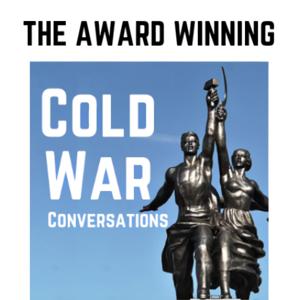


Based on Podcast App listening data
This is part 2 of my conversation with Professor Sergei Khrushchev the son of Nikita Khrushchev who led the Soviet Union 1953 to 1964.
Before we start I would again like to thank all those who are supporting the podcast with monthly pledges and donations.
If you would like to support the podcast further and get access to some exclusive extras go to our website at coldwarconversations.com/donate
In part 2 of this interview, we gain insight into Soviet thinking around the Cuban Missile Crisis, we hear about the Soviet view of the building of the Berlin Wall along with the 1961 Berlin Crisis and his father’s fall from power.
If you missed part 1 you can find it here https://coldwarconversations.com/episode25/
Support the project! https://coldwarconversations.com/donate/
Follow us on Twitter https://twitter.com/ColdWarPod
Facebook https://www.facebook.com/groups/coldwarpod/
Instagram https://www.instagram.com/coldwarconversations/
Youtube https://youtube.com/@ColdWarConversations
Learn more about your ad choices. Visit podcastchoices.com/adchoices
In part 1 of this interview we talk about Professor Khrushchev’s early years, his relationship with his father, his father’s rise to power, the 1956 Hungarian Uprising as well the first international visits accompanying his father to the UK, East Germany and the USA.
Part 2 is here https://coldwarconversations.com/episode26/
Support the project! https://coldwarconversations.com/donate/
Follow us on Twitter https://twitter.com/ColdWarPod
Facebook https://www.facebook.com/groups/coldwarpod/
Instagram https://www.instagram.com/coldwarconversations/
Youtube https://youtube.com/@ColdWarConversations
Learn more about your ad choices. Visit podcastchoices.com/adchoices
West Germany had a number of Nuclear Warning Bunkers dotted around the country similar to the Royal Observer Corps in the UK.
Mirko Krumm describes the organisation West German Civil Defence and the preservation of his bunker near Bremen.
Support the project! https://coldwarconversations.com/donate/
Follow us on Twitter https://twitter.com/ColdWarPod
Facebook https://www.facebook.com/groups/coldwarpod/
Instagram https://www.instagram.com/coldwarconversations/
Youtube https://youtube.com/@ColdWarConversations
Learn more about your ad choices. Visit podcastchoices.com/adchoices
Powers' U-2 was shot down on May 1, 1960, as he flew over Soviet airspace, and after parachuting out of the plane he was captured and convicted of espionage.
He was sentenced to 10 years in prison but was freed on Feb. 10, 1962, in exchange for Soviet spy Rudolf Abel.
The incident and exchange was detailed on the Steven Spielberg film “Bridge of Spies”.
Support the project! https://coldwarconversations.com/donate/
Follow us on Twitter https://twitter.com/ColdWarPod
Facebook https://www.facebook.com/groups/coldwarpod/
Instagram https://www.instagram.com/coldwarconversations/
Youtube https://youtube.com/@ColdWarConversations
Learn more about your ad choices. Visit podcastchoices.com/adchoices
We’re talking about East German cars with Alex Goffe and Mark Mullarkey of the UK-based Wartburg Trabant IFA Club.
Now I don’t think Top Gear or Jeremy Clarkson, etc. have anything to worry about, but I hope you enjoy our chat and ride through the Staffordshire countryside in Alex’s Trabi…
Support the project! https://coldwarconversations.com/donate/
Follow us on Twitter https://twitter.com/ColdWarPod
Facebook https://www.facebook.com/groups/coldwarpod/
Instagram https://www.instagram.com/coldwarconversations/
Youtube https://youtube.com/@ColdWarConversations
Learn more about your ad choices. Visit podcastchoices.com/adchoices
Welcome to Episode 21 of Cold War Conversations.
Now I am very excited by today’s guest and we have a packed episode for you. Nigel Dunkley MBE is a former Royal Scots Dragoon Guard who served in Berlin with a squadron of Chieftain tanks tasked with defending the British Sector including the Brandenburg Gate should the Cold War have turned hot.
Nigel also performed intelligence gathering duties in the former East Germany with BRIXMIS which was an intelligence organisation worked throughout the Cold War years from 1946 to 1990 gathering intelligence in the former Soviet Occupation Zone of East Germany on the threat posed to the West and NATO by the 20 Soviet and 6 East German Army Divisions and their Air Forces deployed there.
In the 1980s Nigel also interpreted for Hitler’s Deputy Rudolf Hess in Spandau Prison, Berlin and provided some fascinating insight into the character of Hess.
Later in his military career he was awarded the MBE and Bronze Star Medal for his services with the US 1st Cavalry Division during Operation Desert Storm. Nigel was also Chief of Staff at the Royal Armoured Corp Centre at Bovington, ending his army career as Defence Attache at the British Embassy in Berlin.
I am delighted and honoured to welcome Nigel Dunkley.
Support the project! https://coldwarconversations.com/donate/
Follow us on Twitter https://twitter.com/ColdWarPod
Facebook https://www.facebook.com/groups/coldwarpod/
Instagram https://www.instagram.com/coldwarconversations/
Youtube https://youtube.com/@ColdWarConversations
Learn more about your ad choices. Visit podcastchoices.com/adchoices
Today we're talking to Anke Holst was born in the GDR during the 1970s in Rostock.
Anke has returned to Rostock after many years abroad and now provides tours of GDR sites in Rostock.
Our conversation highlights how different life was in the provinces of the GDR as opposed to Berlin.
In a wide ranging, frank and honest discussion we talk about her family life with her mother who was a stalwart Party member, Anke's school class role as "Agitator", her training in Marxist-Leninism, and her weapons training in the Ernst Thälmann Pioneer Organisation in Rostock.
Support the project! https://coldwarconversations.com/donate/
Follow us on Twitter https://twitter.com/ColdWarPod
Facebook https://www.facebook.com/groups/coldwarpod/
Instagram https://www.instagram.com/coldwarconversations/
Youtube https://youtube.com/@ColdWarConversations
Learn more about your ad choices. Visit podcastchoices.com/adchoices
Today we're talking to Francesca Akhtar who holds a BA Hons in American Studies with 1st class honours from Canterbury Christ Christ Church University in Kent, and a Masters degree in US history & Politics from the Institute of the Americas, University College London.
Her main research interests are US Cold War foreign policy, intelligence history and defence. Francesca has written a dissertation entitled “The most dangerous Soviet-American confrontation since the Cuban Missile Crisis?” An analysis of the origins, nature and impact of the Able Archer 83 incident .
I am delighted to welcome Francesca Akhtar to Cold War Conversations.
Support the project! https://coldwarconversations.com/donate/
Follow us on Twitter https://twitter.com/ColdWarPod
Facebook https://www.facebook.com/groups/coldwarpod/
Instagram https://www.instagram.com/coldwarconversations/
Youtube https://youtube.com/@ColdWarConversations
Learn more about your ad choices. Visit podcastchoices.com/adchoices
The airfield is probably best known, certainly in the UK, for the controversial deployment of Ground Launched Cruise Missiles in the 1980s and the resulting Greenham Common Women's Peace Camp outside its gates.
Today’s guest is is a graduate in international relations, the author of “In Defence of Freedom; a History of RAF Greenham Common” and is also a Director of Greenham Control Tower Ltd.
I am delighted to welcome Jonathan Sayers.
Support the project! https://coldwarconversations.com/donate/
Follow us on Twitter https://twitter.com/ColdWarPod
Facebook https://www.facebook.com/groups/coldwarpod/
Instagram https://www.instagram.com/coldwarconversations/
Youtube https://youtube.com/@ColdWarConversations
Learn more about your ad choices. Visit podcastchoices.com/adchoices
In 1968 today’s guest was 15 year old at the same school in Prague as Czech communist leader Alexander Dubček’s son.
Jan Čulík provides a valuable eyewitness account of the heady days of the Prague Spring and the subsequent Warsaw Pact invasion. He provides some insightful views that I found challenged my understanding of the Prague Spring.
He details the situation in Czechoslovakia in the late 1960s, the Prague Spring, his experiences as the reformers were suppressed to the late 1970s and his arrest by the STB, the Czech secret police.
The interview starts as we talk about the level of censorship in Czechoslovakia before the Prague Spring.
Support the project! https://coldwarconversations.com/donate/
Follow us on Twitter https://twitter.com/ColdWarPod
Facebook https://www.facebook.com/groups/coldwarpod/
Instagram https://www.instagram.com/coldwarconversations/
Youtube https://youtube.com/@ColdWarConversations
Learn more about your ad choices. Visit podcastchoices.com/adchoices
From the publisher's feed
Ranked by our users in the last 21 days

1,241 Listeners

1,533 Listeners

4,754 Listeners
276 Listeners

1,390 Listeners
1,938 Listeners

363 Listeners
5,243 Listeners
531 Listeners
352 Listeners

338 Listeners
141 Listeners
612 Listeners
97 Listeners

1,076 Listeners