
Sign up to save your podcasts
Or



Based on Podcast App listening data
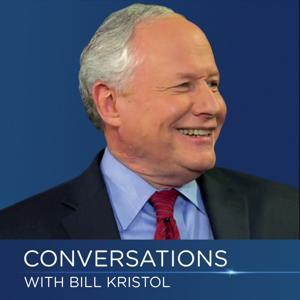
Harvey Mansfield reflects on The Federalist and why it should be read seriously as a great work on politics. Mansfield’s discussion calls our attention to the subtlety and complexity of the argument of The Federalist, as a whole, and explains why it remains an indispensable guide for thinking about American government. Mansfield and Kristol also consider how The Federalist draws on, but also differs from, works of ancient and early modern political science in its analysis of good government and republicanism.
Linda Chavez is an author, syndicated columnist, and served in the Reagan administration. A longtime analyst of immigration and immigration policy in the United States, Chavez shares her perspective on the current debates over immigration. She explains why immigration remains a net benefit to the United States—and why we should address, improve, and streamline the immigration system. Citing relevant data, Chavez notes how recent arrivals to the United States are following the pattern of earlier waves of immigration and assimilating into the American way of life. Finally, Chavez proposes reforms to the immigration system that prioritize relevant skills and also would be more flexible to market conditions.
A leading software entrepreneur and developer of artificial intelligence (AI) technology, Jim Manzi shares his perspective on AI—what it is, what it can do today, and how it might develop in the coming years. Manzi also discusses how AI currently affects politics and society, and the implications of progress in AI for the future. Finally, Manzi compares today’s advances in computer science and in biology to past scientific breakthroughs in chemistry and physics.
Steven F. Hayward is a visiting scholar at UC Berkeley and author of important books on Churchill, Reagan, and many other subjects. In this Conversation, Hayward analyzes Churchill’s wartime leadership and his domestic political concerns—as well as his often neglected writings, which contain both timeless and timely political insights. Highlighting Churchill’s attachment to principles as well as his understanding of circumstances, Hayward demonstrates that Churchill remains vital to understanding statesmanship. Kristol and Hayward also compare and recommend their favorite speeches and works by and about Churchill.
Ronald Brownstein is a Senior Editor at The Atlantic, Senior Political Analyst at CNN, and a shrewd observer of American politics. In this Conversation, Brownstein analyzes factors that fuel our increasingly polarized politics. He explains why these partisan divisions are likely to increase as we head toward elections in 2018 and 2020. Brownstein and Kristol also consider possible outcomes in the midterms, the direction of the Trump presidency, and reflect on the electoral dilemmas both parties face in an atmosphere of intense partisanship.
Diana Schaub is a professor of political science at Loyola University Maryland and a leading interpreter of political philosophy and American political thought. In this Conversation, Schaub considers the life and ideas of the statesman and political thinker Frederick Douglass (c. 1818 – 1885). Schaub reflects on Douglass’s life, including his experience of slavery, his abolitionist politics, his work on behalf of the Union in the Civil War, and his post-war efforts to secure civil rights. Schaub demonstrates Douglass’s importance as a political thinker, pointing to his reflections on the corruptions of slavery, the meaning and requirements of freedom, the significance of the Declaration of Independence and the Constitution, and the role of prudence in politics.
In July 2014, we released the first part of a Conversation with University of Virginia literature professor Paul Cantor on Shakespeare and politics. Now we are pleased to share the second part—in which Cantor analyzes central themes in the English history plays, including the character of monarchies and republics and the relationship of religion and state. Turning to Shakespeare’s comedies, Cantor argues that Shakespeare sought to replace medieval Christian notions of romantic love with a more reasoned approach to love. Finally, in his analysis of "The Tempest," Cantor contends that Shakespeare was the only poet who could write tragedies and comedies at the highest level, transcending the division between the tragic and comedic views of life.
A leading commentator on European politics, Caldwell shares his perspective on recent developments in Europe, particularly the surging populist movements that have upended politics in many countries. Caldwell focuses particularly on populist parties and movements in Britain, France, Germany, Italy, and Hungary—and also analyzes the ramifications for Europe as a whole. Highlighting the effects of mass migration, weak economies, and mounting debt, Caldwell anticipates greater turmoil and significant threats to the European Union in the years ahead.
Edward Conard is a former Managing Director of Bain Capital and bestselling author. In this Conversation, Conard shares his perspective on why innovation is the key to America’s long-term economic vitality and how we can go about fostering it. To address what he describes as a shortage of properly-trained talent and risk-bearing capital, Conard calls for increasing high-skilled immigration and other public policies that match talent with opportunities. Conard and Kristol also reflect on the inequalities that are inherent in a technology-driven economy and consider what can be done now to benefit lower-skilled workers in the years to come.
From the publisher's feed
Ranked by our users in the last 21 days

6,276 Listeners

20 Listeners

12,505 Listeners

4,600 Listeners

8,087 Listeners
1,330 Listeners

3,986 Listeners

4,623 Listeners

2,620 Listeners

492 Listeners

2,238 Listeners

3,186 Listeners

3,454 Listeners

1,091 Listeners
774 Listeners