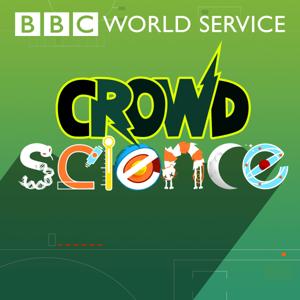
CrowdScience

CrowdScience

By BBC World ServiceScienceTechnology
Download on the App Store
  • Typical duration

    31 min

    per episode

  • If it hooks

    15%

    finish an episode

Based on Podcast App listening data

CrowdScience episodes

  • Can Your Lifestyle Be Passed on to Future Generations?
    Back when Charles Darwin presented his theory of evolution by natural selection, French biologist Jean-Baptiste Lamarck suggested something different - that the changes you are exposed to during your lifetime can be passed on to future generations. By this theory, giraffes have long necks because, over generations, they have stretched them, reaching for leaves.
    This theory became laughable when genes were discovered as the means of heredity. Lifestyle choices cannot be passed down in your DNA, or so we thought….But recently this idea has returned and a new field of biology has emerged called epigenetics – which looks at how the genes we inherit from our parents are controlled and modified by their life experience and the choices they made.
    Marnie Chesterton meets the survivors of the Dutch Famine of World War Two, whose grandchildren show health effects from that event despite being born three generations after the starvation of 1944.
    As the new field of epigenetics develops, does this mean Lamarck was right all along? Can your lifestyle be passed on to future generations and does this mean we need to rethink our traditional view of evolution?
    Do you have a question we can turn into a programme? Email us at [email protected]
    Presented and Produced by Marnie Chesterton
    (Image: Grandmother, Mother and Daughter in a kitchen. Credit: Getty Images)

    30 min
  • Why Does It Always Rain on Me?
    Listener Ros Allen wondered why it always seems to rain on her village but not the one a mile away. It’s all down to microclimates. CrowdScience explores the impact of microclimates on our lives, discovers how more rain can help an English tea plantation and reveals the deadly effect of the urban heat island. Marnie Chesterton also talks to a local project in New York City, the Cool Roofs Program, that aims to reduce the urban heat effect, helping to mitigate the impacts of climate change. But just how much of a difference can measures like this really make?
    Do you have a question we can turn into a programme? Email us at [email protected]
    Presenter: Marnie Chesterton
    Producer: Marijke Peters
    (Image: Women standing on the edge of a forest with an umbrella. Credit: Getty Images)

    28 min
  • What’s the Oldest Living Thing?
    Trees transcend human generations – but are they the oldest living things on Earth? CrowdScience listener William from London, UK, got in touch to ask what the oldest tree or other organism on our planet is. Presenter Marnie Chesterton heads out to meet one of our older arboreal cousins to see how we can work out its age - without cutting it down to count the rings. But whilst certain individual trees can live for thousands of years, some that live in colonies can survive for much longer – perhaps up to 80,000 years old. Along the way, Marnie asks what other organisms contend for this title, what the word ‘oldest’ really means, and even ponders whether some creatures could actually be immortal.
    Do you have a question we can turn into a programme? Email us at [email protected]
    Presenter: Marnie Chesterton
    Producer: Jen Whyntie
    (Image: Ancient Bristlecone Pine Forest. Credit: Getty Images)
    28 min
  • Why do Human Faces Look so Different?
    You don’t have to be a “super-recogniser” to know that human facial features are extremely varied. Just look around you. Yet look at a most other animals and you’d find it hard to tell individuals apart. So why are human faces so diverse?
    We’ll also be finding out why salt tastes salty (warning: lots of spitting and gargling ahead) and one listener wants to know what would happen if one of the key ocean current systems, the North Atlantic Conveyer, slowed down or stopped altogether. Presenter Marnie Chesterton heads to the beaches on the West Coast of Scotland in search of answer.
    Do you have a question we can turn into a programme? Email us at [email protected]
    Presenters: Marnie Chesterton and Geoff Marsh
    Producers: Laura Hyde and Jennifer Whyntie
    31 min
  • Why is Childbirth Painful?
    Childbirth is different for everyone. Depending on who you ask, it’s one of life’s greatest and worst experiences - and can be anything from traumatic and excruciating to life-affirming and spiritual. But what pretty much every mother will agree on is that it hurts. But why is such a fundamental aspect of life so painful? And why do some women find it worse than others?
    Presenter Gareth Barlow – who doesn’t expect to be giving birth ever – goes on a quest to understand the experience of female labour pain and why evolution hasn’t given women an easier ride. He discovers the latest research into the nature and experience of pain and whether the idea of male/female pain thresholds, is a real thing. We also hear from CrowdScience listeners about their own experiences, and find out if having a supportive birth partner can help bringing new life into the world that little bit easier.
    Do you have a question we can turn into a programme? Email us at [email protected]
    Presenter: Gareth Barlow
    Producer: Anna Lacey
    (Image: New born baby with mother. Credit: Getty Images)

    27 min
  • Where’s my Ejector Seat?
    Even if you spent your entire life on a plane, the chances are you’d never crash – commercial air travel is remarkably safe. But after hearing about a recent air tragedy, two brothers in Kampala wondered if commercial airplanes could ever have ejector seats – like fighter jets do - to give passengers a last option for escape.
    We meet 98-year-old John Oliver “Jo” Lancaster, one of the first people ever to eject out of a plane, and discover the seemingly insurmountable barriers to fitting ejector seats into passenger jets. And we find out that an awful lot of work goes into making flying as safe as it is, as we visit an air accident investigation lab, practise an emergency exit from a passenger cabin and deal with a multiple engine failure …in a plane simulator.
    But are any safety ideas as radical as ejector seats on the horizon? We assess a controversial design that would parachute the entire passenger cabin down to earth should the worst happen.
    Do you have a question we can turn into a programme? Email us at [email protected]
    Presenter: Marnie Chesterton
    Producer: Cathy Edwards
    (Image: Person blasting out of a plane cockpit on an ejection seat Credit: Martin-Baker Aircraft Company Ltd)
    28 min
  • Why Do We Have Males and Females?
    Sex is responsible for the large variety of life on earth. Without the two sexes there is no sexual reproduction which means no shuffling of the genetic make-up – and no survival in a changing environment. But why do we have two sexes in the first place and does nature determine your sex? It’s with these questions and more that listener Du from Singapore persuaded the CrowdScience team to investigate the weird and wonderful world of sex. You might think that Nature would have standardised something as important as ensuring the continuation of the species. Far from it – species do sex in many different ways – some stranger than others.
    Presenter Marnie Chesterton unpicks the zoological oddities of sex and along the way learns about her own sex chromosomes. We also meet an unlikely bird keeper, who is the proud owner of a female duck that is morphing into a male. Will her boyfriend, a male mandarin duck, mind the change?
    Do you have a question we can turn into a programme? Email us at [email protected]
    Presenter: Marnie Chesterton
    Producer: Louisa Field
    (Image: Male and female mandarin ducks. Credit: Getty Images)

    28 min
  • Are Fingerprints the Best Form of ID?
    Biometrics are being used everywhere to recognise us. On this edition of CrowdScience we try out the tech that tells us apart. We find out just how unique our irises are and meet a man who can pick people out from a crowd of thousands just by analysing the way they walk.
    Do you have a question we can turn into a programme? Email us at [email protected]
    Presenter: Anand Jagatia
    Producer: Marijke Peters
    (Image: Fingerprints being looked at under a magnifying glass. Credit: Getty Images)
    27 min
  • How Many People Can Earth Support?
    Our planet is getting rather cosy. In just over 200 years, the global population has grown from 1 billion to almost 7.5 billion – and the best estimates suggest it’s going to keep on increasing. But just how far can it go? When will we reach ‘peak human’? That’s what CrowdScience listeners Alan Donaldson and Francoise Brindle want to know: what’s the latest estimate for how many people the Earth can support?
    It’s a question that’s been bothering some of the world’s greatest thinkers for hundreds of years, and now presenter Marnie Chesterton goes on her own quest for answers. Her journey takes her through the technology and innovation that keeps our growing population alive, and she looks to Dhaka, Bangladesh, to find out what a more densely populated world might feel like. But are there signs that things are already levelling off? And could improving photosynthesis allow populations to grow without destroying the environment?
    Do you have a question we can turn into a programme? Email us at [email protected]
    Presenter: Marnie Chesterton
    Producer: Anna Lacey
    (Image: People on busy street. Credit: Getty Images)
    27 min
  • Space Mining
    Mining asteroids, moons or even other planets has remained firmly within the realm of science fiction. But as certain elements become increasingly scarce on Earth, private companies and even nation states are looking to make extra-terrestrial mining a reality. Presenter Marnie Chesterton heads to an Earth-based mine in Scotland to see just how tricky space mining could be, and what possibilities it holds. On the way she discovers what laws govern this new far frontier, and hears from a space prospector who already has designs on key sites for exploration. Could our solar system's asteroids really become self-fuelling gas stations for spaceships?
    Do you have a question we can turn into a programme? Email us at [email protected]
    Presenter: Marnie Chesterton
    Producer: Jen Whyntie
    (Image: Double the Rubble Artist Concept. Credit: NASA)
    27 min

About CrowdScience

From the publisher's feed

We take your questions about life, Earth and the universe to researchers hunting for answers at the frontiers of knowledge.

Best of CrowdScience

Ranked by our users in the last 21 days

More shows like CrowdScience

TED Talks Daily by TED

TED Talks Daily

10,900 Listeners

Global News Podcast by BBC World Service

Global News Podcast

7,608 Listeners

More or Less by BBC Radio 4

More or Less

875 Listeners

The Documentary Podcast by BBC World Service

The Documentary Podcast

1,794 Listeners

The Infinite Monkey Cage by BBC Radio 4

The Infinite Monkey Cage

1,906 Listeners

Future Tense by ABC Australia

Future Tense

62 Listeners

The Science Show by ABC Australia

The Science Show

119 Listeners

The Forum by BBC World Service

The Forum

267 Listeners

BBC Inside Science by BBC Radio 4

BBC Inside Science

391 Listeners

Science Weekly by The Guardian

Science Weekly

420 Listeners

All In The Mind by ABC Australia

All In The Mind

755 Listeners

The Inquiry by BBC World Service

The Inquiry

726 Listeners

CrowdScience by BBC World Service

CrowdScience

474 Listeners

ABC News Daily by ABC Australia

ABC News Daily

149 Listeners

The Intelligence from The Economist by The Economist

The Intelligence from The Economist

2,540 Listeners