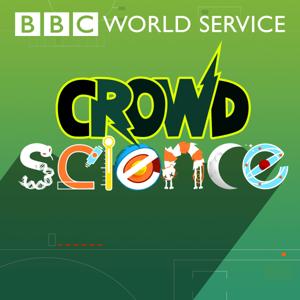
CrowdScience

CrowdScience

By BBC World ServiceScienceTechnology
Download on the App Store
  • Typical duration

    31 min

    per episode

  • If it hooks

    15%

    finish an episode

Based on Podcast App listening data

CrowdScience episodes

  • How Did Life Get onto Land?
    People often talk about being descended from apes. But go back a bit further and we have a more unlikely ancestor – fish. Improbable as it may sound, the creature that gave rise to every bird, reptile and mammal on Earth today lived a fully aquatic life.
    So how did it switch to life on land? And how hard was it to swap swimming for walking and breathing fresh air? That’s what CrowdScience listener Pierre in France wants to know, and what Marnie Chesterton is in Scotland to find out. She goes fossil hunting with members of the TW:eed Project team, as they try to uncover remains of creatures that are crucial in helping solve the puzzle of terrestrial life. She also discovers the landscape these early ancestors walked into – an alien and relatively empty world completely different to what we see today - where grass and flowers were yet to evolve.
    But not everything in this story is preserved in rock. Marnie goes to see a living relic of this period of evolution, and finds out what it can tell us about possibly the most important event in the history of our species.
    Do you have a question we can turn into a programme? Email us at [email protected]
    Presenter: Marnie Chesterton
    Producer: Anna Lacey
    (Image: Artists impression of underwater environment of Carboniferous swamp depicting a rhizodont; a large predatory fish. Credit: Mark Witton)
    30 min
  • How Can We Fight Unwanted Noise?
    Unpleasant man-made noise is something that disturbs many of us and even damages our health. But as millions more people move into crowded cities around the world, it's a cacophony that we almost unavoidably create ourselves. CrowdScience listener Diana from New York City in the USA got in touch to ask how we can temper the din and live a more peaceful life. Presenter Anand Jagatia heads to an acoustics lab at the University of Salford in Manchester, UK, to meet the researchers and engineers investigating the best ways to make cities more pleasant for our ears whilst still maintaining the ‘buzz’ of city life. And reporter Chhavi Sachdev takes us to Mumbai in India, where we discover how sound mapping is being deployed on the city’s streets as the first step to improve the life and health of its citizens.
    Do you have a question we can turn into a programme? Email us at [email protected]
    Presenter: Anand Jagatia
    Producer: Jen Whyntie
    (Image: Children cover their ears as the truck convoy front passes. Credit: Getty Images)
    38 min
  • Is There Proof of Life After Death?
    Is there any scientific proof of an afterlife? Six months ago, CrowdScience tackled a question from a listener who wanted to know whether there was life after death. But following more listener emails, presenter Marnie Chesterton returns to the subject to investigate the world of ghosts, souls and parapsychology. She meets Professor Susan Blackmore, who studies out-of-body experiences and has spent decades hunting for scientific proof of life after death. And she visits the woman who, despite dying in the 1950s, is alive and thriving on a cellular level and helping scientists find cures for cancer, Parkinson’s and other diseases, in laboratories across the world …
    Do you have a question we can turn into a programme? Email us at [email protected]
    Produced and Presented by Marnie Chesterton
    (Image: Four people sitting around a table having a Seance. Credit: Getty Images)
    28 min
  • Can We Worm Our Way Into Better Health?
    We test the science behind parasitic therapy to answer listener Michael’s question about whether intestinal worms can help us stay healthy, and visit a deworming programme in a rural Ugandan village.
    Do you have a question we can turn into a programme? Email us at [email protected]
    Presenter: Marnie Chesterton
    Producer: Marijke Peters
    (Picture: Tapeworm in human intestine, Credit: selvanegra/Getty Images)
    28 min
  • Is Carbon Dioxide Higher Than Ever?
    Carbon dioxide levels in our atmosphere today are higher than at any point in human existence. But going back further into Earth’s history, when do we find concentrations as high as they are now - and what was the planet like back then?
    CrowdScience sets out to answer our listener Thomas’s question, travelling back through time with the help of Antarctic ice cores, ancient plant fossils, and microscopic popcorn-shaped organisms called foraminifera, all of which hold clues to past climates.
    Enlisting the help of chemists, botanists and palaeontologists, we find out about the huge swings in atmospheric carbon dioxide from prehistoric times to the present day, and ask the all-important question: can this help us understand what's happening to our climate now?
    Do you have a question we can turn into a programme? Email us at [email protected]
    Presenter: Marnie Chesterton
    Producer: Cathy Edwards
    (Image: Polar bear on an ice floe. Credit: Getty Images)
    27 min
  • Can We Make Artificial Organs?
    Human Organs are in short supply. But what if you could grow new ones in the lab? And if you donate your body parts to help others, where might they end up?
    That's what Sarah Gray wanted to know after making the difficult decision to donate the body of her son, Thomas, to medical science after he died from an incurable disease shortly after being born. Sarah then contacted the scientists whose research has been made possible by Thomas’ donation and discovered just how he is contributing to research which, may one day mean that organ donation is no longer necessary.
    Presenter Bobbie Lakhera talks to Sarah about her decision and meets some of the scientists working to create biological artificial lab-grown organs, tissues and even bones.
    Do you have a question we can turn into a programme? Email us at [email protected]
    Presenter: Bobbie Lakhera
    Producer: Louisa Field
    (Image: A doctor taking or delivering a bag containing a human organ for transplant. Credit: Getty Images)
    28 min
  • Should We Kill One Species to Save Another?
    Is it fair to kill invasive species which humans have introduced? When people move around the world, many of their favourite – and not so favourite - animals tag along for the ride. From cane toads through to rats, cats and crayfish, so-called ‘invasive species’ can destroy ecosystems and kill off native wildlife. CrowdScience listener Jude Kirkham wants to know if eradicating these invaders is justified.
    One country determined to do something about invasive species is New Zealand, where rats, stoats and possums are causing irreparable damage to the country’s unique bird life. If nothing is done, the iconic Kiwi could be extinct within 50 years. The government and volunteer groups across the country have responded with a plan to eradicate predatory mammals from New Zealand by 2050. But is all the time, energy and money needed to do this really justified? And is it morally right to kill off an animal species that humans introduced in the first place?
    Do you have a question we can turn into a programme? Email us at [email protected]
    Presenter: Marnie Chesterton
    Producer: Anna Lacey
    (Image: Headshot of a Possum Credit: Getty Images)
    32 min
  • Could All Cars Be Electric?
    Just one per cent of vehicles are powered by electricity, but CrowdScience listener Randall from Lac du Bonnet in Canada wants to know how quickly that might change, and whether one day all cars could be electric. Marnie Chesterton begins her journey in an electric car, stuck in traffic on a Los Angeles freeway.
    It was in California where the modern electric car revival began in the late 1990s with the EV1 – popular with Hollywood celebrities like Mel Gibson and Danny DeVito. More than two decades on, several countries have pledged to go all-electric in future. The latest is China, who currently lead the world in the number of electric vehicles on the road. But is the planet’s power infrastructure even capable of supporting this global electric dream?
    Marnie talks to experts about the practicalities of power supply and charging, takes a ride in an electric prototype with enough acceleration to impress even the most cynical petrol head and discovers an extraordinary vision for the future of personalised urban transport.
    Do you have a question we can turn into a programme? Email us at [email protected]
    Presenter: Marnie Chesterton
    Producer: Jennifer Whyntie
    (Image: Electric power cord plugged in and recharging the electric vehicle Credit: Getty Images)

    30 min
  • How Could Humanity Become Extinct?
    Nuclear weapons and mega asteroids: what would the aftermath look like? CrowdScience explores past extinction events and future dystopias.
    In a past episode, CrowdScience headed to Denmark to find out whether humans could go the way of the dinosaurs – mass extinction triggered by a large asteroid impact 66 million years ago. Although no killer rocks are on route to Earth any time soon, we do not have to look far for other dystopias.
    “Do we have enough nuclear weapons to destroy the world?”, listener Ronald from Uganda asks CrowdScience. It turns out there is a web app which can help answer this question. Together with its maker nuclear historian Alex Wellerstein, presenter Anand Jagatia tests hypothetical nuclear disaster scenarios and uncovers the nature of nuclear destruction in interviewees with climate scientist Alan Robock.
    Do you have a question we can turn into a programme? Email us at [email protected]
    Presenter: Anand Jagatia
    Producer: Louisa Field
    (Image: Explosion of a nuclear bomb Credit: Getty Images)
    30 min
  • Spider Silk and Super Fly Senses
    CrowdScience is uncovering the super-powers of spiders, flies and the most irritating mosquitos.
    Anand Jagatia meets spider specialist Jamie Mitchells at London Zoo to find out how spiders create such vast webs and speaks to researchers in Sweden about how they are trying and succeeding in recreating spider’s silk.
    Rory Galloway heads to Cambridge University’s Fly Lab to find out how their tiny brains process the world up to four times faster than humans.
    And Bobbie Lakhera is at the London School of Hygiene and Tropical Medicine to find out how attractive she is to mosquitos and how they use their super-senses to home-in on our blood.
    Do you have a question we can turn into a programme? Email us at [email protected]
    Presenter: Anand Jagatia
    Producer: Laura Hyde
    (Image: Close-up of a Jumping Spider. Credit: Getty Images
    28 min

About CrowdScience

From the publisher's feed

We take your questions about life, Earth and the universe to researchers hunting for answers at the frontiers of knowledge.

Best of CrowdScience

Ranked by our users in the last 21 days

More shows like CrowdScience

TED Talks Daily by TED

TED Talks Daily

10,900 Listeners

Global News Podcast by BBC World Service

Global News Podcast

7,608 Listeners

More or Less by BBC Radio 4

More or Less

875 Listeners

The Documentary Podcast by BBC World Service

The Documentary Podcast

1,794 Listeners

The Infinite Monkey Cage by BBC Radio 4

The Infinite Monkey Cage

1,906 Listeners

Future Tense by ABC Australia

Future Tense

62 Listeners

The Science Show by ABC Australia

The Science Show

119 Listeners

The Forum by BBC World Service

The Forum

267 Listeners

BBC Inside Science by BBC Radio 4

BBC Inside Science

391 Listeners

Science Weekly by The Guardian

Science Weekly

420 Listeners

All In The Mind by ABC Australia

All In The Mind

755 Listeners

The Inquiry by BBC World Service

The Inquiry

726 Listeners

CrowdScience by BBC World Service

CrowdScience

474 Listeners

ABC News Daily by ABC Australia

ABC News Daily

149 Listeners

The Intelligence from The Economist by The Economist

The Intelligence from The Economist

2,540 Listeners