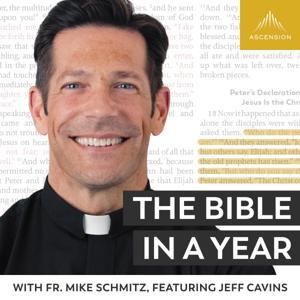
Today marks a major transition in our reading plan! We are turning the final page of Hebrews and stepping into the encouragement of 1 Peter.
In today’s video, we look at how Hebrews ends with practical “marching orders” for love and leadership, and how Peter begins by offering a “living hope” to believers who feel like foreigners in their own world.
Pull up a chair and join us!
The God Who Doesn’t ChangeWe wrap up Hebrews 13 with a beautiful contrast. The world around us is constantly shifting, our circumstances change, and leaders come and go. But the author gives us an anchor in verse 8:
“Jesus Christ is the same yesterday and today and forever.”
Because He is unchanging, we can find contentment (v. 5), we can show hospitality to strangers (v. 2), and we can follow our leaders with confidence. The book concludes with a powerful benediction, reminding us that it is the God of peace who “equips you with everything good for doing his will.”
Refined by FireAs we move into 1 Peter 1, the tone shifts. Peter is writing to God’s elect who are living as exiles. He acknowledges that they are suffering “grief in all kinds of trials.”
But Peter doesn’t offer empty platitudes. He points them to a Living Hope through the resurrection of Jesus. He tells them—and us—that these trials have a purpose:
“These have come so that the proven genuineness of your faith—of greater worth than gold, which perishes even though refined by fire—may result in praise, glory and honor when Jesus Christ is revealed.” (1 Peter 1:7)
We end with 1 Peter 2:1-3, where we are encouraged to strip off malice and deceit, craving the “pure spiritual milk” of the Word so that we can grow up in our salvation.
The One Constant in the Whirlwind of My LifeIf you were to look at a snapshot of my life thirty years ago versus today, you might get emotional whiplash.
Thirty years ago, I was a young mom, deep in the trenches of diapers, toddler tantrums, and trying to figure out who I was outside of wiping spit-up. My worries were immediate: Will this fever go down? Am I ruining my kids? How will we pay this electric bill?
Today, my house is quieter (sometimes), my kids are (mostly) adults navigating their own complex lives, and I’m navigating new seasons of marriage, ministry, and grand-parenting. My worries look different now: Are my adult children really okay? How do I steward this season of life well? What does the future hold as John and I get older?
The scenery of my life has changed drastically. My mirror shows me a different face. My calendar reflects different priorities. Sometimes, the rate of change feels unbelievably overwhelming. Just when I think I have my footing in one season, the ground shifts, and I’m tumbling into the next.
In this whirlwind of shifting shadows and evolving roles, I have found only one anchor that holds fast. It’s a truth that I cling to when the waves of nostalgia hit me or the winds of future anxiety start to blow:
“Jesus Christ is the same yesterday, today, and forever.” — Hebrews 13:8 (NIV)
It’s a verse you might see on a needlepoint pillow or a coffee mug, but when you truly let its reality sink into your marrow, it is radical, life-altering theology.
Here is how this unchanging truth anchors my ever-changing heart.
The Jesus of My Yesterday
I spend a fair amount of time looking back. Sometimes it’s with fond memories, but often, if I’m honest, it’s with a critical eye. I remember the times I lost my temper with my small children. I remember the seasons of doubt where I questioned God’s goodness. I remember the mistakes I made as a young wife.
When I look at my “yesterday” through my own eyes, I see inconsistency. I see a woman who wavered.
But when I look at my “yesterday” through the lens of Hebrews 13:8, I see something else entirely. I see a Savior who was steady when I was shaky. The Jesus who holds me today is the same Jesus who was holding that overwhelmed young mom crying on the bathroom floor in 1995. He hasn’t “matured” in His love for me; His love was perfect then, even when my response to it wasn’t.
We often fear that our past disqualifies our present. But Jesus’s constancy means His grace back then is just as potent as His grace right now.
The Jesus of My Today
Then we have today. Right now. The emails in my inbox, the deadlines looming, the family member who needs a phone call, the sudden pang of worry about a headline I just read.
It is so easy to view Jesus as a historical figure who did extraordinary things back then, or a future King who will fix everything someday. But we often forget that He is the “I AM”—the God of the present tense.
In my book, Walk It Out, I wrote about the struggle to connect with God in the immediacy of the chaotic present:
“Too often we sit in the pew and identify with the message, but then we walk out the church doors and forget to apply it. We forget that God is speaking to us—right here, right now. We forget that He wants to walk with us through the messy, mundane, and difficult parts of our days.” [^1]
The Jesus who walked on water is walking through my messy kitchen today. He isn’t distant or distracted by global events. Because He is unchanging, His attentiveness to the individual heart is the same today as it was when He stopped a crowded procession to heal a woman who touched the hem of His garment (Mark 5:30). He is the same attentive Savior, right here, right now.
The Jesus of My Forever
Finally, there is the looming “forever.” The future.
I am a planner. I like to know what’s coming next. But if life has taught me anything, it’s that my five-year plans rarely survive contact with reality. The future is a giant question mark, and that can be terrifying.
What health challenges lie ahead? What heartache might my children face?
If Jesus were fickle—if His moods changed like mine, or His promises depended on the cultural climate—I would be paralyzed with fear.
But He is the same forever. That means the character of God that I rely on today will be waiting for me ten years from now. The compassion He showed to the grieving sisters of Lazarus is the same compassion He will show me when I face loss.
Because He doesn’t change, my future isn’t secured by my retirement plan, my health regimen, or my ability to control outcomes. It is secured by His immutable nature.
The Anchor for Your Soul
Friend, I don’t know what sits heavily on your heart today. Maybe you are haunted by a “yesterday” you can’t fix. Maybe you are overwhelmed by a “today” that feels crushing. Maybe you are paralyzed by fear of a “forever” you can’t control.
Stop looking at the shifting sands. Look at the Rock.
The circumstances of your life will change. Your emotions will rise and fall like the tide. People will disappoint you. You will disappoint yourself. But Jesus?
He hasn’t moved. He hasn’t changed His mind about you. He is the same yesterday, today, and forever. And that is enough to hold us fast.
Walk It Out: A Practical Application
I don’t want you to just read this and move on to the next post. I want you to walk this truth out in your real life this week. Here are two ways to do that.
1. The “Anchoring Pause”
We often feel the ground shaking because we are reacting to changing things (the news, the bank account, the kids’ moods) rather than the unchanging One.
This week, whenever you feel a spike of anxiety, physically stop what you are doing. Take a deep breath and say this simple prayer:
“Jesus, my circumstances have changed, but You have not. You were faithful then, You are present now, and You will be sufficient for whatever comes next. I am anchoring my heart to You right now.”
2. Subscriber Bonus: The “Anchor vs. Wave” Worksheet
I created a simple concept for you to use in your journal this week. You can draw this out on a napkin or in your prayer journal.
Step 1: Draw a line down the middle of your page.
Step 2: On the left, write “The Waves.” List the things that feel unstable or overwhelming right now (e.g., “My health concerns,” “The decision about school,” “Loneliness”).
Step 3: On the right, write “The Anchor.” For every wave, write a specific truth about who Jesus is that counteracts it.
The Wave: “I feel invisible to my family.”
The Anchor: “Jesus is El Roi, the God who sees me.”
The Wave: “I don’t know how to handle this situation.”
The Anchor: “Jesus is the Wonderful Counselor.”
By getting the “waves” out of your head and onto paper, and then immediately tethering them to the “Anchor,” you are retraining your brain to rest in His consistency.
Tell me in the comments: What is one “Wave” you are facing today, and what truth about Jesus is your “Anchor”? I’d love to pray for you.
With love, Tricia
Download your Anchor vs. Wave Worksheet
Download PDF
Enjoy this worksheet!
Download your Daily Journal Worksheet
Download your Daily Journal Worksheet
Tricia Goyer, Walk It Out: The Radical Practice of Getting Out of Your Comfort Zone and Stepping into the Life God Designed (Colorado Springs, CO: David C Cook, 2017), 18.