
Sign up to save your podcasts
Or



Based on Podcast App listening data
As shelter-in-place orders went into effect, residents of Broomfield, Colorado faced exposure to flowback-driven air pollution thanks to their proximity to oil and gas operations. When the city issued an emergency decree to local operations to cease fracking flowback during the pandemic, Extraction Oil filed for a restraining order to block the city's decree. It's the first test of Colorado's 2019 law prioritizing public health and safety over oil and gas production, which allows local governments to set stringent safeguards.
Additional resources:
Climate-COVID-19 policy tracker
See omnystudio.com/listener for privacy information.
Fossil fuel use has certainly grown GDP, but it has had no effect on life expectancy. In other words, the industry's "benefit" has acrrued to relatively few humans.
Dr. Julia Steinberger, professor of social ecology and ecological economics at the University of Leeds, has published research debunking classic fossil fuel narratives around the industry's importance to society and human wellbeing. Read her study, "Your Money or Your Life?" Environmental Research Letters, here.
Support us on Patreon.
See omnystudio.com/listener for privacy information.
Field investigator Sharon Wilson has spotted a troubling increase in methane emissions from refineries in the Permian Basin, in Texas. Things went from bad to worse in January 2020, and really blew up in early March ... almost as though they knew regulators wouldn't be watching.
Support us on Patreon.
Extra tidbits in the Heated newsletter.
Read the transcript
See omnystudio.com/listener for privacy information.
The American Petroleum Institute, ExxonMobil and Chevron have been amongst the biggest opponents to bailouts for shale gas companies as part of the coronavirus relief package. DeSmog's Justin Mikulka explains why.
Support us on Patreon.
Extra tidbits in the Heated newsletter.
Read the transcript
See omnystudio.com/listener for privacy information.
The oil and gas industry was headed for financial collapse long before COVID-19, but now the Trump administration wants to use the pandemic to put it on life support. Meanwhile, the American Petroleum Institute is using the pandemic to get the industry's deregulation wishlist.
Support us on Patreon.
Extra tidbits in the Heated newsletter.
Read the transcript
Learn more about your ad choices. Visit megaphone.fm/adchoices
See omnystudio.com/listener for privacy information.
Hot Take hosts Mary Annaise Heglar and Amy Westervelt talk to David Wallace-Wells, author of The Uninhabitable Earth and deputy editor of New York magazine, about the intersection of climate change and the coronavirus pandemic.
Support us on Patreon.
Extra tidbits in the Heated newsletter.
Read the transcript
See omnystudio.com/listener for privacy information.
What can be done about Big Oil disinformation now? New York University journalism professor Jay Rosen and former FCC commissioner Nicholas Johnson join us to talk about everything from the Fairness Doctrine to cable access to today's "post-fact" world, and where we can really go from here. Special thanks to Mary Catherine O'Connor for additional reporting.
Support us on Patreon.
Extra tidbits in the Heated newsletter.
Read the transcript
Check out our sister podcast, Hot Take.
See omnystudio.com/listener for privacy information.
E. Bruce and Patricia Harrison launched the E. Bruce Harrison Company in 1973, working for a mix of chemical companies, oil and gas companies, and tobacco companies. E. Bruce is considered the father of environmental public relations—or by his critics, "the godfather of greenwashing."
The Harrisons ran multiple cross-industry coalitions and front groups, aimed primarily at stopping regulation on everything from smoking to carbon emissions. Today, Ms. Harrison is the president and CEO of the Corporation for Public Broadcasting, a position she's held since 2005.
Support us on Patreon.
Extra tidbits in the Heated newsletter.
Read the transcript
Check out our sister podcast, Hot Take.
See omnystudio.com/listener for privacy information.
John Hill, founder of Hill & Knowlton, was an Ivy Lee devotee who worked for Standard Oil in the 1930s, strategized against labor movements and the New Deal, and wound up representing the American Petroleum Institute and the Tobacco Industry Research Committee—a fake research group formed by the CEOs of all the major tobacco companies in the 1950s—at the very same time. His manipulation skills were so good they even fooled the legendary Edward R. Murrow.
Support us on Patreon.
Extra tidbits in the Heated newsletter.
Read the transcript
Check out our sister podcast, Hot Take.
See omnystudio.com/listener for privacy information.
Sigmund Freud's nephew, Edward Bernays, coined the term "public relations" when propaganda started to become a negative term. His specialty was using psychological know-how to manipulate the masses and orchestrate cultural shifts in his clients' favor (clients like Standard Oil, the American Tobacco Company, and General Motors).
Decades later, W. Howard Chase built onto that foundation with the idea of issues management—predicting an industry's potential issues, and manipulating political, social, and cultural forces to neutralize them. Chase is responsible for one of the best-known examples of greenwashing, the so-called "crying Indian ad," which introduced the idea of "litter bugs" and individual responsibility for pollution.
Support us on Patreon.
Extra tidbits in the Heated newsletter.
Read the transcript
Check out our sister podcast, Hot Take.
See omnystudio.com/listener for privacy information.
From the publisher's feed
By 2050, one in eight people are expected to have been displaced by climate change, forcing millions of people to leave their hometowns, their countries of origin, and in many cases their identities behind. For communities all over the world, that time has already come. In this three-part mini series, Drilled global climate justice reporter Nina Lakhani takes us to three Latin American communities, each dealing with climate displacement—and the race to save their community—in a different way, to give listeners a window into the complexities of this issue. Imagine if your kid's school was suddenly submerged in the ocean, or if the government gave you a new house but it was 20 miles away and looked like everyone else's, or if the same country that made the drought worse in your village stole your stuff and put you in prison for the crime of trying to feed your family?
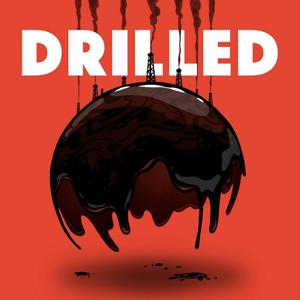
Drilled is a true-crime climate change podcast exposing how corporate corruption and political operatives built decades of climate denial and delay. Hosted and reported by award-winning investigative climate journalists and led by Amy Westervelt, each season unravels new evidence of deception, disinformation, and the power structures keeping real climate solutions out of reach.
Ranked by our users in the last 21 days

26,170 Listeners

9,182 Listeners

8,424 Listeners

466 Listeners
573 Listeners

54 Listeners

6,103 Listeners

19 Listeners

125 Listeners

211 Listeners
23 Listeners

16,310 Listeners
100 Listeners
295 Listeners

148 Listeners

573 Listeners
77 Listeners

34 Listeners

177 Listeners

635 Listeners
0 Listeners
46 Listeners
65 Listeners

564 Listeners
320 Listeners

602 Listeners