
Sign up to save your podcasts
Or



Based on Podcast App listening data
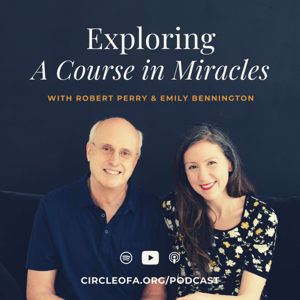
Given how persistent and formative childhood wounds can be, unearthing them can seem to be the way to explain who we are now. The early dictation of the Course addressed this issue at some length, as it turns outs, and the perspective that emerges is one that you might find surprising. Join Robert and Emily for a lively discussion of how the Course would have us approach the healing of childhood wounds.
To a significant degree, the Course is resting the achievement of its goals on our repeating of its words. The Workbook, for example, opens by saying that "it is doing the exercises that will make the goal of the course possible" (W-pI.In.1:2) and each exercise includes some form of word repetition. In this episode of Exploring A Course in Miracles, Robert Perry and Emily Bennington discuss why this is the Course's main practice and how to claim the gift that its words contain for us.
As spiritual seekers, we tend to see our job as getting out of the way so that divine light can flood in and fill our awareness. Accordingly, we typically see the spiritual life as the process of becoming ever more receptive and surrendered. Yet there is also another side to our nature that is actively expressive and creative. In this episode of Exploring A Course in Miracles, Robert Perry and Emily Bennington dive into the fundamental urge in us to create - to take something valuable and precious inside us and express it on the outside – and why the Course says we are "unfulfilled" until we do.
Given that protection is on everyone's minds these days, it makes sense to look into what A Course in Miracles has to say on the topic. How, according to the Course, can we find protection? It turns out that the Course mentions protection 237 times and that these references add up to a fascinating picture, one that turns our normal ideas of protection upside down. Join Circle of Atonement Founder Robert Perry and Executive Director Emily Bennington for a discussion where we can go for protection, which has our current challenges very much in mind.
What is the relationship between the victim and the victimizer in you? If you're like most people, you may feel you only become defensive when you feel like a victim yourself. We, in other words, never attack first. In this episode of Exploring A Course in Miracles, Robert Perry and Emily Bennington discuss the Course's (very different) approach to this topic, which many students find challenging at first - but in the end is quite liberating.
In the early part of the Course's story, there are at least three instances where its scribe, Helen Schucman, prays for others in an unusual way. On these occasions, she is joining with Jesus and speaking directly to someone in her mind. In this episode of Exploring A Course in Miracles, Robert Perry and Emily Bennington discuss Helen's unique style of prayer and how we can all use it to help ourselves and others adopt a healed point of view.
In the previous episode, Robert and Emily talked about the Course's radical view of war—that, rather than being good or evil, war is simply senseless. But knowing this is merely a starting point. What we really need to know is how we ourselves should respond to war. That is the subject of this second episode: What is our role in relation to war? To answer that question, Robert will share six points gleaned from A Course in Miracles. Through these points we will discover the surprising relevance of war for our personal lives. For ultimately, there is no difference between wars in distant countries and the small wars we wage every day in our homes and workplaces. We are all combatants on the battlefield, and we all can choose to rise above it and become a force for peace in a world that desperately needs it.
What does A Course in Miracles have to say about war? Does it even address the subject? In fact, the Course contains over a hundred references to war and battle, along with many depictions of warfare and weaponry. In addition, there are hidden references to two wars in particular: World War II and the Vietnam War. Through it all, a consistent view of war emerges, which is radical and challenging, yet which should be no surprise if we believe that the Course really comes from Jesus, the one who told us "resist not evil" and who went willingly to his own death. This view includes war as we think of it—war between countries—yet its main focus is on the battleground that we call daily life. Join us for a discussion of one of the central issues in our lives and in this world: the issue of war.
Forming new habits sounds like a very mundane issue, hardly one we expect to see in the pages of A Course in Miracles, yet the Course mentions "habit" or "habits" seventeen times. Out of these references, a fascinating pattern emerges of why we need new habits, what new habits we should form, and how we form them. One of the most striking things is that three habits in particular are mentioned again and again. Join us for a discussion of a topic we may not have associated with the Course, but one that has surprising relevance for our lives and our journey to God.
Inequality may seem like a strictly social issue, far from the concerns of the spiritual path. Yet according to A Course in Miracles, the desire and attempt to be unequal—above others—is at the very center of the ego. It was the root of the separation and even now it drives our personal lives. The inequality we see on a social level is just the end result of masses of individuals striving to be above their fellows.
In the face of this universal desire, the Course teaches a radical equality, in which, despite all our surface differences, we are all inherently equal. This even includes history's most "superior" individual: Jesus. Join us for a discussion of this central issue, in which we explore the ego's need for inequality, why it backfires, and how we can apply the truth of our fundamental equality in our relationships and daily interactions.
From the publisher's feed
Ranked by our users in the last 21 days

10,512 Listeners

1,856 Listeners

632 Listeners
388 Listeners
3,695 Listeners
5,468 Listeners

272 Listeners

412 Listeners
868 Listeners

902 Listeners

1,408 Listeners
299 Listeners
642 Listeners

782 Listeners
83 Listeners