
Sign up to save your podcasts
Or



Send us Fan Mail
Bishop Wright's sermon "Anchored for the Future" given at the 120th Annual Council of the Diocese of Atlanta.
Support the show
Follow us on IG and FB at Bishop Rob Wright.
Send us Fan Mail
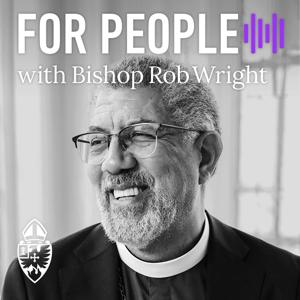
This week's For People is based on Bishop Wright's opening worship sermon given on November 6, 2026, at the 120th Annual Council of the Diocese of Atlanta.
What if Christian confidence is not about recovering an era, but about trusting a living person?
Drawing from Bishop Wright’s sermon on Hebrews 6, Melissa and Bishop Wright have a conversation about hope as an “anchor for the soul” that holds when the church feels stressed, culture feels volatile, and your own energy runs thin. They explore why Hebrews speaks so directly to people who feel fatigued, disappointed, or tempted to despair and why the answer is not a new technique. Instead, they lean into the precedent of God’s faithfulness and the claim that Jesus is risen and active now. That shifts everything: tradition becomes something we can distill for wisdom without turning it into an idol, and faith becomes a forward-facing windshield rather than a rearview mirror. Listen in for the full conversation.
Read For Faith, the companion devotional.
Support the show
Follow us on IG and FB at Bishop Rob Wright.
Send us Fan Mail
Political life can feel like a constant pressure to pick a side, assume the worst, and speak with total certainty. But God calls us to find common ground in a divided world; to love our neighbors as ourselves.
In this episode, just days before the midterm elections, Bishop Wright has a conversation with Erle Newton III, District Attorney for Bartow and Gordon Counties, and Kelley Dial, Chief Assistant Public Defender for the same circuit. While their work often places them on opposite sides of the courtroom, they share a deep friendship, a common faith, and leadership roles at Church of the Ascension in Cartersville, Georgia.
Together, they explore what it means to disagree without division, pursue justice with humility, and remember that Jesus was political, but not partisan. They discuss how faith shapes their understanding of justice, mercy, and accountability, as well as practical approaches to criminal justice reform through mental health and drug courts.
At a time when political differences too often define our relationships, this conversation offers a powerful reminder that we can hold different perspectives while remaining committed to loving our neighbors. Listen in for the full conversation.
Erle J. Newton III is the District Attorney for the Cherokee Judicial Circuit which is comprised of Bartow and Gordon counties. He has 16 years of experience as a prosecutor. Erle has tried cases ranging in severity from speeding to murder. For seven years, he was the circuit’s Drug Prosecutor, focusing on dismantling and disrupting drug dealing and trafficking operations. He has also served as a prosecutor in both of the circuit’s accountability courts, Drug Court and Mental Health Court. Erle is a graduate of the Walker School (which has Episcopal roots). Erle earned a Bachelor of Arts degree from The University of the South, Sewanee, Tennessee and a Juris Doctor from Mercer University’s Walter F. George School of Law in Macon. He currently serves as Chair for the Recovery Bartow board of directors, a non-profit organization that supports addiction recovery. Erle also serves as the Senior Warden, a Verger, and a Lector at the Episcopal Church of the Ascension in Cartersville. He is a member of the Brotherhood of St. Andrew. Erle and his wife have been blessed with one daughter.
Kelley Dial has practiced law in the Cherokee Judicial Circuit, serving Bartow and Gordon Counties, since 1990. A lifelong resident of Cartersville and graduate of Cartersville High School, she earned a Bachelor of Music from Berry College in 1983 and a Juris Doctor from Georgia State University College of Law in 1990. Throughout her legal career, Kelley has worked as an associate at two law firms and spent many years as a sole practitioner, consistently focusing on criminal defense. Since 2005, she has served as Chief Assistant Public Defender for the Cherokee Judicial Circuit, joining the office when it was established as part of Georgia’s statewide public defender system. She has tried hundreds of criminal cases and is certified to handle death penalty cases. Beyond her legal career, Kelley has demonstrated a longstanding commitment to public service, education, and her faith community. She has served on the Cartersville City School Board since 2000 and currently serves as its president. A member of the Episcopal Church of the Ascension in Cartersville since 1998, Kelley is deeply involved in the life and leadership of her parish. She currently serves as Junior Warden, and is a member of the diocesan Standing Committee. Kelley and her husband, Bill, have been married for 43 years and have one son, Alex.
Support the show
Follow us on IG and FB at Bishop Rob Wright.
Send us Fan Mail
Opposition can do one of two things: it can turn us into smaller, harsher versions of ourselves, or it can uncover what we truly believe about God, power, and love.
In this episode, Melissa and Bishop Wright have a conversation about opposition, drawing from 1 Thessalonians 2:1–8 and Paul's example of proclaiming the Gospel in the face of resistance. What does it mean to stand against injustice without becoming consumed by anger or vengeance? Bishop Wright introduces the idea of a “compassion riot,” a radical response to opposition rooted in love, nonviolence, and the conviction that compassion is stronger than hate. Together, they explore what it means to love our enemies, resist evil without dehumanizing others, and live a faith that goes beyond Sunday worship and shows up in our everyday choices. Listen in for the full conversation.
Read For Faith, the companion devotional.
Support the show
Follow us on IG and FB at Bishop Rob Wright.
Send us Fan Mail
Steadfast can sound like a personality trait you either have or you don’t, but Paul uses it as a lived description of hope that keeps its seat when life tries to shove you off course.
In this episode, Melissa and Bishop Wright have a conversation about 1 Thessalonians 1:1–10 and what “steadfast” actually looks like in real Christian life: spiritually stable, determined, and resilient, without the fake shine of perfection. They challenge one of the most common stories people tell about their spiritual life: “I fell off the wagon.” Bishop Wright offers a different picture, where faith is more like music, made of notes and rests, sound and silence. Sometimes the moment you think you’re farthest from God is the moment you’re finally honest enough to be helped. That’s where grace shows up, not as a reward for getting it right, but as a steady presence that doesn’t quit. Listen in for the full conversation.
Read For Faith, the companion devotional.
Support the show
Follow us on IG and FB at Bishop Rob Wright.
Send us Fan Mail
“Whatever” is usually the word you use when you’re done listening. In Philippians 4:1-9, Paul flips is the other way. Paul turns “whatever” into a wide-open invitation to grow your moral imagination and to pursue what is honorable, just, pure, pleasing, and commendable. The surprising twist is that those words are not a small box. They are guardrails for a bigger life with God and neighbor.
In this episode, Melissa and Bishop Wright have a conversation about a real tension many of us feel: church can drift into being an institution that shrinks people, which is why “spiritual not religious” resonates. If Jesus is not meant to be domesticated, what would it look like to “give him back to the world” through the way we live, lead, and serve? Listen in for the full conversation.
Read For Faith, the companion devotional.
Support the show
Follow us on IG and FB at Bishop Rob Wright.
Send us Fan Mail
The blues gets mislabeled as “music for older folks” until you hear a young artist explain where it really comes from.
In this episode, Bishop Wright has a conversation with Grammy-nominated singer-songwriter Jontavius Willis, a Georgia musician whose sound carries something old, something new, and something deeply personal. From his first performances in church to the way he learned by listening to records, he connects the dots between gospel roots, acoustic guitar grit, and the kind of storytelling that still feels like home. Listen in for the full conversation.
Come hear Jontavious and others at the Talbotton Blues Festival at Historic Zion Church on October 24, 2026. This all-day event will feature many artists, dance classes, sacred harp singing, gospel, harmonica sessions, and cultural talks. Learn more and get your tickets here.
Jontavious Willis is resolved in his mission: to reinvigorate today’s Blues with the spirit of the past. Inspired by a time when the Blues were plentiful and rhythm reigned supreme, Jontavious leverages his unique sound—a synthesis of his Georgia heritage and reverence for traditional Blues—to get the world dancing again. A Grammy-nominated musician and songwriter, Jontavious performs original, toe-tapping tunes in the style of Delta, Piedmont, Texas, and Gospel Blues. Dynamic vocals, technical prowess, and an abundance of Southern charm keep Jontavious sending jolts of vitality through the Blues community. Jontavious was born and raised in rural Georgia, an environment with deep cultural roots that provides the inspiration he has continuously drawn upon to create his unique sound. He spent much of his childhood singing Gospel music at the Mount Pilgrim Baptist Church with his grandfather, which provided him his first setting to perform for an audience. An early phenom, his passion for the Blues was sparked at age 14 when he came across a YouTube video of Muddy Waters playing “Hoochie Coochie Man.” He achieved widespread acclaim when living legend Taj Mahal invited Jontavious to accompany him onstage in 2015, with Taj describing him as his “Wonderboy.” Jontavious was invited to open for Taj Mahal and Keb’ Mo’ during their joint TajMo tour in 2018, giving him an opportunity to present his work on a national stage.
Support the show
Follow us on IG and FB at Bishop Rob Wright.
Send us Fan Mail
This is part two of a two-part conversation centered on Bishop Wright’s teachings at Clergy Conference 2026: Anchored for the Future.
When everything feels like it’s shaking, the real question is, “What can actually hold me?” In Jeremiah 29:11, we get a glimpse of what holds Jeremiah in a world marked by collapse, displacement, and grief. Hope shows up here as more than comfort.
In this episode, Melissa and Bishop Wright have a conversation about hope as a disciplined, soul-strengthening tension with suffering, rooted in God’s stubborn liveliness and fidelity. They push back on nostalgia, especially the kind that tries to baptize the “good old days” in politics or in church life. Christian hope doesn’t beg for a preferred past to be restored. It throws an anchor forward, toward where Christ has gone and where Christ invites us to follow. That shift changes everything: instead of building a museum faith that only celebrates what God did long ago, we start asking what God is doing now and what our part is in God’s mission today. Listen in for the full conversation.
Read For Faith, the companion devotional.
Support the show
Follow us on IG and FB at Bishop Rob Wright.
Send us Fan Mail
This is part one of a two-part conversation centered on Bishop Wright’s teachings at Clergy Conference 2026: Anchored for the Future.
Hope often gets treated like a soft word, but we don’t experience it that way when life gets real. Hebrews 6:19 names godly hope as an anchor. That hope is built on a clear conviction: God is alive, so the universe is not random and the story is not finished. That belief doesn’t erase suffering, division, loneliness, violence, or injustice. It changes what we do with them.
In this episode, Melissa and Bishop Wright have a conversation about the difference between optimism and godly hope. Optimism depends on circumstances and can break under the weight of repeated disappointment. Godly hope has “and yet” strength—a durable energy that holds the tension of hard facts without blinking. What does it mean to be anchored by that kind of hope, especially when the world around us feels uncertain? Listen in for the full conversation.
Read For Faith, the companion devotional.
Support the show
Follow us on IG and FB at Bishop Rob Wright.
Send us Fan Mail
Delay is one of the quickest ways to test what we really trust. When God’s timing does not match our urgency, we can start to panic, negotiate, or replace faith with something that feels more responsive. In Exodus, Moses is “delayed” on the mountain, and the newly freed community chooses a God made of gold because it feels available right now.
In this episode, Melissa and Bishop Wright have a conversation about why God’s pacing and our pacing collide so often, and why that collision can bring out our most reactive selves. From self-soothing and control to the pull of familiar habits that are not life-giving, the wilderness exposes what we worship when we cannot see what comes next. They also name the “prison mindset” that can linger after liberation, when freedom is real, but uncertainty still feels like a cage. Listen in for the full conversation.
Read For Faith, the companion devotional.
Support the show
Follow us on IG and FB at Bishop Rob Wright.
From the publisher's feed

90,409 Listeners

43,805 Listeners

31,943 Listeners

37,803 Listeners

43,331 Listeners

3,927 Listeners

14,643 Listeners

112,302 Listeners

24,528 Listeners

5,089 Listeners

5,212 Listeners

16,341 Listeners
3,334 Listeners

16,260 Listeners

10,913 Listeners