
Sign up to save your podcasts
Or



Send us Fan Mail
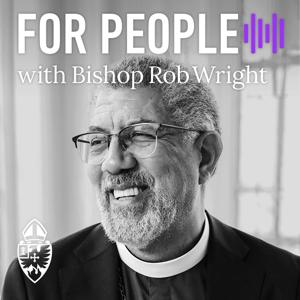
Bishop Wright's sermon "An Uncommon Success" given at the 119th Annual Council of the Diocese of Atlanta.
Support the show
Follow us on IG and FB at Bishop Rob Wright.
Send us Fan Mail
This week's For People is based off of Bishop Wright's opening worship sermon given on November 7, 2025 at the 119th Annual Council of the Diocese of Atlanta.
What if success isn’t about wins on paper but trust put into practice? Luke 10 teaches us how Jesus sends people out light on gear but heavy on purpose and asks us to measure progress by reliance, integrity, and the peace we carry into real places. The kingdom isn’t far off; it’s near and asking for a public life that heals, feeds, and invites—even when doors close and welcome is thin.
In this episode Melissa and Bishop Wright have a conversation about an uncommon success. They unpack peace as shalom instead of silence: not keeping the powerful comfortable, but seeking wholeness, equity, and purpose that challenges harmful norms. That peace moves toward cities where people should flourish, not just scrape by. From there, they discuss scale. Jesus grows the team from twelve to seventy, and we take the cue: faith and data can be partners. They talk targeting new congregations in the poorest areas, gathering facts on health and education gaps, and budgeting for ministry that brings hope to “fingernail dirty” places. All of it leads back to one audit question: do we trust Jesus more today than yesterday, and more tomorrow than today? Listen in for the full conversation.
Read For Faith, the companion devotional.
Support the show
Follow us on IG and FB at Bishop Rob Wright.
Send us Fan Mail
The heat of Jesus’ public life wasn’t condemnation but redemption that actually changes people and communities! Luke 19:1-10 teaches us that every sinner has a future and every sinner has a past. Zacchaeus’, a corrupt tax collector, turnaround begins when Jesus comes near to him and shares a table. turnaround in Luke 19 as a living case study. The scandal isn’t just that Jesus notices a corrupt tax collector; it’s that he moves toward him, shares a table, and sparks real repair. That grace and mercy extended created a future for Zacchaeus and his community.
In this episode, Melissa and Bishop Wright have a conversation about redemption. They name the hard part: communities often resist grace. It’s easier to exile than to accompany, to watch from a distance than to risk relationship. They discuss the tension between telling the truth about harm and still seeing the person as more than their deed, a distinction that keeps justice honest and mercy strong. Listen in for the full conversation.
Read For Faith, the companion devotional.
Support the show
Follow us on IG and FB at Bishop Rob Wright.
Send us Fan Mail
We believe death is not to be feared. We believe that death does not end life, it only changes life. Fear loves the last word, but it doesn’t deserve it, and naming our fears out loud is the first act of courage.
In this episode, Melissa and Bishop Wright have a conversation about fear, death, and faith. How shall we live a good life that will result in us dying a good death? Listen in for the full conversation.
Read For Faith, the companion devotional.
Support the show
Follow us on IG and FB at Bishop Rob Wright.
Send us Fan Mail
Faith isn't something we own; it's something we steward to others. In Luke 18:1–8, Jesus teaches us about the persistent widow who kept knocking until a weary judge relented. Her courage becomes our template for a faith that endures indifference, resists despair, and stays tender without giving up. We talk about hope as the engine of perseverance, how small acts compound into movements, and why faith gains its richest colors when life runs hot and hard.
In this episode, Melissa and Bishop Wright have a conversation about perseverance. Together, they unpack a countercultural claim: perseverance is community property. When your trust is thin, you can borrow mine; when I’m weary, I may need yours. From singing each other back to courage to telling honest stories that spark imagination, we show how public witness—bold yet gentle—invites others in. This conversation reaches into the public square, naming dignity for every person, resisting dehumanization, and calling for peace with justice that allows neighbors to flourish together. Perseverance becomes a daily posture: steady, hopeful, and communal—rooted in love that refuses hate’s heavy load. Listen in for the full conversation.
Read For Faith, the companion devotional.
Support the show
Follow us on IG and FB at Bishop Rob Wright.
Send us Fan Mail
A man turns back to say thank you—and discovers a deeper kind of healing. That small pivot in Luke 17:11-19 launches a wide‑open conversation about gratitude as action, the difference between being cured and being made whole, and why a daily practice of thanks can change your chemistry, your relationships, and your resilience.
In this episode, Melissa and Bishop Wright have a conversation about gratitude. They discuss starting prayer with thanksgiving, naming three to ten blessings a day, and turning down the noise long enough to notice the quiet mercies that keep us afloat. Listen in for the full conversation.
Read For Faith, the companion devotional.
Support the show
Follow us on IG and FB at Bishop Rob Wright.
Send us Fan Mail
Sorrow doesn’t mean you’ve lost faith; it means you’ve loved deeply enough to tell the truth. Naming our losses can be both spiritual and practical. Psalm 137 shows what happens when a community refuses euphemism, resists denial, and chooses to face reality with courage. That choice isn’t about wallowing; it’s about setting the stage for healing, responsibility, and real hope.
In this episode, Melissa and Bishop Wright have a conversation about what we learn from Psalm 137. They discuss the tension between emotional performance and emotional honesty, and why the psalms offer a vocabulary for the full range of human experience: doubt, trust, anger, and gratitude. They unpack how the power of a single voice can serve the entire community by helping others see afresh. Listen in for the full conversation.
Read For Faith, the companion devotional.
Support the show
Follow us on IG and FB at Bishop Rob Wright.
Send us Fan Mail
What does it mean when we have proximity without fellowship? Through Jesus' parable of the rich man and Lazarus in Luke 16:19-31, we get a glimpse. This parable reveals two men sharing the same address—one living in luxury while the other suffers at his gate—yet separated by an unbridgeable social gulf that continues even after death.
In this episode, Melissa and Bishop Wright have a conversation about the parable and how the rich man's sin wasn't wealth but indifference to human suffering. Rather than being "Washington-minded and locally neglectful," Wright urges us to start by interrogating our own hearts. Listen in for the full conversation.
Read For Faith, the companion devotional.
Support the show
Follow us on IG and FB at Bishop Rob Wright.
Send us Fan Mail
What happens when you discover your family tree has branches on both sides of America's racial divide? Dr. Spenser Simrill Jr.'s journey began with simple curiosity about his family name and evolved into a profound story of reconciliation that's now a CNN documentary premiering September 21, 2025 at 10p.
In this episode, Bishop Wright has a conversation with Dr. Spenser Simrill Jr. about his discovery while teaching family history at the University of Georgia. Spenser found an alternate spelling of his surname that unlocked an unexpected connection – in 1871, a Black woman named Harriet Simrill testified against the Ku Klux Klan in a federal Reconstruction trial. Given the distinctive nature of his family name, Spenser realized there must be a connection through enslavement. This suspicion was confirmed when he found a Facebook suggestion for a Black man his age from his father's hometown with the original spelling of their shared surname.
Eleven years later, the two families reunite annually, have produced an Audible podcast called "Once Removed: An American Family Reunion," and are featured in CNN's "A Family in Black and White." Their story challenges the notion that denial is the only way to handle difficult historical truths. Instead, Spenser demonstrates how confronting these realities leads to healing and wholeness. Spenser's work reminds us that we are one human family despite our painful history. By choosing to be storytellers who look unflinchingly at reality, we become "peace warriors" committed to recognizing our fundamental interconnectedness. Listen in for the full conversation.
Dr. Spenser Simrill Jr, is the creator of the Once Removed podcast and a TEDx speaker on racial healing. His research has informed reconciliation efforts in Northern Ireland, Liberia, and across the American South—culminating in the first historical marker in South Carolina to mention the Ku Klux Klan.
His work has appeared on CNN’s The Whole Story with Anderson Cooper, Audible Originals, The New York Times, Pitchfork, Rolling Stone, and TEDx Asheville.
His students have won multiple international competitions, including two wins and an honorable mention in The New York Times Best Student Podcast Contest. Spenser lives with his family in Arden, North Carolina, and teaches at Christ School.
Support the show
Follow us on IG and FB at Bishop Rob Wright.
Send us Fan Mail
What does it really mean to be a sinner? When stripped to its Greek roots, sin simply means "missing the mark."
In this episode, Melissa and Bishop Wright have a conversation about sin and what Jesus' approach. The religious elite's biggest complaint against Jesus? That he dined with and welcomed those who missed the mark. "Now that's my kind of God," Bishop Wright reflects. This divine comfort with imperfect people creates a powerful invitation for all of us to bring our whole selves to faith.
Read For Faith, the companion devotional.
Support the show
Follow us on IG and FB at Bishop Rob Wright.
From the publisher's feed

90,397 Listeners

43,810 Listeners

31,952 Listeners

37,792 Listeners

43,323 Listeners

3,927 Listeners

14,645 Listeners

112,250 Listeners

25,292 Listeners

5,149 Listeners

5,211 Listeners

16,344 Listeners

3,334 Listeners

16,281 Listeners

10,924 Listeners