
Sign up to save your podcasts
Or

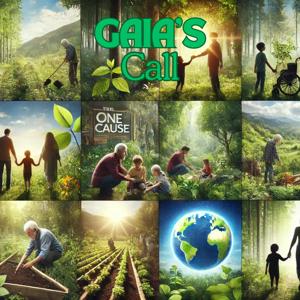


Part 1: The Story in Our Heads Is Shaping the World
How our interpretations fuel despair—or possibility
Not long ago I was outside in the yard with my grandson Logan, who had discovered something that instantly captured his five-year-old imagination. It was nothing particularly dramatic—just a small worm wriggling through the soil after a rainstorm. But to Logan, it might as well have been a dragon. He crouched down, studying it carefully, narrating what he thought the worm might be thinking and where it might be going. Piper, his little sister, soon joined us, equally fascinated.
Watching them, I was reminded of something I think many of us lose as adults. Children don’t just see the world—they relate to it. The worm isn’t an object. It’s a character in the unfolding drama of life. The tree in the yard isn’t scenery; it’s a companion in the landscape of their play. Everything feels alive, meaningful, connected.
This moment with my grandchildren reminded me of something we don’t learn from books… we remember it by being alive.
How our interpretations fuel despair—or possibility
Over the years I’ve developed a little morning ritual. Coffee in hand and a bowl of fruit in front of me for a few quiet minutes before my wife, Ann, wakes up. Often Rascal—my loyal canine companion—is curled up nearby. The early mountain light filtering through the trees here in the mountains of North Carolina. And if I’m honest, sometimes my mind wanders through the headlines of the world we’re living in: climate disruption, political turmoil, economic uncertainty, wildfires, floods, storms. Many of us feel it now—that sense that something larger than a typical “rough patch in history” is unfolding. I often refer to it as the polycrisis—a convergence of ecological, economic, social, and spiritual disruptions all happening at once.
It can be a lot to take in. Some mornings, if I’m not careful, my mind can start telling a story about it all. A story that has become all too familiar. To borrow a phrase from my own childhood: Our world is going to hell in a handbasket. Maybe you’ve heard versions of those stories in your own mind as well.
Recently, two articles I happened to read on the same morning stopped me in my tracks. Something about them felt deeply connected—not just to each other, but to the work many of us are trying to do in this time of planetary transition. And it dawned on me that the climate crisis—and the broader polycrisis—may not just be a technological or political challenge. It may also be a story challenge.
One of the articles explored something psychologists have been saying for a long time: much of our suffering does not come directly from events themselves, but from the interpretations we attach to them. The Stoic philosopher Epictetus put it bluntly centuries ago: “It’s not things that upset us but our judgments about things.” When something happens in our lives, our minds almost instantly begin constructing a story about what it means. A friend doesn’t text back. A project fails. A troubling news headline appears. The event itself may last seconds, but the story we tell ourselves about it can last for years.
Psychologists refer to these internal patterns as schemas—mental frameworks built from past experiences that quietly shape how we see the world and ourselves. Over time those schemas become so familiar that we stop recognizing them as interpretations. They begin to feel like reality itself. Not interpretations, but facts.
When it comes to the climate crisis and ecological disruption, I notice a similar dynamic playing out in the collective psyche. The facts are serious. We are destabilizing the climate. We are losing biodiversity. We are drawing down natural systems faster than they regenerate. These realities deserve our full attention. But the interpretation layer often goes much further. It turns into a narrative of inevitability: We’re doomed. It’s too late. Human beings are the problem.
Those interpretations can quietly shut down the very thing we need most right now—agency. If the story in our head says nothing matters, why would we act? But what if those interpretations are not the only story available to us?
One of the most powerful ideas I’ve encountered over the years comes from Viktor Frankl, the psychiatrist who survived the Nazi concentration camps. He wrote that between stimulus and response there is a space, and in that space lies our power to choose our response. That tiny space may be one of the most important places in the human experience. Because inside that space something extraordinary becomes possible. We can notice the story our mind is telling and decide whether or not we want to keep believing it.
The article I read put it another way: our thoughts are powerful, but they are not us. They are simply things our minds produce. Once we recognize that distinction, something begins to loosen. We don’t have to fight every anxious thought that appears. We can simply notice it. Ah…there’s my mind telling the “nothing will change” story again. Then we come back to the present moment—to our breath, our body, and the living world around us.
When I step back from the daily news cycle and look at the larger arc of human history, another story begins to come into view. Yes, we are facing unprecedented challenges. But we are also witnessing something else: millions of people waking up to their relationship with the Earth. Young people planting forests. Families restoring soil. Communities creating repair cafés and sharing networks. Scientists, farmers, and Indigenous wisdom keepers working together to regenerate ecosystems.
In the language of the One Cause project, we might say that we are slowly rediscovering what I call the Four Great Truths: that life is interconnected, that sufficiency is possible, that reciprocity with nature is essential, and that our role as humans is stewardship rather than domination. These truths do not erase the challenges we face, but they do change the story from doom to responsibility—from despair to participation.
Reading those two articles together sparked an idea that I’d like to explore with you over the next few weeks. Because the second article introduced another fascinating insight: if changing the story in our minds is the first step, the next step is understanding how people actually change their behavior. And it turns out the science of motivation is surprisingly counterintuitive. It’s not about telling people what they should do. In fact, the more we push people, the more they resist. Real change tends to happen when people discover their own reasons for acting.
This is Part 1 of a 3-part exploration. Part 2 goes into what actually motivates real change—and it might surprise you.
That insight will be the focus of Part Two of this series.
Together, these two ideas—changing the story in our heads and discovering our deeper motivations—may help unlock something incredibly important for this moment in history. Not just awareness, but action.
What story about the world have you noticed running in your own mind lately?
Until then, I’d like to invite you into a small experiment. The next time you encounter a troubling news headline or feel anxiety about the state of the world, pause for a moment and ask yourself three simple questions. First: what actually happened? Just the facts. Second: what story is my mind telling about it? And third: is there another interpretation that leaves room for possibility? Not blind optimism—just possibility.
If you try this simple experiment, I’d love to hear what you discover.
Have you ever caught yourself telling a “nothing will change” story? What helped you shift it—if anything?
Because the future we create will depend, in no small part, on the stories we choose to believe—and the actions those stories inspire.
In the next article we’ll explore something fascinating: why people almost never change when they’re told what to do, and the surprisingly simple questions that can ignite real motivation—for ourselves, our families, and perhaps even the wider culture.
Until then, I’d love to hear from you. What story about the future of our world have you noticed running through your own mind lately? And what might a more life-affirming version of that story look like?
Over the past few years, a curious pattern has begun to emerge in many conversations about meaning and faith. Researchers and commentators—including Jamie Wheal in his discussions with the Home Grown Humans community—have pointed out that in times of instability and uncertainty, many people begin returning to religious traditions they may have previously set aside. In the West, that often means a renewed interest in Christianity.
I understand why.
When the ground beneath society feels shaky—politically, economically, ecologically—people naturally seek coherence. They seek community. They seek a moral compass and a story large enough to hold suffering. Religious traditions have long provided those anchors.
But as I’ve listened to these conversations, I’ve found myself wondering whether we might be looking in the wrong direction—not because Christianity is wrong, but because the search may need to reach further back in our collective memory.
My hunch is that we haven’t gone far enough back. Before Christianity. Before modern secularism. Before the idea that the world is mostly made of objects.
For tens of thousands of years, human beings lived with a very different understanding of the world: that we exist within a living community of beings—animals, plants, rivers, mountains, winds. Our ancestors did not think of nature as scenery. They experienced it as relationship.
Today we often call that worldview animism.
Importantly, animism does not have to replace other forms of faith. It isn’t necessarily an either-or proposition. Many people may find ways to hold both perspectives—honoring spiritual traditions while also rediscovering a deeper relational connection with the living Earth. If anything, animism invites us to focus on what many traditions share: reverence, humility, and participation in something larger than ourselves.
Where animism differs from much modern spirituality is that it is less about belief and more about relationship. It is embodied. Present-moment. Experiential. You don’t simply believe the world is alive. You participate in its aliveness.
Gaia: A Living System
Around the same time these ideas were beginning to stir in me, I also began listening more closely to the work of scientist James Lovelock and others who developed what is now known as the Gaia hypothesis—the idea that Earth functions as a vast self-regulating system, with life and environment interacting to maintain conditions favorable for life.
More recently, Nate Hagens has explored these ideas through his podcast and YouTube channel The Great Simplification, where he helps translate complex ecological and energy realities into language ordinary people can understand.
Taken together, these perspectives offer a powerful reframing.
If Earth behaves like a self-regulating system—a kind of planetary-scale organism—then communication does not occur through sentences.
It occurs through changing conditions.
Feedback. Adjustments. Signals embedded in the environment itself.
In that light, weather begins to look a little different. Not as punishment. Not as divine anger. Not as random chaos. But as information made experiential. Storms, droughts, floods, heat waves—they bypass ideology and go straight to the nervous system. They remind us, sometimes quite dramatically, that we are not separate observers of the planet. We are participants inside its processes.
Living here in the mountains of North Carolina, we’ve felt those reminders firsthand. Tropical Storm Helene. The fire that swept across the hills not long after. And this past winter Gaia spoke again with the winter storm of snow and ice someone decided to name Fern. These events are not “messages from God,” but they are interruptions to the illusion of separateness.
They encourage us to pay attention. Several years ago I heard the story about the Universal UPS truck. It goes like this. From time to time, the Universe tries to deliver a package to us within which is an important lesson we are to learn, but like the conventional UPS truck, it’s no big deal if we aren’t home or ready to receive the package. It will just schedule a time to deliver it again. The only real difference with the Universal UPS truck, is that each time it attempts to deliver the packaged lesson to us, it become a bit more deliberate and intentional until eventually it’ll drive its truck through our living room to get our attention.
I believe we are at that point today. Do you agree? What are your thoughts on the subject? How about sharing them by clicking the comment button below, or joining the chat?
The Deeper Issue Beneath the Storms
If we step back even further, we can see that the storms and climate disruptions we experience today are not isolated events. They are symptoms of a deeper pattern.
For roughly the last two hundred years, humanity has been drawing down an enormous storehouse of energy in the form of fossil fuels—coal, oil, and natural gas. These fuels were created through geological processes that unfolded over millions of years. In a sense, they represent a vast savings account of ancient sunlight, stored underground.
But rather than treating that inheritance as a finite trust fund, we treated it as an endless supply.
The result was an explosion of industrial growth, technological progress, and human population. Much of modern civilization has been built on that energy windfall. Yet this rapid extraction also came with consequences—most notably the rising concentration of carbon dioxide in our atmosphere and the resulting destabilization of climate systems.
Here again we encounter one of the central insights of the One Cause framework. For centuries, many of us operated under what I call a Great Untruth: that Earth’s resources are effectively unlimited. But the web of life operates according to a different principle entirely—reciprocity.
Take without giving back long enough, and the system begins to respond. Not out of malice. Out of physics. Out of biology. Out of the simple mathematics of living systems.
Harm a river long enough and its vitality declines. As vitality declines, scarcity increases. Communities downstream suffer. Care for the river, restore its health, protect its watershed—and abundance often returns. The vitality of the system supports the vitality of the people.
Reciprocity is not a spiritual slogan. It is how living systems work.
From Resource to Relationship
This is where the Four Great Truths of the One Cause project come into clearer focus. The Great Untruths teach us to see Earth as backdrop, raw material, or resource. The Great Truths invite us to see Earth as relation—as kin.
If we begin from that place, stewardship stops feeling like an obligation imposed from the outside. It becomes something more intimate. Stewardship becomes love across time.
The choices we make today ripple outward—to forests we may never see, rivers we may never visit, and grandchildren whose lives will unfold long after we are gone. Seen this way, responding to the climate crisis is not merely a technical challenge.
It is a relationship challenge.
A Small Daily Practice
You don’t need to adopt a new belief system to explore this way of relating.
You can begin with a simple daily reflection inspired by many Indigenous wisdom traditions that focus on maintaining balance and vitality in the web of life.
At the end of each day, pause for a moment and ask yourself three questions:
* What did I do today that increased life—in myself, in another person, or in the land around me?
* What did I do that may have diminished life, even unintentionally?
* What is one small act of repair or care I could offer tomorrow?
This practice does not require perfection. Only our attention.
Returning to the Conversation
My own journey into these ideas followed a path I didn’t fully recognize at the time.
Animals first taught me kinship. The rainforest taught me sacred interconnection. And animism finally gave language to something my life had already been practicing. If we are indeed living through what many now call a polycrisis—a convergence of ecological, economic, political, and spiritual disruptions—then perhaps our task is not simply to solve problems.
Perhaps it is to rejoin the conversation with the living world. I’m not asking anyone to adopt animism as an identity. I’m inviting you to experiment with a different relationship to the world—one that feels strangely sane in a time that often feels anything but.
And if we listen closely enough, we may discover that the Earth has been speaking all along and we’ve simply haven’t been listening. It’s time to listen deeply.
Unleashed - W. Bradford Swift is a reader-supported publication. To receive new posts and support my work, consider becoming a free or paid subscriber.
Thanks for reading Unleashed - W. Bradford Swift! This post is public so feel free to share it.
There’s a moment that comes—quietly, and then all at once—when a question stops being philosophical and starts becoming practical. For Ann and me, that question is this: What is enough… and what is it for?
After 32 years in our home, we are in the midst of a significant transition. We’re moving from 2300 square feet—multiple closets, two walk-in storage areas, and the accumulated contents of three decades—into a one-bedroom, one-bath apartment downstairs, roughly 1000 square feet. And we’re doing it by choice. Not because we have to, but because we want to make space for something that matters more. Our daughter Amber, her husband Justin, and our grandchildren Logan and Piper are planning to move in before the school year begins in August. Which means… we’re making room. Literally.
The Outer Work: Letting Go
If you’ve ever lived in a home for 30+ years, you can probably imagine what this process looks like. Closets that quietly filled over time, storage areas that became repositories of “we might need this someday,” and objects that carry stories—some of them easy to release, and some of them surprisingly not. A box of old papers, a tool you haven’t used in years, a random item that somehow feels harder to let go of than it should. And yet, piece by piece, we’re letting go—donating, gifting, sharing (our local Buy Nothing group is about to get very active). With each release, there’s a little more space. Not just in the house, but in us.
The Inner Work: Rethinking “More”
We live in a culture that quietly—and sometimes loudly—reinforces a simple idea: more is better. More space, more storage, more comfort, more accumulation. But what if that’s not actually true? What if “more” isn’t the goal? What if the deeper question is: what supports life, connection, and meaning? This move is, in many ways, an experiment in that question. We’re not downsizing because we’re forced to; we’re choosing to live with less space and fewer possessions so we can live with more connection.
A Living Expression of Sufficiency
In the One Cause framework, one of the Four Great Truths is Sufficiency: there is already—and always—enough when we remember how to share. It’s one thing to write about that. It’s another thing to live it. This transition is giving us the opportunity to do both—to ask what we truly need, what can be shared, what can be released back into the community, and perhaps most importantly, what kind of life we are actually trying to create.
The Messy Middle
I won’t pretend this is all graceful and serene. There are moments of overwhelm, moments of second-guessing, and moments of “Why did we keep all this stuff?” 😄 And also… moments of clarity, moments of lightness, and moments where it feels like we’re aligning our lives more closely with what we say matters.
Making Room for the Future
Logan and Piper don’t care about square footage. They care about connection—about shared meals, about being together. In a very real sense, this move is about making room for the future. Not just physically, but relationally.
An Invitation
You don’t have to move houses to explore this. But you might consider asking: What is “enough” for me right now? What am I holding onto that I no longer need? Where could I make a little more space—for life, for connection, for something new? We’ll keep sharing pieces of this journey along the way, including—quite possibly—a steady stream of items looking for new homes 😄 But more than that, we’re exploring what it means to live into sufficiency. Not as an idea, but as a way of life.
There are moments in a parent’s life when a conversation shifts from the everyday into something deeper—something that feels like it matters not just for your family, but for the times we’re living in. This was one of those moments.
Amber and I were talking—not about anything unusual at first. Just the world as it is right now. The noise. The intensity. The constant stream of headlines and opinions and reactions that can leave even the most grounded among us feeling unsettled. And then she said something that stopped me.
Not in fear—in wisdom.
She told me that instead of getting pulled into the emotional swings of social media, she’s been trying to step back… to look at what’s happening through the lens of history. To understand this moment not as chaos—but as part of a larger pattern. As a dad, and as someone who has spent much of his life trying to make sense of the deeper patterns of life, I felt a quiet sense of respect. And curiosity. Because that’s exactly the question I’ve been living inside of too.
What if what we’re experiencing right now isn’t random? What if it’s not just “things falling apart”? What if it’s part of something that has happened before?
That question led us into a conversation about a book I’ve been reading: The Fourth Turning Is Here by Neil Howe. And while the book itself can be a bit dense at times, the core idea is surprisingly simple—and surprisingly powerful. History, it suggests, moves in cycles. Not perfect circles, but rhythms. Like seasons.
According to this framework, society tends to move through four “turnings” over the course of roughly 80 to 100 years: a time of stability and building, a time of questioning and awakening, a time of unraveling and fragmentation, and then a time of crisis—a Fourth Turning. A winter. A time when systems break down, tensions rise, and the future feels uncertain. But also a time when something new begins to emerge.
If Howe is right—and many historians and observers of history across centuries have sensed that time moves more like a rhythm than a straight line—then we are living in that fourth phase. From Ibn Khaldun’s observations of civilizations rising and falling in cycles, to Arnold Toynbee’s view that societies move through recurring patterns of challenge and response, there has long been an intuition that history has seasons of its own.
As Amber and I explored this together, something else began to come into focus. This moment we’re living through isn’t just about “the world.” It’s about who we are in the world—at this moment in time. According to this model, each generation tends to play a different role during these cycles. And suddenly, it felt very personal.
My generation—what Howe calls the “Prophet” generation—we are the elders now. The ones who have lived through earlier seasons. The ones who remember, or at least can sense, that these cycles are real. Our role isn’t to control what happens next, and it’s not to rescue. It’s to offer perspective. To help name what’s happening. To remind others—especially our children—that winter, as harsh as it can be, does not last forever.
Amber’s generation—the “Hero” generation, those born roughly in the 1980s and 90s—came of age in a time of increasing instability and are now stepping into adulthood during a time of crisis. If this framework holds true, this is the generation that will do the rebuilding. Not alone, but together. They are the ones who will shape the next set of systems, the next culture, the next “normal.” Which means Amber’s instinct—to step back, to look at the bigger picture, to seek understanding rather than reaction—isn’t just wise. It’s exactly what this moment is asking of her.
And then there’s Logan. Five years old. Full of curiosity, energy, and that beautiful openness to the world. In Howe’s language, he would be part of what’s called the “Artist” generation—the ones who are born during the crisis but grow up in what comes after. The ones who don’t lead the rebuilding, but inherit it and shape it in quieter, more relational, more creative ways.
Just the other day, I watched him crouch down in the yard, completely absorbed in something most of us would have walked right past. A tiny line of ants moving with quiet determination across the soil. He stayed there for several minutes, studying them, asking questions, narrating what he thought they were doing. In that moment, the world wasn’t chaotic or broken—it was alive, fascinating, and worthy of his full attention.
Which raises a question that feels very real to me as a grandfather: what kind of world will he grow up into based on what we choose to do now?
One of the things I appreciated most about this framework is that it doesn’t try to sugarcoat the difficulty of times like these. Every Fourth Turning in history has included real hardship, conflict, loss, and uncertainty. The American Revolution tore apart loyalties and families even as it gave birth to a new nation. The Civil War brought unimaginable division and loss of life while redefining what that nation would stand for. And the Great Depression and World War II tested an entire generation through economic collapse and global conflict—yet ultimately led to a period of rebuilding and shared purpose. We have been through winters like this before. But it also offers something that feels deeply needed right now: orientation. A way of seeing that helps us move from “everything is falling apart” to “something is changing—and I have a role to play in what comes next.”
For me, this conversation with Amber didn’t end with answers. It opened something. A shared way of looking at the world that feels less reactive and more purposeful. Less about surviving the moment, and more about participating in what’s emerging. It also reinforced something I’ve been feeling more and more clearly: the future isn’t something that just happens to us. It’s something that is being shaped right now through how we live, how we relate, and what we choose to build together.
If it’s true that we are living in a kind of historical winter, then maybe the question isn’t “How do we get through this as quickly as possible?” Maybe the question is: Who is this time asking us to become?
As parents. As grandparents. As citizens. As stewards of this living Earth.
And perhaps most importantly: what are we creating now that our children—and our grandchildren—will one day call “normal”?
And for Ann and me, that question—what is my role in what comes next?—is no longer theoretical. It’s becoming practical. After more than three decades in our home, we’re in the midst of a significant transition—choosing to move downstairs into a smaller space so that Amber, Justin, and the kids can move into the main home. On the surface, it looks like downsizing. But at a deeper level, it feels like something else entirely. A quiet, imperfect, very human attempt to live into what this moment is asking of us—less accumulation, more connection… less “more,” and more enough. I’ll share more about that journey soon, because in many ways, it feels like our small, personal response to a much larger turning.
P.S. I’d love to hear how this lands for you. Does the idea of a “Fourth Turning” help bring clarity to what you’re seeing in the world… or raise new questions? Feel free to share in the comments or join the conversation in the chat. These are times that call for more than opinions—they call for shared reflection and connection.
If dogs were my first teachers of kinship, the rainforest was my initiation into something far larger.
We awoke before dawn to the sound of birds I had never heard before—notes that seemed less like “song” and more like conversation. The air was thick, humid, alive. My fellow travelers from the North— still a bit jet-lagged, but also curious, slightly unsure—gathered near the Amazon River with members of the Sapara community who had graciously welcomed us into their village.
The ceremony was simple.
Sacred tobacco. Chanting. Leaves brushed gently across our bodies. Murmured words in a language older than my own. The smell of earth and river. The towering trees encircling us like quiet elders.
On one level, it was unadorned. No spectacle. No drama.
On another level, it blew my mind.
I did not merely “appreciate nature” that morning. I experienced being one with it. And especially with the trees.
Not in a metaphorical way. Not in a poetic way. In a felt, embodied way that bypassed analysis. It was as if some subtle membrane between “me” and “them” dissolved. The massive trunks around me no longer felt like background scenery. They felt like presences—vast, patient, ancient participants in a shared field of being.
It wasn’t that I believed the trees were alive. I experienced aliveness as a shared current. That’s a different territory altogether.
Perception as Participation
Looking back, I realize that moment marked a shift. Before Ecuador, I loved trees. I admired them. I had even planted a few. I cared about forests around me where I live in the North Carolina mountains. After Ecuador, something changed in how I related to my surroundings. It was no longer “I am here, observing nature.” It was “I am inside a living community.”
The crisis of meaning so many of us sense today is often framed as a loss of faith. But I’m increasingly convinced it is something deeper: a loss of relationship with thew living world of which we are an inextricable participant—the web of life.
In The Spell of the Sensuous, David Abram writes:
“For a thousand generations, human beings viewed themselves as part of the wider community of nature, and they carried on active relationships not only with other people but with other animals, plants, and natural objects… How, then, did humans come to sever their ancient reciprocity with the natural world?”
That word—reciprocity—landed hard. In that rainforest clearing, I did not feel like an observer of trees. I felt like a participant in a reciprocal exchange of breath, presence, and awareness.
This is not doctrine. I am not claiming a cosmology. I am sharing a lived moment that altered me. Interconnectedness ceased being an abstract concept. It became sacred and cellular.
From Experience to Vow
Out of that experience grew something that now forms an essential part of my One Cause Morning Vow:
We are here to create life, not destroy it.We of Earth—of Gaia, of Pachamama—may be the only place in the vastness of the universe where the miracle and experiment of life is unfolding.To support that miracle through regeneration is, for me, a sacred act.
When I say those words each morning, I am not speaking in metaphor. I am remembering a forest that felt like family.
The Four Great Truths shifted from philosophy to practice.
Interconnectedness was no longer an idea. It was a felt reality.
Sufficiency revealed itself in the forest’s quiet wisdom. Nothing in that rainforest seemed to operate on “more-more-more.” Growth was abundant, yes—but cyclical, balanced, regenerative. Leaves fell. Soil formed. Life fed life without hoarding.
Reciprocity became visible in every layer of that ecosystem. Exchange, not extraction. Giving and receiving as the rhythm of survival.
I am still learning this sacred rhythm and how to be an active steward of it all.
Back home in my garage, I plant seeds in small hydroponic containers and in small recycled containers designed to bring back food from the restaurant. I watch tender shoots push upward toward the light. I harvest greens and enjoy them in my salads. Even there—in that modest act of tending—I feel a whisper of the forest’s lesson: life thrives through relationship.
Meaning Recovered Through Relationship
If our crisis is one of meaning, perhaps it is not because we lack belief. Perhaps it is because we lack participation. The forest did not give me answers to geopolitical instability or climate complexity. It gave me orientation.
It reminded me that I am not outside the web of life. I am a thread within it. And threads have responsibility—not because they are commanded to, but because they belong. Meaning, I am discovering, does not come primarily from ideology. It comes from intimacy.
A Simple Practice
If you’re curious to explore this without flying to Ecuador, try something small.
For one week, choose a tree near your home. Visit it daily for two minutes. Stand beside it. Notice the light at different times of day. Notice the mood of the air. Notice what shifts in your own thoughts and breath. Imagine, gently, that this tree is a distant cousin rather than a decorative object.
Not as superstition. As experiment. Treat the tree like a beloved relative, not scenery.
See what happens. I didn’t leave the rainforest with a new religion. I left with a new way of listening. And then I discovered: this way of knowing isn’t new. It’s ancient.
And it has a name…which we will explore in our part three of this series.
I’m not writing this as an expert in animism.
I’m writing as someone who, late in life, has discovered that something he has been practicing for more than seventy years actually has a name.
Animism.
It’s an old word. Older than most religions. Older than most civilizations. And yet it feels strangely fresh to me—as if I’ve simply rediscovered a way of belonging that was always there, waiting patiently under the surface.
Before I had language for it, I had a dog.
His name was Tiddlywink.
I was five years old when he entered my life. A sturdy, loyal sled-pulling hero who changed winter forever. My brother and I would race down the hill on our sled, laughing wildly, and when we reached the bottom, Tiddlywink would pick up the rope in his teeth and pull the sled to the top. Over and over again. We were the envy of every kid on the block, all of whom had to drag their own sleds uphill.
But what I remember most isn’t the convenience.
It’s the companionship.
He wasn’t a “pet” in the ornamental sense. He was family. A presence. A personality. A partner in adventure. There was loyalty in his eyes. Humor. Even what felt like pride in his work.
Fast forward seventy years.
As I write this, Rascal—my current canine companion—lies sleeping under my desk. His gentle breathing keeps time with the clicking of these keys. The love affair continues.
Reflecting on it now, I realize it was that first love affair that had me decide at seven that I wanted more than anything else to become a veterinarian. Thanks, Tiddlywink. It wasn’t that I had some grand strategy, but it felt natural to devote my life to beings I had always experienced as “someone,” not “something.” Over decades of practice, I met thousands of dogs and cats—each with their own temperament, quirks, dignity, and heartbreak.
I also witnessed something profound in their human companions.
No one believes their dog (or cat) is family.
They know.
There’s a difference between belief and experience. You can read a book about how to ride a bicycle, memorize the mechanics, understand the physics—and still fall over the moment you climb on. Knowing the mechanics is not the same as riding.
In the same way, you don’t believe your dog is part of your family the way you believe a political opinion or a theological claim. You know it because you experience it. You’ve felt the nudge of a nose when you were grieving. You’ve felt the weight of a head on your knee. You’ve watched eyes light up when you walk in the door.
That’s not belief. That’s relationship. And this is where animism quietly enters the room.
Animism, at its simplest, is the shift from seeing the world as a collection of “things we use” to experiencing it as a community of beings we relate to. It doesn’t require superstition. It doesn’t require abandoning science. It simply asks us to notice that our most meaningful relationships often cross species lines.
This is not anti-science.
It’s relational perception.
When I say my dog is a “who” rather than a “what,” I am not making a scientific claim. I am naming a lived reality. A dog is not a human person—but he is undeniably a personality, a presence, a participant in my life. Rascal is one of my best friends who just happens to walk on four legs rather then two.
Over the past year, I’ve taken on what I call the One Cause Vow—to live as though the Four Great Truths are real: Interconnectedness. Sufficiency. Reciprocity. Stewardship.
In reflecting on this vow, I realized something that surprised me.
I didn’t learn interconnectedness from a textbook. I learned it from a dog who loved to pull my sled. I learned reciprocity from decades of two-way devotion—the simple truth that love is a current, not a possession. I rescued Rascal from the Blue Ridge Humane Society. And in the aftermath of losing my beloved Argos, Rascal rescued me from grief and loneliness. That’s reciprocity in its purest form.
And stewardship? Care is the original human technology. Before there were ideologies, before there were institutions, there was the act of tending. Feeding. Healing. Walking. Protecting. Sitting quietly beside another living being simply because they matter.
If this is animism, then perhaps many of us have already been animists without knowing it. Perhaps our first doorway into an ancient way of belonging has always been sleeping at our feet. Here’s a small experiment for today.
One Who Today
Choose one non-human “who.” It could be your dog. A bird at the feeder. A tree outside your window. For sixty seconds, relate without multitasking. No phone. No agenda. Just presence. Notice what shifts in your nervous system. In your breathing. In your sense of aliveness. You may find that meaning does not arrive as an idea. It arrives as relationship.
If animals were my first doorway into kinship, the rainforest blew the door off its hinges. And that’s where we’ll go next.
Unleashed - W. Bradford Swift is a reader-supported publication. To receive new posts and support my work, consider becoming a free or paid subscriber.
If something looks like a human, sounds like a human, responds like a human — but no one is actually there — what does that do to us?
Are we using technology to solve crises… or to avoid feeling them?
What happens when systems scale faster than our capacity for care?
Is AI neutral — or is it simply revealing what we already value?
At what point does innovation become organised abandonment?
From the publisher's feed