
Sign up to save your podcasts
Or



GB2RS News
Sunday 3rd of October 2021
The news headlines:
RSGB Convention on 9 October
IOTA Contest 2021 logs are now online
New club online exam booking system
The RSGB Online Convention takes place on Saturday, the 9th of October. There will be two live streams of talks available all day, with a Q&A session at the end of each talk. After the event, on the RSGB YouTube channel, you can view the lectures as many times as you wish. You can read about the talks in the two streams at rsgb.org/convention. Whether you’re new to amateur radio or have been enjoying it for years, do put the 9th of October in your diary. We look forward to seeing you online with us.
The logs for the IOTA Contest 2021 island stations have been added to the IOTA database and are available for QSO matching. Record holders who have made IOTA contacts in an IOTA contest after 2003 can claim credit for them without submitting QSLs, provided that the contact details match. Go to iota-world.org. Once you have logged in, go to the My IOTA tab and select Add Contest QSOs.
Now that Covid-related restrictions are ending, from Wednesday the 6th of October clubs will be able to start booking online exams for groups of candidates using a new club online booking system. From the 1st of November, clubs will be able to start booking paper-based exams. All bookings must be made online. The RSGB expects to phase out paper exams in the future except where candidates have specific additional needs. Further details will be available in the coming weeks but you can see the full details on the RSGB website at rsgb.org and searching for examination announcements.
Amateur Radio on the International Space Station is a cooperative venture of international amateur radio societies and the space agencies that support the International Space Station. The primary goal is to promote the exploration of science, technology, engineering, and mathematics topics by organising scheduled contacts via amateur radio between crew members aboard the ISS and students. Before and during these radio contacts, students, teachers, parents, and communities learn about space, space technologies, and amateur radio. The ARISS Europe Board election has taken place and Ciaran Morgan, M0XTD has been elected as a Technical Counsellor.
From the 18th of November, the new Ofcom EMF regulations require compliance checking for all stations operating at above 110MHz. The RSGB EMF web page contains links to the requirements as well as tools and advice to help radio amateurs to comply. Two new items have been added to this web page, including a new version of the calculator that incorporates specific advice for VHF beams to help you show compliance. If you have already completed your checks using version 10a of the calculator they remain valid, however, the new version has additional guidance and may make compliance easier to demonstrate. For more information go to rsgb.org/emf.
Following a meeting of the RSGB Examinations Standards Committee at which Ofcom was represented, the current mandatory Foundation practical requirements are, with immediate effect, permanently removed. If clubs want to retain a practical element of training to support the learning of their candidates, either as demonstrations or hands-on, they are strongly encouraged to do so. Full details are on the RSGB website, just search for examination announcements.
On the 10th of October, the Northern California DX Club will celebrate its 75th anniversary. An HF Special Event will take place on the 9th and 10th. Using their callsign W6TI, they will operate SSB, CW and FT8 on the 15, 17, 20 and 40m bands. Activity will be between 1600 and 2359 UTC each day. A special QSL card will be available upon request. QSL details at W6TI on QRZ.com.
The September issue of RadCom Basics is now available online for RSGB Members. It covers a range of topics including how to enter a contest, building your own hotspot and a look at QRZ.com and Logbook of The World. You can subscribe to receive email alerts for future issues at rsgb.org/radcom-basics.
And now for details of rallies and events
Before travelling to any rally or event, please check the event’s website as there may still be alterations or cancellations due to the pandemic.
Today, the 3rd of October, the Welsh Radio Rally is cancelled, as previously publicised.
Stirling and District ARS is holding an Open Day Extravaganza today, the 3rd of October, at their shack. Visitors will be available to operate from 11 am. The day includes a midday barbecue and there will be a Boot Sale on the grounds, with pitches are available for £10. At 2 pm there will be a talk by Gavin Nesbitt on How to Improve your QSO Count on VHF and above. An ARDF competition will take place around the Estate in the afternoon. The club is located at Unit 68, Bandeath Industrial Estate, Throsk, Stirling FK7 7NP.
The second part of the BATC Convention for amateur TV will take place on the 16th of October. It will be a day of free online talks about amateur television. Just search for BATC CAT21 and follow the link for the live stream.
Essex CW Amateur Radio Club will hold a CW Boot Camp on the 16th of October in Witham. You can find out more by searching on the internet for Essex CW ARC and clicking their Boot Camp link.
On the 17th of October, the Hornsea Amateur Radio Rally is due to be held at the Driffield Show Ground, YO25 3AE. Doors open at 10 am and parking is free. Admission is £2. There will be trade stands, a Bring & Buy and a car boot area. Catering will be available on site.
Also on the 17th, the Hack Green Radio Surplus Hangar Sale will be held at the Hack Green Secret Nuclear Bunker in Nantwich. Doors open at 10 am and there will be equipment, components and amateur radio gear on sale.
The Galashiels Rally, scheduled to take place on the 24th is cancelled, as previously publicised.
Now the DX news
Rich, WA5LFD will be operating portable from North Padre Island, IOTA reference NA-092, until the 30th of November. His bands of interest are 6 and 2m, but he will also be on the 80 to 10m bands. QSL preferably via Logbook of The World.
One of many stations celebrating the 60th anniversary of the Antarctic Treaty System is Tamas, HA6LT. He will be active as HA60ANT until the 31st of December. Listen out for other stations with ANT in the special event callsign.
Ken, K4ZW is operating as EY8/K4ZW until the 7th of October while on a work assignment in Tajikstan. QSL to home his home callsign.
Pasi, OH3WS will be operating as OJ0WS from the 3rd to the 9th of October. Activity will be on the HF bands and on 160 meters using CW only. QSL to his home callsign.
Now the Special Event news
From the 6th of October through to the 2nd of November, West of Scotland ARS will be running a special event station GB4GDS, celebrating 90 years of the Guide Dog Association. More information about the station can be found at www.wosars.club.
Now the contest news
When operating in contests, please keep yourself and fellow amateurs safe by following relevant pandemic-related government recommendations.
This weekend there are two higher frequency contests. They have the same exchange of signal report, serial number and locator. The 432MHz to 245GHz contest runs for 24 hours ending at 1400UTC today, the 3rd of October. The IARU 432MHz to 245GHz contest runs for the same period.
The 24-hour Oceania DX SSB contest ends at 0800UTC today, the 3rd. Using the contest bands between 1.8 and 28MHz, the exchange is signal report and serial number. There are multiple categories to enter and there are new trophies this year for female operators both in and outside Oceania. Read more at oceaniadxcontest.com.
The Worked All Britain DX contest will take place today, Sunday the 3rd of October, from 0500 to 2300UTC. There will be a multiplier point for every DXCC country worked as well as for each WAB square worked. Contacts can be made on the 80, 40, 20, 15 and 10m bands. The full rules are on the WAB website and entries must be with the contest manager by the 13th of October.
The DX Contest runs from 0500 to 2300UTC today. Using CW and SSB on the contest bands between 3.5 and 28MHz, the exchange is signal report and serial number.
On Monday, the CW leg of the 80m Autumn Series runs from 1900 to 2030UTC. The exchange is signal report and serial number.
On Tuesday the 144MHz FM Activity Contest takes place from 1800 to 1855UTC. It is followed by the all-mode UK Activity Contest from 1900 to 2130UTC. The exchange for both is signal report, serial number and locator.
Also on Tuesday, the IRTS 80m Evening Counties contest runs from 1900 to 2000UTC. Using CW and SSB the exchange is signal report and serial number. Note that EI and GI operators also send their County codes.
The 144MHz FT8 Activity Contest takes place on Wednesday between 1900 and 2100UTC. The exchange is signal report and your 4-character locator.
The UK EI Contest Club 80m contest runs between 2000 and 2100UTC on Wednesday. Using SSB, the exchange is your 6-character locator.
Next weekend, the Oceania DX CW contest runs for 24 hours, ending at 0800UTC on the 10th. Using the contest bands between 1.8 and 28MHz, the exchange is signal report and serial number.
Next Sunday, the 10th, is the UK Microwave group’s 122 to 248GHz contest. Running from 0900 to 1700UTC, it uses all modes. The exchange is signal report, serial number and locator.
Now the radio propagation report, compiled by G0KYA, G3YLA & G4BAO on Friday the 1st of October.
Life is starting to get a bit more interesting in terms of the Sun and HF propagation. This week we have seen more sunspots, a coronal mass ejection and some minor solar flares, so the Sun is definitely waking up. The solar flux index passed 100 on Thursday, reaching 102. This is high enough to allow 10 metres to open up, which will no doubt be helped by the move into Autumn HF conditions as well. There have been widespread reports that 10m is becoming more active, especially on FT8, so don’t miss out on any choice DX that is around.
Argentina and Brazil have both appeared on FT8 in the afternoons. Robert, 3B9FR on Rodriguez Island has been worked on 10m CW. SSB is seeing some activity as well, with Gary, G0FWX reporting on the 10 Metre UK Net Facebook group that he worked ZT1T and ZS1F in South Africa.
As we’ve said before, now is a good time for North-South paths to open up on HF so make the most of them. Propquest shows that 15 metres, and 12 metres, are now often opening reliably during daylight hours, so make the most of all the higher HF bands, that is 15, 12 and 10 metres.
Predicting what will happen next week is tricky. NOAA places the SFI in the high 70s, but this could easily be exceeded if this current crop of sunspots continues. NOAA also predicts unsettled geomagnetic conditions on the fifth, when the Kp index could rise to four. Unsettled geomagnetic conditions are also forecast for this weekend.
As always, solar flares could temporarily shut down the HF bands at any time during daylight hours and are hard to predict. And any associated CME could cause problems on HF, perhaps two to three days later.
And now the VHF and up propagation news.
Unsettled weather at this time of the year is typical and quite often due to the migration south of the jet stream across the Atlantic and into western Europe. This brings deep lows and active weather fronts and heavy showers, all good for rain scatter operation, as highlighted by the excellent rain scatter conditions during last week’s SHF UKAC contest. Incidentally, the jet stream can still be useful for ‘out of season’ Sporadic-E, particularly for digital modes up to 6m or to 10m for CW/SSB.
This unsettled weather lasts through to the middle of next week, then there are some diverging opinions from the models. One evolution brings high pressure in from the Azores after Wednesday, so there is a chance of Tropo to end the week. Another model output suggests that the low pressure remains until the delayed high arrives next weekend.
There are, of course, auroral and meteor scatter possibilities to check out and autumn is a favoured season for auroral activity.
The 8th of October, at around 1830UTC, brings the peak of the Draconids meteor shower, with a respectable ZHR of 10 expected. Every now and again the Draconids produce spectacular storms and huge outbursts as in 2011 where the ZHR was 300. This is unlikely this year as the shower’s parent comet, 21P Giacobini-Zinner, made its closest approach to the sun in September 2018.
Moon declination is positive until Wednesday and EME path losses are at their lowest with perigee on Friday. There is DX interest with the SV5/HB9COG DXpedition to Rhodes still active until Tuesday.
And that’s all from the propagation team this week.
GB2RS News
Sunday 26th of September 2021
The news headlines:
There are less than two weeks to go before the RSGB Online Convention on the 9th of October. There will be two live streams of talks available all day with a Q&A session at the end of each talk. After the event, on the RSGB YouTube channel, you can view the lectures as many times as you wish. Allan, EA3HSO will talk about the JW0W DXpedition that was a mini-Arctic radio adventure. He is very active on the HF bands and an avid radio traveller and has taken part in several DXpeditions. He says that he loves pile-ups! Sean, KX9X is doing an Intro to Ham Radio Satellites, one of the fastest-growing areas of the hobby worldwide. It will be a beginner’s guide on how the satellites function, what equipment is needed and some help to make it easier for you to get started. Questions are welcome! You can read about the other talks in the two streams at rsgb.org/convention. Whether you’re new to amateur radio or have been enjoying it for years, do put the 9th of October in your diary.
The RSGB and the ARRL in the USA, are jointly celebrating the achievement of transatlantic communications by radio amateurs 100 years ago. In December 1921, the ARRL sent Paul Godley, who held the US callsign 2ZE, as their representative to listen for amateur signals from North America during the Second Transatlantic Tests. Godley set up his listening equipment in Ardrossan, on the west coast of Scotland. During the morning of 12 December in Scotland, Godley received the first transatlantic message from amateur radio station 1BCG in Connecticut. These successful Transatlantic Tests, and the ones that followed in the next few years, would spur technological advances and new wireless distance records spanning the globe. There are several events celebrating these significant milestones that heralded the dawn of two-way international amateur radio communications. You can read more at rsgb.org/transatlantic-tests.
The volcano on La Palmas in Spain’s Canary Islands erupted for the first time in 50 years on Sunday the 19th of September. In order to facilitate communications to and from that area, EMCOM-SPAIN is asking for the Emergency Centre Of Activity frequencies to be kept clear in case the situation gets worse. The frequencies are
3.760MHz, 7.110MHz, 14.300MHz and 21.360MHz.
The RSGB President, Stewart Bryant, G3YSX and Spectrum Chair Murray Niman, G6JYB attended the online IARU Region 3 Conference, hosted by the Thai National Society. One of the reasons for the RSGB attendance was to help in the preparation for the IARU Region 1 Strategic Workshop in October. The RSGB report is on the Conference website, search for IARU Region 3 Conference.
Essex CW Amateur Radio Club will hold a CW Boot Camp on the 16th of October in Witham. You can find out more by searching on the internet for Essex CW ARC and clicking on the boot camp link.
British Railways ARS is celebrating its 55th anniversary. During this weekend’s Railways On The Air event they will be running GB0LMR and the following week GX4LMP will be on the air. There’s more information on qrz.com.
During the RSGB Online Convention on the 9th of October, we will be live streaming video from the National Radio Centre of real-time operations of GB3RS and GB4RS. Unlike last year when the NRC was entirely shut due to the pandemic, this year the visiting public will be able to watch proceedings. The Radio Room will need to be cordoned off due to the number of cameras and equipment required, but the public will be able to see what happens.
Chelmsford Amateur Radio Society’s face-to face-training will resume in October - at Danbury Village Hall CM3 4NQ. Foundation courses will be held in October and November and an Intermediate and Full course in December. See g0mwt.org.uk for full details.
For 100 days, until the 23rd of December, all OH and OH0 stations may use the OF prefix to celebrate the 100th anniversary of the Finnish Amateur Radio League.
And now for details of rallies and events
Before travelling to any rally or event, please check the event’s website as there may still be alterations or cancellations due to the pandemic.
Weston-super-Mare Radio Society is holding its 6th Radio & Electronics Rally today, the 26th of September. It is in The Campus Community Centre, Highland Lane, Worle BS24 7DX, which is just off M5 junction 21. Over 60 tables have been booked and the doors will be open at 10 am. The entry fee is £3.
The 3rd of October Welsh Radio Rally is cancelled, as previously publicised.
The second part of the BATC Convention for amateur TV will take place on the 16th of October. It will be a day of free online talks about amateur television. Just search for BATC CAT21 and follow the link for the live stream.
On the 17th of October, the Hornsea Amateur Radio Rally is due to be held in the Driffield Show Ground. Also on the 17th, the Hack Green radio Surplus Hangar Sale will be held at the Hack Green Secret Nuclear Bunker in Nantwich.
Now the DX news
Nobby, G0VJG expects to be active as 8Q7CQ from the Maldives, AS- 013, from the 28th of September to the 13th of October. He will operate SSB and digital modes on the 80 to 10m bands. QSL via M0OXO's OQRS.
Paul, G4PVM will be active as GW4PVM from Holy Island, EU-124, from the 26th of September to the 1st of October. He will operate holiday style on the 40 to 10m bands using CW and SSB. QSL via Logbook of The World and eQSL; the QSOs will be uploaded to Club Log and made available for Club Log Matching on the IOTA website.
Now the Special Event news
GB8ROC will be operating from Scotland’s Secret Bunker, in Fife, on Thursday the 30th of September. Further activity may take place the following weekend. This is to commemorate the 30th anniversary of the national stand-down of the Royal Observer Corps, and also to mark the 80th anniversary of the award of Royal title to the Observer Corps, in recognition of their services in the Battle of Britain. The operation will be on HF and VHF. QSL via the bureau.
GB4SRM will be on the air for Railways On The Air today, the 26th of September, from Locomotion at Shildon in County Durham. All are welcome and entry to the venue is free.
Now the contest news
When operating in contests, please keep yourself and fellow amateurs safe by following relevant pandemic-related government recommendations.
The 48-hour CQ World Wide DX RTTY Contest ends at 2359UTC today, the 26th. Using the contest bands between 3.5 and 28MHz, the exchange is signal report and Zone, which is 14 for the UK.
The UK Microwave group contest runs today from 0600 to 1800UTC. Using all modes on the 5.7 and 10GHz bands, the exchange is signal report, serial number and locator.
The Practical Wireless 70MHz contest runs from 1200 to 1600UTC today, the 26th. Using all modes, the exchange is signal report, serial number and locator.
On Monday, the seventh FT4 series contest runs from 1900 to 2030UTC. Using the 80m band, the exchange is your 4-character locator.
Tuesday sees the SHF UK Activity Contest run from 1830 to 2130UTC. Using all modes on the 2.3 to 10GHz bands, the exchange is signal report, serial number and locator.
The UK EI Contest Club 80m CW contest runs for just an hour from 2000UTC. The exchange is your 6-character locator square.
Next weekend there are several higher frequency contests. They all have the same exchange of signal report, serial number and locator. The 432MHz to 245GHz contest runs for 24-hours ending at 1400 on the 3rd of October. The IARU 432MHz to 245GHz contest runs for the same period. Saturday the 2nd of October sees both the 1.2GHz trophy and 2.3GHz Trophy contests run from 1400 to 2200UTC.
Also next weekend is the 24-hour Oceania DX SSB contest, ending at 0800UTC on the 3rd. Using the contest bands between 1.8 and 28MHz the exchange is signal report and serial number. There are multiple categories to enter and there are new trophies this year for female operators both in and outside Oceania. Read more at oceaniadxcontest.com.
The Worked-All-Britain DX contest will take place on Sunday the 3rd of October from 0500 to 2300UTC. Entries to be with the contest manager by the 13th of October. There will be a multiplier point for every DXCC country worked as well as for each WAB square worked. Contacts can be made on the 80, 40, 20, 15 and 10m bands. The full rules are on the WAB website.
Next Sunday, the 3rd of October, the DX Contest runs from 0500 to 2300UTC. Using CW and SSB on the contest bands between 3.5 and 28MHz, the exchange is signal report and serial number.
Now the radio propagation report, compiled by G0KYA, G3YLA & G4BAO on Friday the 24th of September.
This week saw the Sun more active with up to five sunspot regions in place. Two of the regions are quite large, pushing the solar flux index up to 89 on Thursday with a sunspot number of 76. That should be enough to get the ionosphere up and running and we are also seeing early Autumnal HF propagation starting to take off.
Gary, G0FWX reports working Central America and the Caribbean on 10 metres, namely Venezuela, Puerto Rico and Surinam. Brazil has also been logged, but we are still awaiting widespread reports of North American stations to be logged on 28MHz.
Geomagnetic conditions have been variable with the Kp index hitting four on Wednesday, thanks to material from a coronal mass ejection. This sent the solar wind speed up to more than 400km per second and it was still above 300km/s on Thursday.
There has been solar flare activity recently and we can expect it to continue. This could mean sudden ionospheric disturbances and HF blackouts if the flare is strong enough and occurs during daylight hours. There could also be associated coronal mass ejections to contend with.
Next week NOAA predicts the solar flux index will remain in the mid-80s while the Kp index should eventually decline to two after reaching five this weekend. This is due to a coronal hole that is currently facing Earth. A high-speed solar wind stream flowing from this zone should reach Earth later this week and contribute to a geomagnetic disturbance at higher latitudes.
And now the VHF and up propagation news.
As predicted last week, we had a mix of weak Tropo and rain scatter modes, with an isolated report of the Cornish 10GHz beacon GB3MCB being copied for an hour by G4DBN in East Yorkshire at 460km overland.
This coming week the Tropo conditions will take a hit as low pressure becomes the dominant pattern for the coming week. This will take the form of active fronts crossing the country together with areas of showers, so at least there will be some rain scatter potential for the GHz bands.
At the moment, indications are that the return of any ridges, and hence Tropo, between the lows, will be temporary and limited in scope, so best to think of other options like meteor scatter or aircraft scatter and possibly aurora to provide the unconventional modes this week.
There is one small meteor shower due to peak this week. The daytime Sextantids with a ZHR of five is due to peak on the 27th, but the timing of this peak is often uncertain. The maximum may occur even a day earlier than expected, so be alert and continue to check the early morning for the best random meteor scatter conditions.
EME path losses are at their highest this week with apogee today, Sunday, but with peak Moon declination coming up on Wednesday there is plenty of Moon visibility for Moonbounce enthusiasts. The Moon is at its zenith in the early morning.
And that’s all from the propagation team this week.
GB2RS News
Sunday 19th of September 2021
The news headlines:
The RSGB Online Convention is taking place on the 9th of October. There will be two live streams of talks available all day with a Q&A session at the end of each talk. After the event, on the RSGB YouTube channel, you can view the lectures as many times as you wish. Callum, M0MCX from DX Commander is no stranger to YouTube videos. He will talk about An Obsession with Antennas, covering everything from very basic antenna modelling, through antenna shapes to achieving an impossible gain. You can watch a video trailer about the Convention and read about the other talks in the two streams at rsgb.org/convention. Whether you’re new to amateur radio or have been enjoying it for years, do put the 9th of October in your diary.
The RAF Air Cadets are planning to run the next Blue Ham Radio Communications Exercise on the 16th and 17th of October. They hope that radio amateurs can put some time aside to join in with the cadets and staff on the shared section of the 5MHz bands. A Blue Ham participation certificate is available to those who contact 15 or more special Cadet callsigns during the exercise. Details will be on the alphacharlie.org.uk website.
The RSGB has introduced a new VHF UHF award. It is intended to encourage people to use their new handheld and the substantial bandwidth we have at VHF and UHF. There are five levels of awards available for progression. Full details as rsgb.org.uk/awards
Another casualty of the worldwide Covid-19 pandemic is the 2021 Tokyo Ham Fair, scheduled for the 2nd and 3rd of October. Due to the latest wave of infection this summer, the Japanese national society, JARL, has reluctantly decided to cancel the Ham Fair. They hope that the Tokyo Ham Fair will be back in 2022 under safer conditions.
The recently formed Amplitude Modulation Amateur Society has announced the date of its very first monthly AM net. It will take place today, Sunday the 19th of September, at 1830UTC on 3.625MHz. Robert, GW6GBY will be the net controller, using the callsign GC5AMS from the historic transmitter site at Criggion. Members and non-members are welcome to join in, using AM. More information is on QRZ.com under G5AMS.
Next week, after a few months of normal eclipse periods, FUNcube-1, AO73, will re-enter full sunlight for about two months. It has been in continuous transponder mode for some time now and AMSAT-UK has decided that, during this sunlight period, FUNcube-1 should operate in continuous high-power telemetry mode. The change will be made within the next few days. FUNcube-1 has now been in orbit for almost eight years and the telemetry indicates that all systems, including the battery and solar panels, appear to be operating as well now as they did immediately after launch.
The IARU Region 1 Monitoring Service newsletter, dated August 2021, is now available. Generally, August showed a very similar situation to previous months. Well-known intruders were regularly present in the 7MHz band. From time to time, an intermodulation artefact of 13855kHz and 13710kHz was heard on 14000kHz. Also, several over the horizon radar systems were active almost daily. You can read the full report, including the UK report from Richard, G4DYA, at iaru-r1.org.
And now for details of rallies and events
Before travelling to any rally or event, please check the event’s website as there may still be alterations or cancellations due to the pandemic.
Today, the 19th, the Cambridge Repeater Group Rally will be held in Foxton Village hall, Hardman Road, Foxton CB22 6RN. Please be aware that there will not be a Bring & Buy, but car boot traders are welcome. Visitors are recommended to wear face masks for the indoor section. Doors open at 9.30 am and entry is £3.
Weston-super-Mare Radio Society be holding its 6th Radio & Electronics Rally on the 26th of September. It will be held in The Campus Community Centre, Highland Lane, Worle BS24 7DX, which is just off M5 junction 21. Over 60 tables have been booked and the doors will be open at 10 am. The entry fee is £3.
The 3rd of October Welsh Radio Rally is cancelled, as previously publicised.
Now the DX news
SP9FIH and SP6CIK will be active as D60AC and D60AD respectively, from the Comoros archipelago, IOTA reference AF-007, until the 2nd of October. They will operate SSB, CW, RTTY and FT8 on the 80, 40, 20, 17, 15, 12 and 10m bands. The preferred method of QSL is via Club Log’s OQRS, otherwise use their home callsigns.
Look for JI3DST/5, JR8YLY/5 and JR8YLY/p using FT8 from Shodo Island, AS-200, until the 23rd of September and again between the 25th and 28th September. All QSOs will be uploaded to Club Log and made available for Club Log Matching on the IOTA website.
Stian, LB5SH will be active as OY/LB5SH from the Faroe Islands, EU-018, until the 20th of September. He will operate mainly SSB and FT8, possibly with some CW during the SAC Contest. QSL via Logbook of The World.
Now the Special Event news
Thurrock Acorns Amateur Radio Club will be operating GB2BB for the Battle of Britain until the 20th of September.
Riviera Amateur Radio Club will be running GB8BB in September in commemoration of those who served in the Battle of Britain. Apologies for the error last week, this is the 81st anniversary of the Battle of Britain.
GB8ROC will be operating from Scotland’s Secret Bunker, in Fife, on Thursday the 30th of September. Further activity may take place the following weekend. This is to commemorate the 30th anniversary of the national stand-down of the Royal Observer Corps, and also to mark the 80th anniversary of the award of Royal title to the Observer Corps, in recognition of their services in the Battle of Britain. The operation will be on HF and VHF. QSL via the bureau.
GB4SRM will be on the air for Railways On The Air on the 25th and 26th of September from Locomotion at Shildon in County Durham. All are welcome and entry to the venue is free.
Now the contest news
When operating in contests, please keep yourself and fellow amateurs safe by following relevant pandemic-related government recommendations.
Today, the 19th, is the 70MHz Affiliated Clubs Contest, running from 0900 to 1200UTC. Using all modes, the exchange is signal report, serial number and locator.
The IRTS 70cm Counties contest runs from 1300 to 1330UTC today, the 19th. Using SSB and FM, the exchange is signal report and serial number. Note that EI and GI stations also give their County.
The IRTS 2m Counties Contest is also today, but running from 1330 to 1500UTC. Details and exchange are the same as for the 70cm contest.
Finally, the BARTG Sprint PSK63 contest runs from 1700 to 2100UTC today. The exchange is just the serial number.
On Tuesday the 1.3GHz UK Activity Contest runs from 1900 to 2130UTC. Using all modes, the exchange is signal report, serial number and locator.
Thursday sees the data leg of the 80m Autumn Series take place from 1900 to 2130UTC. The exchange is signal report and serial number.
Next weekend is the 48-hour CQ World Wide DX RTTY Contest, ending at 2359UTC on the 26th. Using the contest bands between 3.5 and 28MHz, the exchange is signal report and Zone, which is 14 for the UK.
The UK Microwave group contest runs next Sunday from 0600 to 1800UTC. Using all modes on the 5.7 and 10GHz bands, the exchange is signal report, serial number and locator.
The Practical Wireless 70MHz contest runs from 1200 to 1600UTC next Sunday, the 26th. Using all modes, the exchange is signal report, serial number and locator.
Now the radio propagation report, compiled by G0KYA, G3YLA & G4BAO on Friday the 17th of September.
After last week’s very active Sun, we have had a quieter week with little solar activity. As of Thursday, there were zero sunspots and the solar flux index had declined to 75, pretty much as predicted. The upside is that the Sun has been quiet geomagnetically with a maximum Kp index of three over the past week. This means the ionosphere has not been adversely affected.
HF conditions have been adequate rather than exceptional, with FT8 F2-layer openings on 10 metres as well as some late-season Sporadic-E. Brazil has been logged in the late afternoons on 10m FT8, as have a few other stations from the Caribbean and South America. We haven’t seen much of the long-awaited Autumnal trans-Atlantic DX on 10 metres, but it is still early days. We may not see this until later in the month or even early October.
At the moment it isn’t looking too good for next week either. NOAA predicts the SFI will be in the range 76 to 78. This could, of course, change if we have a sudden outburst of sunspots. Geomagnetically, NOAA predicts more of the same with the Kp index at two to three. Propquest shows that the predicted maximum usable frequency over a 3,000km path is likely to just touch the lower end of 21MHz at times.
And now the VHF and up propagation news.
The continuation of the mixed weak Tropo and rain scatter modes seems to be the way to go during the period to next weekend. At the moment the primary Tropo period comes along for the first half of next week, before being eroded from the west as Atlantic fronts move in. The preferred Tropo directions are probably east across the North Sea and south into northern France. The other modes such as meteor scatter and aurora and of course, the most reliable of DX modes, aircraft scatter, are always worth checking out.
Now international air travel is getting frequent again, the dip in aircraft scatter opportunities that we had at the height of the pandemic, should be reducing, so check the beaconspot.uk website for the latest on VHF and up beacons and monitor them to see some interesting propagation, and set up some skeds on VHF and up via the ON4KST.info chat.
Look on www.airscout.eu to download an excellent aircraft scatter path prediction program from Frank, DL2ALF.
No meteor showers this week, and random meteor activity will be declining from the August/September peak, but keep checking in the early morning for the best random meteor scatter conditions.
Time to put the EME system back in the dish for this month as we return to positive Moon declination on Tuesday. Losses are still low but increasing this week. The Moon is up from early evening to the early hours.
And that’s all from the propagation team this week.
GB2RS News
Sunday 12th of September 2021
The news headlines:
IARU Region 1 has announced the recipients of the Region 1 Medals. They are six people who have each made a very significant contribution to the IARU Region 1’s work over the years. Hilary Claytonsmith, G4JKS, is an EMC Committee member and, until recently, its Secretary for nearly 25 years. She has been an IARU representative in the European Telecommunications Standardisation Institute during discussions on power line technology. The EMC Committee is a forum for progressing the Region’s work on EMC matters and much of its success is due to Hilary’s early work. Hilary is also a past President of the RSGB. Dave Court, EI3IO led the Spectrum and Regulatory Liaison Committee through the period of WRC 19 that resulted in the Region-wide allocation to the amateur service of a 2MHz segment at 50MHz. Other medal recipients were Peter, HB9CET, Tore, LA9QL, Jacques, ON4AVJ and Hans, ON6WQ. You can read more about the six medallists online at iaru-r1.org.
The RSGB Online Convention is taking place on the 9th of October. The Society has just released its video trailer for the event that will give you a taste of what to expect. There will be two streams of talks available all day as well as after the event on the RSGB YouTube channel. Steve, G0KYA, chairman of the RSGB’s Propagation Studies Committee, will look at what we can expect from the upcoming solar maximum in his talk Solar Cycle 25 – the good, the bad and the downright ugly. He looks at the good and not so good aspects, including better propagation on the higher HF bands, but greater risks of solar flares and coronal mass ejections. You can watch the video and read about the other talks in the two streams, at rsgb.org/convention. Whether you’re new to amateur radio or have been enjoying it for years, do put the 9th of October in your diary.
The National Museum of Computing on the Bletchley Park site will be holding an Electrojumble on Sunday the 19th of September from 11 am to 3 pm. Although entry to the event is free, admission will be by pre-booked ticket only. For more detailed information and booking details please visit tnmoc.org and scroll to upcoming events.
The early 1920s saw the dawn of international amateur radio. A series of significant milestones led, over some five years, from no amateur transmission ever having been heard on another continent, to intercontinental two-way communications becoming commonplace. The RSGB will commemorate these historic events by encouraging everyone to get on the air to make QSOs, focusing on December 2021 and December 2022. Full details of how you can participate will be published via the Society’s communications channels over the coming months. There will be features and photos in RadCom but you can also read the fascinating story on the RSGB website at rsgb.org/transatlantic-tests.
Last week RSGB General Manager Steve Thomas, M1ACB was invited to speak online to Stockport Radio Society members. His presentation explained the framework of the RSGB, looked back at the challenges and successes of 2020, and also highlighted the need to support the thousands of new licensees who have joined in the last year. He answered a wide range of questions and was joined by RSGB Board Director Dave Wilson, M0OBW. You can watch the presentation on the Stockport Radio Society YouTube channel.
Sadly, the GENESIS-L and GENESIS-N amateur radio satellites were among several lost following the failure of the Firefly Alpha rocket during launch. An anomaly occurred about two minutes into the mission, causing controllers to destroy the launcher in flight. The anomaly has yet to be explained.
This week, the RSGB passed the fantastic milestone of 4,000 candidates passing their Foundation licence via remote invigilation. In 2020 the Society implemented remote invigilation in stages for all three licence levels, to enable people to become involved with amateur radio and progress despite the pandemic. The RSGB is delighted that 1,241 candidates have since passed the Intermediate exam and 544 have gained their Full licence. Thanks are due to the small team of remote invigilators and congratulations to all those successful candidates.
The DXCC Most Wanted entities list has been updated on Club Log. The full list contains 340 entities, with the top three being North Korea, Bouvet Island and Crozet Island. There have been no changes at the top of the list.
And now for details of rallies and events
Before travelling to any rally or event, please check the event’s website as there may still be alterations or cancellations due to the pandemic.
Today, the 12th, the Caister Lifeboat Rally takes place at Caister Lifeboat station, Tan Lane, Caister on Sea, Norfolk NR30 5DJ. Doors open at 9.30 am. There will be a raffle and the onsite café will be open. The museum will also be open.
Also, today the 12th, the Exeter Radio and Electronics Rally takes place in America Hall, De la Rue Way, Pinhoe, Exeter EX4 8PW. Doors open at 10.30 am and admission is £2, with under-16s free. Visitors are encouraged to wear a face-covering when inside.
Next Sunday, the Cambridge Repeater Group Rally will be held in Foxton Village hall, Hardman Road, Foxton CB22 6RN. Please be aware that there will not be a Bring & Buy, but car boot traders are welcome. Visitors are recommended to wear face masks for the indoor section. Doors open at 9.30 am and entry is £3.
Looking ahead, the Weston-super-Mare Rally will take place on the 26th of September in the Campus Community Centre BS24 7DX. Doors open at 10 am and entry is £3.
Now the DX news
Gabor, HA3JB will be active as 5H1IP from Zanzibar Island, IOTA reference AF-032, between the 17th and 29th of September. He will operate CW, SSB, RTTY and FT8 on the 160 to 6m bands. QSL via Club Log's OQRS, or direct to HA3JB.
Adrien, F4IHM will be back in Niger until the 22nd of October and will be active as 5UAIHM in his spare time. He operates CW and SSB on the 40 and 20m bands. QSL via F4IHM, direct or via the bureau.
Harald, DF2WO will be active as 9X2AW from Kigali in Rwanda between the 13th and 28th of September. He will operate CW, SSB, RTTY and FT8 on the 160 to 10m bands. QSL via M0OXO and Logbook of The World.
Klaus, DL8DZL will be active as DL8DZL/P from Usedom Island, EU-129, until the 21st of September. He will operate CW and SSB on the 40 to 10m bands. QSL via his home callsign, direct or via the bureau.
Now the Special Event news
International Chocolate Day is on the 13th of September. EG5DIC will be on the air to mark International Chocolate Day until the 19th of September. Using CW, SSB and FT8 on the 10 to 80m bands, and there is a downloadable award available.
Thurrock Acorns Amateur Radio Club will be operating GB2BB for the Battle of Britain from the 10th to the 20th of September.
Riviera Amateur Radio Club will be running GB8BB in September in commemoration of those who served in the Battle of Britain. This year is the 80th anniversary.
Now the contest news
When operating in contests, please keep yourself and fellow amateurs safe by following any government recommendations during the pandemic.
This weekend, the WAE DX SSB contest ends its 48-hour run at 2359UTC today, the 12th. Using all the contest bands from 3.5 to 28MHz, the exchange is signal report and serial number. European stations work non-European stations only.
Today, the UK Microwave group contest runs from 0900 to 1700UTC. Using the 24 to 76GHz bands, the exchange is signal report, serial number and locator.
On Tuesday the 432MHz FM Activity Contest runs from 1800 to 1855UTC. It is followed by the all-mode 432 UK Activity Contest at 1900 to 2130UTC. The exchange for both is signal report, serial number and locator.
On Wednesday the CW leg of the 80m Autumn Series runs from 1900 to 2100UTC. The exchange is signal report and serial number.
The 70MHz UK Activity Contest takes place between 1900 and 2130UTC on Thursday. Using all modes, the exchange is signal report, serial number and locator.
Next Sunday is the 70MHz Affiliated Clubs Contest, running from 0900 to 1200UTC. Using all modes, the exchange is signal report, serial number and locator.
The IRTS 70cm Counties contest runs from 1300 to 1330UTC next Sunday, the 19th. Using SSB and FM, the exchange is signal report and serial number. Note that EI and GI stations also give their County.
The IRTS 2m Counties Contest is also next Sunday, but running from 1330 to 1500UTC. Details and exchange are the same as for the 70cm contest.
Finally, for next Sunday, the BARTG Sprint PSK63 contest runs from 1700 to 2100UTC. The exchange is just the serial number.
Now the radio propagation report, compiled by G0KYA, G3YLA & G4BAO on Friday the 10th of September.
What a difference a week makes! Last week we were looking at a virtually spotless Sun and we said that NOAA predicted the SFI would decline into the low 80s. But this week we have had an explosion of sunspot activity. As a result, the SFI has gone up to 100 with a sunspot number of 87. Just to recap, that doesn’t mean that there are 87 sunspots, as groups count for 10 and sunspots count for one. In any event, it shows that the cycle is progressing nicely.
The solar wind pushed the Kp index up to four on Wednesday, but this didn’t seem to impact MUFs too much.
HF conditions are definitely improving, probably by a combination of seasonal changes and the increased solar flux. There were extensive openings to South America and the Caribbean this week on 21MHz and we can expect these to improve as the month goes on. It was good to work the Dominican Republic on 15m FT8 as well as numerous Brazilian and Argentinian stations. It will be interesting to see if we get 10m openings to North America in late September, which normally requires an SFI of more than 100 to make them reliable.
Next week NOAA predicts the SFI will reduce to around 85 again as active regions 2863 to 2869 rotate out of view. There are signs of another group that will come into view, but we may not get the high SFI that we have experienced this week. The good news is that geomagnetic conditions are likely to remain settled due to a lack of coronal holes, as long as we don’t get any coronal mass ejections.
And now the VHF and up propagation news.
For newer licensees, last weekend was possibly the first experience of a decent Tropo opening coinciding with a major European SSB/CW contest. The European 144MHz contest showed what the band is capable of, without the help of a computer, with SSB QSOs from Scotland down to the Czech Republic.
This week on VHF and above it's very much a little bit of Tropo, a little bit rain scatter, and a little bit flat band. The weekend is seeing the end of the unsettled conditions with high pressure returning for a while for the start of the new week. A couple of further showery incursions and rain in the northwest around midweek and just a hint that further high-pressure ridging may return at the end of the week. So, in terms of propagation interests, it feels like a mix of Tropo and some GHz rain scatter at times, with periods of no particular preference, and of course, always a small chance of some aurora or meteor scatter, so keep your options open.
Random meteor activity is still high and the September Epsilon-Perseids are still active until the 21st of September, so keep checking in the early morning for the best MS conditions.
With the Moon at minimum declination on Tuesday, peak moon elevations drop to 11 degrees and the Moon is only above the horizon for around six and a half hours. It reached perigee on Saturday so path losses will be low but increasing.
And that’s all from the propagation team this week.
GB2RS News
Sunday 5th of September 2021
The news headlines:
The RSGB is delighted to announce that Professor Cathryn Mitchell, M0IBG has agreed to be the keynote speaker at the Online Convention on the 9th of October. Her talk, Radio technology and space science – a perfect partnership, will explore the connections between radio and space and will look at the many ways that everyone can get involved. Cathryn is the Academic Director of the University of Bath Doctoral College and recipient of the 2019 Edward Appleton Medal. She was recently inducted into the CQ Hall of Fame. You can read more about the talk, and all the others in the two streams, at rsgb.org/convention. Whether you’re new to amateur radio or have been enjoying it for years, do put the 9th of October in your diary.
A group of children at the Mary Hare School for deaf children in Newbury will be talking to an astronaut aboard the International Space Station in October, using amateur radio equipment set up with the help of Newbury and District ARS. The children will each ask a question to the astronaut who will then answer the question live over amateur radio. The reply will then be interpreted into subtitles and sign language for the children to understand. More details when the October date is announced.
The IARU Region 1 Political Relations Committee, PRC, has responded to two recent European Commission consultations to promote the amateur radio viewpoint. In the case of the consultation on ‘Designing mobile phones and tablets to be sustainable – ecodesign’, the PRC responded with a written submission. It is expected to set a precedent for all wireless equipment needing to be 'greener' in due course. In the second instance, the consultation on the Delegated Act under the Radio Equipment Directive on the subject of ‘Internet-connected radio equipment and wearable radio equipment, the IARU response was one of 26 received by the Commission. The Delegated Act aims at strengthening the security of internet-connected devices, most of which are expected to be part of the Internet of Things, and of wearable radio equipment. However, the IARU has concerns as to how the Act will be implemented and how it might affect amateur radio.
On Monday 6 September the RSGB starts its autumn Tonight @ 8 webinar series. Gavin Nesbitt, MM1BXF will introduce meteor scatter communications. These free webinars are live-streamed on the RSGB YouTube channel and you can ask questions during the presentations via live chat. For more information about this and other webinars in the series go to rsgb.org/webinars
Roger Castle-Smith, G3IOT is presenting an IET webinar at 7 pm on the 8th of September. It is about the Broadcast Group of the Diplomatic Wireless Service that had its origins in the Political Warfare Executive at the beginning of World War Two. This illustrated talk will look at the transmission of black propaganda and associated activities during WWII. There will be many pictures and descriptions of the equipment and aerials used at these stations. Also covered will be an introduction to the progress of amplitude modulation techniques that enabled transmitters to become more compact. This lecture will last for two hours, with a 10-minute break at around halfway. To sign up for the event, which is open to anybody, not just IET members, go to events.theiet.org. Scroll down to 08 Sep and click on the one that mentions Aspidistra, then follow the registration instructions.
Churches and Chapels on the Air is taking place on Saturday the 11th of September. Most activity will take place on the 80 and 40m bands in SSB from 10 am to 4 pm local. For anyone intending to put a station on at their local church or chapel, do ensure that permission is obtained and any Covid guidance is observed. A list of CHOTA stations is at wacral.org.
This year's International Air Ambulance Week will take place between the 4th and 12th of September. The focus is on supporting and generating donations for flying medical services around the world. The event covers two weekends, giving amateurs a great chance to get involved and support the event. For full details, including how to register, search for ‘amateur radio air ambulance week’ on the internet.
And now for details of rallies and events
Before travelling to any rally or event, please check the event’s website as there may be alterations or cancellations due to the pandemic.
The annual Telford HamFest takes place today, the 5th of September, at the Harper Adams University campus near Telford, Shropshire. The event opens at 10.15 am, with talk-in via GB4THF. Details can be found at telfordhamfest.org.uk.
Next Sunday, the 12th, the Caister Lifeboat Rally will be held at Caister Lifeboat station, Tan Lane, Caister on Sea, Norfolk NR30 5DJ. Doors open at 9.30 am. There will be a raffle and the onsite café will be open. The museum will also be open.
Also, on the 12th, the Exeter Radio and Electronics Rally will take place in America Hall, De la Rue Way, Pinhoe, Exeter EX4 8PW.
Now the DX news
Tina, HB0/DL5YL and Fred, HB0/DL5YM will be active from Liechtenstein from the 5th to the 28th of September. Usually, they operate CW, RTTY and some SSB on the 160 to 6m bands. QSL via home calls, direct or bureau.
Claudio, HB9OAU will be active holiday style as SV5/HB9OAU from the Greek island of Karpathos, IOTA reference EU-001, until the 17th of September. He will operate SSB, RTTY and FT8 on the 80 to 10m bands. QSL via Logbook of The World, eQSL or via his home call, both bureau and direct.
Now the Special Event news
GB2SCC will be activated at St Cynllo's Church in Coed Y Bryn as part of CHOTA this year. They expect to be active mostly on 80m and 40m SSB between 10 am and 4 pm from IO72TB, with perhaps some 20m, 17m and 15m SSB excursions if conditions permit. QSL will be via the bureau.
Thurrock Acorns Amateur Radio Club will be operating GB2BB for the Battle of Britain from the 10th to the 20th of September.
Riviera Amateur Radio Club will be running GB8BB in September in commemoration of those who served in the Battle of Britain. This year is the 80th anniversary.
Now the contest news
When operating in contests, please keep yourself and fellow amateurs safe by following any government recommendations during the pandemic.
This weekend is a busy one for contests. The SSB Field Day ends its 24-hour run at 1300UTC today, the 5th. Using the 3.5 to 28MHz contest bands, the exchange is signal report and serial number.
The IARU Region 1 Field Day ends its 24-hour run at 1300UTC today, the 5th. Using the 3.5 to 28MHz contest bands, the exchange is signal report and serial number.
The 144MHz Trophy Contest ends its 24-hour run at 1300UTC today, the 5th. Using all modes, the exchange is signal report, serial number and locator.
The All Asian DX contest runs for 48 hours this weekend ending at 2359UTC today, the 5th. It is SSB only on the 1.8 to 28MHz contest bands. The exchange is signal report and your age, although ladies can just send 00.
Today, the 5th, the fifth 144MHz Backpackers contest runs from 1100 to 1500UTC. Using all modes on the 144MHz band, the exchange is signal report, serial number and locator.
The Worked All Britain 144MHz QRO contest takes place today, the 5th of September, from 1000 to 1400UTC. The full rules are on their website. Entries to be with the contest manager by the 15th of September. Mobile and portable categories have resumed, but the organisers ask that participants please act sensibly.
On Monday the 80m Autumn Series contest runs from 1900 to 2130UTC. It is SSB only and the exchange is signal report and serial number.
On Tuesday the 144MHz FM Activity Contest runs from 1800 to 1855UTC. It is followed by the all-mode 144MHz UK Activity Contest from 1900 to 2130UTC. The exchange for both is signal report, serial number and locator.
Thursday sees the 50MHz UK Activity Contest run from 1900 to 2130UTC. Using all modes, the exchange is signal report, serial number and locator.
Next weekend the WAE DX SSB contest runs for 48 hours from 0000UTC on the 11th to 2359UTC on the 12th. Using all the contest bands from 3.5 to 28MHz, the exchange is signal report and serial number. European stations work non-European stations only.
On Sunday the 12th, the UK Microwave group contest runs from 0900 to 1700UTC. Using the 24 to 76GHz bands, the exchange is signal report, serial number and locator.
Now the radio propagation report, compiled by G0KYA, G3YLA & G4BAO on Friday the 3rd of September.
Well, NOAA got the solar flux index prediction wrong last week. The SFI actually ended up higher than the prediction, thanks to active region 2860, which grew as the week went on. NOAA also issued a G1 or Minor, and G2, or Moderate, geomagnetic storm watch for the 1st and 2nd of September, just days after two CMEs occurred on the 28th of August. The first was associated with an M4 X-ray flare or R1-Minor Radio Blackout. The second CME was associated with a filament eruption. As of 1800 on Thursday it looks like this may have been overcautious as no disturbance had occurred. Active region 2863 has now rotated into view, but on Thursday it still looked quite small and non-threatening.
There are signs of HF propagation improving as we move to more autumnal ionospheric conditions. Antoine, 3D2AG and Dominik, 3D2USU in Fiji were both logged on 17 metres this week and ZS1OIN in South Africa was noted on 15 metres. Chris, G3SJJ reports working Chile on 15 and 20 metres, along with Uruguay, Peru and Puerto Rico on 20m.
The equinoxes are typically very good for North-South paths so we can expect conditions to improve as the month wears on. Propquest shows that the maximum usable frequency over a 3,000km path is generally struggling to reach 18MHz during the day.
Next week NOAA predicts the SFI will decline into the low 80s, due to a lack of serious sunspot activity. It also predicts a maximum Kp index of two. However, a large equatorial coronal hole was Earth-facing on Thursday, so we may expect a geomagnetic disturbance and higher Kp index across this weekend, due to the incoming plasma from the high-speed solar wind.
And now the VHF and up propagation news.
The prolonged spell of high-pressure weather has produced some strong lift conditions across the country and surrounding seas. Unfortunately, it seems the high will probably suffer some knocks during the coming week and there will be some rain or showers. However, there is a good chance the high will fight back, to some extent, and there may be further Tropo periods during the week. The rain events are unreliable with marked changes in outcome from run to run of the forecast models but may provide occasional opportunities for rain scatter on the GHz bands.
The main Sporadic-E season has pretty much finished and, although occasional outliers can still provide activity into September, the events may be very brief. Of course, random meteor scatter and auroral propagation modes are always possible. For one reason or another, it is good to periodically check the VHF/UHF beacons; they are there for this very purpose. Perhaps now is a good time to update your VHF/UHF beacon list by looking at the real-time, updated lists at www.beaconspot.uk to ensure you are there for the next chance opening!
Random meteor activity is still high and there is just one small meteor shower again this week. The September Epsilon-Perseids have a low Zenithal Hourly Rate of five. It is active from the 5th to the 21st of September, reaching a maximum on the 9th at 1100UTC.
Moon declination goes negative again on Wednesday so we’ll have decreasing peak elevations shortening Moon visibility windows. It reaches perigee on Saturday so path losses will be getting lower all week.
And that’s all from the propagation team this week.
GB2RS News
Sunday 29th August 2021
The news headlines:
The G QRP club has released a detailed agenda for its Online Convention 2021, taking place on the 4th and 5th of September. The event comprises a series of online presentations and knowledge-sharing meetings where people can share ideas and ask questions. You can find all the details at gqrp.com.
The RSGB has announced further details of its online Convention, which will be held on Saturday the 9th of October. The event will be streamed live on the Society’s YouTube channel. Andrew Barron, ZL3DW will present an entertaining talk about Software Defined Radio that re-evaluates what we mean by SDR. The talk is technical, but not too technical; no maths – well, not much – no software code and no vector diagrams. It is suitable for those who want to learn more about software-defined radio. Ray Novak, N9JA from Icom is well-known in DXing circles. He will look at the question of would you like to be on a DXpedition that doesn’t break the bank? He will help you get interesting ideas on how to have fun as if you were on a DXpedition to a rare entity because your next amateur adventure could be as close as your local park. Whether you’re new to amateur radio or have been enjoying it for years, do put the 9th of October in your diary. You can find more information at rsgb.org/convention.
The popular amateur radio WebSDR at Farnham is to close in a few weeks due to a change of site ownership. It is hoped to eventually relocate to a new site, and the operators are asking for help to identify a suitable location. More at farnham-sdr.com.
Ron White, G6LTT has been co-opted as RSGB Regional Representative 9, London and Thames Valley, until the RSGB 2022 AGM. He can be contacted by email to [email protected]. Other appointments include Martin Hallard, G1TYV who takes up the role of District Representative 52, Central and East Birmingham and Leigh Preece, M5GWH, District Representative 55, Staffordshire.
The Cambridge Repeater Group Foxton Rally is still going ahead on Sunday the 19th of September, however, there will not be a Bring & Buy. Car Boot traders are welcome. See cambridgerepeaters.net for details.
If you are planning a visit to the RSGB National Radio Centre at Bletchley Park, please note that the RSGB will continue asking visitors to wear a face mask or shield, unless exempt. This policy is in the interest of volunteer and visitor safety, as there is limited airflow and it can get crowded in the theatre and technology areas. The RSGB is actively looking to recruit additional volunteers to join the team, particularly for the weekends. If you think this could be of interest to you, contact Martyn, G0GMB via email to [email protected].
And now for details of rallies and events
Before travelling to any rally or event, please check the event’s website as there may be alterations or cancellations due to the pandemic.
As previously publicised, the Milton Keynes ARS Rally, originally due to be held on the 29th of August, is cancelled. The organisers look forward to welcoming visitors again in 2022.
The organisers of the Torbay Amateur Radio Society are very pleased to be able to confirm that the annual communications rally is going ahead today, the 29th of August. The event is being held at the Newton Abbot Racecourse site. Further details are at tars.org.uk.
The Huntingdonshire ARS Rally will take place on bank holiday Monday, the 30th, at Ernulf Academy, St Neots PE19 2SH. Gates open for the public at 9 pm. There is free car parking, a Bring and Buy and indoor and outdoor stalls are available. More at hunts-hams.co.uk.
The online G-QRP Convention takes place on the 4th and 5th of September. See gqrp.com.
The annual Telford HamFest takes place on the 5th of September, at the Harper Adams University campus near Telford, Shropshire. In addition to the usual wide range of traders and exhibitors, there will be presentations by three prominent speakers covering topics such as EME, antennas and RTTY. The event opens at 10.15 am, with talk-in via GB4THF. Details can be found at telfordhamfest.org.uk.
Now the DX news
A group will be active as TM3U from the Saint Marcouf Islands, IOTA reference EU-081, until the 3rd of September. They will operate CW, SSB and digital modes on the 80 to 6m bands. They also plan to be active on the QO-100 satellite. All QSOs will be uploaded to Club Log and confirmed automatically via the bureau; direct cards should be sent to ON8AZ. See eu081.be for updates.
Matt, AF2F will be active again as AF2F/W4 from Hatteras Island, NA-067 until the 4th of September. He will operate CW and FT8 on the HF bands, and Q65 on 6 metres. QSL via Club Log’s OQRS.
Paco, EA7KNT plans to be active as D4SAL from Sal, AF-086, in Cape Verde until the 5th of September.
Now the Special Event news
Nigel, M0NJW will be active as GB1SAK between the 3rd and the 5th of September during the St Anne’s Kite Festival. QSL via M0OXO’s OQRS. This special event station will run from the beach using a long wire supported by a kite flying at a maximum of 60m above the ground.
The Shropshire Linux User Group is celebrating 30 years of the Linux operating system with GB4TUX from the 4th of September. The call will be activated from the Telford Hamfest on the 5th of September.
Members of Leyland & District Amateur Radio will be activating a disused 1950s passenger liner on the 4th and 5th of September. The TSS Duke of Lancaster is beached on the River Dee Estuary, North Wales. The group will operate as GB1DOL with a mixture of SSB, CW, FM and FT8 on HF and the 2m band. Details are on QRZ.com.
Members of the Air Training Corps from Surrey Wing will be operating GB80ATC at their Annual Field Day at Brooklands Museum in Weybridge on the 4th of September. This marks the 80th anniversary of the Air Training Corps. The station plans to be operating on the 2m band using FM and on the 80 to 12m bands depending on conditions. Operations will be between 9 am and 4 pm.
The Alabama Contest Group will operate a Special Event commemorating the victims of the 9/11 attacks. It will run from the 5th of September at 0000UTC to the 12th of September at 2359UTC. The callsign will be K4A and there will be special QSL cards available. QSL with SASE to Bob Beaudoin, WA1FCN.
9Y59IND will be on the air to celebrate Trinidad and Tobago’s 59th Independence Day. Running until the 12th of September, it will operate HF SSB, FT8, EME, DMR and D-Star. A schedule of activities can be found at 9y59ind.info.
Riviera Amateur Radio Club will be running GB8BB in September in commemoration of those who served in the Battle of Britain. This year is the 80th anniversary.
Now the contest news
When operating in contests, please keep yourself and fellow amateurs safe by following any government recommendations during the pandemic.
This weekend is the World-Wide Digi DX contest. It runs for 24 hours from 1200UTC on the 28th to 1200UTC on the 29th. Using FT4 and FT8 on the 1.8 to 28MHz contest bands, the exchange is your 4-character locator.
Today, the 29th, the UK Microwave group contest runs from 0600 to 1800UTC. Using all modes on the 5.7 and 10GHz bands, the exchange is signal report, serial number and locator.
On Wednesday, the 144MHz FT8 Activity Contest runs from 1900 to 2130UTC. The exchange is signal report and your 4-character locator.
Also on Wednesday, the UK EI Contest Club 80m contest runs from 2000 to 2100UTC. The exchange is your 6-character locator.
On Saturday, the CWops CW Open contest runs for the full 24 hours. Using the 1.8 to 28MHz contest bands, the exchange is serial number and your name. There are three 4-hour sessions to this contest.
Next weekend is a busy one for contests. The SSB Field Day runs from 1300UTC on the 4th to 1300UTC on the 5th. Using the 3.5 to 28MHz contest bands, the exchange is signal report and serial number.
The IARU Region 1 Field Day also runs for 24 hours from 1300UTC on the 4th. Using the 3.5 to 28MHz contest bands, the exchange is signal report and serial number.
The 144MHz Trophy Contest also runs for 24-hours from 1300UTC on the 4th. Using all modes, the exchange is signal report, serial number and locator.
The All Asian DX contest runs for 48 hours next weekend from 0000UTC on the 4th. It is SSB only on the 1.8 to 28MHz contest bands. The exchange is signal report and your age, although ladies can just send 00.
The 2nd Fox Mike Hotel Portable Operations Challenge will take place on the 4th and 5th of September. Session 1 is 0800 to 1159UTC on the 4th; Session 2 is 1600 to 1959UTC also on the 4th; Session 3 is 0000 to 0359UTC is on the 5th. This contest uses the 10, 15, 20, 40 and 80m bands. CW, phone and digital contacts are permitted. Full details at foxmikehotel.com/challenge.
Next Sunday, the 5th, the fifth 144MHz Backpackers contest runs from 1100 to 1500UTC. Using all modes on the 144MHz band, the exchange is signal report, serial number and locator.
The Worked All Britain 144MHz QRO contest will take place on the 5th of September from 1000 to 1400UTC. The full rules are on their website. Entries to be with the contest manager by the 15th of September. Mobile and portable categories have resumed, but the organisers ask that participants please act sensibly.
Now the radio propagation report, compiled by G0KYA, G3YLA & G4BAO on Friday the 27th of August.
We had another week with a quiet Sun, but it wasn’t as settled as you might think. Yes, the solar flux index was in the low- to-mid-80s, but the Sun started to get very active. The first event on Sunday saw a prominence eruption off the west limb that flung a coronal mass ejection, or CME, into space. Another eruption near active region 2859 also launched a large amount of plasma into space, but luckily it was not headed towards Earth. So, by Thursday, we had two large sunspot groups visible, with perhaps region 2860 looking more and more active as it grows. Any potential CME activity occurring as a result of any solar flare this weekend will likely end up hitting the Earth.
DX was a little sparse, but there were some nuggets to be had. Josep, EA3BT, on holiday in Tanzania, was workable on 15m as 5I3B and Pasi, OJ0W, on Market Reef, supplied CW QSOs for many stations on a mix of bands including 80 metres. Gary, G0FWX on the 10 metre UK Net Facebook group reported hearing Australia on 10m FT8 last week. Gary said: “I started working VKs in the middle of September on SSB last year, but this is a good sign”.
Next week, NOAA predicts the solar flux index will be in the mid-70s with mainly settled geomagnetic conditions. Friday the third is the exception when the Kp index is set to rise to four.
Maximum usable frequencies are starting to rise a little thanks to seasonal changes, with 18MHz and even 21MHz often open during the daytime. These openings will likely firm up as we head towards mid-September and head into Autumn ionospheric conditions.
And now the VHF and up propagation news.
High pressure looks very likely to dominate the weather charts for the coming week and will continue the Tropo-themed weather pattern of the last few days. Unlike Sporadic-E, Tropo tends to be long lasting but is usually better overnight and across sea paths like the North Sea or across Biscay to Spain and beyond to EA8. Don’t forget to try modes other than FM and FT8, such as SSB or CW – and do call CQ if the band is quiet.
Sporadic-E itself is looking less exciting as we head to the end of the current summer season. Fleeting events can still happen, and 10m will carry the most traffic with just the odd foray onto 6m on a good day.
Meteor scatter via random meteors is usually at its best in August, so keep looking around dawn to benefit from the pre-dawn enhancement. This is caused by the dayside of the earth rotating into the flux of meteors in the orbital plane.
There is just one small meteor shower this week, peaking on the 1st of September. The Aurigids have a low Zenithal Hourly Rate of just six.
The Moon reaches apogee on Monday so path losses will be at their highest for the month. On the positive side, peak declination occurs on Thursday so we have high peak elevations over 60 degrees meaning less ground noise at VHF and long Moon visibility windows.
And that’s all from the propagation team this week.
GB2RS News
Sunday 22nd August 2021
The news headlines:
The RSGB has announced further details of its online Convention, which will be held on Saturday the 9th of October. The event will be streamed live on the Society’s YouTube channel. Dan, M0WUT will be focusing on hand-soldering techniques that will allow you to tackle all but the most challenging of components. If levels of interference at home are a problem, Michael, G0POT will look at taking your station out into the countryside and how to make it effective. Whether you're new to amateur radio or have been enjoying it for years, do put the 9th of October in your diary. You can find more information at rsgb.org/convention.
The RSGB is delighted that it can now resume its RSGB Members’ free entry voucher for Bletchley Park, which also gives entry to the RSGB National Radio Centre. Visitor arrangements have changed and you will need to pre-book a date and time slot for your visit via the Bletchley Park website. You will need your visitor ticket and your RSGB entry voucher to hand in when you arrive. Please follow carefully the instructions on the RSGB website at rsgb.org/bpvoucher so you can enjoy your visit to Bletchley Park and the RSGB NRC.
Kevin, G0PEK and Lauren, 2E0HLR commenced their Megacycle 2021 ride at the start of August and have now reached the North of Scotland. This weekend they are active using GB5CWL at Cape Wrath. They plan to finish their cycling challenge on Thursday the 26th of August. While radio activity has been limited during the ride, they have been using the challenge to raise funds for the RNLI. For more information look for Megacycle DXpedition on Facebook.
Part two of the BATC Convention will take place on the 16th of October. It will be a day of free online talks about amateur television. More information is at batc.org.uk.
The International Air Ambulance Week will take place between the 4th and the 12th of September 2021. The event covers two weekends, giving amateurs a great chance to get involved. Details can be found at radio-amateur-events.org.
The National Museum of Computing on the Bletchley Park site will be holding another Electrojumble on Sunday the 19th of September from 11 am to 3 pm. Although entry to the event is free, admission will be by pre-booked ticket. For more detailed information and booking details please visit tnmoc.org.
The QSL Bureau sub-manager for the G4T-Z group has retired. A replacement volunteer to distribute cards to this active sub-group is urgently needed. If you have time, a little space, some basic computer skills plus the desire to help your fellow members, the bureau would like to hear from you. You can find out more by emailing [email protected].
And now for details of rallies and events
Before travelling to any rally or event, please check the event’s website as there may be alterations or cancellations due to the current restrictions.
Today, the 22nd, a Grand Field Day Out will be held at Willesborough Windmill, Ashford, just off M20 junction 10.
As previously publicised the Milton Keynes ARS Rally, originally due to be held on the 29th of August, is cancelled. The organisers look forward to welcoming visitors again in 2022.
The Organising Team & Club Committee of the Torbay Amateur Radio Society are very pleased to be able to confirm that the annual communications rally is going ahead this year on the 29th of August. The event is being held at the Newton Abbot Racecourse site. Further details are at tars.org.uk.
The Huntingdonshire ARS Rally will take place on bank holiday Monday, the 30th, at Ernulf Academy, St Neots PE19 2SH. More at hunts-hams.co.uk.
Now the DX news
Elvira, IV3FSG will be active as 5X3R from Uganda until the 2nd of September. QSL via IK2DUW direct; the log will be uploaded to Club Log.
A team will be active as EJ7NET from Gola Island, IOTA reference EU-121, until the 25th of August. They will operate CW, SSB and FT8 on the 80 to 6m bands. QSL via EI6FR, direct only.
Pasi, OH3WS will be active as OJ0WS from Market Reef, EU-053, until the 28th of August. He will operate CW only. QSL via the bureau to OH3WS.
Bill, K9HZ will be active as J68HZ from St. Lucia, NA-108 until the 8th of November. He operates FT8, CW and SSB. QSL via Logbook of The World, which is preferred, eQSL or direct to K9HZ. He will also upload his log to Club Log.
Now the Special Event news
Today, the 22nd is the final day of the International Lighthouse and Lightship Weekend. Many lighthouses, lightships and associated places will be activated for this annual event.
Moray Firth Amateur Radio Society will be operating as GB0CSL from the Covesea Skerries Lighthouse, Lossiemouth, with the kind permission of the lighthouse trustees. GB0ELH will be active from near the Beachy Head Lighthouse. North Bristol Amateur Radio Club will run GB0AVL from Avonmouth Community centre, close to the Avonmouth Lights.
Today, the 22nd, members of Colchester Radio Amateurs are operating GB0BRO to support the reopening of the British Resistance Organisation Museum. Activity will be on 80, 30 and 20m SSB, FT8 digital and PSK31.
The Shropshire Linux User Group is celebrating 30 years of the Linux operating system with GB4TUX from the 4th of September. The call will be activated from the Telford Hamfest on the 5th of September.
Now the contest news
When operating in contests, please keep yourself and fellow amateurs safe by following any government recommendations during the pandemic. August is the month of the traditional summer holiday so there are no RSGB HF contests this month.
On Tuesday the SHF UK Activity Contest runs from 1830 to 2130UTC. Using all modes on the 2.3 to 10GHz bands, the exchange is signal report, serial number and locator.
Next weekend is the World Wide Digi DX contest. It runs from 1200UTC on the 29th to 1200UTC on the 30th. It uses FT4 and FT8 on the 1.8 to 28MHz contest bands. The exchange is your 4-character locator.
Next Sunday, the 29th, the UK Microwave group contest runs from 0600 to 1800UTC. Using all modes on the 5.7 and 10GHz bands, the exchange is signal report, serial number and locator.
Now the radio propagation report, compiled by G0KYA, G3YLA & G4BAO on Friday the 20th of August.
We had another week of low sunspot numbers but generally settled geomagnetic conditions. The solar flux index generally stayed in the range of 73-75, which is nothing to get too excited about. The Kp index hit a maximum of three but was more often at zero or one.
Maximum usable frequencies over a 3,000km path have struggled to exceed 18MHz during daylight hours and 14MHz has probably been more usable. Thirty metres, and sometimes 20 metres, have remained open long after dark, but we are seeing those bands closing earlier as we leave Summer and head towards Autumn. But this does mean that we are also heading for an upturn in ionospheric propagation as the chemical make-up of the ionosphere changes from molecular to atomic components, which are easier to ionise.
Next week, NOAA predicts more of the same, with a solar flux index in the range 72-74. It also predicts a rise in the Kp index to four on Tuesday the 24th, which could see MUFs decline. This may be due to a high-speed stream from a coronal hole, stretching down towards the solar equator and currently rotating into an Earth-facing position.
It’s the North American SSB QSO party this weekend, so perhaps a good opportunity for a trans-Atlantic phone contact. Again, 20 metres would be best during daylight hours, with an occasional opening on 15 metres.
And now the VHF and up propagation news.
Last week’s spell of indifferent summer weather partially supported Tropo conditions due to a weak ridge close to southern areas, but it remained more unsettled in the northwest. This Tropo saw a few stations in Southern England managing to launch signals into the almost ever-present Tropo ducting down to the Canaries caused by the Azores High phenomenon. Even some lucky stations east of the Meridian in JO02 square worked the 3,000km or so path to the Canaries and Madeira, EA8 and CT3 respectively, on 144MHz FT8. This is very rare on Tropo alone and usually is the privilege of stations much further south and west.
Early in the coming week, a high-pressure area is signalled to return to northern areas initially, with improving Tropo prospects soon extending to the whole country in the early part of next week. Some models suggest the return of low pressure towards the end of the week, with some rain scatter to be had from this on the microwave bands.
There have been a few Sporadic-E examples continuing into the second half of August and, although becoming harder to find now, it is still worth checking the clusters and beacons. Last week, some activity on 10m even extended well past midnight.
We are still close to the broad-peaked Perseids meteor shower, so continue to monitor for improved meteor scatter conditions. The shower radiant might still enhance the usual peak of random meteors around dawn.
Moon declination goes positive again on Wednesday so we’ll see lengthening Moon windows and higher peak Moon elevation as the week progresses. Path losses will rise steadily as the Moon goes out to apogee, its farthest point from Earth, a week on Monday, the 30th.
And that’s all from the propagation team this week.
GB2RS News
Sunday 15th August 2021
The news headlines:
Radio Amateurs from the Algerian National Society ARA are assisting their Government in the response to forest fires, where 65 people have lost their lives already. An ARA team was dispatched to the scene of the incident, where communications networks were already weak, to communicate emergency needs between the mobile station in the area and the crisis unit in Tamda via the ARA HQ station. Frequencies reported in use are 7110kHz, 3650kHz and 14300kHz. Please take care not to affect emergency operations on those frequencies.
The RSGB has announced further details of its online Convention, which will be held on Saturday 9 October. The event will be streamed live on the Society’s YouTube channel and there is a great line-up of expert speakers to inspire you. Whether you're new to amateur radio or have been enjoying it for years, do put the date in your diary. You can find out more information from the website at rsgb.org/convention
Milly, Alice and Caitlin, the three girls featured in the August issue of RadCom, have made a video about Morse Texting. It will be shown at the QSO Today online conference on Sunday 15 August at 5 pm BST. Access to the Exhibitor area is free but does require registration. You can see a complete list of over 90 speakers and purchase tickets at qsotodayhamexpo.com.
For a number of years, the RSGB has been operating a very successful Morse Competency Scheme. Until he recently became SK, Philip Brooks, G4NZQ ran the scheme’s administration. It relies on the services of approximately 28 Morse Assessors dotted up and down the country to carry out the actual tests/assessments. The Society would like to appoint someone to take on this important role. Ideally, applicants should have an interest in Morse code. For further information see the full description on the RSGB volunteers’ web page, rsgb.org/volunteers
The G-QRP Club has released the agenda for its Online Convention 2021, which takes place on the 4th and 5th of September. The event comprises a series of online presentations and knowledge-sharing meetings. It’s free to G-QRP Club members; others are charged. For more information and to view the full event schedule, visit gqrp.com/convention.htm
The QSL Bureau sub-manager for the G4T-Z group has retired. A replacement volunteer to distribute cards to this active sub-group is urgently needed. If you have time, a little space, some basic computer skills plus the desire to help your fellow members, the bureau would like to hear from you. You can find out more by emailing [email protected].
Dudley and District club plans a nine-week Foundation course that commences on the 10th of September. For details, email [email protected].
The RSGB held its 2021 AGM online in April and members were invited to send in questions for RSGB Board Directors before the AGM. These questions were answered during the event. In successive issues of RadCom, the RSGB is sharing the Q&A so that everyone can see the topics discussed and the answers given. You can also read them on the Society’s website and if you missed the event, you can still view the whole of the AGM on the RSGB YouTube channel.
And now for details of rallies and events
Before travelling to any rally or event, please check the event’s website as there may be alterations or cancellations due to the current restrictions.
The Dartmoor Radio Rally takes place today at its new venue, The Yelverton War Memorial Hall, Meavy Lane, Yelverton. Devon, PL20 6AL. Free parking is available on site. Doors open at 10 am and admission is £2.50. There will be the usual Bring & Buy, trade stands and refreshments.
Part 1 of the British Amateur Television Club Convention, CAT 21, will commence on the 21st of August at the Midland Air Museum, Rowley Road, Coventry CV3 4FR. There will be lectures, discussions and fix-it sessions on Saturday afternoon and Sunday morning, followed by the BATC General meeting on Sunday afternoon. The intention is that all lectures will be streamed online. Details can be found at forum.batc.org.uk.
On Sunday the 22nd, a Grand Field Day Out will be held at Willesborough Windmill, Ashford, just off junction 10 of the M20.
Now the DX news
Yann, F1SMB is activating several French Polynesia islands as FO/F1SMB. From the 15th to the 17th of August he is on Rangiroa, IOTA reference OC-066; for 17th to the 20th he moves to Fakarava, OC-066 and finally, on the 20th to the 23rd, it’s Tahiti, OC-046. He operates QRP SSB and FT8, mainly on 40m and 20m. QSL via F1SMB and eQSL, according to operator’s instructions.
AM1CCB is the special callsign for URE Burgos to mark the 800th anniversary of Burgos Cathedra, which is a UNESCO World Heritage Site. The callsign is active until the 18th of August. QSL via the bureau, LoTW, eQSL, or direct.
Massimo, HB9TUZ will be active as HI9/HB9TUZ from Las Terrenas, Dominican Republic, NA-096, until the 30th of August. He will operate SSB on 40 to 10m. QSL via eQSL only.
Special callsign 6E0D will be active until the end of August to commemorate the 500th anniversary of the fall of the capital of the Aztec Empire, Tenochtitlan, on the 13th of August 1521. QSL via LoTW, or direct to XE1EE.
Special callsigns R20RTA, R20RTM, R20RTP, R20RTRN and R20RTT will be active until the end of August to celebrate the 20th anniversary of the Russian Television and Radio Broadcasting Network, created on 13 August 2001. QSL via operator’s instructions.
Now the Special Event news
Next weekend is International Lightships and Lightship weekend. Many lighthouses, lightships and associated places will be activated for this annual event.
Moray Firth Amateur Radio Society will be operating as GB0CSL from the Covesea Skerries Lighthouse, Lossiemouth, with the kind permission of the lighthouse trustees. Activity will be on HF and VHF, with details listed at www.mfars.club and on QRZ.com under GB0CSL.
GB0ELH will be active over the weekend of the 21st and 22nd August 2021 for the International Lighthouses and Lightships Heritage Weekend from near the Beachy Head Lighthouse. They will be operating on an ad-hoc basis from HF through to 23cm. QSL by email only to [email protected]. Full details are on the QRZ.com page for GB0ELH.
North Bristol Amateur Radio Club will run GB0AVL from Avonmouth Community centre, close to the Avonmouth Lights. They intend to operate from 9 am to 5 pm on both days. Details are at nbarc.org.uk.
Other special event calls we know of in relation to the weekend include GB2RL for Roker Light, Sunderland; GB5HCL, Hurst Castle Lighthouse; GB0TLH, Teignmouth Lighthouse and GB0ALK for the Association of Lighthouse Keepers. There are many more, worldwide.
Next Sunday, members of the Colchester Radio Amateurs are holding a special event called BRO On The Air, using the callsign GB0BRO. The aim is to support the reopening of the British Resistance Organisation Museum and to celebrate, belatedly, the 80th Anniversary of the formation of the British Resistance Organisation in June 1940. Activity will be on 80,30 and 20m SSB, FT8 digital and PSK31.
Now the contest news
With different parts of the UK having different lockdown restrictions, please make sure you follow the appropriate regulations. Keep yourself and fellow amateurs safe. August is the month of the traditional summer holiday so there are no RSGB HF contests this month.
The first of the Worked All Europe DX contests of the year ends its 48-hour run at 2359UTC today, Sunday. This is the CW leg. Europe works non-Europe only in this German-run series. Exchanging QTCs, that’s reports of previously held contacts, can significantly boost your score, although not everybody chooses to do it. See the rules to learn how QTCs work. The exchange is signal report and serial number.
Today, the 5th 70MHz Cumulative contest runs from 1400 to 1600UTC. The exchange is signal report, serial number and locator.
On Tuesday the 1.3GHz UKAC runs from 1900 to 2130UTC. Using all modes on the 23cm band, the exchange is signal report, serial number and locator.
Thursday sees the 70MHz UKAC from 1900 to 2130UTC. Using all modes on the 4m band, the exchange is signal report, serial number and locator.
Now the radio propagation report, compiled by G0KYA, G3YLA & G4BAO on Friday the 13th of August.
We had another week of minimal sunspot numbers, a low solar flux, but quiet geomagnetic conditions. As a result, DX was a little harder to find. We did have a low-level C-class solar flare on August the 9th that erupted from a plage region on the Sun. Whether this was a precursor to a sunspot appearing we will have to wait and see.
HF conditions have been a little lacklustre with maximum usable frequencies over a 3,000km path struggling to get above 18MHz a lot of the time. Sporadic-E has helped a little, but that is also starting to decline now that the bulk of the season is over.
The best DX may be occurring overnight. Laurie, G3UML reports working Anguilla on 3.799MHz at 0109Z this week – the top 10kHz on 80 metres is often a good DX watering hole. He also reports very good conditions to South America on 20m up to around 2300hrs local and huge signals on 40m from the eastern US. On Thursday morning he also logged K7GI in Arizona on 40m at a genuine S9+. Meanwhile, Colin, G3VCQ reports that signals from Japan on 40m in the early evening have been good too. This may be due to the quiet geomagnetic conditions, which allow the ionosphere to settle. The lower SFI means that higher bands may not be open during the day, but the lower bands can come into their own after dark.
As of Thursday, there were no coronal holes on the Sun’s equator so we may expect the good conditions to continue over this weekend. NOAA predicts the solar flux index will start next week in the low 70s. There may be a slight increase to the mid-70s as the week goes on. We may expect slightly unsettled geomagnetic conditions on the 16th with a Kp index of three, but after that, it should settle again to one or two.
And now the VHF and up propagation news.
The end of last week saw some reasonable Tropo conditions over southern areas extending south into the near continent and down across Biscay to Spain. This area of enhanced lift conditions will be displaced to just affect southwestern parts of the UK and southern Ireland as we move into the new week.
The main change is a return to a more unsettled northwesterly weather type with showers in the first half of next week, so some rain scatter options should be available. By about midweek the next change comes in the form of high pressure returning to northern areas and perhaps more widely later. This is potentially useful for Tropo again, although not as good as that at the end of last week.
Last week’s Perseids meteor shower has probably added some useful new long-lived metallic ionisation into the mix as fuel for Sporadic-E. The coming week shows that jet streams are still present, so maintain your watch list of 10m and 6m beacons to check. The Perseids are a relatively broad-peaked shower, so there will still be some good meteor scatter moments through the coming week as well as the best random meteors around dawn. The Kappa Cygnids shower is active and should peak around the 18th, but with a ZHR of just three, it’s a small one.
Moon declination is negative this week so Moon windows will be short. Minimum declination is very close to Tuesday’s perigee where we have the lowest path losses.
And that’s all from the propagation team this week.
GB2RS News
Sunday 8th August 2021
The news headlines:
The G5RP Trophy is an annual RSGB award to encourage newcomers to HF DXing. The award is not limited to youngsters or the newly licensed; it is open to anyone who has recently discovered and made significant progress in HF DXing. If you are an established HF DXer and want to recommend someone to be awarded the G5RP Trophy for 2021, send your nomination to Ian Greenshields, G4FSU, via email to [email protected] to arrive no later than Friday the 10th of September.
Churches and Chapels on the Air is taking place on Saturday the 11th of September. Most activity will take place on the 80 and 40m bands, SSB, between 10 am to 4 pm. If you are intending to put a station on at their local church or chapel, please ensure permission has been obtained and any Covid rules in force are observed. Please send details of your CHOTA station to John, G3XYF via email to [email protected]. A list of CHOTA stations should be available at wacral.org.
The RSGB National Radio Centre is seeing amazing visitor numbers. In July they welcomed 7,682 visitors and, on the last Saturday in July, there were 639 in a single day. The RSGB continues to put emphasis on the well-being of visitors and volunteers; visitor numbers are carefully monitored. The RSGB is also asking visitors and volunteers to continue to wear a face-covering or face shield, use the hand sanitiser stations frequently and respect social distancing within the NRC. At this time, we are still not permitting visiting radio amateurs to use the GB3RS station.
The next QSO Today Virtual Ham Expo will take place on the 14th and 15th of August. Tickets include entry for the Live two-day period as well as the 30-day on-demand period. Access to the Exhibitor area is free but does require registration. You can purchase tickets and see a complete list of over 90 speakers at qsotodayhamexpo.com.
In July, Steve, G0FUW gave a talk that covered the history of Amateur Radio Exams in the UK and the 2019 Exam Syllabus. Steve is well-known for his involvement with Bath Based Distance Learning. The talk was given online to the Bath & District Amateur Radio Club. Go to YouTube and search for Bath & District Amateur Radio Club and you can view the video.
On the 12th of December 1921, Paul Godley, 2ZE received the first complete and verified amateur radio short wave transatlantic message ever sent, from 1BCG based in Greenwich, Connecticut. Godley finally settled on Ardrossan as the site to conduct his reception experiments. The Crocodile Rock Amateur Group is celebrating the centenary of Paul Godley’s success, in collaboration with North Ayrshire Council. GB2ZE and GB1002ZE will be operating throughout December. They would welcome volunteers for all aspects of the centenary celebrations. To volunteer please contact Bob, GM0DEQ via email to [email protected].
And now for details of rallies and events
Before travelling to any rally or event, please check the event’s website as there may be alterations or cancellations due to the current restrictions.
As previously publicised, the Flight Refuelling Hamfest that was originally scheduled for today, the 8th, is cancelled.
The Cockenzie & Port Seton Mini Rally scheduled for the 13th of August is also cancelled.
The Dartmoor Radio Rally will take place on the 15th of August at The Yelverton War Memorial Hall, Meavy Lane, Yelverton. Devon, PL20 6AL. Free parking is available on site. There will be the usual Bring & Buy, trade stands and refreshments. Doors open at 10 am and admission is £2.50.
Part 1 of the British Amateur Television Club Convention will take place of the 21st of August at the Midland Air Museum, Rowley Road, Coventry CV3 4FR.
On the 22nd, a Grand Field Day Out will be held at Willesborough Windmill, Ashford, just off junction 10 of the M20.
Now the DX news
Bruno, IW5BBV will be active as CN2BBV while touring Morocco until the 30th of August. He will operate SSB mainly on the 40 and 20m bands. QSL via his home callsign.
Frans, DJ0TP will be active as TK/DJ0TP from Corsica, IOTA reference EU-014, until the 14th of September. QSL via Logbook of The World, or via the bureau to his home callsign.
Bruce, ZL1AAO will be active holiday style as E51AAO from Rarotonga, OC-013, in the South Cook Islands from the 9th to the 19th of August. He will operate SSB on the 40 and 20m bands. QSL via his home callsign and Logbook of The World.
Now the Special Event news
Today, 8th of August, Welland Valley ARS will be running GB5HAW from the Harborough At War event at the Market Harborough Show Ground LE16 7QB.
Coventry ARS is running two special event stations until May 2022 to celebrate Coventry being the City of Culture. GB1COC & GB8CCC will be running most days, with GB8CCC passing between members of the club. Dates and times will vary.
Now the contest news
With different parts of the UK having different lockdown restrictions, please make sure you follow the appropriate regulations. Keep yourself and fellow amateurs safe. August is the month of the traditional summer holiday so there are no RSGB HF contests this month.
The Machine Generated Modes contest ends its 24 hour run at 1400UTC today, the 8th. Using the 50 and 144MHz bands, the exchange is your report and 4-character locator.
On Tuesday the 432MHz FM Activity Contest runs from 1800 to 1855UTC. It is followed by the all-mode 432MHz UK Activity Contest from 1900 to 2130UTC. The exchange for both is signal report, serial number and locator.
On Thursday the 50MHz UK Activity Contest runs from 1900 to 2130UTC. Using all modes, the exchange is signal report, serial number and locator.
Next weekend, the first of the Worked All Europe DX contests of the year runs for 48 hours from 0000UTC on the 14th to 2359UTC on the 15th. This is the CW leg. Europe works non-Europe only in this German-run series. Exchanging QTCs, that’s reports of previously held contacts, can significantly boost your score, although not everybody chooses to do it. See the rules to learn how QTCs work. The exchange is signal report and serial number.
Next Sunday, the 15th, is the 5th 70MHz Cumulative contest that runs from 1400 to 1600UTC. The exchange is signal report, serial number and locator.
Now the radio propagation report, compiled by G0KYA, G3YLA & G4BAO on Friday the 6th of August.
The last week looked like we were back at solar minimum again! With the solar flux declining to 71, and the sunspot number at 14 on Thursday, it hardly looks like things are improving. This was coupled with news from NASA that they have revised their projections for Solar Cycle 25.
NASA heliophysicists at the High-Altitude Observatory, based at the University Of Colorado, now predict the peak of Solar Cycle 25 will top out at a value of 195, plus or minus 17. This is based upon the new scale for calculating smoothed sunspot numbers. For reference, Solar Cycle 21 peaked at an SSN of 233 on the new scale, while Solar Cycle 23 peaked at an SSN of 180 on the same scale. They also now agree that the dramatic run-up in sunspot activity we experienced late last Autumn was an outlier. In other words, they are saying that Cycle 25 may not yet have properly started. Or at least, we are not seeing a dramatic start, but only time will tell if they are right.
Maximum useable frequencies remain subdued, partly because of the low solar flux and partly because we are still in the summer doldrums. With the daytime critical frequency mainly in the range 5 to 6MHz, this means the 40m band remains closed to near-vertical incidence skywave or short skip. Daytime MUFs over 3,000km struggle to get much above 18MHz.
Laurie, G3UML reports OA4DX in Peru has been CQing on 30m using CW around midnight, nice if you fancy working a fairly rare one. Thirty metres can be a good band after dark if you like digital modes or CW.
Amateurs looking to work around the UK during the day are better off looking at 60 metres, the 5MHz band, or perhaps just waiting until nightfall when the absorbing D-layer dissipates and 80m comes alive.
There is a chance of unsettled geomagnetic conditions across this weekend, thanks to a high-speed solar wind from a coronal hole.
Next week NOAA predicts that the solar flux index will remain in the mid-70s. Geomagnetic conditions look set to remain mainly quiet, apart from a period around August 10th and 11th when the Kp index may rise to four.
So, in conclusion, we think the main message is to make the most of any Sporadic-E as the season is now past its peak. And if you want to work DX stay as high in frequency as you can during the day, perhaps 17 or even 15 metres, or look at 30m and 40m after dark for some occasional surprises.
And now the VHF and up propagation news.
The basic pattern of unsettled weather looks like continuing into the coming week. This means that rain scatter QSOs should be worth a look for the GHz operators. It is hard to see any significant Tropo coming out of this weather pattern except perhaps for a time around the middle part of the week when high pressure to the south of Britain may give some Tropo conditions from southern areas into the continent.
The other mode of choice, even in August, is still going to be Sporadic-E and this spell of unsettled weather is very good for providing strong summer jet streams, which can be important in the formation process of Sporadic-E. Overall, the positioning of the jet streams looks better at the end of this week and into the beginning of next week, whereas later next week the jet stream strengths will probably be weaker.
As we move into the middle of August, the peak of the Perseids meteor shower is approaching in the second half of the week. This is potentially good for Sporadic-E since meteors are the source of the ionisation comprising Sporadic-E, but obviously, also a good thing for meteor scatter activity. Thursday the 12th and Friday the 13th sees the peak of the shower, so with a ZHR of 100 and some big fireballs, not only will MSK144 and FSK441 digimodes produce excellent results with modest stations, fast CW and SSB with slick operating will also bring QSOs for those larger stations.
Moon declination goes negative next Thursday so Moon windows will shorten as the week progresses. Perigee is still nearly a fortnight away, but path losses will continue to decline.
GB2RS News
Sunday 1st August 2021
The news headlines:
Russian cosmonauts on the International Space Station are planning to transmit Slow Scan TV images on 145.800MHz FM using the SSTV mode PD-120. The transmissions will be made from RS0ISS in the Russian ISS Service module. The dates are planned as the 6th of August from 1050 to 1910UTC and the 7th of August from 0950 to 1555UTC. As always, these dates and times could change depending on operations onboard the ISS. The signal should be receivable on a handheld with a quarter-wave whip. If your rig has selectable FM filters try the wider filter for 25kHz channel spacing. You can find ISS pass times at amsat.org/track.
We’re always seeking new ways to bring you GB2RS each week, and now we have news of an interlinked broadcast. John, G4TRN and Sean, G7NJX have interlinked GB3ZB and GB3FI to extend their 70cm broadcast to both sides of the Mendips. Thank you to them and all the other newsreaders who bring the news to listeners week by week.
Nikolas, M0IPY, who is Chair of Cambridge University Wireless Society, will be appearing in the Emmanuel College team on University Challenge. The programme airs on Monday the 2nd of August at 8.30 pm. Why not watch and cheer his team on! Nikolas also recently took part in the VHF NFD in Cambridge. You can find out more details from the BBC website.
Kevin, G0PEK and Lauren, 2E0HLR will be taking part in the Megacycle DXpedition as they cycle from Lands End to John O’Groats. It starts today, the 1st of August, and they hope to be home by the 28th. They will be carrying radio equipment on the bikes and operating VHF bicycle mobile and APRS along much of the route. Some HF QRP operations may be possible too. You can follow their progress on the Megacycle DXpedition Facebook page.
The British Amateur Television Club Convention will take place, on the 21st of August only, at the Midland Air Museum. This event will be a meetup, show & tell and Bring & Buy event with full test facilities. On the 16th of October, part 2 of the BATC Convention will be a day of free online talks about amateur television. You can read more at batc.org.uk.
Today, the 1st of August is Yorkshire Day and for many of the participants of the Hambleton ARS daily net, it will be a double celebration. It is the 500th consecutive day of operation of their daily net on 2m FM. The net is open to any amateur or listener and was started to keep amateurs in the area in touch during the Covid lockdown. So far, 87 different stations have been logged since it started. A special Yorkshire themed ‘Cabin Fever’ award is available for any station taking part in the net, issued via email by Tim, G0TYM. SWL Reports are welcome and should be sent to [email protected]. The net starts at 11 am on the 2m calling frequency and usually moves to S18 if clear.
Many stations will take to the airwaves between the 2nd and 15th of August to celebrate the 4th anniversary of FT8. Commemorative stations will use callsigns with FTDMC or FTDM in the suffix. Logs will be uploaded to the Logbook of The World and eQSL systems and paper QSL cards will be available. A list of stations due to take part can be found at ft8dmc.eu/anniversary.
The AMSAT Engineering and Operations Teams has announced that the satellite known as AO-109 is now open for amateur use. Users are advised to use efficient modes such as CW or FT4 for making contacts, as there are issues with the satellite that make SSB voice contacts difficult. AO-109 is an inverting linear transponder. The uplink is 145.860MHz to 145.890MHz and the downlink is 435.760MHz to 435.790MHz. Later, there will be 1200 baud PSK telemetry on 435.750MHz, but that is still non-operational.
And now for details of rallies and events
Before travelling to any rally or event, please check the event’s website as there may be alterations or cancellations due to the current restrictions.
News of a cancelled rally first. The Galashiels Rally, planned for the 24th of October, has been cancelled for this year.
The Wiltshire Radio Rally, Electronics Fair & Car Boot Sale is planned for today, the 1st of August, at Kington Langley Village Hall & fields, SNl5 5NJ. Doors are open from 9 am to 3 pm and admission is free. Details are at chippenhamradio.club.
Also today, the 1st of August, the radio operators of Cornwall are holding the 1st Cornwall Antenna Build-Off. This is a free event. As well as the Build-Off there are Bring & Buy tables available as well as refreshments. For details search @g5xdx on Facebook or email [email protected].
The King’s Lynn ARC radio rally will go ahead today, the 1st of August, at Gaywood Community Centre, King’s Lynn PE30 4EL. Doors open at 9 am and the entry is £2.50. There will be trade stands, a Bring & Buy and car boot pitches outside. Catering is available on site. See klarc.org.uk.
The Flight Refuelling Hamfest, originally scheduled for next weekend, is cancelled for 2021, as previously publicised.
Now the DX news
Yann, F1SMB will be active as FO/F1SMB from several French Polynesia islands in August. Between the 2nd and 6th of August, he will be on Moorea, IOTA reference OC-046, and between the 6th and the 10th, it will be Tahaa, OC-067. He will operate QRP SSB and FT8 mainly on 40m and 20m. QSL via F1SMB for SSB contacts and eQSL for both SSB and FT8 contacts.
Hal, W8HC will be active holiday style as FS/W8HC from St. Martin, NA-105, until the 6th of August. He will operate CW and FT8 on the 40 to 6m bands. QSL via Logbook of The World.
Massimo, HB9TUZ will be active as HI9/HB9TUZ from Las Terrenas, NA-096, in the Dominican Republic throughout August. He will operate SSB on the 40 to 10m bands. QSL via eQSL only.
Now the Special Event news
On the 7th and 8th of August, Welland Valley ARS will be running GB5HAW from the Harborough At War event at the Market Harborough Show Ground LE16 7QB. It is a two-day 1940s and World War II living history show. There will be trade stands, static military vehicle displays, battle re-enactments with smoke and pyrotechnics galore. There will also be a home front area that will host static displays and a marquee. This is where the WVARS will be located. They will be on air from the 6th of August when they set up.
Coventry ARS is running two special event stations until May 2022 to celebrate Coventry being the City of Culture. GB1COC & GB8CCC will be running most days, with GB8CCC passing between members of the club. Dates and times will vary.
Now the contest news
With different parts of the UK having different lockdown restrictions, please make sure you follow the appropriate regulations. Keep yourself and fellow amateurs safe. August is the month of the traditional summer holiday so there are no RSGB HF contests this month.
Today, the 1st of August, the 432MHz Low Power Contest runs from 0800 to 1200UTC. Using all modes, the exchange is signal report, serial number, locator and postcode.
On Tuesday the 144MHz FM Activity Contest runs from 1800 to 1855UTC. It is followed by the all-mode 144MHz UK Activity Contest from 1900 to 2130UTC. The exchange is the same for both: signal report, serial number and locator.
On Wednesday it’s the 144MHz FT8 Activity Contest, running from 1900 to 2130UTC. The exchange is a report and your 4-character locator.
Next weekend is the Machine Generated Modes contest, running for 24 hours from 1400UTC on the 7th. Using the 50 and 144MHz bands, the exchange is your report and 4-character locator.
Now the radio propagation report, compiled by G0KYA, G3YLA & G4BAO on Friday the 30th of July.
Last week the Sun was bursting with sunspots, with a solar flux index in the high 80s. But, by Thursday, we were looking at a different picture, with zero sunspots and a solar flux index of 79. We also had a geomagnetic disturbance, thanks to the arrival of a high-speed stream from a coronal hole late on Wednesday. This pushed the Kp index to four, with the solar wind speed remaining elevated until at least late Thursday. The disruption triggered a short-lived ionospheric enhancement, with maximum usable frequencies over a 3,000km path reaching 25MHz at 2040UTC on Wednesday, according to Propquest and the Chilton Ionosonde data. But, by Thursday morning, MUFs were struggling to reach 14MHz.
Propagation earlier in the week had been quite good, with extensive openings to the Far East on 17m. Rodney, G0CBO reports working a host of stations, including Japan and Kazakhstan, using just 40W FT8 to a vertical. Steve, G0KYA worked 8N8OLP, the Tokyo special event station for the Olympics, using 50W FT8 to a quarter-wave vertical on 20m.
Next week, NOAA’s Space Weather Prediction Centre predicts the solar flux index will remain in the mid-70s. It also has the Kp index at a maximum of two or three, reflecting the lack of solar coronal holes. There is the possibility of a geomagnetic disturbance this weekend caused by material arriving from a small coronal hole on the Sun’s equator, but its effects are likely to be minimal and short-lived.
And now the VHF and up propagation news.
Last week provided some excellent rain scatter QSOs for GHz bands operators. The heavy showers across the South and East of the country coincided with not one, but two GHz contests. During the all-day Sunday, UK Microwave group event, many stations reported working into the North of England from the South and East Anglia via backscatter from a line of heavy showers extending from Ipswich down to Southampton.
The coming week looks very similar to the last one, with an unsettled weather pattern offering further heavy showers or thunderstorms and longer periods of rain. This will favour rain scatter, while there is little prospect of any high-pressure systems returning to produce Tropo.
Regarding Sporadic-E, the unsettled weather suggests there will be jet stream activity to help along any late-season interest. Remember that the season can extend into early September, so plenty of time to fill in any missing squares this year.
With positive Moon declination, this week we’ll have long Moon visibility windows, but with apogee on Monday, path losses will be at their highest.
Random or sporadic meteor rates are still high, but there’s a big shower on the way. Get ready for the largest shower of the year, the Perseids. This peaks on the 12th and 13th of August with a zenithal hourly rate of 100. Find out more about this shower next week.
And that’s all from the propagation team this week.
From the publisher's feed

871 Listeners

37 Listeners
127 Listeners

3,717 Listeners

2,100 Listeners

381 Listeners

30 Listeners

14 Listeners

404 Listeners
65 Listeners
203 Listeners
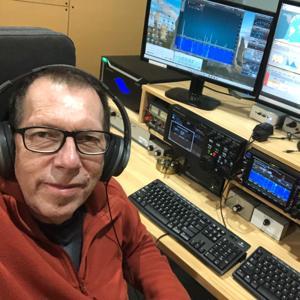
1 Listeners
1 Listeners

894 Listeners

1,096 Listeners