
Sign up to save your podcasts
Or



Why the Market is Wrong
Groomers tend to look to each other to determine how much they should charge for their services, but all too often, this strategy fails because no one is charging enough. Most groomers’ prices don’t account for factors like skill levels and inflation.
Hi, I’m River Lee of the Savvy Groomer. I’m going to show you why the market is wrong and how we can raise our prices to change that.
What is inflation?
For our purposes, I’m going to simplify some economic concepts a ton. Simply defined, inflation is a general increase in prices and a decrease in the purchase value of money.
When something is rare, it has more value and prices go up. When something is common, it is worth less and prices go down.
Every year, the U.S. government adds more money to the economy. This means there is more money in the supply, which causes the value of money to go down, which means you need more money to buy something year after year.
How does inflation affect grooming?
Let’s look at this real-life example. A great groomer working in a shop charged $20 for a Shih Tzu in 1980. That same groomer charges $60 for a Shih Tzu in 2021. At first, this seems like a lot more money!
But because of inflation, that $20 in 1980 is actually worth almost $65 in 2021.
Inflation happens every year, at an average of 3% per year. It affects the price of everything, including grooming prices and grooming products, as well things like gas, building materials, food… literally everything!
This means that the groomer who was charging $20 in 1980 would need to increase her prices to $65 to ONLY keep up with inflation. This groomer has since become a certified master groomer and gained 40 years of industry experience. That means she should be charging much higher prices to properly reflect her value. And why wouldn’t she?
Why is the market so bad?
A lot of groomers base their prices on what they charge at chain stores like PetSmart and Petco. But what most people don’t realize is that all these stores are actually selling grooming services at a loss!
These businesses are losing a lot of money on grooming and instead, they make their money on other services and products. People are more likely to buy pet food, toys, and other stuff from the store that they already take their pet to get groomed at, so it builds customer loyalty.
So why are we using businesses that take losses as our reference for the market?
I think it is because they train a tremendous number of groomers. Many groomers started there, so we think their prices are the market price.
Small salons have the chance to take a stand and charge the prices they want. But unfortunately most people are too afraid. We have to be brave and increase our prices.
How can groomers increase prices?
I have worked with many clients whose prices were not even keeping up with inflation. They come to me because they want to increase prices, but are scared.
I’ve encouraged many of my clients to increase their prices significantly, and their businesses have done amazing. Many have been able to work less than they used to, but make more money, work with only clients they like, take more time off — and still keep their clients happy.
You can do it too! You just need to know how to market yourself and do it right.
Use small yearly price increases
Inflation happens every year, so you need to increase your prices every year to keep up.
This might seem scary at first, but think about it! It is much nicer to your clients to have a small yearly price increase instead of a much larger one every several years.
If inflation is about 3% each year and you charge $100 for a groom, then you should plan to raise your prices at least $3 every year. I recommend increasing at least $5 per year to cover your bases and keep your prices at nice round numbers.
If this seems like a lot, consider that if you only raise prices every 3–5 years then you’ll not be keeping up with inflation for those few years. Your business expenses will increase because the price of supplies and everything goes up every year. And then when the time comes, you’ll need to raise your prices by $15–25 instead! Large price increases like this tend to be very difficult.
If you are worried about customers leaving, consider this: A customer who will leave you over $5 will definitely leave you over $20 or $30, so you’re likely to have a mass exodus anyways. And if they leave you over just $5, either you didn’t market the change well and you’re doing something wrong, or they are simply not your soulmate client. Your soulmate client won’t leave over $5.
You need your grooming customers to invest in you because you want to grow your business; so if they aren’t willing to invest, then they aren’t worth your time. Maybe you want to take classes to improve your skills, upgrade your products and equipment, or get training for your other groomers. You need to make enough money to not just live, but to thrive.
Key takeaways
So the industry is wrong, but we create this terrible market for ourselves by being too afraid to stand up. When we encourage these bad prices, we give the bad clients control over our business.
In economics, everything is about supply and demand. Right now there is high demand, but actually a groomer shortage. Therefore, there is no reason not to raise prices.
It’s all about doing what’s best for you and your business.
You decide your pricing! Don’t worry about the market.
Learn more:
If you want to learn more about the market and why you should increase your prices, watch my YouTube video on this topic and please subscribe to my channel! You can also check out my live workshops every Monday at 7 pm ET or sign up for my business coaching classes.
I also encourage everyone to sign up for my 6-week Price Increase Masterclass. This Masterclass contains 12 weeks’ worth of business coaching packed into an awesome 6-week group class where you will learn all about the market and how to increase your prices the right way.
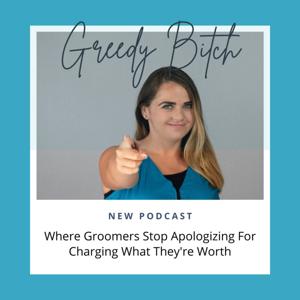
Hello hello and welcome to Greedy Bitch, a podcast where groomers stop apologizing for charging their worth. I’m your host River Lee, founder of the Savvy Groomer where I teach you to go from burnt out, broke and broken to healthy, wealthy and happy- building a grooming business you love!
How do you decide your grooming prices?
There are many ways you can charge for grooming services — whether it’s by hour, by breed, by weight, or something else. But which way is best?
Recently, I’ve talked a lot about figuring out how much you should charge. But this week I want to help you figure out what method of charging is best for you.
If you’ve been following along with the Savvy Groomer, you probably know by now that as an industry, we all need to increase our prices. So the question then becomes, how do you go about doing this? How should we structure our prices?
Should you charge by the breed? Or should you charge by weight? Should you charge per grooming slot? Or should you come up with hourly rates?
I’ll cut right to the chase. Unfortunately, there is no magic formula. And different solutions might work for different businesses. I can’t tell you how you should charge because I do not know about you and your business!
You might have heard me say that we all need to stop doing cookie cutter pricing. What works for other groomers probably won’t make sense for you, because you have to factor in so many variables like location, experience level, type of salon, what products you’re using, how many employees you have, whether you’re a high-volume salon or not, and so on. Every business is unique so your pricing structure needs to reflect that.
The reality is that you can charge any way you want. It all depends on you and what makes sense for your business goals.
So we all know that we need to raise our prices and audit our price structure, but to do that you need to decide how you are going to charge your clients. So let’s talk about it.
How should you charge?
Like I said, this will vary from business to business. There is not one right way to charge for your services. But, there are some things we can generalize about and consider.
Charging by breed or weight
If you have a high-volume business, charging by breed or weight might make the most sense for you because you are going to need to keep things simple.
High-volume businesses need to minimize the amount of time that staff spends on checking a pet in or out, so it is best to keep things straightforward. Your receptionist won’t be able to spend a lot of time considering other factors and figuring out the scope of work.
If you charge by breed or weight, this does not factor in any variation of pets. For example, if you charge by breed only, you could have anything from a 4-pound chihuahua to a 30-pound chihuahua (unfortunate, but they exist). These two dogs can be very different. You might make a lot of money on the 4-pound dog, but actually lose money on the 30-pound dog. But since you have such a high volume then things quickly even out and it does not matter.
Petco and PetSmart are volume-based businesses. They groom a very high volume of pets every day, so they cannot afford to be very customer-service oriented. They also offer pet grooming services as a loss leader. That means it works for their business to charge simple rates per breed.
But charging by breed or weight doesn’t work for everyone. Lower volume businesses might not be able to make enough money and perform good, complete grooms with this pricing structure.
Charging hourly
I can say that I don’t recommend charging hourly — or if you do choose to charge hourly, that you do so only on the back end and that you don’t market your rates as hourly to your clients.
The reason I don’t recommend telling your clients that you charge hourly is because clients have no idea how long anything takes. Giving an hourly rate can make clients panic and they’ll probably want to rush you.
Many people have had past grooming experiences where they dropped off at 9 am and picked up at 4 pm — so they might not understand and they won’t want to pay for 7 hours! It is a sure way to make your clients and your employees nervous and confused.
When I pay for any service, like if I take my car in to get worked on, I know that I don’t want them to tell me their hourly rate — just tell me how much it will cost! I don’t know what I need or how long it will take, and they are the professionals.
Another problem with charging hourly is that different groomers take different amounts of time. Baby groomers take much longer than experienced power groomers, but everyone is probably working the same hours in a day. That means that you’re probably going to lose money on the baby groomers because they groom less per hour. It also means that you are going to be underpaying the power groomers because they can groom more per hour.
This sets you and your employees up for failure. It is unfair to your groomers but it is also unfair to your customers because they aren’t getting the same service with every groomer.
Of course, if you are a solopreneur with no plans of hiring or training anyone else, then hourly can be a great option for you. There are no other mitigating factors to consider and you know exactly how long each service takes you. That said, I still don’t recommend letting your clients know that you charge hourly, and instead charge them for the scope of work (like you would if you were working on someone’s car).
Charging with a points system
My favorite method — and what I work with my clients to do! — is to develop a hybrid points method that considers all factors like breed, weight, and time, but also factors things like groomer skill levels, emotional burden, risk, and more.
Using this system, I assign each pet points. Pets with more points cost more money. Every time a groomer finishes a pet, they get the same number of points. Groomers who earn more points earn more money per hour. This way it is fair to your groomers and your clients, and it fits your business goals. I also find that it is very easy for people to understand and be comfortable with.
Let’s say an average Shih Tzu takes about 45 minutes to an hour. They get 2 points.
I like to groom about 5 Shih Tzus per day. If each one is 2 points, that makes me a 10 point groomer. My shop owner knows that they can comfortably give me 5 Shih Tzus per day to bathe and groom and I will be successful.
Now they’ve hired a bather. The bather gets 1 point and I get 1 point. Now I can groom 10 Shih Tzus per day, instead of just 5.
But say one of my clients is a nightmare Shih Tzu, so they are worth 4 points. As a 10 point groomer, now I can only do 3 other Shih Tzus that day because this one dog took more points, and therefore more time and energy out of my day. The shop also needs to charge this Shih Tzu more than they charge other dogs to make it worth our time.
This is useful for customizing prices and making sure that you are charging the right price for every pet that comes through your shop.
Now you know that a Shih Tzu is 2 points, so a dog that is much bigger, more difficult, and takes longer — like a Doodle — should be somewhere between 4-6 points.
For easy math, let’s say you charge $50 for a 2 point Shih Tzu. Now you know you need to charge at least somewhere between $100–$150 for a doodle. Now, if you need to factor in extras like chiropractic care or massages, or you know that your groomer will get burnt out faster on a lot of doodles — then you know that you need to be charging even more.
This point system exercise allows your pricing to be flexible and causes you to pay close attention to how much each dog is worth. It can also help you think about things very mathematically and remove some of the emotional aspects of pricing.
I have used this in my own business and recommended it to many clients. It is easy for everyone to figure out and implement.
It also helps you take care of yourself because it is not just based on making more money. It helps you understand how you price your services and why you have those prices. It also helps you make sure that your pricing structure works well for you, your business, and your business goals. It is good to charge enough money to be ok financially, but you need to do more than that! Set long-term goals for financial success.
Hire business coaching services or take my class!
Price restructuring can be scary, but I am here to support you through this transition!
I offer one-on-one business coaching to pet grooming clients who are looking to restructure their prices and business model. We will go through a full price evaluation and audit, figure out how much you want to make, and create a plan to implement everything.
If you’re not ready to invest in one-on-one coaching, you can sign up for my 6-module Price Increase masterclass. This is an amazing, information-packed course where I will help you develop a personal pricing framework.
I know that this is a diverse industry with all kinds of unique businesses, so I work hard to look at every business as an individual business and create plans that support all the different types of clients.
Learn more:
If you want to learn more about different pricing strategies, watch a rerun of my livestream on YouTube on this topic and please subscribe to my channel! You can also check out my live show every Monday at 7 pm ET
I encourage everyone to sign up for my 6-module Price Increase Masterclass. This Masterclass contains 12 weeks’ worth of business coaching packed into an awesome 6-week group class where you will learn all about the market and how to increase your prices the right way. This class is self-study so you can learn at your own pace.
Want to learn more about how pricing and points works? Purchase my 1.5-hour workshop: Pricing & Points (www.savvygroomer.com/pricingandpoints)
Hello hello and welcome to Greedy Bitch, a podcast where groomers stop apologizing for charging their worth. I’m your host River Lee, founder of the Savvy Groomer where I teach you to go from burnt out, broke and broken to healthy, wealthy and happy- building a grooming business you love!
Are Big Dogs Profitable?
The average pricing that I see for big dog grooming is simply not profitable for business owners. Big dogs take more of everything to groom, and they usually aren’t priced appropriately to account for this. But with adjusted rates, can big dogs be profitable?
I’m going to discuss what’s a profitable price for big dog grooming and explain why you should probably raise your prices or adjust your clientele balance.
Big dogs can be bad for business.
It might sound harsh, but they really can be if you don’t structure your pricing properly. Most people don’t realize how much damage they are doing to their business by not charging enough for big dogs.
Why do big dogs cost more?
Grooming a big dog doesn’t simply mean taking more time or using more product. Big dogs truly take more of everything from you and your business.
On average, a small dog like a Yorkie, Shih Tzu, or Pug might take about an hour at most to groom, and large dogs like a Golden Retriever, Doodle, or Bernese Mountain Dog could take anywhere from 1.5 to 3 hours. They take so much longer because they have more hair to cut, often they have more complicated cuts, they can be more challenging to handle, and sometimes blow-drying can take forever.
If you’re charging the same price for a small dog and a large dog, that means that your hourly earnings for the large dog could be as much as three times less than your hourly earnings for a small dog. Ouch, right? That’s why time is one of the most important factors to consider when setting grooming prices. Because their grooming needs are more challenging, you also usually cannot hand a Doodle or other large dog to a novice groomer and instead need someone who might have higher hourly rates to groom that dog.
Like I said, time is not the only factor. Big dogs use a lot more product, like shampoo, conditioner, and cologne. You might not think it would make a huge difference but pay close attention to how much more product you are using for larger dogs! It all adds up.
Another huge cost factor for big dogs is that they often require more than one person to handle them. Groomers should not lift a dog heavier than 40-50 pounds by themselves, and big dogs like this often need multiple people attending to them throughout the process. This means that you need to hire a groomer and a bather to work on a large dog. Now, you have to split that hourly rate between two people.
There is fancy equipment that you can purchase to help make grooming large dogs easier, like lifting tables, but again that is an added cost. Even if you already own this equipment, big dogs can be challenging and are likely to damage or break your nice equipment. So even if you are able to groom a large dog by yourself, you still need to factor in the cost of upgrading, repairing, or replacing your equipment into the price of the grooming session to remain profitable.
Finally, I like to mention the physical and emotional cost of big dogs. They take so much more energy and effort to groom, and they can contribute to burnout or exhaustion. There is also greater risk for injury or throwing your back out when dealing with large dogs. Personally, if I had the choice between grooming three Shih Tzus or one Bernese Mountain Dog, I would absolutely take the Shih Tzus! They both might take me a total of three hours, but the Shih Tzus would be so much easier and more pleasant at the end of the day!
How do you set profitable prices for big dogs?
When setting your prices, always charge for your high-end, worst-case-scenario estimate. That means if it takes you anywhere from one to two hours to groom a certain type of dog, set your prices as if it always takes two hours. That way, you are always covered in case you get a nightmare client that takes forever, if your equipment fails during the session, or if anything else goes wrong.
You also need to factor in your business overhead expenses. I am a firm believer that businesses cannot afford to pay their employees more than 30% of their gross income (if you’re curious to learn more about how I arrived at this number, check out my video called Why 50% is Bad for Business — it explains it all). That means that hourly rates for your groomers are a lot less than you might originally think.
If I am charging $50 for a Shih Tzu that takes one hour to groom, and I can only afford to pay my groomer 30% of that, then the groomer will get an hourly rate of $15. Not much, right?
For big dogs, this number gets even lower. If I am charging $75 for a doodle that takes two hours to groom, at 30%, the groomer gets an hourly rate of just $11.25. And that is with just one groomer! We all know, you’d probably need to pay a bather as well. At this rate, you might be paying the groomer and bather as low as $5 or $6 an hour, which is below minimum wage and frankly unacceptable.
A general rule of thumb is that you should aim to pay your groomer at least $20 an hour and pay a bather at least $10 an hour. You likely also need to pay a receptionist at least $10 an hour. Therefore, in this theoretical example, you should aim to set your prices so that the 30% allotted for wages should be at least $40 an hour.
If we were to do that, the prices would be as follows: $150 for a Yorkie (at one hour), $225 for a Shih Tzu (at 1.5 hours), $150 for a pug (at one hour), $300 for a Golden Retriever (at two hours), $450 for a Doodle (at three hours), and $450 for a Bernese Mountain Dog (at three hours).
Now, these prices are extremely high and I don’t think there is a market for them right now, but it is not crazy to charge prices like $100 or $120 for a Yorkie, $135 for Shih Tzu, or $200 for a Golden or a Doodle. I have seen many mobile groomers and high-end salons move towards offering a base price in the $100-120 range for dogs like Shih Tzus, and then they charge for add-ons for additional services to get the prices higher.
Since you cannot realistically charge upwards of $300 or $400 for big dogs, a good pricing technique is to pad the cost into your prices for smaller dogs. You also need to pay attention to your clientele ratios and try to find a balance so that you are grooming more small dogs than big dogs. That way, the pricing will even out and you’ll be able to groom some large dogs without losing money on it. However, this model won’t work very well if you are just grooming large dogs all day long.
Raising prices can definitely be scary, but as an industry, it is something we all need to do. Dog grooming prices have not been raised in decades, despite a lot of inflation. The price to groom a Doodle has not increased from $75 in over 70 years! That’s right, the price to groom a Doodle in the 1950s was also $75! This is just insane to me, and it is no wonder why it is such a challenge for businesses to stay profitable with big dog grooming.
Are big dogs profitable?
So are big dogs profitable to groom? The answer is, it depends!
Big dogs can be a challenge and a huge strain on resources, so you have to be smart and strategic about it. If you aren’t careful, big dogs will most definitely not be profitable for your business. But if you structure your pricing appropriately, it can be done.
If you’re going to groom big dogs, here are a few strategies you can use to make it profitable for your business:
Learn more:
If you want to learn more about how to make grooming big dogs profitable, check out my live show every Monday at 7 pm ET (www.youtube.com/savvygroomer)
If you want to work with me, enroll in my Price Increase Masterclass (www.savvygroomer.com/pimc)
If you’re not quite ready to invest in your business but want to network with other pet professionals, join our free Facebook group, Savvy pet professionals (https://www.facebook.com/groups/savvygroomer)
Hello hello and welcome to Greedy Bitch, a podcast where groomers stop apologizing for charging their worth. I’m your host River Lee, founder of the Savvy Groomer where I teach you to go from burnt out, broke, and broken to healthy, wealthy, and happy- building a grooming business you love!
Soulmate client relationships: what are they and how to find them
Every groomer wants to run a high-end salon, but not everyone wants to deal with the baggage that comes along with high-end clients. Often, your services just aren’t a perfect match for their needs.
What is a soulmate client?
A soulmate client, also called an ideal client or ideal client avatar, is essentially what it sounds like: your target market or the perfect type of client you want to attract.
I like the term “soulmate client” because comparing your perfect client to someone you are dating can be a very helpful analogy.
Often, when someone calls your salon to make an appointment you immediately say yes. You need the money so you’ll take any paying client you can get — it is only natural. Similarly, in dating, you might be tempted to say yes to anyone who wants to take you on a date and buy you dinner.
But wait! To make sure this date will be worth your time; I recommend asking some questions first.
Figure out your deal-breakers
It is important to figure out what are your deal-breakers for this relationship. When you’re dating, this might be 'do you want children?' For grooming appointments, a deal-breaker might be how often do you want your pet groomed?
For me and my grooming business, I wanted someone who needed or wanted grooming regularly. A soulmate client was someone who would be happy to sign up for my membership, get on a regular schedule, and need monthly grooming services. One-off clients or irregular clients were not worth my time.
Figure out what traits your soulmate client has
Many people want to be a high-end salon owner who charges top dollar. This usually means they think their soulmate clients are people who make six figures — maybe folks who live in wealthy areas.
But just like you might expect in dating, there are downsides to attracting clients with this lifestyle. Say you’re dating a surgeon — they are going to be very busy and on-call often. This means they might cancel dates (or appointments) often and need you to be very flexible. If you know you want to date a doctor, but need someone who is more reliable, then maybe a dermatologist is a better choice for you!
Let’s look at another analogy: coffee drinkers! Maybe you think your soulmate is a Starbucks drinker. If they pay $7 for a Starbucks drink, they want it to be perfect or else they’ll be annoyed and send it back. Similarly, when you’re charging top dollar for your services, people are more likely to get mad when something goes wrong. In pet grooming, Starbucks drinkers are tough clients to have as a soulmate. Maybe your soulmate is actually someone more middle of the road like a Dunkin Donuts drinker.
Analogies aside, my point is: everyone wants high-end clients but they don’t want to deal with the crap that comes with them. Middle of the road clients are more flexible, willing to work around your schedule, and are usually nicer and easier to please. If the relationship with a high-end client is not working, maybe you’re mismatched. Many people should actually be serving middle-ground clients because those clients fit their goals better.
Figure out how to attract that soulmate client
In personal and business relationships, if you want a relationship with someone amazing, then you have to be amazing. Put another way, you need to be a good friend to have good friends! Simply providing a great haircut is not enough to attract and keep your soulmate clients.
You need to think about what you bring to the table for your clients. How do you meet their needs? Are you making them feel cared for? What do they need out of a grooming relationship: is it convenience, emotional connection, or reliability?
While you should always keep things professional, you should be thinking of ways you can nourish your client relationships. Maybe you send home a report card with their pet or call after every few grooming appointments to ask if they are satisfied with the groom. Maybe you need to change your cancellation policy or offer pick-up and drop-off services.
Figure out who your dream client is, how you can meet their needs, and how to nourish that relationship on an ongoing basis.
Set boundaries and reward those who put in the effort
Once you have this initial conversation with a new client and finish their first grooming appointment, the next steps are very important to your relationship. To go back to the dating analogy, this can be like wondering if you ask them for a second date or do they? Do you wait for them to call you?
If you meet someone and you think you might be each other’s’ soulmate, you’re going to naturally go through the effort to stay in contact with them and build a good relationship.
By contrast, if you aren’t hitting it off then you’re not going to ask as many questions and just try to get it over with. Or maybe you find that you are playing a kind of game with your clients trying to get them to book an appointment — Maybe when you ask them would you like to book another appointment? They say, No, I’ll call when I’m ready. Maybe this client waits until they are a little desperate to get their dog groomed because they waited eight weeks instead of four and so their dog is a mess (which is going to be more work for you).
Here is where you set your boundaries and expectations with people. Many groomers have toxic and codependent relationships with clients where they essentially teach their clients to treat them poorly. Instead, you want to reward people who go above and beyond in the relationship to make things work, and discourage those who don’t make an effort or follow the rules. The more exclusive and harder to get your services are, the harder people will work to get the reward.
“Dating” questions to ask a new client
So what should you ask your new clients? Below are a few great example questions.
How often do you have your pet professionally groomed?
If they answer:
What are your expectations of your groomer? What services would you like to be included?
How can we improve upon your past grooming experiences?
If you’d like to explore this more, you can sign up for my Business Workshop Library, where we’ll create a cheat sheet of questions for you to ask your new clients.
Find Savvy Groomer on Facebook:
www.facebook.com/growwealthygrooming
www.facebook.com/groups/SavvyGroomer/
Find Savvy Groomer on Youtube:
www.youtube.com/savvygroomer
Sign up for Savvy Groomer Business Workshop Library:
www.savvygroomer.com/gwg
From the publisher's feed

346 Listeners
237 Listeners

99,668 Listeners

8,030 Listeners

15 Listeners

929 Listeners