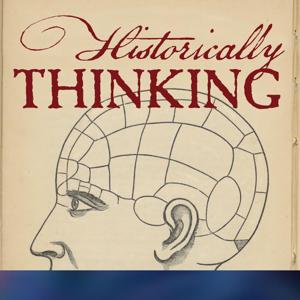
Historically Thinking

Historically Thinking

Download on the App Store
  • Favorites

    22

    Followers

  • Typical duration

    31 min

    per episode

Based on Podcast App listening data

Historically Thinking episodes

  • Episode 398: The Celts
    During the age of the European Renaissance, a new people was discovered. Not the Aztecs, or the Maya, or the Inca, but a mysterious people with an intriguing language who had once dominated Europe itself. These were the Celts. And their discoverers were not conquistadores or maritime adventurers, but dusty scholars, learning their eighth or fourteenth language, rummaging through dusty manuscripts. Yet somehow, as my guest Ian Stewart describes in his new book The Celts: A Modern History, these dusty scholars birthed a craze for Celticness which has lasted into our own day. It also became linked to some of the most powerful forces in the modern world, nationalism and racialism. How this happened is the argument of Ian Stewart’s book and the topic of our conversation today.
    Ian Stewart is a Research Fellow at the University of Edinburgh. The Celts is his first book.
    1 hr 2 min
  • Episode 397: Mutiny on the Black Prince
    In April 1769 a small British vessel sailing along the southern coast of Hispaniola discovered a shipwreck near the current border of Haiti and the Dominican Republic. An investigation found no survivors aboard. But they also found a log which identified that ship as the Black Prince. And there the mystery might have ended. But over the next eight years, “ship’s crew members surfaced in unexpected places and recounted its demise.”
    That demise is part of the story in James H. Sweet’s Mutiny on the Black Prince: Slavery, Piracy, and the Limits of Liberty in the Revolutionary Atlantic World. But so too is how the Black Prince came to be wrecked on the Hispaniolan reef; how its crew escaped; and how the owners of the ship, and the interest they represented, took their own revenge. Above all it is a story of how Atlantic slavery was linked not only to commerce, but nearly every other corner of the 18th century world.
    James H. Sweet is the Vilas-Jartz Distinguished Professor of History at the University of Wisconsin-Madison, and a past president of the American Historical Association. He has previously been the prize-winning author of Recreating Africa: Culture, Kinship, and Religion in the African-Portuguese World, 1441-1770 and Domingos Álvares, African Healing, and the Intellectual History of the Atlantic World.
    1 hr 8 min
  • Episode 396: Obscure Important Historian
    Lists of important Roman historians would certainly include cerebral Polybius (who, to be fair, was also Greek); the friend of Augustus, Titus Livius; the austere Tacitus; and the gossipy Suetonius,. To one extent or another, all of them were participant observers–not simply historians, but actors in the drama of Roman life and politics. 
    Not usually included on this list of great Roman participant-historians is Cassius Dio. Like Polybius, he was Greek. But since he was born somewhere between 155 and 165 AD, and died in the 230s, the Mediterranean world had changed quite a bit since Polybius’ time, three centuries before. For Cassius Dio was a Roman senator, and he served and wrote during a time of unprecedented tumult within the Roman Empire. He is often the only source for a variety of events, even ones which occurred centuries before his own lifetime. But was he simply a Tacitus wannabe? Or an important and influential historian in his own right?
    With me to talk about Cassius Dio is Colin Elliot, Professor of History at Indiana University. He hosts his own podcast, Pax Romana, where you can hear many verbal footnotes  to Cassius Dio, which helped inspire this discussion. Colin’s last appearance on Historically Thinking was in Episode 351, when we talked about this book Pox Romana: The Plague That Shook the Roman World.
    56 min
  • Episode 395: Summer of Fire and Blood
    It was the greatest popular uprising in western Europe prior to the French Revolution. By spring 1525, across regions of what are now Austria, Germany, Switzerland, and France, armed bands of peasants marched to defeat their lords and to overturn the social and religious hierarchy that had existed for centuries. At least 100,000 people were involved, and likely many more. When it collapsed in the summer of 1525, perhaps 1% of the regions population were killed in just two months, making it a summer of fire and blood.
    Which, as it happens, is the title of my guest’s new book. Lyndal Roper is the Regius Professor of History at University of Oxford. Her most recent book Summer of Fire and Blood: The German Peasant’s War.
    1 hr 11 min
  • Episode 394: Greek Revolution
    If English speakers—or French speakers, or Spanish speakers, or really most any speaker of any language other than Greek…or Turkish—think about the Greek Revolution at all, then that’s amazing. If they do not, then they continue to ignore one of the most consequential collection of events in the 19th century, a series of imperial overlaps, social convulsions, massacres, sieges, expulsions, and sometimes battles that not only resulted in an independent Greece, but also changed forever the culture of the eastern Mediterranean, and birthed nationalism as a successful way of not only theorizing but of being. 
    My guest Yanni Kotsonis is Professor of History at New York University, where he was founding director of the Jordan Center for the Advanced Study of Russia. Raised in Athens, he was educated in Montreal, Copenhagen, London, and Moscow. His most recent book is The Greek Revolution and the Violent Birth of Nationalism, which is the subject of our conversation today.
    1 hr 15 min
  • Episode 393: Lawless Republic
    Marcus Tullius Cicero lived from 106 BC to his murder in 43 BC. He was a writer, a philosopher, a traveller, a consul of the Roman Republic, and perhaps one of the last people to take the Roman Republic seriously–even when it was long past its shelf date. But most importantly, Cicero was a lawyer—and it was his practice of the law that was at the heart of his philosophy, politics, and devotion to the republic. 
    Josiah Osgood has written a biography of Cicero that is a biography of some of his most famous legal cases. Through this narrative, we see a gifted young lawyer literally take the stage in Rome, and over a career make impassioned speeches that will in time would undermine that same republic which he held so dear. 
    Josiah Osgood is professor of classics at Georgetown University. A winner of the Rome Prize, he is the author of six books on Roman history, the most recent of which is Lawless Republic: The Rise of Cicero and the Decline of Rome.
    1 hr 11 min
  • Episode 392: Papa von Ranke
    He was and has been criticized as a “mere burrower into archives”; as a dry man without any ideas; as a painter of miniatures rather than of broad portraits; as a conservative by liberals, and insufficiently dogmatic by conservatives; as motivated by the Lutheran religion of his forebears, but also as a scholar set against teleology and mysticism.
    This was Leopold von Ranke, born in 1795, dying in Berlin in 1886. Over his long life, he not only influenced the historical world by his writings, but by his students, and their students. Through his teaching and his examples, he altered not only the historical profession in Germany, but in the United States as well through the horde of Americans who passed through faculties of history whose members had been trained by Ranke, or by one of his students. He did  not invent the footnote or the insistence upon using primary sources, but arguably more than anyone else established them as part of the apparatus of history as a social science.
    With me to talk about Leopold von Ranke is Suzanne Marchand, Boyd Professor of European Intellectual History at Louisiana State University. This September, she was elected to the Presidency of the American Historical Association for 2026. This is her fourth appearance on Historically Thinking; she was last with us as part of our continuing series on intellectual humility and historical thinking.
    56 min
  • 391: Roman Roads
    Listeners to this podcast are certainly aware of the saying that “all roads lead to Rome”; and, given this audience, you might even be aware that this probably derived from the observation mīlle viae dūcunt hominēs per saecula Rōmam, made by the 12th century theologian and poet Alain de Lille. But what is the history of the Roman roads, or rather, what is the history of how people imagined and related to the Roman Roads? And how has that imaginary influenced the ways that we think of Rome, the classical world, roads, travel, and perhaps even the powers of the state?
    That Roman roads actually have produced a social imaginary should perhaps be a little more mysterious to us. After all, as my guest writes: 
    Many roads do go without saying. They’re not aesthetically exciting. They’re functional and mundane. We notice roads when they have problems  –  a traffic jam or accident. When the journey is smooth they’re not worthy of comment. (I noted, while researching, how rarely the word ‘road’ is indexed.) And yet for centuries the Roman roads have been a source of fascination.
    Those were the words of Catherine Fletcher, Professor of History at Manchester Metropolitan University, and author most recently of The Roads to Rome: A History of Imperial Expansion. This is her second appearance on Historically Thinking; she was last here in Episode 166 talking about her book The Beauty and the Terror: The Italian Renaissance and the Rise of the West.
    57 min
  • Episode 390: Atlantic Ocean
    “He was a bold man who first ate an oyster,” observed Jonathan Swift; and in fact the first human interaction with the Atlantic Ocean was probably eating shellfish, traces of which can be found along the Western Cape of South Africa dating back 160,000 years ago. When humans began to finally live in numbers along the ocean coast, their culture changed. They took their food from it, and from the shoreline, and their metals from the rocks and marshes along its coast. In time they built boats capable of venturing along those coasts, and then gradually farther and farther out. All of this, my guest John Haywood argues, was foundational for what was to come. He writes: 
    The history of the pre-Columbian Atlantic is…the where and when that Europeans served their apprenticeships in ocean navigation, commerce and colonialism, and that saw them formulate the ideologies they used to justify their territorial claims and their exploitation of colonized peoples. When Europeans finally broke out onto the world’s oceans in the sixteenth century, they already had everything they needed to secure global domination.
    John Haywood is a historian of the Vikings, and of the early maritime history of the North Atlantic. The author of numerous books, his latest is Ocean: A History of the Atlantic before Columbus.
    1 hr 28 min
  • Episode 389: Indian Religions
    “India has 2,000,000 million gods, and worships them all,” wrote Mark Twain, following his 1896 speaking tour of British India. “In religion other countries are paupers; India is the only millionaire.” Twain was exaggerating, but perhaps only a little. Consider that Hinduism, Buddhism, and Jainism all took form some 2,500 years ago in South Asia, that they and their offshoots are now practiced by hundreds of millions of people around the world, and you will see how that wealth has been spread about. 
    In his new book Religions of Early India: A Cultural History, Richard H. Davis explores how that wealth was accumulated, and how it began to be spent. Beginning from before the earliest written records–which are, for a Western historian, astonishingly early–he traces the story forward to thirteen hundred years before the present, in approximately 700 AD, just as the entire Afro-Eurasian world was about to be transformed by the advent of Islam. 
    Richard H. Davis is Professor Emeritus and Research Professor of Religion at Bard College.  His primary research and teaching interests include classical and medieval Hinduism, Indian history, South Asian visual arts, and Sanskrit. He is author of, among numerous other books, The Bhagavad Gita: A Biography. Religions of Early India is his most recent, and is the subject of our conversation today.

    1 hr 7 min

About Historically Thinking

From the publisher's feed

We believe that when people think historically, they are engaging in a disciplined way of thinking about the world and its past. We believe it gives thinkers a knack for recognizing nonsense; and that…

More shows like Historically Thinking

The LRB Podcast by The London Review of Books

The LRB Podcast

300 Listeners

More or Less by BBC Radio 4

More or Less

873 Listeners

In Our Time by BBC Radio 4

In Our Time

5,481 Listeners

HistoryExtra podcast by Immediate

HistoryExtra podcast

3,201 Listeners

The Infinite Monkey Cage by BBC Radio 4

The Infinite Monkey Cage

1,907 Listeners

EconTalk by Russ Roberts

EconTalk

4,275 Listeners

Conversations with Tyler by Mercatus Center at George Mason University

Conversations with Tyler

2,451 Listeners

Tides of History by Audible /  Patrick Wyman

Tides of History

6,223 Listeners

Cautionary Tales with Tim Harford by Pushkin Industries

Cautionary Tales with Tim Harford

5,079 Listeners

The Bunker – Your daily news Deep Dive by Podmasters

The Bunker – Your daily news Deep Dive

103 Listeners

The Old Front Line by Paul Reed

The Old Front Line

181 Listeners

The Rest Is History by Goalhanger

The Rest Is History

15,702 Listeners

Empire: World History by Goalhanger

Empire: World History

2,458 Listeners

Disorder by Jason Pack

Disorder

106 Listeners

Strong Message Here by BBC Radio 4

Strong Message Here

56 Listeners