
Sign up to save your podcasts
Or

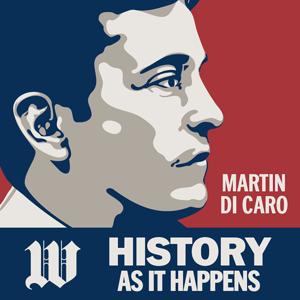


Based on Podcast App listening data
If a key lesson of the Vietnam War was the United States should avoid fighting guerrilla wars in faraway countries of little strategic importance, whose people, histories, and cultures we do not understand, then the U.S. failed to heed that lesson in Afghanistan. As the final American and NATO troops prepare to exit Afghanistan after 20 years of war and nation-building, Pulitzer Prize-winning historian Fredrik Logevall of the Harvard Kennedy School joins the podcast to discuss the similarities and differences between the two lost conflicts. Logevall is a preeminent scholar of the French and U.S. wars in Southeast Asia.
Go to historyasithappens.com to learn more.
Hosted by Simplecast, an AdsWizz company. See pcm.adswizz.com for information about our collection and use of personal data for advertising.
The date upon which Americans celebrate their nation's independence helps explain a curious act of forgetting, a whitewashing of a complicated past in favor of a mythic narrative of heroism and unity. It is on the Fourth of July when we mark the Continental Congress' adoption of the Declaration of Independence, whose opening words have come to embody the American ideal. We do not gather for barbecues or fireworks on, say, October 17. On that date in 1781 Cornwallis surrendered to Washington at Yorktown, effectively ending the Revolutionary War -- a rebel victory without which the words of the Declaration would have amounted to a footnote in history. By embracing the Fourth of July and celebrating the Enlightenment ideals articulated in Jefferson's magisterial Declaration, we tend to obscure the war part of the Revolutionary War -- the internecine violence, civil war, cruelty, terror, destruction of private property, and outright misery that has accompanied most wars and revolutions. In this episode, Pulitzer Prize-winning University of Virginia historian Alan Taylor discusses why it is important to acknowledge the violence and terror that scarred the revolutionary years as well as tales of heroism and courage and the triumph of freedom and liberty.
Go to historyasithappens.com to learn more.
Hosted by Simplecast, an AdsWizz company. See pcm.adswizz.com for information about our collection and use of personal data for advertising.
As the Chinese Communist Party marks its 100th anniversary, its leaders are using history to explain where the nation has been and where it intends to go. President Xi Jinping, eager to consolidate his authoritarian power, is paying his respects to Mao, conveniently ignoring the decades of violent chaos Mao instigated during his terrible reign. But Chinese youth are also looking to Chairman Mao for guidance -- for different reasons. They feel alienated in a society that is leaving them behind, where economic inequality is rampant and political freedoms scarce. Mercatus Center analyst Weifeng Zhong, an expert on Chinese domestic policy, joins the podcast to discuss China's contradictions and complexities.
Go to historyasithappens.com to learn more.
Hosted by Simplecast, an AdsWizz company. See pcm.adswizz.com for information about our collection and use of personal data for advertising.
It is an iconic Olympic moment that resonates in our current climate of racial activism. At the summer games in Mexico City in 1968, American sprinters Tommie Smith and John Carlos raised their fists during the playing of the Star Spangled Banner as they stood on the awards podium, the "Black Power salute." If that stands out as the most memorable act of political protest in Olympic history, it was also part of a long tradition of Black activism and sports. Politics and sports have always mixed, and the 2021 summer games in Tokyo will be no different. From Jesse Owens to Jackie Robinson, from Lew Alcindor (who would change his name to Kareem Abdul-Jabbar) to Mohammad Ali, athletes have fought for their causes while winning medals and championships.
Go to historyasithappens.com to learn more.
Hosted by Simplecast, an AdsWizz company. See pcm.adswizz.com for information about our collection and use of personal data for advertising.
It is time for fresh thinking about America's place in the world and the meaning of national security. As 2021 reaches its midway point, Americans are still clearing the wreckage of the past year -- a deadly pandemic has claimed nearly 600,000 lives in the U.S., racial protest continues to simmer -- while their government struggles to extricate its military from "forever wars" in the Middle East. U.S. Army veteran and historian Andrew Bacevich, who is currently the president of the Quincy Institute for Responsible Statecraft, says it is long past time to question the fundamental assumptions underlying "American exceptionalism." Our collective belief in the ability to manage history has led to folly, alienation, and national drift.
Go to historyasithappens.com to learn more.
Hosted by Simplecast, an AdsWizz company. See pcm.adswizz.com for information about our collection and use of personal data for advertising.
In 1992 Benjamin Netanyahu, then Israel's deputy prime minister, first warned the world that Iran was "three to five years" away from developing a nuclear bomb. In the three decades since, Netanyahu has repeated similar warnings countless times in interviews and speeches, alleging that Iran is led by irrational fanatics who dream of annihilating Israel in a nuclear armageddon. Bibi is out of power now, but his legacy on Iran lives on. No foreign politician had more influence over U.S. foreign policy over the past two decades. But Iran neither has a nuclear bomb nor does it want to produce one, according to historian John Ghazvinian. Was it all a cynical bluff to maintain U.S. support after the Cold War?
Go to historyasithappens.com to learn more.
Hosted by Simplecast, an AdsWizz company. See pcm.adswizz.com for information about our collection and use of personal data for advertising.
From the bombing of Pearl Harbor to the JFK assassination, from Watergate to the 9/11 terrorist attacks, special commissions and select committees have investigated traumatic events and political scandals throughout the past century. Their purpose was, to the extent possible, to set aside partisan politics and establish a comprehensive, factual record for history. So why are Senate Republicans blocking the creation of a 1/6 commission to investigate the mob attack on the U.S. Capitol? Historian Alvin Felzenberg, who was the chief spokesman for the 9/11 Commission, joins the podcast to discuss why the nation deserves all the facts.
Go to historyasithappens.com to learn more.
Hosted by Simplecast, an AdsWizz company. See pcm.adswizz.com for information about our collection and use of personal data for advertising.
If today's Republican Party, from Ronald Reagan to Donald Trump, is known for fighting the left in the Congress, courts, and culture, the Republican Party of the 1850s rose to prominence by building on "the foundational left-wing social movement of the modern era," which was the antislavery movement, according to Princeton historian Matthew Karp. Then a new party after the collapse of the Whigs, the antebellum Republicans fused social activism to end slavery with effective electoral politics. What can the the story of the abolitionists and antislavery men teach today's left-wing movements struggling to accomplish their goals? Karp joins host Martin Di Caro for a timely discussion tying the past to the present.
Go to historyasithappens.com to learn more.
Hosted by Simplecast, an AdsWizz company. See pcm.adswizz.com for information about our collection and use of personal data for advertising.
In this episode, we are joined by world-renowned war historian Sir Antony Beevor. When someone says the Soviet Union, not the Western allies, defeated Nazism, they can point to this date, June 22, 1941, as a pivotal moment in that narrative. Eighty years ago today, the largest invasion in history began as more than three million German soldiers attacked the USSR in Operation Barbarossa. The battle caused a cataclysm; millions of people were brutally killed, including more than a million Soviet Jews. But the USSR survived, and Barbarossa's outcome helped shape our modern world.
Go to historyasithappens.com to learn more.
Hosted by Simplecast, an AdsWizz company. See pcm.adswizz.com for information about our collection and use of personal data for advertising.
One summit between President Joseph Biden and Russian president Vladimir Putin will not resolve 30 years of missteps, miscalculations, and meddling by both nations. When the Cold War ended and the Soviet Union vanished in 1991, the relationship between the two states appeared hopeful, signaling a future of cooperation and peaceful coexistence. In this episode, the Quincy Institute's Anatol Lieven, a seasoned journalist and expert on international relations, discusses why U.S.-Russia relations have sunk so low: the expansion of NATO, human rights abuses, and cyber sabotage are among the issues.
Go to historyasithappens.com to learn more.
Hosted by Simplecast, an AdsWizz company. See pcm.adswizz.com for information about our collection and use of personal data for advertising.
From the publisher's feed
Ranked by our users in the last 21 days
8,440 Listeners

1,100 Listeners

741 Listeners

6,279 Listeners

717 Listeners

902 Listeners

18 Listeners

2,035 Listeners
7,124 Listeners
2,398 Listeners

15,915 Listeners

209 Listeners

384 Listeners
493 Listeners
471 Listeners