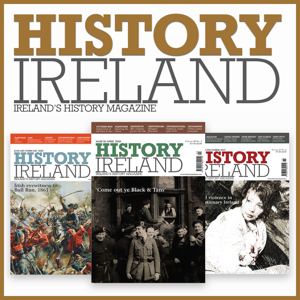
History Ireland

History Ireland

By History IrelandSociety & CultureHistory
Download on the App Store

History Ireland episodes

  • 'Better a state without public records than public records without a state’?
    'Better a state without public records than public records without a state’?— state formation, archives and commemoration

    So said Winston Churchill in reference to the Irish Free State on hearing news of the destruction of the Public Records Office in the Four Courts in June 1922 at the outbreak of the Civil War. But in many respects, this also applies to Northern Ireland whose Public Records Office Northern Ireland (PRONI) didn’t open its doors until 1924. How did these two institutions overcome this initial setback and what has been their significance in state formation, archives and commemoration? Listen to Tommy Graham, editor of History Ireland, in discussion with Marie Coleman, Catriona Crowe, Ray Gillespie and Neil Johnston. 
    This Hedge School is a part of a wider digital event hosted by the Public Record Office of Northern Ireland, in conjunction with Beyond 2022.
    1 hr 13 min
  • Nenagh and North Tipperary during the revolutionary decade
    Having considered the ‘global’ impact of the Irish revolution in the last podcast (The Irish Republic abroad in 1920—Dev in America), this Hedge School zooms in on the ‘local’—the market town of Nenagh and the surrounding North Tipperary area during the revolutionary decade—but also sets events in the wider national context. Listen to Tommy Graham, editor of History Ireland, in discussion with Gerard Dooley, John Flannery, Seán Hogan and Caitlin White.
    1 hr 24 min
  • The Irish Republic abroad in 1920—Dev in America
    While the War of Independence raged in Ireland, a parallel international diplomatic campaign for recognition and funding for the underground Irish Republic was being waged. Central to this was the tour of Éamon de Valera, ‘President of the Irish Republic’, to the United States from June 1919 to December 1920.  To assess its success or otherwise listen to Tommy Graham, editor of History Ireland, in discussion with Michael Doorley, Darragh Gannon, Miriam Nyhan Grey and David McCullagh. This Hedge School is supported by the Department of Media, Tourism, Arts, Culture, Sport and the Gaeltacht under the Decade of Centenaries 2012-2023 initiative.
    1 hr 17 min
  • IRELAND, EMPIRE AND THE SEA
    The great voyages of discovery (Columbus, de Gama, etc.) shifted the centre of gravity of European maritime trade from the Mediterranean to the Atlantic. Over the same period the conquest of Ireland was completed. By the eighteenth century, Ireland, for centuries on the periphery of Europe, found itself at the centre of this newly formed ‘Atlantic world’ as part of the British Empire. Listen to Tommy Graham, editor of History Ireland, discuss the maritime and colonial legacies with Aoife Bhreatnach (Irish Garrison Towns), Claire Connolly (UCC), Lar Joye (Dublin Port) and David Murphy (Maynooth).This podcast is supported by Dublin Port in association with the West Cork History Festival.
    1 hr 13 min
  • Terence MacSwiney—martyrdom, civil resistance & the Irish Revolution
    This podcast is part of the History Ireland Hedge School programme supported by the Department of Culture, Heritage and the Gaeltacht under the Decade of Centenaries 2012–2023 initiative.
     Terence MacSwiney—martyrdom, civil resistance & the Irish Revolution On 25 October 1920, after 74 days on hunger strike, Terence MacSwiney, lord mayor of Cork, died in Brixton Prison. His death not only evoked huge sympathy within Ireland but was also a turning point in the mobilisation of Irish nationalism abroad. In addition, his martyrdom inspired anti-colonial struggles throughout the world, particularly in India. Listen to History Ireland editor Tommy Graham discuss these and related questions, in particular the relationship between passive, civil and physical resistance, with Dr John Borgonovo, Dr Sarah-Ann Buckley, Dr Kate O’Malley and Dr Pádraig Yeates. 

    Photo:
    Terence MacSwiney on the day of his wedding to Muriel Murphy in Bromyard, Herefordshire, where he had been interned after the 1916 Rising prior to his release in June 1917. Standing (left to right) are sisters Mary and Annie, Capuchin friar Fr Augustine Hayden OFM, bridesmaid Geraldine O’Sullivan and best man Richard Mulcahy. (Cork Public Museum)
    1 hr 8 min
  • Cork—Crucible of the War of Independence
    Why was it that Cork (county and city), which accounted for c. 10% of the country’s population, produced nearly 25% of those killed in the War of Independence? What role did its substantial (c. 10%) non-Catholic (mainly loyalist) population play? Did individual IRA commanders like Tom Barry make a difference and what was the significance of the engagements he led at Kilmichael and Crossbarry?  Listen to Tommy Graham, editor of History Ireland, discuss these and related questions with Andy Bielenberg, Eve Morrison, Pádraig Óg Ó Ruairc and Gerry White. This podcast is supported by the Department of Culture, Heritage and the Gaeltacht under the Decade of Centenaries 2012–2023 initiative. 


    1 hr 14 min
  • Derry and the North-West, 1920–22—War of Independence or Communal Conflict?
    Historians have long contrasted the more nakedly sectarian conflict in Belfast (c. 500 deaths in 1920–2) with the conduct of the War of Independence elsewhere. With disturbances costing twenty lives in June 1920, Derry seemed to be heading the same way but never reached the same level of intensity. Why not? What was the relationship between the city and its rural hinterland, including Donegal? What role did the region’s substantial Hibernian element play? Listen to Tommy Graham, editor of History Ireland, discuss these, and related, questions with Liz Gillis, Adrian Grant, Breandán Mac Suibhne and Brian Walker. This podcast is supported by the Nerve Centre and Tower Museum’s Decade of Commemorations project, funded by the European Union’s Peace IV programme, managed by the Special EU Programme Body (SEUPB).
    1 hr 18 min
  • The Connaught Rangers Mutiny—1920, 1970 & 2020
    On 28 June 1920, five men from C Company of the 1st Battalion of the Connaught Rangers led a mutiny in Jalandhar, Punjab, in protest against martial law in Ireland. Following their surrender a few days later, 88 mutineers were court-martialled, of whom 77 were imprisoned; the leader, James Daly, was executed. The imprisoned mutineers were released in 1923; they returned to Ireland, and in 1936 were granted State pensions. In 1970 the remains of James Daly and two other mutineers were repatriated from India. Listen to Tommy Graham, editor of History Ireland, discuss the complex web of issues arising from these events and their commemoration both in 1970 and today with John Gibney, Cécile Gordon, Brian Hanley and Kate O’Malley.
    1 hr 10 min
  • Henry Grattan 200 years on—a misunderstood legacy?
    Born in Dublin’s Fishamble Street in 1746, but resident for most of his life in Tinnehinch, near Enniskerry, Co. Wicklow, Henry Grattan was the most noted, and certainly the most eloquent, of the eighteenth-century opposition ‘patriots’ in the Irish Parliament.
     To mark the bicentenary of his passing and to reassess his often misunderstood legacy, listen to History Ireland editor Tommy Graham in discussion with David Dickson, Patrick Geoghegan, Sylvie Kleinman and Tim Murtagh. 
    Find our more at: https://www.historyireland.com/ 
    1 hr 13 min
  • Soviets, strikes and land seizures—class conflict & the Tan War

    This Podcast is part of the History Ireland Hedge School programme supported by the Department of Culture, Heritage and the Gaeltacht under the Decade of Centenaries 2012–2023 initiative.

    In the midst of the War of Independence a parallel class war raged, with strikes, land-seizures and even the establishment of soviets. What was its relationship to the national struggle? And why did it seem to dissipate? To answer these and related questions, listen to History Ireland editor, Tommy Graham, in discussion with Sarah-Anne Buckley (NUI Galway), John Cunningham (NUI Galway), Brian Hanley (TCD) and Mary Muldowny (Dublin City Council Historian-in-Residence).

    This Hedge School, supported by the Commemorations Unit, Department of Culture, Heritage and the Gaeltacht  in association with Galway Trades Council was recorded on 22 April via video link consequently the sound quality may be variable.

    1 hr 6 min

About History Ireland

From the publisher's feed

History Ireland magazine has now been in production for over 27 years. 

More shows like History Ireland

Irish History Podcast by Fin Dwyer

Irish History Podcast

1,339 Listeners

Documentary on One Podcast by RTÉ Documentary on One

Documentary on One Podcast

183 Listeners

The Last Word with Matt Cooper by Today FM

The Last Word with Matt Cooper

48 Listeners

Callan's Kicks by RTÉ Radio 1

Callan's Kicks

50 Listeners

Inside Politics with Hugh Linehan by The Irish Times

Inside Politics with Hugh Linehan

141 Listeners

The Pat Kenny Show by Newstalk

The Pat Kenny Show

58 Listeners

The David McWilliams Podcast by David McWilliams & John Davis

The David McWilliams Podcast

346 Listeners

Three Castles Burning by Donal Fallon

Three Castles Burning

134 Listeners

The Other Hand by Jim Power & Chris Johns

The Other Hand

40 Listeners

In The News by The Irish Times

In The News

48 Listeners

The Indo Daily by Irish Independent

The Indo Daily

108 Listeners

Free State with Joe Brolly and Dion Fanning by Gold Hat Productions

Free State with Joe Brolly and Dion Fanning

70 Listeners

Path to Power by Matt Cooper

Path to Power

24 Listeners

The BelTel by Belfast Telegraph

The BelTel

53 Listeners

The Troubles Podcast by Oisin Feeney

The Troubles Podcast

520 Listeners