
Sign up to save your podcasts
Or

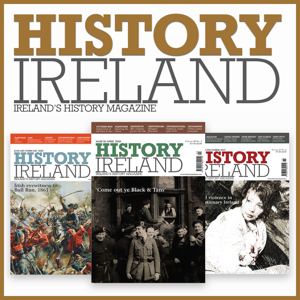


The general election of 8 February 2020 marked a seismic shift in Irish politics. The Fianna Fáil/Fine Gael duopoly, which had dominated for nearly a century, was shattered by a resurgent Sinn Féin, creating a novel tripartite division. To make sense of it all, and in particular to address any historical precedents, History Ireland editor, Tommy Graham, spoke with Brian Hanley, author of The Impact of the Troubles on the Republic of Ireland, 1968-79
Recorded 25 February 2020
(organised by The History Teachers Association of Ireland (as part of the Dublin Branch Spring Seminar) in conjunction with the National Library of Ireland and History Ireland)
Recorded @ the National Library of Ireland on 7 March 2020
Tommy Graham: Editor of History Ireland was joined by Jim Herlihy, Historical and Reconciliation Police (Harp) Society; Dr Mary McAuliffe, Assistant Professor in Gender Studies at UCD; Dr Brian Hanley, Lecturer and Author of Boiling Volcano? The Impact of the Troubles on the Republic of Ireland, 1968–79; and Deirdre Mac Mathúna, History Teachers Association of Ireland, to discuss the difficulties of teaching and explaining controversial and contentious subjects such as the recent proposal to commemorate the RIC/DMP, but also other issues raised during this decade of centenaries.
This Hedge School was supported by the Department of Culture, Heritage and the Gaeltacht
Recorded on Tuesday 26 November at 7pm
@ National Photographic Archive, Temple Bar
How valid is the assumption that because the War of Independence and Civil War are considered ‘low rape’ conflicts there is little to address in the arena of sexual assault? To consider this question History Ireland editor Tommy Graham was joined, for a ground-breaking discussion, by Linda Connolly, Lindsey Earner-Byrne and Brian Hanley.
We apologise for the variable quality of the sound recording which was outside our control.
@ Mechanics Institute, Galway (in association with the ICTU & the Irish Centre for the Histories of Labour and Class, NUI Galway)
recorded at 8pm on Friday 8 Nov 2019
James Connolly, executed for his part in the 1916 Rising, famously asserted that ‘The cause of Labour is the cause of Ireland; the cause of Ireland is the cause of Labour’. But how did this pan out in the subsequent War of Independence? Members of the trade union movement, the largest civil society organisation in Ireland at the time, were involved in a range of activities, from cultural resistance and industrial action to civil disobedience, and served in Dáil Courts and local authorities as well as in the armed struggle. Yet Labour was left in a relatively weak position in the politics of the consequent Irish Free State. To discuss this conundrum and related matters, History Ireland editor Tommy Graham was joined for a lively discussion by Emmet O’Connor, Margaret Ward and Brian Hanley.
Also supported by the Commemorations Unit of the Department of Culture, Heritage and the Gaeltacht
The Hedge School was supported by the Commemorations Unit of the Department of Culture, Heritage and the Gaeltacht
David Fitzpatrick’s Politics and Irish Life, 1913–21: provincial experience of war and revolution (1977) reassessed
In association with Clare County Library
recorded @ Temple Gate Hotel, Ennis on Saturday, 14 Sept 2019 at 2pm
The untimely passing of Prof. David Fitzpatrick (TCD) earlier this year provided an opportunity to reassess his ground-breaking 1977 local study of County Clare, which was to become the template for many similar local studies of the War of Independence. How does it measure up to the intervening 42 years of scholarship, in particular the release of primary sources such as the Bureau of Military History and the Military Service Pensions Collection?
To discuss this and related matters History Ireland editor Tommy Graham, was joined by Pádraig Óg Ó Ruairc, Eve Morrison, Cécile Gordon and Tomás Mac Con Mara for a lively debate on the subject.
Recorded @ Edinburgh University, Meadows Lecture Theatre,
Wednesday 15 May 2019
To what extent did revolutionary developments abroad shape what happened within Ireland during the revolutionary period 1919–23? And in what ways did events within Ireland impact beyond Irish shores, for instance amongst the large Irish diaspora population and other national groups? To discuss this generally, and the case of Scotland in particular, History Ireland editor, Tommy Graham, was joined for a lively discussion by Darragh Gannon, Fearghal McGarry (both Queen’s University, Belfast), Niall Whelehan (Strathclyde), and Kirsty Lusk (Glasgow).
Supported by the Commemorations Unit of the Department of Culture, Heritage and the Gaeltacht
Organised in association with the University of Edinburgh School of History, Classics and Archaeology
History Ireland Hedge school at the Anonymous Was A Woman exhibition launch
@ Linen Hall Library, Belfast
Friday 12 April 2019
The exhibition makes use of the Linen Hall Library’s extensive collections and archives to highlight the historical advancements for women across education, employment and politics. The launch was followed by a special History Ireland Hedge School, A century of Women, chaired by editor, Tommy Graham, with Myrtle Hill and Margaret Ward (authors and advisors of the online exhibition, along with Lydia Walker, www.acenturyofwomen.com), Donal Fallon (Come Here To Me), Baroness May Blood (Women’s Coalition founder).
Supported by the Commemorations Unit of the Department of Culture, Heritage and the Gaeltacht.
The runaway success of the Atlas of the Irish Revolution (and the parallel TV documentary) and the proliferation of microstudies of the War of Independence and Civil War seems to bear out the adage that, like politics, all history is local. But is it? Do we risk losing sight of the ‘bigger picture’, of a world torn apart by war, revolution, and state formation? What, for example, can either approach tell us about violence directed at women, hitherto ignored in Ireland? To discuss these and related matters, History Ireland editor, Tommy Graham was joined for a lively discussion by John Borgonovo, Fearghal McGarry, Darragh Gannon and Linda Connolly.
From the publisher's feed
1,339 Listeners

183 Listeners

48 Listeners
50 Listeners
141 Listeners

58 Listeners
346 Listeners
134 Listeners
40 Listeners

48 Listeners

108 Listeners

70 Listeners

24 Listeners

53 Listeners
520 Listeners