
Sign up to save your podcasts
Or

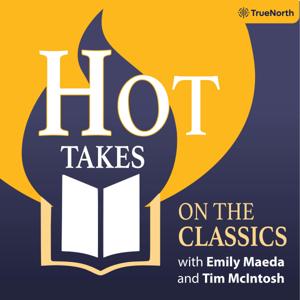


In this episode of Hot Takes on the Classics, Tim McIntosh and Emily Maeda explore James Baldwin’s “Sonny’s Blues,” a story about two brothers trying to understand one another across the distance created by responsibility, suffering, addiction, and art. They discuss Baldwin’s lyrical prose, his Harlem upbringing and life in Paris, the tension between the older brother’s dutiful path and Sonny’s vocation as a jazz musician, and the way music gives form to experiences that ordinary speech cannot contain. The episode culminates in the jazz-club scene, where listening becomes an act of recognition and the narrator finally begins to understand why music is necessary to Sonny’s life.
Episode Outline
Key Topics & Takeaways
Questions & Discussion
Suggested Reading & Resources
In this episode of Hot Takes on the Classics, Tim McIntosh and Emily Maeda explore Ernest Hemingway’s “Hills Like White Elephants,” a story in which the most important subject is never named. At a Spanish train station, an American man and a young woman called Jig wait for a train to Madrid while circling around a “simple operation” that will determine the future of their relationship. Tim and Emily discuss Hemingway’s iceberg theory, the story’s compressed setting and dialogue, the unequal pressure between the couple, and the way Jig sees possibility where the man sees a threat to freedom. They close with Tim’s Hot Take and a discussion of what the story reveals about the difficult passage from adolescence into adulthood.
Episode Outline
Key Topics & Takeaways
Questions & Discussion
Suggested Reading & Resources
In this episode of Hot Takes on the Classics, Tim McIntosh and Emily Maeda explore Flannery O’Connor’s “Everything That Rises Must Converge,” a story of young adulthood, race, pride, dependence, and painful moral awakening. Set largely on a city bus, the story brings Julian, a self-consciously progressive college graduate, into collision with his cheerful but deeply prejudiced mother as the changing South forces people who would rather remain separate into uncomfortable proximity. Along the way, Tim and Emily consider O’Connor’s grotesque humor, her idea of dark grace, the story’s title from Pierre Teilhard de Chardin, and the devastating moment when Julian’s superiority gives way to guilt and sorrow.
Episode Outline
Key Topics & Takeaways
Questions & Discussion
Suggested Reading & Resources
In this episode of Hot Takes on the Classics, Tim McIntosh and Emily Maeda explore T. S. Eliot’s “The Love Song of J. Alfred Prufrock,” a poem that captures the uncertainty and self-consciousness of adolescence and early adulthood. They consider Prufrock’s anxious journey through the modern city, his inability to act or speak decisively, and Eliot’s use of jarring images, near rhymes, and the dramatic monologue to make interior experience visible. Along the way, Tim and Emily discuss why modernist writers broke with inherited forms, how Eliot remained deeply engaged with the tradition he challenged, and why Prufrock’s fear of embarrassment, wasted possibility, and an ordinary adult life remains so recognizable.
Episode Outline
Key Topics & Takeaways
Questions & Discussion
Suggested Reading & Resources
In this episode of Hot Takes on the Classics, Tim McIntosh and Emily Maeda explore Jon Fosse’s Trilogy, the work of a Norwegian novelist and playwright whose spare, musical prose gives voice to experiences that resist ordinary explanation. Focusing primarily on “Wakefulness,” they follow the young lovers Asle and Alida as they wander through cold and rain searching for shelter before the birth of their child, while memories of music, love, rejection, and the past flow through the present. Along the way, Tim and Emily consider Fosse’s use of repetition and stream of consciousness, the story’s echoes of the Nativity, the self-giving character of young love, and the way his writing holds together harsh physical realities with a sense of mystery and transcendence.
Episode Outline
Key Topics & Takeaways
Questions & Discussion
Suggested Reading & Resources
In this episode of Hot Takes on the Classics, Tim McIntosh and Emily Maeda enter the teen years with Joyce Carol Oates’s “Where Are You Going? Where Have You Been?,” a terrifying story in which almost nothing violent happens on the page. They follow fifteen-year-old Connie from a restless family life and flirtation at a drive-in to a long, increasingly threatening conversation with Arnold Friend at her screen door. Along the way, they discuss Bob Dylan’s influence on the story, Oates’s use of ordinary suburban details to create dread, the dynamics of grooming and seduction, and the ways Connie’s hunger for attention leaves her vulnerable to someone who seems to know far more about her than he should.
Episode Outline
Key Topics & Takeaways
Questions & Discussion
Suggested Reading & Resources
In this episode of Hot Takes on the Classics, Tim McIntosh and Emily Maeda close their exploration of childhood with Antoine de Saint-Exupéry’s The Little Prince. Part children’s story, part fairy tale, and part philosophical meditation, the book asks readers to recover a childlike capacity for wonder without confusing innocence with naïveté. From the Little Prince’s encounters with kings, businessmen, lamplighters, and geographers to his friendship with the fox and devotion to his rose, Tim and Emily explore how relationships, rituals, responsibility, and attention reveal what matters most.
Episode Outline
Key Topics & Takeaways
Questions & Discussion
Suggested Reading & Resources
In this episode of Hot Takes on the Classics, Emily Maeda and Tim McIntosh begin their exploration of adolescence with James Joyce’s “Araby”, a story of youthful longing set against the drab, paralyzed world of Dublin. Tim and Emily discuss the unnamed boy’s intense attraction to Mangan’s sister, the religious and chivalric language through which he understands his desire, and the painful disillusionment that awaits him at the bazaar. The conversation also considers Joyce’s development from the realism of Dubliners to the experimental modernism of Ulysses and Finnegans Wake, his fascination with ordinary experience, and the lasting influence of Catholic imagery, ritual, and symbolism on his writing.
Episode Outline
Key Topics & Takeaways
Questions & Discussion
Suggested Reading & Resources
In this episode of Hot Takes on the Classics, Emily Maeda and Tim McIntosh explore Henry James’s The Turn of the Screw, a psychologically complex ghost story that challenges idealized visions of childhood innocence. They discuss James’s elaborate prose, the governess’s uncertain perceptions, the sinister influence surrounding Miles and Flora, and the story’s unresolved tension between supernatural evil and psychological instability. The conversation also considers how impressionable children can be shaped by the adults and forces around them.
Episode Outline
Key Topics & Takeaways
Questions & Discussion
Suggested Reading & Resources
In this episode of Hot Takes on the Classics, Emily Maeda and Tim McIntosh explore Hans Christian Andersen’s life and two of his best-known stories: “The Emperor’s New Clothes” and “The Ugly Duckling.” They consider how fairy tales preserve patterns of reality, form the moral imagination, and speak as powerfully to adults as to children.
Episode Outline
Key Topics & Takeaways
Questions & Discussion
Suggested Reading & Resources
From the publisher's feed

8,581 Listeners

19,474 Listeners

1,126 Listeners
4,427 Listeners

7,113 Listeners

876 Listeners

731 Listeners

21,184 Listeners
866 Listeners

743 Listeners

1,253 Listeners

1,190 Listeners
121 Listeners

219 Listeners

560 Listeners