
Sign up to save your podcasts
Or

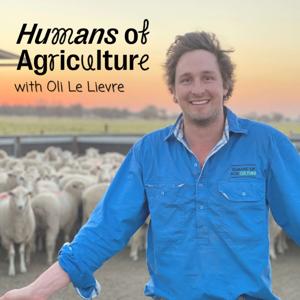
By Humans of Agriculture

5
33 ratings


The podcast currently has 405 episodes available.
The most played episodes among Podcast App listeners.
Building a premium beef brand isn't just about producing exceptional cattle. It's about understanding markets, embracing data, building the right team, and having the patience to make decisions years before the product reaches a customer's plate. In this episode, Harry Kemp shares the story behind King River, the family-owned Wagyu business that has grown from a bold partnership between two Queensland families into a premium beef brand supplying customers across more than 35 countries. Harry reflects on growing up in a family grazing business, leaving school early to return to the land, and how his approach to learning has evolved alongside the rapid transformation of Australian agriculture. What began as a traditional cattle operation has become a data-driven business where genetics, consumer demand, and long-term thinking shape every decision. Together, Oli and Harry explore the realities of building a premium export brand, why consistency matters more than chasing perfection, and how strong relationships have underpinned King River's remarkable growth over the past five years. From genetics and data to leadership, teamwork, and customer relationships, this conversation offers a fascinating insight into what it takes to build a modern beef business that delivers quality from paddock to plate. Key insights from the conversation:Harry's journey from the family cattle property to co-founding King RiverWhy two family businesses joined forces to build a premium Wagyu brandThe challenges of building a business with a four-year production cycleHow genetics, data, and consumer demand are transforming beef productionWhy consistency matters more than producing the highest marbling scoresBuilding a business that now supplies premium Wagyu to more than 35 countriesLessons on rapid business growth, leadership, and putting people in the right rolesThe importance of relationships, accountability, and shared values in successful partnershipsWhy producing great food is ultimately about bringing people together, regardless of language or cultureChapters: 00:00 Introduction to Harry Kemp and King River Beef 02:20 The significance of the Ekka week and industry events 04:00 Harry's background and early life in farming 07:32 Changes in beef farming over 21 years 10:07 The formation of King River Beef in 2019 11:30 Utilising Wagyu to optimise feedlot infrastructure 14:05 Transition from selling cattle to branding and marketing 16:22 Meeting the Rich family and forming the partnership 19:45 Managing rapid growth and team restructuring 24:55 Impact of genetics and breeding on marbling 29:38 The importance of data and technology in decision-making 34:22 Building a global customer base and maintaining quality 44:01 The future vision for King River Beef 45:20 Harry's perspective on being a food producer 46:47 The universal language of good food and beef 47:22 Closing remarks and next steps for the business Rabobank Partner Ad: This Humans of Agriculture podcast is proudly brought to you by Rabobank. When it comes to agriculture, relationships matter. That's why Rabobank supports clients through a network of local branches and dedicated rural managers who understand the opportunities and challenges facing Australian producers. As a specialist food and agribusiness bank, Rabobank combines local knowledge with global expertise to support farming businesses as they plan for the future. Visit rabobank.com.au to find your local branch

In this episode of Humans of Agriculture, Oli sits down with Hamish Irvine, Head of Southern States at Halter Australia, to explore the technology, leadership and mindset driving one of agriculture’s fastest-growing companies. Growing up on a mixed farming operation in western New South Wales, Hamish always imagined a future on the land. But after drought forced a change in direction, his career took him through the meat industry, global supply chains and commercial leadership before landing at Halter, the virtual fencing and livestock management company now transforming grazing systems across Australia and New Zealand. This conversation goes beyond the technology itself. Hamish shares the lessons that shaped his career, what it takes to build high-performing teams, and why feedback, accountability and culture are critical in fast-growing businesses. He also unpacks how Halter is helping farmers rethink labour, pasture management and livestock performance through virtual fencing and real-time animal insights. From career progression and leadership to innovation and the future of livestock farming, this is a conversation about embracing change and creating impact. Key insights from the conversation:How growing up on a family farm and experiencing drought shaped Hamish’s career journeyWhy stepping outside traditional agriculture career pathways can create unexpected opportunitiesThe lessons learned from building a career across meat processing, sales and agribusiness leadershipWhat high-performance culture looks like in practice and why feedback is central to successHow Halter uses virtual fencing and animal insights to transform livestock managementThe three biggest drivers of value for farmers: pasture utilisation, labour efficiency, and animal healthWhy adopting new technology requires trust, clear outcomes and a willingness to changeHow innovation is reshaping the future of livestock farming and creating new opportunities across agricultureThe importance of leadership, ownership and accountability in building successful teamsWhy agriculture needs more people focused on solving industry challenges rather than following traditional career paths Chapters: 00:00 Introduction to Halter and Hamish Irvine 02:05 Career Path and Early Experiences 04:37 The Importance of Diverse Experiences 08:37 Reflections on Career Choices 10:37 Leadership and Team Building at Halter 12:17 Transitioning to Halter: Embracing Change 20:13 High-Performance Culture at Halter 26:56 The Art of Feedback and Communication 30:18 The Birth of Halter: A Journey from Dairy Farming to Tech Innovation 34:37 Expanding Horizons: Halter's Growth in Australia 37:36 Understanding Farmer Needs: The Halter Approach 39:59 Building Trust: Overcoming Skepticism in Agriculture 43:45 Transformational Technology: The Future of Farming 46:42 Bridging Agriculture and Technology: The Ideal Candidate 48:07 The Future of Agriculture: Opportunities and Challenges Rabobank Partner Ad: This Humans of Agriculture podcast is proudly brought to you by Rabobank. When it comes to agriculture, relationships matter. That's why Rabobank supports clients through a network of local branches and dedicated rural managers who understand the opportunities and challenges facing Australian producers. As a specialist food and agribusiness bank, Rabobank combines local knowledge with global expertise to support farming businesses as they plan for the future. Visit rabobank.com.au to find your local branch
Michael Spencer has spent more than 30 years across livestock agency, corporate agriculture, cattle processing and pastoral operations, including roles with Elders, AACo and Bindaree Beef before helping build Adcock Partners. In this episode of The Tom & Mick Show, Michael joins Tom and Mick to unpack what good livestock agency actually looks like, why Adcock Partners deliberately operates under the radar, and what he is seeing across cattle markets from northern Australia through to the eastern states. They discuss: Michael’s unconventional path through Elders, AACo, Bindaree Beef and into Adcock Partners Why relationships and people remain the foundation of a strong agency business Building a business around agility rather than corporate complexity Why Adcock Partners has deliberately stayed relatively quiet and selective How livestock agency has changed over the past 30 years What good service looks like when clients span enormous distances Seasonal conditions across Queensland and the Northern Territory Why producer confidence can move cattle prices quickly The relationship between live export and domestic cattle markets Why live export remains critical to northern Australia and Indonesia What Michael expects from cattle markets heading through spring and into 2027 Chapters 00:00 Introduction to Michael Spencer and Adcock Partners 05:24 Michael’s path from Melbourne to livestock agency 12:41 From Elders and AACo to Bindaree 18:05 Building Adcock Partners and the business philosophy 23:34 What good livestock agency service looks like 29:48 Seasonal conditions across northern Australia 35:12 The cattle market and influence of the farmer 40:36 Live export, Indonesia and changing cattle markets 46:18 What happens next for the cattle market 50:20 The Charbray question and wrapping up Rabobank Partner Ad: This Humans of Agriculture podcast is proudly brought to you by Rabobank. When it comes to agriculture, relationships matter. That's why Rabobank supports clients through a network of local branches and dedicated rural managers who understand the opportunities and challenges facing Australian producers. As a specialist food and agribusiness bank, Rabobank combines local knowledge with global expertise to support farming businesses as they plan for the future. Visit rabobank.com.au to find your local branch
In the second of a two-part panel series with the Southern Queensland and Northern New South Wales Drought Resilience Adoption and Innovation Hub, Oli Le Lievre sits down with St George producers Jake Moon of Moonrocks and cotton grower Craig Saunders to explore how innovation is being used to solve real problems within two very different farming businesses. Jake shares how Moonrocks identified labour and weed management as a growing constraint before adopting an AI-powered green-on-green sprayer, while Craig reflects on how the pursuit of growing more cotton with less water led him to rethink irrigation and develop automation for bankless systems. This conversation is not about promoting a particular product. It is about what happens before and after a technology is adopted: identifying a problem, researching potential solutions, working through the economics and building the people, systems and processes needed to make it work. Jake and Craig discuss the importance of measuring performance, understanding return on investment and being willing to challenge the way things have always been done. They also share the limitations, frustrations and unanswered questions that remain, from integrating data across a business to deciding which investment should come next. From robotics and irrigation automation to labour, software, profitability and long-term planning, this is a practical conversation about using innovation to build more productive, adaptable and drought-resilient farming businesses. The Southern Queensland and Northern New South Wales Drought Resilience Adoption and Innovation Hub is supported by funding from the Australian Government's Future Drought Fund. Learn more at www.unisq.edu.au/sqnnswhub. Key insights from the conversation:Why Jake and Craig began looking for new ways to solve labour, water and productivity challenges.How Craig’s pursuit of “more profit per drop” led to the automation of bankless irrigation.How robotics is helping Moonrocks reduce manual weeding, lower herbicide use and improve crop performance.Why measuring water use, labour, inputs and yield is essential when assessing new technology.The importance of matching innovation with a clearly defined business problem.Why successful adoption depends on people, processes and simple, reliable systems - not just the technology itself.How farmers can assess return on investment without chasing every new product or efficiency.The role of data, software and connected systems in improving decision-making.The value of learning from other farmers, industries and international businesses.The practical challenges of adopting technology, including cost, integration, support and uncertainty.Why profitability is central to long-term sustainability and drought resilience.How innovation can shift farm roles away from repetitive manual work and toward higher-skilled decision-making. Chapters: 00:00 Introduction to Craig Saunders' farm and innovation focus 01:50 Historical context of farming equipment and evolution 03:52 The rapid pace of agricultural change and innovation 06:53 Craig Saunders' farm history and diversification 10:06 Water management challenges and technological solutions 15:01 Adopting bankless irrigation and automation 20:06 Jake Moon's farm history and crop diversification 24:57 Use of AI-powered sprayers and weed management 30:11 The impact of technology on crop health and yields 34:48 Decision-making processes and data leverage in farming 40:00 The role of grants, strategic planning, and future opportunities 45:11 Lessons learned from travel and industry networks 50:10 The importance of continuous evolution and innovation in agriculture 55:04 Future prospects: local manufacturing, AI, and robotics 57:52 Final thoughts on the future of agriculture and technology Rabobank Partner Ad: This Humans of Agriculture podcast is proudly brought to you by Rabobank. When it comes to agriculture, relationships matter. That's why Rabobank supports clients through a network of local branches and dedicated rural managers who understand the opportunities and challenges facing Australian producers. As a specialist food and agribusiness bank, Rabobank combines local knowledge with global expertise to support farming businesses as they plan for the future. Visit rabobank.com.au to find your local branch
In the first of a two-part panel series with the Southern Queensland and Northern New South Wales Drought Resilience Adoption and Innovation Hub, Oli brings together Alex Archer from Webster Grain & Grazing at Lundavra and Ewen Beaton, Aminya Pastoral Pty Ltd, Manager at Kioma, west of Goondiwindi, to explore how two producers have approached the adoption of virtual fencing within their own grazing businesses. While each operation uses a different virtual fencing platform, this conversation is not about comparing technology. It is about the decision-making process behind adopting innovation, identifying opportunities within a farming business and understanding how new tools can support more productive, resilient grazing systems. Alex shares how virtual fencing has unlocked more than 160 hectares of previously underutilised country within a predominantly cropping enterprise, while Ewen reflects on how the technology is changing the way his team thinks about pasture utilisation, forage management and livestock movement. Together, they discuss the practical realities of implementation, the importance of good systems and the lessons they've learned along the way. From business decisions and grazing management to resilience and continuous improvement, this is a conversation about using innovation to solve real problems on farm. The Southern Queensland and Northern New South Wales Drought Resilience Adoption and Innovation Hub is supported by funding from the Australian Government's Future Drought Fund. Learn more at www.unisq.edu.au/sqnnswhub. Key insights from the conversation:Why both businesses started looking for new grazing solutions and what drove their investment decisions.How virtual fencing is helping improve pasture utilisation and unlock previously underutilised country.The importance of matching technology adoption with business goals and economic outcomes.What successful implementation looks like beyond the technology itself.The role of management systems, people and processes in making innovation work.How virtual fencing is changing the way producers think about grazing intensity, livestock movement and pasture management.The practical challenges, limitations and lessons learned during adoption.Why curiosity, continuous learning and asking questions are essential when adopting new technology.How innovation can help farming businesses become more productive, adaptable and drought resilient. Chapters: 00:00 Introduction to Virtual Fencing and Guests 02:02 Why Virtual Fencing is a Game Changer 03:05 Alex Archer's Farm and Grazing Innovation 05:01 Ewan Beaton's Experience with Halter 05:48 Adoption Timeline and Decision Factors 09:04 Economic Drivers and Farm Benefits 11:55 Training Cattle and Managing Boundaries 16:03 Animal Behaviour and Welfare Insights 19:58 Seasonal Grazing and Pasture Management 28:05 Challenges, Connectivity, and Lessons Learned 32:08 Future Potential and Next Steps in AgTech Rabobank Partner Ad: This Humans of Agriculture podcast is proudly brought to you by Rabobank. When it comes to agriculture, relationships matter. That's why Rabobank supports clients through a network of local branches and dedicated rural managers who understand the opportunities and challenges facing Australian producers. As a specialist food and agribusiness bank, Rabobank combines local knowledge with global expertise to support farming businesses as they plan for the future. Visit rabobank.com.au to find your local branch
The podcast currently has 405 episodes available.
626 Listeners

559 Listeners
6 Listeners
14 Listeners
2 Listeners
9 Listeners

1 Listeners
2 Listeners
2 Listeners

0 Listeners
243 Listeners

0 Listeners

2 Listeners

1 Listeners

57 Listeners
0 Listeners
0 Listeners