
Sign up to save your podcasts
Or

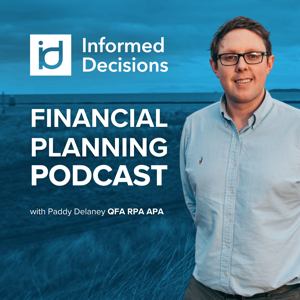


Budget 2027 in Ireland came with the usual noise about tax bands and credits. If you are within 5 to 10 years of retiring, or already retired, those are rarely the lines that matter. In this Budget special, Paddy Delaney goes through what actually changed for Irish pensions, investments and retirement income.
If the Budget has you wondering where you actually stand, this episode is for you.
🎓 Free webinar about "Your Money in 2027": Friday 9 October, 12:00, with Alan Purcell: https://www.informeddecisions.ie/webinar
📖 Full Blog: www.informeddecisions.ie/post/budget-2027-ireland-pensions-investing
📊 Want to check where you are? Try our free 10-minute Retirement Readiness Scorecard: https://www.informeddecisions.ie/pension-calculator
📅 Find out how we work: https://www.informeddecisions.ie DISCLAIMER This content is for general educational purposes only and does not constitute personalised financial advice. Everyone's situation is different — always speak to a qualified, independent advisor before making pension or investment decisions. Tax rules and pension regulations change; figures quoted are accurate at time of recording.
It's good to know which decisions can never be undone, before you retire in Ireland. Most of a pre-retirement checklist can be changed next year. Four or five items cannot. In this episode Paddy Delaney, independent retirement and investment planner, takes them door by door: the €200,000 lifetime limit on tax-free lump sums, the annuity decision, the tax year you crystallise near the Standard Fund Threshold, the pension tax relief that stops with your last payslip, and the order you do it all in.
This episode is for anyone a year or two from retirement who wants to know which doors close for good.
What you'll learn:
If you're approaching retirement with a significant pension and want clarity on which decisions to slow down on, this episode is for you.
🎙️ Access all our podcast episodes and our blog
📊 Want to check where you are? Try our free 10-minute Retirement Readiness Scorecard
📅 Find out how we work
DISCLAIMER: This content is for general educational purposes only and does not constitute personalised financial advice. Everyone's situation is different. Always speak to a qualified, independent advisor before making pension or investment decisions. Tax rules and pension regulations change; figures quoted are accurate at time of recording.
Trust in financial services in Ireland sits at 49%, against a global average of 63%. Paddy Delaney goes through the 2026 Edelman Trust Barometer research on financial services, where Ireland ranks, and what sits behind the number.
Edelman surveyed almost 34,000 people across 28 countries and publishes a separate report on financial services. Ireland comes in 23rd of 28, inside the distrust band, below the developed-economy average of 53% and well below the global figure.
In this episode, Paddy goes through the following:
If you are weighing up financial advice in Ireland, particularly with significant pension or investment assets behind you, this episode is about how to judge who is worth listening to.
🎙️ Full podcast episode and 📖 Blog: www.informeddecisions.ie/post/trust-financial-advice-ireland
📊 Want to check where you are? Try our free 10-minute Retirement Readiness Scorecard: https://www.informeddecisions.ie/pension-calculator
📅 Find out how we work: https://www.informeddecisions.ie
DISCLAIMER This content is for general educational purposes only and does not constitute personalised financial advice. Everyone's situation is different: always speak to a qualified, independent advisor before making pension or investment decisions. Tax rules and pension regulations change; figures quoted are accurate at time of recording.
The Prize Bond prize fund rate rose from 1.00% to 1.50% this month, the first State Savings increase in about three years. Almost every write-up has described that 1.5% as a return. It is not one. It is the size of the prize pool spread across the whole €4.4 billion in issue, and what an individual holder receives is decided by a draw.
In this Episode, Paddy works through the NTMA's own published figures and puts a realistic number on what Prize Bonds are actually worth to a normal holding, then lines them up against what the same State will pay for certainty.
What you'll learn:
If you are holding Prize Bonds, State Savings or cash on deposit in Ireland and want to know what those balances are really doing, this episode is for you.
🎙️ Full podcast episode and 📖 Blog: https://informeddecisions.ie/prize-bonds-ireland-what-the-rate-means/
📊 Want to check where you are? Try our free 10-minute Retirement Readiness Scorecard: https://www.informeddecisions.ie/pension-calculator
📅 Find out how we work: https://www.informeddecisions.ie
DISCLAIMER This content is for general educational purposes only and does not constitute personalised financial advice. Everyone's situation is different: always speak to a qualified, independent advisor before making pension or investment decisions. Tax rules and pension regulations change; figures quoted are accurate at time of recording.
Inheritance tax in Ireland is charged at 33% on anything above €400,000 passing from a parent to a child. The question most families never properly work through is whether to move assets during their lifetime or leave them until the end. And that decision changes the bill, the timing, and who ends up paying it.
Paddy is joined by Mairéad Hennessy of Taxkey, a firm of independent tax consultants, for a practical conversation about passing wealth on in Ireland.
What you'll learn in this episode:
• Why the tax question is the wrong place to start, and what to work out first
• How the €3,000 small gift exemption works, what makes it fail, and why it is worth far more over time than the figure suggests
• How capital gains tax paid by a parent can be credited against a child's inheritance tax bill and the two-year condition attached to it
• What a business transfer needs in place in the ten years before it happens, and why the child has to be in the room
• Family partnerships: how they work, who they suit, and what they cost you in privacy
• The US Federal Estate Tax exposure sitting in Irish households through employer shares, and the $60,000 threshold behind it
We recorded this just as the roadmap for the taxation of private investments was published; it therefore also provides an initial outlook on the investment account to be introduced in 2027 and its implications for notional disposals.
If you are approaching retirement with a business, property or a portfolio that will have to move at some point, or you are in line to inherit and would rather understand it in advance, this episode is for you.
🎙️ Full podcast episode and 📖 Blog: www.informeddecisions.ie/post/inheritance-tax-ireland-gift-or-inherit
📊 Want to check where you are? Try our free 10-minute Retirement Readiness Scorecard: www.informeddecisions.ie/pension-calculator
📅 Find out how we work: www.informeddecisions.ie
🔗 Mairéad Hennessy, Taxkey: www.taxkey.ie
Book mentioned: Self Employed – The Forgotten Community by Dan O'Donoghue: https://buythebook.ie/product/self-employed-the-forgotten-community/
DISCLAIMER This content is for general educational purposes only and does not constitute personalised financial or tax advice. Everyone's situation is different: always speak to a qualified, independent advisor before making pension, investment or estate planning decisions. Tax rules and pension regulations change; figures quoted are accurate at time of recording.
Should you retire with the market at an all-time high? In Ireland, the record level feels dangerous, but it is not the risk that decides your outcome.
In this episode, Paddy asks whether retiring at an all-time high is really the risk Irish savers fear, or whether the thing that decides your outcome is something else entirely.
What you'll learn:
• Why all-time highs are common, not a warning: global equities sit at or near record highs on roughly a third of trading days
• What Japan's lost decades really warn against: concentration in one market, not equities themselves
• A sequence-of-returns case study: how two retirees with the same €1.2m and the same average return finished €1.25m apart
• The Irish nuance: why Revenue's imputed distribution makes the buffer inside your ARF matter more than any market call
If you're within a couple of years of drawing down, and the timing has you worried, this episode is for you.
🎙️ Full podcast episode and 📖 Blog: www.informeddecisions.ie/post/should-i-retire-at-all-time-highs-ireland
📊 Want to check where you are? Try our free 10-minute Retirement Readiness Scorecard: https://www.informeddecisions.ie/pension-calculator
📅 Find out how we work: https://www.informeddecisions.ie
DISCLAIMER This content is for general educational purposes only and does not constitute personalised financial advice. Everyone's situation is different. Always speak to a qualified, independent advisor before making pension or investment decisions. Tax rules and pension regulations change; figures quoted are accurate at time of recording. #PensionIreland #RetirementPlanningIreland #SequenceOfReturnsRisk #StockMarketAllTimeHigh #ARFIreland
Your Irish pension plan probably runs to age 95, but you'll likely live to around 83, and the gap changes your pot far less than you'd expect.
In this episode, Paddy digs into the retirement life expactancy in Ireland. He checks on the one age assumption buried in almost every Irish retirement plan, where the default of 95 comes from and what the most recent CSO life tables actually say about how long a 65-year-old really lives.
It's for you if you're approaching or already in retirement with a meaningful pension or ARF, and you've never been asked (or never questioned) the age your own plan is built to.
Using a fictional €1.2m ARF, this piece shows how Revenue's imputed distribution means the closing pot is almost identical whether you plan to 83 or 95 (around €1.25m versus €1.21m). The end age was never really the lever.
What is covered in this Episode:
📖 Blog: www.informeddecisions.ie/post/how-long-should-retirement-plan-last-ireland
📊 Want to check where you are? Try our free 5-minute Retirement Readiness Scorecard: https://www.informeddecisions.ie/pension-calculator
📅 Find out how we work: https://www.informeddecisions.ie
DISCLAIMER This content is for general educational purposes only and does not constitute personalised financial advice. Everyone's situation is different. Always speak to a qualified, independent advisor before making pension or investment decisions. Tax rules and pension regulations change; figures quoted are accurate at time of recording.
If you hold an Irish pension or an ARF invested in a global equity index fund, you have almost certainly been told you are diversified: Thousands of companies, dozens of countries, one fund, job done. And it is true: your global index fund really does hold well over a thousand companies across more than twenty developed markets.
But there is a second truth sitting right beside it. As at the end of June 2026, roughly 72.45% of that same "global" fund is allocated to a single country: The United States. Same fund, same name, same low-cost passive approach and yet quietly a very different animal to the one you bought a decade ago. For anyone drawing an income from an ARF, that second fact matters a great deal more than most people realise.
In this episode, Paddy walks through what has actually happened inside these funds while we have been getting on with things: why a cap-weighted index concentrates all on its own, what the published weightings look like right now, and why the very same allocation means something completely different depending on whether you are still contributing or already drawing an income. He uses a worked Irish example (Seamus, 65, with €900,000 in an ARF held in a single global fund) to show what concentration actually looks like under the bonnet, and where Revenue's imputed distribution quietly turns a concentrated investor into a forced seller.
What you'll learn:
None of this is an argument against index investing, and it is not a forecast. It is an argument for being able to describe what you own before you decide how you feel about it. Never mind before you decide what to do about it. If you hold an ARF invested in a single global fund and you haven't seen a factsheet in years, this episode is for you.
🎙️ Full podcast episode and 📖 Blog: www.informeddecisions.ie/post/market-concentration-irish-pensions
📊 Want to check where you are? Try our free 5-minute Retirement Readiness Scorecard: https://www.informeddecisions.ie/pension-calculator
📅 Find out how we work: https://www.informeddecisions.ie
DISCLAIMER This content is for general educational purposes only and does not constitute personalised financial advice. Everyone's situation is different. Always speak to a qualified, independent advisor before making pension or investment decisions. Tax rules and pension regulations change; figures quoted are accurate at time of recording.
Turning 60 with a significant pension pot and nothing forcing your hand? This episode is a worked case study on the pension lump sum decision at 60 in Ireland: Take the tax-free lump sum now, or leave the fund invested and revisit it at 65.
Paddy goes through a study-case: Larry is 60, a senior private-sector executive, with €1.4 million in a defined contribution scheme. He doesn't exist. The numbers do.
What you'll learn in this Episode:
If you're approaching retirement with a significant pension pot and you've been assuming 60 or 65 is the moment you have to act, this episode is for you.
🎙️ Full podcast episode and 📖 Blog: www.informeddecisions.ie/post/tfls-at-60-or-wait-ireland
📊 Want to check where you are? Try our free 5-minute Retirement Readiness
Scorecard: https://www.informeddecisions.ie/pension-calculator
📅 Find out how we work: https://www.informeddecisions.ie
DISCLAIMER This content is for general educational purposes only and does not constitute personalised financial advice. Everyone's situation is different — always speak to a qualified, independent advisor before making pension or investment decisions. Tax rules and pension regulations change; figures quoted are accurate at time of recording.
There is a pitch doing the rounds in Irish advice circles at the moment: private markets have finally been democratised, and private credit and private equity are now open to anyone with a decent pension pot. But is it really like that? In this episode, Paddy looks at what is actually being sold, and at the one feature that matters more than anything else in the brochure, because liquidity here is offered, not guaranteed.
Have a listen, if you'd like to get an idea of what these 'zombie funds' in the private markets sector are all about, what your ARF has to do with them, and what considerations there are regarding private loans and equity investments when it comes to your retirement planning.
What you'll learn:
None of this means private markets are wicked, or that nobody should ever own them. It means a bit of healthy scepticism is no bad thing. If you are approaching or already in retirement and someone has put one of these opportunities in front of you, this episode is for you.
🎙️ Full podcast episode and 📖 Blog: www.informeddecisions.ie/post/zombie-funds-private-markets-ireland
📊 Want to check where you are? Try our free 5-minute Retirement Readiness Scorecard: https://www.informeddecisions.ie/pension-calculator
📅 Find out how we work: https://www.informeddecisions.ie
DISCLAIMER This content is for general educational purposes only and does not constitute personalised financial advice. Everyone's situation is different — always speak to a qualified, independent advisor before making pension or investment decisions. Tax rules and pension regulations change; figures quoted are accurate at time of recording.
From the publisher's feed
10 Listeners
48 Listeners
41 Listeners

44 Listeners

57 Listeners

10 Listeners
344 Listeners

5 Listeners

5 Listeners
40 Listeners

107 Listeners

22 Listeners

1 Listeners

55 Listeners

5 Listeners