
Sign up to save your podcasts
Or


For decades, we’ve told ourselves that manufacturing is something advanced economies naturally outgrow. That once you move into services, data, and software, heavy industry becomes optional, nice to have, but not essential.
But from a national and economic security perspective, America can’t afford to treat industrial capacity as a legacy asset it can outsource and revisit later—especially now.
Hollowing out manufacturing doesn’t just weaken supply chains. It introduces risk into systems that depend on precision, reliability, and readiness.
The question isn’t whether the U.S. can still build complex things; it’s whether we’ve kept the muscle memory to do it at scale, in volume, and fast enough when demand shows up all at once.
And the problem doesn’t live in one place. It shows up across the workforce, the factory floor, and the balance sheet. A generation was steered away from the trades. Production systems were optimized for low-volume, high-complexity output instead of sustained throughput.
Capital flowed toward financial efficiency rather than reinvestment in plants, tooling, and people. On paper, the industrial base still exists. In practice, it’s been stretched thin by decades of offshoring, underinvestment, and policy drift.
So how do you refocus a country after decades of offshoring?
Chips, ships, pharma, manufacturing, defense programs, and aerospace production, and data centers are all pulling on the same constrained supply chains, the same limited pool of skilled labor, and the same aging infrastructure.
Meeting that moment will take coordinated industrial policy, sustained capital investment, and a clear demand signal strong enough to justify rebuilding capacity at scale.
So what does that actually look like, and how is the government trying to close the gap?
In this episode, I sit down with Alex Krutz, CEO of Patriot Industrial Partners, who recently returned to industry after serving as Deputy Assistant Secretary of Manufacturing. We talk about what he saw moving through global industrial hubs, why the industrial renaissance is real—but fragile—and what actually has to change if capacity, resilience, and readiness are going to be rebuilt rather than debated.
You’ll also learn;
About the Guest
Alex Krutz is the Managing Director of Patriot Industrial Partners and a former Deputy Assistant Secretary of Manufacturing at the U.S. Department of Commerce. With more than two decades in aerospace and defense, Alex is known for leading complex manufacturing and supply-chain turnarounds across the industrial base—earning him the industry nickname “The Factory Doctor.” His work spans global performance-improvement engagements in the United States, Mexico, Canada, the UK, Italy, France, South Africa, South Korea, Malaysia, and Japan. Before his role in government, Alex founded Patriot Industrial Partners, a boutique advisory firm focused on value creation, operational excellence, and supply-chain resilience in aerospace, defense, and advanced manufacturing. In public service, he helped shape manufacturing and industrial policy at a national level, working closely with industry leaders across sectors including aerospace, energy, shipbuilding, and semiconductors. Alex’s insights have been featured in publications such as Aviation Week, Forbes, and FlightGlobal, and he’s been cited by outlets including The Wall Street Journal, Reuters, and CNBC. He’s also spoken at and contributed to conferences and executive forums hosted by institutions like Bank of America, JP Morgan, and Morgan Stanley.
Connect with Alex on LinkedIn and send an email to [email protected].
About Your Host
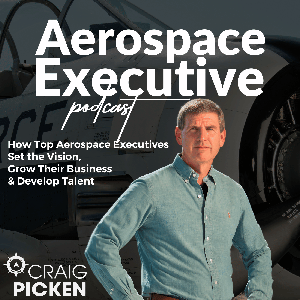
Craig Picken is an Executive Recruiter, writer, speaker, and ICF Trained Executive Coach. He is focused on recruiting senior-level leadership, sales, and operations executives in the aviation and aerospace industry. His clients include premier OEMs, aircraft operators, leasing/financial organizations, and Maintenance/Repair/Overhaul (MRO) providers, and since 2008, he has personally concluded more than 400 executive-level searches in a variety of disciplines. Craig is the ONLY industry executive recruiter who has professionally flown airplanes, sold airplanes, and successfully run a P&L in the aviation industry. His professional career started with a passion for airplanes. After eight years’ experience as a decorated Naval Flight Officer – with more than 100 combat missions, 2,000 hours of flight time, and 325 aircraft carrier landings – Craig sought challenges in business aviation, where he spent more than 7 years in sales with both Gulfstream Aircraft and Bombardier Business Aircraft. Craig is also a sought-after industry speaker who has presented at Corporate Jet Investor, International Aviation Women’s Association, and SOCAL Aviation Association.
 View all episodes
 By Craig Picken

4.8
3838 ratings
For decades, we’ve told ourselves that manufacturing is something advanced economies naturally outgrow. That once you move into services, data, and software, heavy industry becomes optional, nice to have, but not essential.
But from a national and economic security perspective, America can’t afford to treat industrial capacity as a legacy asset it can outsource and revisit later—especially now.
Hollowing out manufacturing doesn’t just weaken supply chains. It introduces risk into systems that depend on precision, reliability, and readiness.
The question isn’t whether the U.S. can still build complex things; it’s whether we’ve kept the muscle memory to do it at scale, in volume, and fast enough when demand shows up all at once.
And the problem doesn’t live in one place. It shows up across the workforce, the factory floor, and the balance sheet. A generation was steered away from the trades. Production systems were optimized for low-volume, high-complexity output instead of sustained throughput.
Capital flowed toward financial efficiency rather than reinvestment in plants, tooling, and people. On paper, the industrial base still exists. In practice, it’s been stretched thin by decades of offshoring, underinvestment, and policy drift.
So how do you refocus a country after decades of offshoring?
Chips, ships, pharma, manufacturing, defense programs, and aerospace production, and data centers are all pulling on the same constrained supply chains, the same limited pool of skilled labor, and the same aging infrastructure.
Meeting that moment will take coordinated industrial policy, sustained capital investment, and a clear demand signal strong enough to justify rebuilding capacity at scale.
So what does that actually look like, and how is the government trying to close the gap?
In this episode, I sit down with Alex Krutz, CEO of Patriot Industrial Partners, who recently returned to industry after serving as Deputy Assistant Secretary of Manufacturing. We talk about what he saw moving through global industrial hubs, why the industrial renaissance is real—but fragile—and what actually has to change if capacity, resilience, and readiness are going to be rebuilt rather than debated.
You’ll also learn;
About the Guest
Alex Krutz is the Managing Director of Patriot Industrial Partners and a former Deputy Assistant Secretary of Manufacturing at the U.S. Department of Commerce. With more than two decades in aerospace and defense, Alex is known for leading complex manufacturing and supply-chain turnarounds across the industrial base—earning him the industry nickname “The Factory Doctor.” His work spans global performance-improvement engagements in the United States, Mexico, Canada, the UK, Italy, France, South Africa, South Korea, Malaysia, and Japan. Before his role in government, Alex founded Patriot Industrial Partners, a boutique advisory firm focused on value creation, operational excellence, and supply-chain resilience in aerospace, defense, and advanced manufacturing. In public service, he helped shape manufacturing and industrial policy at a national level, working closely with industry leaders across sectors including aerospace, energy, shipbuilding, and semiconductors. Alex’s insights have been featured in publications such as Aviation Week, Forbes, and FlightGlobal, and he’s been cited by outlets including The Wall Street Journal, Reuters, and CNBC. He’s also spoken at and contributed to conferences and executive forums hosted by institutions like Bank of America, JP Morgan, and Morgan Stanley.
Connect with Alex on LinkedIn and send an email to [email protected].
About Your Host
Craig Picken is an Executive Recruiter, writer, speaker, and ICF Trained Executive Coach. He is focused on recruiting senior-level leadership, sales, and operations executives in the aviation and aerospace industry. His clients include premier OEMs, aircraft operators, leasing/financial organizations, and Maintenance/Repair/Overhaul (MRO) providers, and since 2008, he has personally concluded more than 400 executive-level searches in a variety of disciplines. Craig is the ONLY industry executive recruiter who has professionally flown airplanes, sold airplanes, and successfully run a P&L in the aviation industry. His professional career started with a passion for airplanes. After eight years’ experience as a decorated Naval Flight Officer – with more than 100 combat missions, 2,000 hours of flight time, and 325 aircraft carrier landings – Craig sought challenges in business aviation, where he spent more than 7 years in sales with both Gulfstream Aircraft and Bombardier Business Aircraft. Craig is also a sought-after industry speaker who has presented at Corporate Jet Investor, International Aviation Women’s Association, and SOCAL Aviation Association.

32,236 Listeners

229,529 Listeners

154,087 Listeners

4,785 Listeners

1,086 Listeners

397 Listeners

30,192 Listeners

144 Listeners

4,465 Listeners

27 Listeners

344 Listeners

6,121 Listeners

46,470 Listeners

10,196 Listeners

4,515 Listeners