
Sign up to save your podcasts
Or



Based on Podcast App listening data
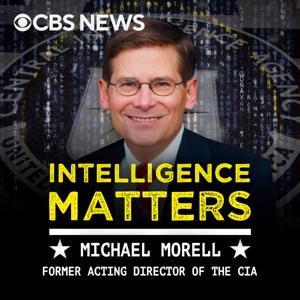
In this episode of Intelligence Matters, host Michael Morell speaks with Chris Johnson, senior fellow at the Center for Strategic and International Studies and a leading expert on China, about the Biden Administration's rhetoric about and actions toward China. Johnson outlines the leading challenges facing the new administration and the views from both Washington and Beijing. He explains how diplomacy has been complicated by some of the scorched earth policies of the Trump administration and domestic considerations related to the COVID-19 pandemic. Johnson and Morell also discuss the overall trajectory of U.S.-China relations in the coming years and decades.
In this episode of Intelligence Matters, National Security Commission on Artificial Intelligence Chair and Former CEO of Google Eric Schmidt joins Michael Morell to discuss the importance of investing in artificial intelligence as a national security priority. Schmidt believes China is likely to catch up to the United States in a few years in its artificial intelligence capabilities. He outlines how intelligence and national defense can benefit from superiority in these technologies and the benefits of holding A.I. to American values.
In this episode of Intelligence Matters, President Biden's Deputy Homeland Security Advisor at the National Security Council Russ Travers speaks with host Michael Morell about the varied and diffuse array of terrorist threats to the United States. A career intelligence officer and former acting and deputy director of the National Counterterrorism Center, Travers offers a history of Islamist terrorism and describes how splintered, geographically dispersed networks tied to ISIS and Al Qaeda continue to pose a threat to the U.S.. Travers and Morell also discuss the increase in racially and ethnically motivated attacks by domestic groups, and why preventing them poses a complex set of challenges for U.S. law enforcement and intelligence communities. Travers also shares thoughts on how to responsibly move resources away from counterterrorism toward Great Power competition.
In this episode of Intelligence Matters, guest host Sandy Winnefeld interviews Frances Townsend, former Homeland Security Advisor to President George W. Bush, and Adm. James Stavridis (ret.), former Supreme Allied Commander at NATO, about their work for the American Edge Project, a political advocacy group that promotes investment in U.S. innovation and technology. Townsend and Stavridis explain the links between technological advancement and national security, and explain why China's autocratic approach to technology in particular poses an increasingly serious threat. They outline several proposals to address known challenges, including the establishment of cyber norms to on-shoring certain critical industries. They also identify priority areas for the Biden administration to address.
In this episode of Intelligence Matters, host Michael Morell speaks with Ambassador William Roebuck, the former Deputy Special Envoy to the Global Coalition to Defeat ISIS, former U.S. ambassador to Bahrain, and current executive vice president of the Arab Gulf States Institute. Roebuck provides an intricate history of the conflict in Syria and U.S.-led efforts to battle back the ISIS caliphate. He details his work with U.S. special forces and partners on the ground and discusses the involvement and sacrifices of Kurdish forces in the region. Roebuck also offers thoughts on the Biden administration’s possible approach to resolving the ongoing conflict in Syria.
In this episode of Intelligence Matters, host Michael Morell speaks with Sunil John, a leading public relations executive in the Middle East and the driving force behind the Arab Youth Survey, a seminal piece of public opinion research on the views of the largest demographic group in the region. John explains how the survey is administered – in person and across 17 countries – and how it has for years provided an incisive and nuanced look at the thinking of the more than two hundred million young Arabs living and working in the Middle East. John tells Morell how perceptions of the United States have evolved in recent years, explains the “Trump effect” on the views of young Arabs, and addresses what he says are important opportunities for the Biden administration to pursue.
In this episode of Intelligence Matters, Michael Morell speaks with Jamie Metzl, geopolitical expert and technology futurist, who argues for transparency and access to resources from China in order to find the origins of COVID-19. Metzl believes the most likely origin of COVID-19 is a lab leak from the Wuhan Institute of Virology. Metzl, a WHO supporter, emphasizes the need for a full, transparent investigation instead of the previous joint expert committee investigation with the Chinese government.
In this episode of Intelligence Matters, host Michael Morell interviews Robert "Bob" Pape, a political science professor at the University of Chicago specializing in international security affairs. He is also the director of the Chicago Project on Security and Threats where he leads a team producing fascinating new research on the insurrection at the U.S. Capitol, amongst other things. Pape puts into context how truly historic the storming of the Capitol was and warns of the movement further congealing.
In this episode of Intelligence Matters, in partnership with the Michael V. Hayden Center for Intelligence, Policy, and International Security, Michael Morell spoke with Chairman of the House Intelligence Committee Adam Schiff about the politicization of intelligence and the need to “reset” the committee. Schiff details his support of an airline crash style review to investigate the Solar Winds hack and urges the intelligence community to address the challenge posed by the rise of China.
In this episode of Intelligence Matters, host Michael Morell interviews one of the world's top intelligence officials from down under, Nick Warner. Warner has held senior positions in Australia's diplomatic service, its defense ministry, and its intelligence services. He also served as the director of Australia's equivalent to the CIA, an agency known as ASIS or the Australian Secret Intelligence Service. Warner tells listeners the path he took to becoming a top intelligence official, the importance of the power of the trust, and how he managed to make it out of an Iranian desert stranded.
From the publisher's feed
Ranked by our users in the last 21 days

2,732 Listeners

1,138 Listeners

189 Listeners
1,529 Listeners

10,743 Listeners

657 Listeners

6,283 Listeners

87,116 Listeners
586 Listeners

111,799 Listeners

2,387 Listeners

20 Listeners

466 Listeners

62 Listeners

1,330 Listeners

256 Listeners

1,675 Listeners

1,856 Listeners
1,940 Listeners

15,702 Listeners

15,882 Listeners
350 Listeners

10,759 Listeners

401 Listeners
266 Listeners