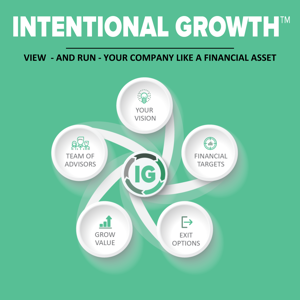
Intentional Growth

Intentional Growth

By Arkona - Intentional GrowthBusinessEntrepreneurshipInvestingManagement
Download on the App Store

Intentional Growth episodes

  • #273: Marketing Doesn't Have to Feel Like Hocus Pocus and Pixie Dust: Demystifying Marketing and the Role of a CMO with Jennifer Zick
    “Marketing is just hocus pocus and pixie dust” — does that feel familiar? Most of us are tired of wasting time and money on the latest marketing strategies that never seem to work. Jennifer Zick of Authentic Brand shares why one of her clients said this (and why it’s one of her favorite quotes of all-time) on today’s show. Not only did her company coin the phrase “Random Acts of Marketing,” Authentic Brand provides fractional chief marketing officer (CMO) services that get businesses back on track and making better marketing decisions for the long-term. Jennifer’s mission is to help bring big company marketing resources and planning to the middle market, so tune in to learn a few things about strategy and team alignment to achieve your sales and clientele goals particularly in the B2B space. We go over how to eliminate the random acts of marketing, including all the associated costs, headaches, and — most frustrating of all — lack of progress that comes with them. Authentic Brand’s unique approach combines marketers, methodology, and mindshare to deliver real revenue results for any business owner.
     
    What You Will Learn
    What makes an elite fractional CMO
    Why the key truths of marketing hasn’t changed with new tools and technology
    The questions you have to answer when marketing - and why they haven’t changed
    What random acts of marketing means and why most companies are doing that
    When to use an agency versus a marketing leader
    How marketing helps the long term view for all divisions in a business
    How sales is different from marketing and how they are similar
    How to identify proof points - how to know if a plan is working when community building
    How to budget for a community building plan that reaps its rewards years down the road
    What marketing investment strategies have in common with baseball
    Why it’s so important for your marketing leaders and resources teams to be focused on the main goals
    The ways people are pivoting their marketing strategy when the supply chains are all messed up
     
    Bio:
    With nearly twenty years of B2B marketing experience in innovative, entrepreneurial, and accelerated-growth companies, Jennifer brings a wealth of experience to B2B growth organizations. 
    Jennifer’s career has included several leadership roles for high-growth B2B professional services organizations, primarily centered on sales and marketing innovation through digital and SaaS technologies. Prior to launching Authentic Brand, Jennifer led marketing teams and programs for Magnet 360, PwC, and Corporate Visions.
    Jennifer is Past-President of the Minnesota Chapter of the Business Marketing Association – a national non-profit business association focused on B2B marketing – where she also served a prior term as VP of Events & Development. In 2014, Jennifer was honored by the Minneapolis-St. Paul Business Journal as the recipient of their “40 Under 40” award which recognizes young leaders who have been successful in business, while also making significant contributions to their communities.
    More recently, Jennifer has leveraged her network to create “two or more“- a grassroots community service movement that brings together business professionals from across the Twin Cities to volunteer, serve, and support local charities and social causes.
     
    Quotes:
    11:13 - “[Our CMOs] know what it takes to be at ground level and build from there, as good stewards of those resources. Right? Because there’s not established brand and market share already that provides this assumed brand air cover.” - Jennifer Zick
    1 hr 2 min
  • #272: Paper Wealth & Lottery Tickets with Andres Moran
    On today’s show, we’re going to dive into Andres Moran’s entrepreneurial journey and the lessons he learned from three exits, particularly as they relate to the various roles an owner can play.
    Currently he is the head of a division at WunderKind which is a SaaS company that helps ecommerce companies decrease their bounce rates and shopping cart abandonments. Prior to WunderKind Andres was the co-founder and Head of Business Development of Fundera - which was sold to NerdWallet. Fundera is a SaaS platform that compares multiple small business loan options at once (think Kayak for business loans). Andres had two businesses prior - his first company was a medical spa in Miami that he started with his sister, which was acquired several years later. His second venture was an online exercise rewards company called Earndit, which was acquired in 2013 by Higi, a company that measures and attaches a score to your personal health.
    We’re going to be diving into Andres’ entrepreneurial journey and the lessons he’s learned. One theme that continued to resurface was how important it was to understand the different roles we all play as business owners and entrepreneurs - and that is the difference between the job we have (our management role) which we get income for performing compared to our ownership role (our equity as an investor) and how these two roles need to be separate and dealt with differently. Both of these roles need to be designed based on the stage of the company and the personal needs of the founder. They need to be aligned with the future potential for value creation in the company (what Andres refers to as a lottery ticket or paper wealth) and the need to have our desired level of personal income.
    There is no universal prescription for this challenge but one thing is for sure - you need to understand the differences between these two roles and all the decisions that come with them. There is no better way to learn than to hear someone else’s story OR  by taking the Intentional Growth™ online training
     
    What You Will Learn 
    Why investors in a startup can act as gatekeepers during an exit
    How to think about your management role (job) versus your ownership role (investor)
    The pros and cons when getting into business with family
    What Andres means by paper wealth and lottery tickets
    Why it can be difficult to compensate people who have both jobs and equity in the company
    How to build an “orbit” with competitors and potential buyers, and what that means
    The extra step to take when a private company is acquiring your company
    Why you shouldn’t mentally (or in reality) spend the money until the deal is done and the wire transfers are complete
    What Andres learned from his out-of-the-blue offer
    Finding the middle ground between your entrepreneurship bug and being “employed”
    The benefits to entering a well-funded company after a couple of exits and the growth potential there
    Why it’s important not to regret your decisions for less equity or higher salary based on your current living situation
     
    Bio:
    Andres Moran is a serial entrepreneur with three exits under his belt. Currently, he is the head of a division at WunderKind, a SaaS company that helps ecommerce businesses decrease their bounce rates and shopping cart abandonments. Prior to WunderKind, Andres was the co-founder and Head of Business Development of Fundera, which was sold to NerdWallet. Fundera is a SaaS platform that compares multiple small business loan options at once (think Kayak for business loans). Andres’ first company was a medical spa in Miami that he started and sold with his sister. His second venture was an online exercise rewards company called Earndi
    1 hr 7 min
  • #271: Entrepreneurship Through Acquisition (ETA) with Pete Seligman: 5 Acquisitions, 3 'tours-Of-Duty' as CEO, 2 Exits And 3 Partial Exits
    In today’s episode, we’re talking with Pete Seligman. Pete is here to talk about his experience diving into the world of Entrepreneurship Through Acquisition (ETA) after leaving corporate America. He is going to share what his journey has been like now that he has bought five companies, been the CEO of three of them and successfully worked himself out of the job, sold two of the companies and sold a partial stake in the other three.
    Pete has the track record to prove that entrepreneurship through acquisition is not only possible but extremely accessible if you put your mind to it, create a plan and execute like hell. He proves that it is possible to buy a company, swoop in as a CEO who gets to know the people and industry, build a plan to grow enterprise value - ON PURPOSE- and successfully work yourself out of the business so that you can have options to keep growing other companies, choose to sit on the board and take distributions or sell the business.
     
    What You Will Learn
    Why it’s important to calculate risk before investing
    Why Pete chose businesses he understood and how important it was when he was getting started
    Why you should grow and sell businesses that you know and are passionate about - plus how to delegate tasks to get growth you desire
    the importance of reinvesting back into a small business for future growth and value
    Pete’s favorite way to invest and how to manage his vision while recruiting people to do the things he can’t
    The three questions you should ask before placing a bid on a business
    Why you need to be able to work with the people in a small to medium business
    Why Pete didn’t take dividends for years and how doing that helped him sell fast
    Why Pete spent a lot on recruiting people when reinvesting in the business
    Understanding capacity is super important in a service business
    Why you grow by taking more market share rather than the market growing
    The relation growing a small business and starting a campfire have in common
    Why managing multiple businesses starts with acquiring the skill of delegation
    Outcomes are derived from how well you can coach your team - so long as you have the same idea of the course you need to go on
    The positive mindset business owners should have when they have sold their business
     
    Bio:
    Pete Seligman one of Australasia's most experienced practitioners and a leading voice for Search Fund and ETA insights and advice.
     
    Quotes:
    06:37 - “I tried things and I failed. I wanted it to hurt, you know? If I fell off a bike, I wanted to actually skin my knee. Whereas in big corporate environments, all sorts of things can go wrong but because it’s such a big beast, you’re not really close to the action.” - Pete Seligman
    19:26 - “What difference am I going to make? If there’s nothing that I can do that’s going to make it better than anyone else, then how am I, firstly, going to compete in the bidding process? And secondly, how am I going to make anything of it after I’ve bought it?” - Pete Seligman
    24:37 - “Raising kids, there’s this concept of ‘quality time.’ I was reading in a book the other day, and it’s not actually about quality time; it’s about just time. In order to spend good time with you kids, you actually need to spend a lot of time with your kids, right? Because you never know when the quality is going to show up. And it’s similar with the relationship-building process with a vendor.” - Pete Seligman
    38:18 - “I think it’s really important to make sure your house is in order. It makes for a bet
    1 hr 13 min
  • #270: The Art of Startup Fundraising and Selling Your Company with Alejandro Cremades
    You can learn a lot from a world driven by growing enterprise value from day one. Let the expert who wrote two books on the subject walk you through the world of startups — from fundraising to exit — to show what focusing on the end goal can do for you and your company, starting today.Alejandro Cremades is a serial entrepreneur, M&A advisor, and author of the books The Art of Startup Fundraising and Selling Your Startup. He’s even been recognized by Barbara Corcoran of “Shark Tank” and is well-known for “The Deal Makers Podcast,” so to say he knows a thing or two about entrepreneurship is an understatement. Be ready to get pumped up about growth in this episode designed to help small- and mid-sized businesses navigate the funding landscape and achieve their long-term goals.
     
    What You Will Learn
    Why Alejandro thinks exiting is 10x harder than raising capital
    What types of investors are out there any why they invest
    The differences between a strategic acquisition vs a financial acquisition and when each exit makes sense
    Why Alejandro says the biggest mistake is when founders think “they are the company”
    The different rounds in fundraising - and what the requirements and expectations are for each round
    The art of the deal when negotiating the valuation of your company with an investor (let them talk first so you can talk them up)
    How to balance your priorities with an investor’s priorities while scaling the company
    Why it’s important to have an M&A advisor in an exit and how to avoid bad decisions under stress
    The one question you need to ask when seriously considering an investor
    Why VC competition has expanded globally vs what it was like 15 years ago
    Which businesses are going to suffer when a market corrects itself
    What Private equity and venture capital truly invests in (numbers vs founders)
     
    Bio:
    Alejandro Cremades is a serial entrepreneur and the author of The Art of Startup Fundraising (foreword by ‘Shark Tank‘ star Barbara Corcoran) and recently released Selling Your Startup. Most recently, he started Panthera Advisors, a premier investment banking and financial consulting firm after his own exit.
    Alejandro built and exited CoFoundersLab which is one of the largest communities of founders online with over 500,000 members. Prior to CoFoundersLab, he worked as a lawyer at King & Spalding where he was involved in one of the biggest investment arbitration cases in history ($113 billion at stake). 
    Alejandro is an active speaker and has given guest lectures at the Wharton School of Business, Columbia Business School, and at NYU Stern School of Business. He have been involved with the JOBS Act since inception and was invited to the White House and the US House of Representatives to provide his stands on the new regulatory changes concerning fundraising online.
     
    Quotes:
    11:56 - “When people raise money, they don’t realize that when you’re raising money, there is money in with expectations of money out.” - Alejandro Cremades
    12:35 - “The way you raise money today is going to impact the way that you raise money tomorrow but then also, they way that you can exit your business.” - Alejandro Cremades
    15:14 - “You should never think about fundraising as money. You need to think about fundraising as networks. It’s all about turning around the money and really thinking–more than anything–about who is giving you the money and how you can leverage their network in order to get to
    1 hr 2 min
  • #269: Blitzscaling with Chris Yeh: The lightning-fast path to creating massively valuable companies
    My guest today is Chris Yeh, entrepreneur, investor, writer, and mentor with two Bachelor’s degrees with distinction from Stanford University and an MBA from Harvard Business School, where he was a Baker Scholar. Chris co-authored the New York Times best-seller The Alliance as well as the book Blitzscaling with Reid Hoffman (co-founder of LinkedIn). Chris wrote Blitzscaling with Reid to explain how some of the largest companies in the world like Amazon, AirBNB, and Uber use a very specific set of offensive, competitive strategies that prioritize speed to achieve massive scale at incredible speed.
    In this episode, Chris is going to demystify what some of the world's most valuable companies did in order to reach their highest highs and then break down his concept of blitzscaling. He’ll even go over the principles and methodologies in his book and how they apply to any idea or business. We’ll break down the different principles and methodologies in the book and how they can apply to any idea or business.
     
    What You Will Learn
    How to compete and grow faster than the competition in a winner-take-all market
    The three key principles of blitzscaling and how they work
    Business model innovation
    Strategy innovation
    Management innovation
    How the world's most valuable companies use a framework for growth called blitzscaling
    The five stages of growth a blitzscaling company will go through
    Why tying your ego in with the company is extremely dangerous
    Ways to evolve that all-important culture as your company grows
    How the blitzscaling growth model has changed the world and created the most valuable companies
    What the network effect is and how it fits into a company’s flywheel
    Why you must define “what is better” compared to “what currently exists”
    How to intelligently calculate risks — and why risks are beneficial in innovation
    Why it’s “better to be a pirate than join the navy” and what that means
    Current thoughts on raising money and the truth about valuations
     
    Bio:
    Chris Yeh is a writer, investor, and entrepreneur who has had a ringside seat in the world of startups and scaleups since 1995. He has authored such books as The Alliance and Blitzscaling (co-authored with Reid Hoffman of LinkedIn), the book that explains how to build world-changing companies like Amazon, Alibaba, and Airbnb in record time. His books help founders, venture capitalists, corporate leaders, policymakers, and everyday people better understand how the internet has changed the way we work together to build amazing organizations.
     
    Quotes:
    13:20 - “It really is the case that these feedback loops are getting stronger and stronger. [...] The feedback loop of talent and capital. We’ve seen this happen. Companies that breakout to an early lead find it much easier to attract great talent and the follow-on capital and that’s because people love a winner.” - Chris Yeh
    13:53 - “Think of the number of millionaires that have been minted by the Facebooks and the Googles and the AirBnBs of the world.” - Chris Yeh
    14:40 - “There’s a little bit of a controversy there because the term Blitzscaling is explicitly modeled on the term Blitzkrieg, which you may remember from your history lessons of WWII. It’s the concept of a lightning war, where your forces go out ahead of their supply line, and is moving faster than anyone is possibly anticipating. It’s a high risk, high reward s
    58 min
  • #268: Starting, Scaling & Selling Wavve, the SaaS Company for Sharing Podcast Audio Clips, with Founder Baird Hall
    Today we’re interviewing Baird Hall, an entrepreneur who has successfully built a business from scratch and exited with a smile on his face. As a sales engineer selling data integration systems at a startup in Charleston, he was always looking for a creative outlet. Something where he could do his own thing. This longing led him to choose the path of entrepreneurship. In this episode, he offers lessons he’s learned along the way.
    We’re going to be talking about how he started, scaled, and sold Wavve, a SaaS company built for sharing podcast audio clips. He talks about the right mindset and how to “stay in check” so you can stay true to yourself and do everything for the right reason - if you let your ego get in the way you will hit those anxiety periods - and you have to know how to course correct.
    Software as a service (SaaS) is an increasingly popular sales and business model that has a unique ability to discover and solve issues in unserviced markets. On today’s show, we’re doing a deep dive into one SaaS industry entrepreneur’s journey—from bad investments to seven-figure deals—to show how it’s possible to do a lot of good while making money. Baird Hall shares his greatest success of selling Wavve to Calm Capital after only four years in business and how it allowed him to realign his long-term vision with his career by solving real issues in an intentional and self-aware way through entrepreneurship. Learn how his personal drivers kept him in check when he got off track and how he grew from zero to over 200,000 users and $1.5M in ARR in this episode
     
    What You Will Learn
    Why it’s important to build your business off of your personality traits
    How Wavve scaled to 200,000 users and $1.5M in annual recurring revenue (ARR) within only a few years
    How to reflect on those anxiety pits that can surface when you are not in “the zone”
    Why failure can be a great thing, but you shouldn’t “fail fast”
    The difference between educating a market and listening to the market
    When Baird and his partner decided to start pulling money out of the business
    What methods Wavve used to maintain their growth
    How your personal drivers play a big part in your business—and what happens if you veer off course
    Why creativity and growth go hand in hand when scaling a SaaS business
    The importance of building social capital with different stakeholders
    How to plan out a successful scale by setting goals tied to target MRR
    The pros and cons to hiring a business broker to sell your business
    How Baird negotiated the sale of Wavve completely through Slack
    Understanding what your priorities are (what do you want from the business and why) in the exit is in the best interest of both parties
    How to identify some signs that it may be a good time to sell
    Listening to customers to help you grow—and how that’s different with B2C vs B2B
    Why failure helps you figure out what you want to learn
     
    Bio:
    Baird Hall is a four-time SaaS founder with broad experience in the market. He has no trouble sharing his failures right alongside his successes because he knows the value of the lessons he’s learned from both. Baird now works to reduce churn through customizing and improving offboarding experiences through his company Churnkey.
     
    Quotes:
    10:07 - “But then it was just, we felt the pull. It’s hard to explain that if you haven’t felt that pull in your business before. People would just come to our website to ask, ‘How do I do this? How can I make this better? How do I do X, Y, and Z to my video?’ And you can just feel it.” -
    1 hr 5 min
  • #267: How - and Why - to Leverage Franchising as a Growth Strategy with Jon Ostenson
    If you only think of fast food restaurants when you think of Franchising, then this podcast will completely shift your mindset. Jon Ostenson is on the show to demystify how Franchising works, how it can be used to scale your current company, as an investment asset class to grow your wealth, or as a way to start your entrepreneurial journey (on 3rd base).
    Jon got his start in corporate America working for Accenture before he left to become President of a Shelfgenie - a national brand with 200 locations. Now, Jon is the CEO of FranBridge Consulting, a franchise investor himself, author of 'The Franchise Path', and international speaker specializing in the area of non-food franchising.
     
    What You Will Learn
    Franchising can be a strategy to grow your brand with other people’s money
    Why franchising is a great alternative to starting from scratch
    Why franchising forces the owner to view their business as a financial asset
    You don’t have to go into a industry that you know - or have experience in
    Franchising could mean faster scalability
    The importance of additional support for franchisee’s and how it relates to royalty free
    Where success comes from as a franchisee
    Why markups are super profitable as a franchisor and how to make it a win-win for everyone
    People love the “non-sexy” spaces
    Getting started on the FDD (franchise disclosure document) and how to begin your franchisor endeavour
    Why outsourcing your sales team from the start is a great idea as a franchisor
    How the franchise industry can play a part in the generational wealth transfer
     
    Bio:
    Jon is a consultant, investor, author, and international speaker specializing in the area of non-food franchising. He draws on his experience as both the President of an Inc. 500 franchise system and as a multi-brand franchisee in serving clients across these capacities. Jon serves as CEO of FranBridge Consulting where he helps clients understand all aspects of non-food franchising in the process of introducing them to opportunities from the over 300 high growth brands that he represents. Additionally, Jon oversees FranBridge Capital where he and his partners own 17 territories across 5 property service franchises.
    Jon is the author of 'The Franchise Path' and is a frequent contributor and thought leader for publications on the topic of franchising and franchise investments. Prior to FranBridge, Jon was the President of ShelfGenie, a national franchise system with 200 locations. Prior to ShelfGenie, Jon was the Vice President of Sales for Carter’s Inc., responsible for over $350M in annual sales. Jon began his career as a Consultant with Accenture, often working Internationally on behalf of clients.
    Jon has BBA and MBA degrees from the University of Georgia and lives in Atlanta, GA where he and his wife have 3 children and are active in the community.
     
     
    Quotes:
    - "Private equity has been looking for places that will get a decent return without taking insane risks..."
    - "Private Equity is getting more aggressive in the Franchising space because - by the nature of the industry - the companies have to build sustainable business models that are scalable."
    - "Most people, when they think about franchising their company, think that their only revenue stream is through franchise fees."
    - "When becoming a franchisee, you understand that you have all your marketing material, sales assistance and technology in place. However you need more than proven systems In order to succeed. Just like starting a business from scratch, you need to hire rock star players to be the face of your company."
    - "Food is not the only option when it comes to buying a franchise. Especially now a d
    54 min
  • #266: How to Invest in Commercial Real Estate & How it Compares to Owning a Business
    My guest today is Mike Sowers. Mike rehabbed, flipped, wholesaled, and rented over a thousand properties in his first decade of investing, He was on the podcast sharing how he sold his residential rehab company for millions of dollars and all the things he learned (before and after the sale). Hegot involved in commercial real estate investing after selling his business and has done over $150 million in real estate transactions.
    As the CEO and founder of Commercial Investors Group, author of Commercial Real Estate Investing, a step by step guide to finding and funding your first deal and the host of the Creative Commercial Real Estate Podcast, I thought he would be a wonderful guest and could give great insight on his process for investing in real estate. In fact, he has a 7 step process commercial real estate investing and he happily delves into that as well as his comparisons to investing in commercial real estate and viewing your company as a financial asset. Namely, how to view them both and how to grow value.
    Mike is the real deal. This is not some BS fluffy episode about theories. He has real live stories from things he’s done and that are super actionable. He hands out tips that he has learned from his experience and shares stories about his journey into real estate.
     
    What You Will Learn In Today's Podcast Interview
    Mike Sowers’ background and real estate journey
    How to invest in commercial real estate
    How real estate investment compares to owning your own business
    The perks of buying real estate
    The seven steps to successful commercial real estate investment
    Mike’s tips on how to invest in commercial real estate
    The perks of real estate partnerships and investing
     
    Are You Growing The Value of Your Business
    Take The 2-Minute Assessment To Get Your Intentional Growth Score™ And 1-Page Vision Board.
    Are your company's current initiatives intentionally designed to increase the value of the business?
    Do you know what you want from your business long term and why?
    Do you know what your company is worth?
    Do you know the differences between Management, Family Transitions, PE Firms, ESOPs and Strategic Buyers?
    Does the business have a written strategic plan on how to achieve the desired normalized EBITDA and valuation?
     
    About the Guest:
    Mike Sowers rehabbed, flipped, wholesaled, and rented over a thousand properties in his first decade of investing, but decided he was ready for something bigger. A LOT bigger. So he sold his multimillion-dollar remodeling business, modified his residential investing system for commercial use, and added an extra digit to every deal.
    As of Today, Mike has done over $150 million in real estate transactions. He is the CEO and founder of Commercial Investors Group and the host of the Creative Commercial Real Estate Podcast. He cracked the code on how to automate a commercial real estate investing business and his team has done some mega deals netting multiple 7 figures per deal. He gives you the exact strategy he uses in this book to consistently generate off market deals and fund them by structuring equity partnerships to split the profits.
     
    Quotes:
    13:49  - “Most people know about depreciation. I find that a lot of people don’t know about bonus depreciation.” – Mike Sowers
    16:17  - “You can participate in different forms, whether you’re super active or passive, but it’s about understanding the game and I think entrepreneurs like to participate a little more than handing over a little over a portfol
    1 hr 6 min
  • #265: Mom, Lawyer, Renovator, Boss: HGTV’s ‘Good Bones’ Karen Laine Shares Tips on Transitions and Business Planning
    On today’s show, Karen Laine from HGTV’s ‘Good Bones’ will be talking about business transitions and planning. She will also be talking about what it was like to take a backseat while her daughter took over the business and took it to the next level. She goes over all of the successes and challenges that came with that transition, and she’ll also offer some tips on how to overcome some of those challenges.
    She’s also a mom, a lawyer, a renovator, and boss. She practiced law as a prosecutor and a criminal defense attorney in the 1990s. Then, in 2007, Karen and her daughter Mina began to transform and rehabilitate neighborhoods in Indianapolis. In 2014, they were approached by High Noon Entertainment (the same production company who made Fixer Upper). They met via Skype and after some negotiations, Good Bones was born and aired on HGTV. In 2021, season six of Good Bones will premiere as the production of season seven is ongoing.
    If you’ve worked in a family business with multiple generations, you know all about the different challenges and the various relationships involved in this sort of partnership. How do you align your visions alongside the transitions, family buyouts, and all of the other ingredients that go into that blender? Karen and Mina are so open about these challenges on the show and Karen is just as open as she answers my questions in this episode.
     
    What You Will Learn In Today's Podcast Interview
    Karen’s transition from mother to lawyer to businesswoman
    The journey to HGTV
    Challenges associated with partnering with family
    Pros and cons to different mindsets in a business partnership
    Healthy communication within a multi-generation business partnership
    Knowing when you need to wear different hats
    The division within the business
    What to do when your visions evolve and possibly misalign
    How different generations can work well together
    Finding appropriate outlets for creativity
    The importance of reinventing yourself and redefining yourself after an exit
     
    Are You Growing The Value of Your Business
    Take The 2-Minute Assessment To Get Your Intentional Growth Score™ And 1-Page Vision Board.
    Are your company's current initiatives intentionally designed to increase the value of the business?
    Do you know what you want from your business long term and why?
    Do you know what your company is worth?
    Do you know the differences between Management, Family Transitions, PE Firms, ESOPs and Strategic Buyers?
    Does the business have a written strategic plan on how to achieve the desired normalized EBITDA and valuation?
     
    About the Guest:
    Karen Laine is a businesswoman, attorney, TV personality from her show Good Bones, and mother.  After growing tired of her regular routine as an attorney, she discovered her love of renovating. She paired up with her daughter Mina and started “Two Chicks and a Hammer,” a home renovation business.
     
    Quotes:
    05:07 - “Lawyer was after mom. So I was a mom and then I went to law school and became a lawyer. [So diapers, then paperwork.] Yes, right. It, kind of, prepares you. ‘Cause what you find in diapers is often what you find in legal cases. It’s the same.” – Karen Laine
    13:33 - “I’ll be out in public and someone will say, ‘Hi Karen.’ And I’ll say, ‘I don’t remember where I know you from.’ And they will say, ‘You don’t know me. I know you from TV.’ Oh, that’s right. I have a TV s

    1 hr 8 min
  • #264: Scaling and Selling a Professional Services Firm to KPMG for 12x EBITDA
    On today’s show, I’m talking with Pete Martin, who started, scaled, and sold four of his previous companies (including car leasing, systems integration consulting, business process outsourcing, and software distribution). Pete will share how he intentionally applied what he learned in the first couple exits to his last venture in order to scale up EntryPoint to sell to KPMG for 12x EBITDA without having to go with the sale or take an earn out.
    This is a very rare story because many times professional services companies are valued around 1x revenue or a small multiple of EBITDA with an earn out.  Pete explains how he created a company manifesto at the very beginning, created a very unique service and pricing model and then scaled up using very little cash… all on purpose.
     
    What You Will Learn In Today's Podcast Interview
     
    How and why Pete created a company manifesto on day one
    How seeing his business as an asset helped Pete achieve his goals
    Why Pete declined a $5M customer contract
    Why you should look at 5 years for an ROI on each hire
    What polling your employees about culture and values will tell you about your business
    When to hire full-time or part-time employees and what that means for culture
    The underappreciated impact of invoicing on your cash flow and company (for employees and customers)
    Ways to scale your company without using any capital
    How to balance cash flow when hiring, whether contractors or salaried positions
    What happens when a company lives in accordance to its values, as well as the long-term client Pete secured by owning up to an expensive mistake
    How to get out of the owner’s trap (when you are the key employee)
    How to build a narrative that allows a strategic buyer to buy into the reasons they should acquire your company
    How Pete got the business sale unstuck within 30 minutes after talking to the VP of KPMG
    The difference between a strategic buyer vs a financial buyer of a business 
    What happens when you tie outcomes to your Net Promoter Score and get your employees aligned with that
    Clarify Your Path Towards a More Valuable Business and Turn Your Vision into Reality
    CLICK HERE to get 5 Videos to help you clarify your vision and start making
    1 hr 4 min

About Intentional Growth

From the publisher's feed

Intentional Growth™ is a podcast is a podcast for entrepreneurs and business owners wanting to view - and run - their company like a financial asset so they can have fun, create wealth, and make an impact. Truly make the entire journey of owning and running a company "worth it".