Intentional Growth

Intentional Growth

By Arkona - Intentional GrowthBusinessEntrepreneurshipInvestingManagement
Download on the App Store

Intentional Growth episodes

  • #263: Lessons from a Serial Entrepreneur
    On today’s show, I’m talking with Joseph Fung about what we can learn from a serial entrepreneur. Entrepreneurs often struggle with the idea of following their passion but also realizing that their businesses are an asset and are something they eventually will want to liquidate and tap into at some point. How do you make the change and social impact you want in addition to building your business as an asset? Can you balance these two aspects of running a successful business?
    Joseph knew from the age of 18 that he wanted to leave an entrepreneurial legacy. True to his goal, he has since started and sold five companies, with his biggest success going to NetSuite for $32M. He talks about his philosophies and how he balances sustainability and his version of conscious capitalism while also building businesses that are financially successful for him and for the future of the business beyond him. Joseph’s stoic and passionate perspective seeps into his approach to business and his advice to entrepreneurs.
    He’s an excellent example of how not having your identity tied to your business opens flexible and lucrative doors to success. If you’ve ever thought about what it would take to be a successful serial entrepreneur, this episode’s for you!
    What You Will Learn In Today's Podcast Interview 
    What helped Joseph—from early childhood—know that he wanted to be a serial entrepreneur
    Why defining what success means to you lets you make decisions more easily and keeps you on track for achieving goals
    How the type of business, funding sources and future buyer all influence valuations
    The breakdown of the five companies Joseph grew and sold, from how he raised the money to the end result of the sales
    How unrealistic it is to expect outsized outcomes for every deal or every person on your team
    How to plan for your family so you’re not overwhelmed while building your business
    Why your first key hires should be a pair and how to track their outcomes
    The role emotions play in M&A and how that impacts your future strategies
    When you should start giving back to your team, business and community as an entrepreneur
    Where your employees fit into the process of selling a business (plus when and how to communicate it to them)
    How to identify when you can accept something versus when you’re willing to get fired for it, and what to do about it
    Why Joseph moved from B2B to
    58 min
  • #262: Accessing Capital: Funding Your Company’s Growth Using Non-Control Capital
    On today’s show, I’ll be talking with Billy Amberg about accessing a unique type of capital: non-control growth capital. If you’re looking to fund your growth but don’t want to sell a controlling stake in your company, or you’re not a fit for a traditional bank, or you just want to tap into your largest financial asset, then this episode is for you. Billy is going to be talking about the entire sector of non-controlled growth capital, why it's needed, where it comes from, the terms and conditions that come with it, and the circumstances when it is most applicable. Tune in for a detailed rundown of how to make this type of funding work for you, without opening up your business to a whole bunch of risk.
     
    What You Will Learn In Today's Podcast Interview
     
    What’s going on in the current M&A marketplace
    The definition of non-control capital: the various types, how to structure it and where it comes from
    Billy’s definition of an institutional investor
    How traditional private equity compares to non-control capital funding
    The different roles of debt and equity when looking to raise capital
    The different reasons entrepreneurs are looking for growth capital (e.g., acquisitions or distributions)
    How to view your business through an investment banker’s eyes
    What factors make owners resistant to different types of investors and buyers
    Why Billy says the lines between venture capital and private equity are blurring
    Why middle market private equity firms already have another buyer lined up for your business, before you even sign on the dotted line
    What it's like having an investor sit at the table and what you should expect
    Are You Growing The Value of Your Business
    Take The 2-Minute Assessment To Get Your Intentional Growth Score™ And 1-Page Vision Board.
    Are your company's current initiatives intentionally designed to increase the value of the business?
    Do you know what you want from your business long term and why?
    Do you know what your company is worth?
    Do you know the differences between Management, Family Transitions, PE Firms, ESOPs and Strategic Buyers?
    Does the business have a written strategic plan on how to achieve the desired normalized EBITDA and valuation?

     
    About the Guest:
    Billy Amberg is a managing director of Corporate Finance Associates (CFA), an international investment banking firm specializing in the middle market, as well as owner of Bloomwood Capital, which provides highly differentiated land conservation investment services. He has embraced the entrepreneurial spirit throughout his career, making an impact at elite wall-street firms as a principal in venture capital and private equity, and starting and running several successful businesses. Billy has also successfully performed in the three key roles for any transaction: owner, investor and banker.
     
    Quotes:
    04:46  - “If you really want to get good at this, you really need to start building relationships because that’s harder to teach, the older you get.” – Billy Amberg
    09:26  - “The real standout, which I think is going to continue, is going to be technology because every business is a technology business now. Or, at least, that’s what the capital providers like to see.” – Billy Amberg
    09:48  - “In the non-tech space, what I have told a lot of our client
    1 hr
  • #261: The Role of a Company’s Technology and Infrastructure in Mergers and Acquisitions
    The IT infrastructure of a business isn't usually what gets entrepreneurs jazzed up, however it can have an outsized impact on the risk of a company as well as a company's ability to scale. This episode is a crash course in how to manage, grow and update your IT infrastructure so it's a valuation enhancer, instead of a detractor. If you're not willing to invest in your IT infrastructure, you're asking your potential buyer to do so. How do you think that's going to affect your deal?
    It is incredibly important to understand the role IT infrastructure plays in mergers and acquisitions — whether you're on the sell side or the buy side. Our guest today not only sold the IT company he started after 27 years, he also handled the six-company integration afterwards. Jake knows a thing or two about IT infrastructure and integration. Listen in as he takes us through the reasons why you should be doing technology-fueled mergers and acquisitions.
     
    What You Will Learn In Today's Podcast Interview
     
    The value of technology-fueled mergers and acquisitions
    How IT is viewed by the buyer and seller during due diligence
    Why cutting corners on your IT infrastructure could detract from the value of your business and increase risk
    Ways to think about your IT if you're looking to sell in the near future
    The impact acquiring a company has on your IT's infrastructure and how to plan for the extra capacity
    How a company's IT fits into post-transaction integration
    Why saying ‘no’ to upgrade requests from your IT person can hurt the value of your company
    The value of technology-fueled mergers and acquisitions
    What a security fortress is and why you need one
    How to determine if your IT vendors are truly partners contributing to your long-term goals or simply selling you products and services to make bank
    The benefit of having an infrastructure and application technology road map
    How much IT integration costs, including the impact it has on your team
    When to replace your IT person and how to evaluate their impact
    Why your current IT infrastructure is holding you back and what you can do to fix that
    How to avoid security threats in the modern technology market and mitigate IT costs
    It’s not just data you’re protecting, it’s your entire livelihood
    Are You Growing The Value of Your Business
    Take The 2-Minute Assessment To Get Your Intentional Growth Score™ And 1-Page Vision Board.
    Are your company's current initiatives intentionally designed to increase the value of the business?
    Do you know what you want from your business long term and why?
    Do you know what your company is worth?
    Do you know the differences between Management, Family Transitions, PE Firms, ESOPs and Strategic Buyers?
    Does the business have a written strategic plan on how to achieve the desired normalized EBITDA and valuation?
     
    About the Guest:
    Jake Kent is a Navy veteran, entrepreneur, and founder and CEO of two fast-growing information technology companies, JCMR Technologies and Chief Acquisition Lifeguard. In 2000, he sold JCMR after 27 years and helped with the six-company integration that followed. Jake has also previously started a bank, which gave him more insight on the IT securities market. Jake made it his mission to help CEOs view technology as a core feature of successful acquisition strategies by teaching them how to build a technology-fueled M&A plan. He is also committed to the community and has participated in many charitable events. He is a founder of the Matthews-Mint Hill Optimist Club and a Board Membe
    56 min
  • #260: How to Increase the Retention Rate After Hiring a C-suite Executive
    The financial and cultural risk of hiring a C-suite executive is huge. Stats show that it could cost anywhere from 1-3 times their salary if it doesn’t work out. Today’s episode is all about what you can do to ensure the highest probability of long-term success when onboarding new executives. Steve Moss is the founder and president of Executive Springboard, which helps companies integrate C-suite executives into new roles. 72% of CEOs claim onboarding is critical, yet only 47% of their onboarding programs last more than a week. Steve shares how pairing C-suite executives with external mentors who have sat in their functional chairs increase the retention rate of new executives to 95%. Newly hired executives can lean on a mentor to navigate the minefield of culture, politics, relationships and unmet expectations that can derail even the most talented executive. Listen in to hear how you can make sure the next rock star you hire works out over the long term.
     
    What You Will Learn In Today's Podcast Interview
    The five top reasons executives leave and what to do about them
    How trust plays a factor in hiring and onboarding
    Why highly talented — and highly paid — executives need and deserve time to integrate into a company
    The true cost of turnover if you hire the wrong executive
    Why a C-suite candidate should come to an interview with a 90-day plan, even if it’s completely wrong
    When to look internally versus externally for your next hire
    Why an outside mentor can increase executive retention to 95%
    What questions you should ask during an interview to get a better feel for a candidate’s fit, and what questions you can’t resolve until they’re hired
    The difference between a mentor and a coach
    The best ways to match executives with a mentor, and what qualities, experiences and attributes that mentor should have
    Why managing change is like managing grief, and how recognizing that helps integrate a new C-suite executive
    How important it is to have trust and confidentiality with your mentor
    Culture is more than a feeling employees get; it’s about all the small goings-on and what the business is driving for
    Why the most successful onboarding lasts eight months (and the stats to back this up)
    How to measure the impact of mentorship, especially if your mentor is outside the company
    Are You Growing The Value of Your Business
    Take The 2-Minute Assessment To Get Your Intentional Growth Score™ And 1-Page Vision Board.
    ●
    1 hr
  • #259: Selling a Home Services Company to Create GreenPal, the Uber of Lawn Care
    Bryan Clayton is a serial entrepreneur with multiple exits under his belt and a unique take on being a business owner —  viewing your business like a video game — and how it can help you accomplish your loftiest goals. His first company, PeachTree, grew to be one of the largest landscaping companies in Tennessee at over $10M in annual revenues, before selling in 2013. Bryan only took a short sabbatical (more on that in the interview) before co-founding GreenPal, an online marketplace that connects homeowners with local lawn care professionals. GreenPal is already doing over $20M, over 100,000 active customers, and completes thousands of transactions every day.
     
    What You Will Learn In Today's Podcast Interview
    How the landscaping industry is a great place to learn how to be an entrepreneur
    What Bryan learned from selling his first company at 32
    The impact software has on manual labor-facing businesses
    Why Bryan says being an entrepreneur keeps his life interesting and helped him grow as a person
    How running a business and writing are alike
    The biggest difference between being a business owner and an entrepreneur
    When you should go into debt versus push for a debt-free business
    Why you need to bake your philosophies into your business-running DNA
    How venture capital is like rocket fuel and what impact it has on unprepared business owners
    The real story of Uber’s success and the fallacy of “overnight” successes
    When receiving funding, you have to aware of the bet you’re taking
    What makes pragmatism the most valuable trait for an entrepreneur in Bryan’s eyes
    The impact finding your ideal team size has on business planning
    Why you should cut your teeth on smaller businesses to get a win under your belt before you start the big project
    What land-and-expand can do for your business
    Why you should make it easy for your customers to talk to you
    Don’t let the bad actors get to you; feedback generally is in good faith
    Why necessity is the mother of all invention
     
    Are You Growing The Value of Your Business
    Take The 2-Minute Assessment To Get Your Intentional Growth Score™ And 1-Page Vision Board.
    Are your company's current initiatives intentionally designed to increase the value of the business?
    Do you know what you want from your business long term and why?
    Do you know what your company is worth?
    Do you know the differences between Management, Family Transitions, PE Firms, ESOPs and Strategic Buyers?
    Does the business have a written strategic plan on how to achieve the desired normalized EBITDA and valuation?
     
    About the Guest:
    Bryan Clayton is a serial entrepreneur with multiple exits under his belt and a unique take on the home services market. He is co-founder of GreenPal, a web and mobile app that instantly connects homeowners with home service professionals, where he actively engages with both his team and customers. Outside of work, Bryan likes to hang out with his family and play video games.
     
    Quotes:
    04:45 - “All of the fundamentals you learn in the lawn-mowing business apply to every business.” – Bryan Clayton
    08:39 - “My business is the thing that lends purpose to my life. It is the thing that causes my life to be interesting. It is the thing that causes my life to almost matter. I didn’t think about it at the time but looking back at it, that’s the case. That’s just how I’m
    1 hr 7 min
  • #258: Creating, Training and Investing in the Next Generation of Acquisition Entrepreneurs
    If you’re acquiring a business, immediately overhauling the way the company operates is not likely going to be the most effective strategy. Unless the company was a fire sale, you’ll lose customers and staff by changing too much too soon. Getting people who are already in the company to buy-in to what you’re planning is crucial. When you buy a business, you’re acquiring all of its people too—and you can’t just expedite trust.
     
    On today’s show, we have Kylon Gienger, president of Acquira (an investment fund for people looking to buy small businesses and an accelerator for those looking to do the same), who is going to prove the value of securing key relationships in new acquisitions, particularly with the people who will be executing the strategic plan to increase the value of the business. On the way, we explore the crucial role of emotional intelligence for any business buyer, the different types of search fund investment structures and what an ideal acquisition entrepreneur profile looks like. This is an episode you don’t want to miss if you’re looking at taking over a new operation.
     
    What You Will Learn In Today's Podcast Interview
     
    Why the acquisition entrepreneur is on the rise and how they can help fill a void in the impending wave of Baby Boomer transitions
    The differences between on-market and off-market deals
    How private equity is expanding the multiples in the home services industry
    Why some sellers would be willing to take less of a purchase price to sell their “baby”
    What the “gauntlet” is and how it’s used to filter the investors and business buyers Acquira brings into their ecosystem
    Why you should never underestimate the human component of a deal—livelihoods depend on it
    The reason you should keep on the previous owners in any lower market companies you acquire, if possible
    How to hire good people—those who match your values as well as have the skills and training you need in the role
    What factors Acquira considers when evaluating new businesses to invest in and their strategies to mitigate risks discovered
    How Acquira is using EOS to onboard the companies they buy
    When you should compromise with established staff rather than steamroll their ideas post-acquisition
    The value of ongoing learning as a business owner (even if it’s just-in-time!)
    Why understanding the human element of transactions can help you rise to the top as the buyer of choice
    What the "Silver Tsunami" investment landscape looks like as $10 trillion in Baby Boomer business assets makes its way to market
    How to make the transfer of ownership enjoyable rather than traumatic
    Building trust in the culture of your company is vital to making the value creation changes you need
    Are You Growing The Value of Your Business
    Take The 2-Minute Assessment To Get Your Intentional Growth Score™ And 1-Page Vision Board.
    Are your company's current initiatives intentionally designed to increase the value of the business?
    Do you know what you want from your business long term and why?
    Do you know what your company is worth?
    Do you know the differences between Management, Family Transitions, PE Firms, ESOPs and Strategic Buyers?
    Does the business have a written strategic plan on how to achieve the desired normalized EBITDA and valuation?
     
    About the Guest:
    Kylon Gienger is president of Acquira, and investment fund for people looking to buy small business and an accelerator for people looking to do the same. He is a serial entrepreneur hims
    1 hr
  • #257: Market Forecasts from ITR Economics: Debt Complacency, Inflation, China - USA Relations and the 2030 Great Depression
    With the current state of the world, it’s only natural to wonder how stable the economy is, what is going on in the markets and if there are any major concerns on the horizon. Alan Beaulieu is on the show today to give us a market update. He is a principal at ITR Economics, which has had an unmatched 94.7% forecast accuracy at four quarters out since 1985. ITR has also predicted an economic downturn in 2030 as big as the Great Depression.
    Alan has a reputation as an accurate, straightforward economist, delivering award-winning workshops and economic analysis seminars world-wide for the last 30 years. Alan has a reputation as an accurate, straightforward economist who has delivered award-winning workshops and economic analysis seminars world-wide for the last 30 years, and has co-authored three books with his brother Brian Beaulieu: Make Your Move, Prosperity in the Age of Decline and But I Want It!


    What You Will Learn In Today's Podcast Interview
    The impact the 2020 pandemic has had on the current and future states of the economy
    The leading indicators ITR Economics uses to make their economic forecasts and how the four phases of a business fit in
    How a lack of “sound financial thinking” is helping to spur the next depression
    The importance of measuring your rate of change and how it will help you predict the future
    How Alan and his team forecast with a 95% accuracy during the 2020 pandemic
    The impact of 80 million Americans drawing social security (within the next decade), be on prescription drugs and using Medicare—double the 40 million who use such programs today
    What modern monetary theory (MMT) is and how it could impact the future of our economy
    Why one could argue we’re driving the bus straight toward the cliff when it comes to our economy
    When to pass on growth rather than overextend
    The fallacy of equality
    Why ITR Economics is forecasting a serious depression by 2030
    How focusing on relevant producer price index (PPI) can help you navigate your business through a recession
    What to do to avoid floundering during a depression
    USA’s new place in the global market and what’s next
    What ways you can start de-risking your business today to better prepare for the future
    1 hr 2 min
  • #256: Capitalism as an Antidote for Inequality: Collab Capital Raises $50 Million to Invest in Black Entrepreneurs
    Access to capital is crucial in order to take a dream and turn it into a business, create wealth and build a future full of opportunities. Today’s show focuses on the impact access to capital (or lack thereof) has on a Black business owner’s ability to create wealth through equity in a business. Rachel Wilson and Elliott Holland from Collab Capital share why and how they raised $50 million to invest in Black entrepreneurs—with backers such as Apple, Goldman Sachs, Google, The Andrew W. Mellon Foundation, Mailchimp and PayPal—as their debut move, making it one of the largest funds closed from an entirely Black-led firm solely committed to Black founders.
    Rachel and Elliott debunk the scarce Black tech founder myth, plus share the investment strategy that increases Collab Capital’s investors’ IRR while hitting the company’s goal to establish a path to economic parity for Black communities by giving Black entrepreneurs access to capital and establishing generational wealth in a community that has historically been denied it. Learn the biggest challenges faced entering the market as an investment firm, as well as the individual barriers Rachel and Elliott had to overcome — and how that compares to what their parents faced not so long ago. Be ready to be inspired by industry disrupters working to bring about real change at a crucial juncture.
    What You Will Learn In Today's Podcast Interview
    The generational impact of compounding equity and access to capital has
    The great benefits capitalism can have when aligned with the right mission
    How home ownership is similar to owning a business when it comes to growing wealth
    What equality really looks like in the business world
    Stories to better understand the underlying causes of inequity in the market (and society)
    The unintentionally negative impact a ‘core group’ of people who control access to capital can have
    How solving the equity issue is going to require purposeful use and allocation of capital
    Why Black investors are more likely to have to go to friends and family to fund raise and what Collab Capital is doing to rectify this
    What impact recent social unrest has had on the market and Collab Capital
    The fallacy of uncorrelated, outsized returns
    What a shared profit and collaborative endorsement agreement is and how it can help grow a business
    What it was like for Elliott’s dad as a Black financial consultant and what has (and has not) changed since the ‘60s
    How focusing on lifestyle businesses allows Collab Capital to avoid the typical churn-and-burn of the industry
    Why Collab Capital’s return on investment is good for both the companies they invest in and their investors
    When celebrities and influencers can improve your business
    Where private equity overlaps with a portion of profit model
    How Collab Capital finds companies to invest in
     
    Are You Growing The Value of Your Business
    Take The 2-Minute Assessment To Get Your Intentional Growth Score™ And 1-Page Vision Board.
    Are your company's current initiatives intentionally designed to increase the value of the business?
    Do you know what you want from your business long term and why?
    Do you know what your company is worth?
    Do you know the differences between Management, Family Transitions, PE Firms, ESOPs and Strategic Buyers?
    Does the business have a written strategic plan on how to achieve the desired normalized EBITDA and valuation?
     
    About the Guest:
    Rachel Wilson
    1 hr 2 min
  • #255: Value Creation and Multiple Arbitrage by Transforming Analog Businesses into Digital Companies
    Software and tech companies get much higher valuations than traditional service-based companies because these “digital” companies are valued on a multiple of revenue instead of a multiple of EBITDA. This huge difference in how the business is valued provides a unique opportunity to reap high financial rewards by transforming old analog businesses into technology companies.
    Today’s guest, Corey Tollefson of ArcSpring, shares how his company combines capital, technology, operational expertise, and design to unlock exponential growth in traditional businesses. He and his team of rock stars (a bunch of heavy hitters from Oracle and Infor) are creating real value—and multiple arbitrage—by investing in companies they think should be software companies.
     
    What You Will Learn In Today's Podcast Interview
    What ‘Analog to Digital’ (A2D) means and how it impacts the value of a business
    Why transforming an analogue business into a technology business changes the valuation methodology
    How ArcSpring scales their portfolio companies by focusing on ‘micro-verticals’
    The difference between a spreadsheet jockey private equity firm and one that has an operations background
    How ArcSpring defines digital transformation
    Why ArcSpring bought the largest flag football league in the area and how they scaled it by integrated technology 
    Why having—or upgrading—an ERP system is not the type of technology that can change your valuation multiple
    How to mine your customer base for new products and services 
    Why a five-year timeline to transform a business from analog to digital is more than enough time to capture the value creation and multiple arbitrage 
    How his company got to the tagline “Enterprise software sucks!”
    Why the experience and involvement of the general partners at a private equity firm matters
    How to use your customers and their needs as the backbone of your digital transformation
    Things to think about when you are trying to determine how much equity you should be rolling
    back into your business
    What makes companies consider becoming a SaaS business
     
    Are You Growing The Value of Your Business
    Take The 2-Minute Assessment To Get Your Intentional Growth Score™ And 1-Page Vision Board.
    Are your company's current initiatives intentionally designed to increase the value of the business?
    Do you know what you want from your business long term and why?
    Do you know what your company is worth?
    Do you know the differences between Management, Family Transitions, PE Firms, ESOPs and Strategic Buyers?
    Does the business have a written strategic plan on how to achieve the desired normalized EBITDA and valuation?
     
    About the Guest:
    Corey Tollefson is co-founder and general partner at Arcspring, a PE firm that invests in companies that should be software companies, and has over 20 years of experience in the software and technology industry. He’s on the Board of Advisors for #YesWecode, Sezzle and PLNIFY. Previously, Corey was senior vice president and general manager at Infor and group vice president at Oracle. He also has a BSc in Marketing and Management Information Systems from the G.R. Herberger College of Business at Saint Cloud State University.
     
    Quotes:
    06:57 - “To really own an industry and to become dominant in an industry, you have to have micro-vertical solutions.” – Corey Tollefson 
    07:21 - “The more you can speak to ru
    1 hr 4 min
  • #254: John Rood: How and Why He Sold His Business and Started a Search Fund
    On today’s show, we’re focusing on how a founding entrepreneur grew and sold his tutoring business to private equity. John Rood previously co-founded Next Step Test Preparation, which grew from a 2-person tutoring company to one of the largest MCAT test prep companies in the US. After building it up from scratch, he sold it to private equity in 2018. He runs us through why he chose private equity over other sales options (including an ESOP) and how that influences his buying patterns today.
     After selling, John started a search fund: an investment vehicle through which an entrepreneur raises funds from investors in order to acquire a company in which they wish to take an active, day-to-day leadership role. John isn’t shy about diving into how search funds operate, what makes an attractive acquisition target, how capital structures influence a purchase, and the incredible value of long-term planning if you want to achieve your goals and ultimate lifestyle.
    In this episode, you’ll learn all about search funds: what they are, how they’re structured, and how they might be beneficial and a viable option if you’re partnered with the right person who is going to be the owner/operator. If you want to learn more about search funds, go check out the Intentional Growth course at Arkona.io.
     
    What You Will Learn In Today's Podcast Interview
    How John turned his small tutoring business into a sellable business
    What a search fund is and how to make it work for you
    The big differences between private equity and a search funds
    Why you should put meaning and purpose behind your business
    How EOS© helped turned John’s business around
    John’s reasoning when selecting his exit, including what eliminated an ESOP for him
    The impact creating a board of advisors early on (before it was necessary)
    Why you should sit down and plan out what you want your life—all elements—to look like in 30 years
    What you should think about when choosing your staff to better address fit
    The value of building a moat around your clients and its impact on your valuation
    How John handled an out-of-the-blue offer
    Why it’s crucial to understand how valuations work if you want to have a successful sale
    What your network can tell you about market trends, especially in M&A
    The importance of connecting with your employees and equity partners to get the full picture of what they value in your business
    How to balance drawing a salary from your business versus taking distributions
    Why you should look at hiring like recruiting for a sports team—you’re constantly filling your bench
    What made John select an investment banker instead of a business broker
    How to shed societal values that don’t serve you, and the incredible benefit of therapy on figuring things out
    John’s key insights from selling his business that every business owner needs to hear
     
    Are You Growing The Value of Your Business
    Take The 2-Minute Assessment To Get Your Intentional Growth Score™ And 1-Page Vision Board.
    Are your company's current initiatives intentionally designed to increase the value of the business?
    Do you know what you want from your business long term and why?
    Do you know what your company is worth?
    Do you know the differences between Management, Family Transitions, PE Firms, ESOPs and Strategic Buyers?
    Does the business have a written strategic plan on how to achieve the desired normalized EBITDA and valuation?
    1 hr 1 min

About Intentional Growth

From the publisher's feed

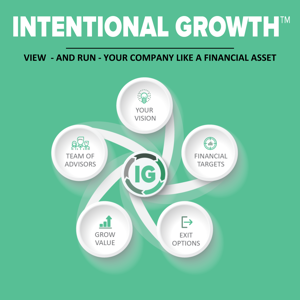
Intentional Growth™ is a podcast is a podcast for entrepreneurs and business owners wanting to view - and run - their company like a financial asset so they can have fun, create wealth, and make an impact. Truly make the entire journey of owning and running a company "worth it".