Intentional Growth

Intentional Growth

By Arkona - Intentional GrowthBusinessEntrepreneurshipInvestingManagement
Download on the App Store

Intentional Growth episodes

  • #243: What it Takes to Be Unapologetically Ambitious with Shellye Archambeau
    Want to know what it took for a Black woman CEO to succeed in Silicon Valley in the early IBM years — and still be at the top of her game today?  If you’ve ever felt like you’re facing insurmountable odds, this episode is for you. Shellye Archambeau shares her incredible journey to show you how staying true to your values and aligned to your long-term vision while making (sometimes ruthless) decisions will get you to your goals.  As her new book suggests, Shellye is unapologetically ambitious and thinks you should be too. Listen as she highlights the importance of having cheerleaders on your side as well as standing your ground when your convictions are challenged. As her new book suggests, Shellye is unapologetically ambitious and thinks you should be too.
     
    What You Will Learn In Today's Podcast Interview
    The similarities in being a CEO and running a club
    Why it was the "right, holistic decision" to return to work after only five weeks of maternity leave to further her career (and why later she would commute for three years instead of move her family)
    The difference between choice and sacrifice
    Why she can’t stand the term "work/life balance"
    How washing a pie plate changed her entire life
    The importance of having a shared long-term vision with key players in your life and seeking help along the way to avoid burning out before achieving your potential
    What your "backpack" looks like, how everyone’s is slightly different and what this means for our interactions
    How cheerleaders helped Shellye overcome major issues and why you should recruit your own
    Why it’s ridiculous to compare yourself to other people
    When you should swerve or stay the course and how to adjust your goals accordingly
    How planning makes it easier to step into ambitious roles and achieve aspirations
     
    Are You Growing The Value of Your Business
    Take The 2-Minute Assessment To Get Your Intentional Growth Score™ And 1-Page Vision Board.
    Are your company's current initiatives intentionally designed to increase the value of the business?
    Do you know what you want from your business long term and why?
    Do you know what your company is worth?
    Do you know the differences between Management, Family Transitions, PE Firms, ESOPs and Strategic Buyers?
    Does the business have a written strategic plan on how to achieve the desired normalized EBITDA and valuation?
     
    About the Guest:
    Shellye Archambeau is one of Silicon Valley's first Black women CEOs. MetricStream, a recognized global leader in governance, risk, and compliance (GRC) software solutions, was recognized for growth and innovation under her leadership and made the top ten of the“Deloitte Technology Fast 50” as well as was named a global leader in GRC by leading independent analyst firms for nine consecutive years. Shellye has also served on a number of boards, helping build brands, high performance teams and organizations. Her first book, Unapologetica
    55 min
  • #242: Is There Such a Thing as Growing Your Company Too Fast?
    Today’s show is all about growth rate: the rate you should target, how to identify that rate, what you can do to manage your growth and how much you can expect that growth to cost you. Listen in as Kevin Trout, former founder and owner of Grandview Medical Resources, Inc. — a fast-growing and award-winning specialty medical equipment distributor to hospitals and healthcare providers — explains how he landed on his optimal growth rate of 20% and gives specific examples of the tactical marketing they implemented to scale the company and compete with the industry giants. Kevin started out with a maxed-out credit card and sold the business years later when they were doing millions of dollars of revenue, multiple product lines and over 60 employees.
     
    What You Will Learn In Today's Podcast Interview
    The way Kevin’s focus led to doubling revenue within six months
    How Kevin went from maxing out his credit cards to a $1 million line of credit and 23% growth rate
    What the maximum sustainable growth rate is for distribution companies and how Kevin challenged it
    The importance of understanding where your financing comes from because you’ll just keep eating your float otherwise and grow right into bankruptcy
    Why Kevin started with the end in mind when deciding the growth rate
    Your P&L statement shouldn’t be a surprise to you
    Why Kevin set out to capture the patients most underserved by hospitals and how this impacted his bottom line
    How to achieve excellent profits through rentals
    How vertical integration works, why more companies need to be focusing on that, and how incentive plans typically encourage horizontal integration and are missing big segments of the markets they already serve
    The value in complementing vs competing and winning clients through good service rather than aggressive sales
    What “flanking the enemy” means in marketing and how to pull it off with style
    The false dichotomy of offense and defense and how it hurts your strategy
    How knowing he was building to sell let him
    The benefits of maximizing profits, paying down debt and investing in technology before you sell your company
    Why, despite an intentionally designed and successfully executed sale, Kevin wishes he’d known more about the impact of culture, EOS, how to build value and exit planning
    How building a business is like driving a manual transmission — you need to know when to push in the clutch
     
    Are You Growing The Value of Your Business
    Take The 2-Minute Assessment To Get Your Intentional Growth Score™ And 1-Page Vision Board.
    Are your company's current initiatives intentionally designed to increase the value of the business?
    Do you know what you want from your business long term and why?
    Do you know what your company is worth?
    Do you know the differences between Management, Family Transitions, PE Firms, ESOPs and Strategic Buyers?
    Does the business have a written strategic plan on how to achieve the desired normalized EBITDA and valuation?
     
    About the Guest:
    Kevin Trout is the former founder and owner of Grandview Medical Resources, Inc., a fast-growing and award-winning specialty medical equipment distributor to hospitals and healthcare providers. Kevin is now a Vistage Chair, where he leads four private peer-advisory boards and coaches, mentors and advises CEOs and business owners on strategic growth, leadership skills, and developing and retaining their top talent. He is also a past president and long-time board me

    1 hr 4 min
  • #241: Trust is an Entrepreneur's Most Valuable Asset with David Horsager
    Straight from the leading global expert, this episode is all about trust: how you get it, how you grow it and how you get it back if you lose it. And we do lose it, every day, unless we’re actively putting in effort to prevent the attrition. How you constantly and consistently show up for people — whether they’re employees, vendors or customers — is how they’ll trust you to show up, so ask yourself: what message are you sending? The big takeaway is that trust is the most important thing that makes the world go round. Trust is more important than capital. Capital comes after people trust one another. The most important thing you can do is to earn the trust of all your stakeholders. Growing the value of your business comes after earning the trust of others.
     
    What You Will Learn In Today's Podcast Interview
    Howhis 8 pillars of trust can solve every organizational or leadership issue
    The practical metrics that help you build the skills required to build trust
    How to engage with contrary viewpoints and start productive conversations
    Coaching advice for employers and managers looking to improve engagement and results
    What healthy coaching is and how to build a workplace culture that encourages it
    How speaking his truth lost him a client temporarily but ultimately deepened the client’s trust in him for the long-term
    The importance of accountability groups that operate as trust circles where you’re held to what you say and forced to examine your level of truthfulness
    Three places you can find good advisors and how to evaluate if they’re a fit for you based on the number of touch points you share
    The benefit of actively pursuing alternative points of view to increase your ability to build trust in others
    Tips on building (and rebuilding) trust in any relationship
    Why saying “I’m sorry” makes you a lying apologizer if you don’t follow-through on your new commitment (the real purpose of an apology)
     
    Are You Growing The Value of Your Business
    Take The 2-Minute Assessment To Get Your Intentional Growth Score™ And 1-Page Vision Board.
    Are your company's current initiatives intentionally designed to increase the value of the business?
    Do you know what you want from your business long term and why?
    Do you know what your company is worth?
    Do you know the differences between Management, Family Transitions, PE Firms, ESOPs and Strategic Buyers?
    Does the business have a written strategic plan on how to achieve the desired normalized EBITDA and valuation?
     
    About the Guest:
    David Horsager (MA, CSP, CPAE) is CEO of Trust Edge Leadership Institute and a global authority on helping leaders and organizations become the most trusted in their industry. He is the inventor of The Enterprise Trust Index™, director of the annual study The Trust Outlook™, and national bestselling author of The Trust Edge and Trusted Leader: 8 Pillars That Drive Results. With clients ranging from Fortune 100 companies to professional sports teams and global governments, David has taken the platform across the United States and on 6 continents.
     
    Quotes:
    08:12 -  “The number one reason people want to work for an organization is trusted leaders.” – David Horsager
    08:49 - “I believe nothing affects the bottom line more than trust. I believe trust is always the leading indicator.”
    58 min
  • #240: How Service Express Grew by Double Digits Year- Over- Year from $2.8M to $240M
    How clear is your company’s BHAG? Are you the best person to run the day-to-day operations of your company? Today’s episode is a perspective shift as we speak to Ron Alvesteffer, the key employee behind massive culture and fiscal shifts at Service Express, who took the company from $2.8 million to $240 million. Ron highlights the importance of a clear BHAG and how it aligns the company’s strategic plan, financials and core values. He shares how trusting your staff to do the jobs you hired them to do and the impact training future owners, not just employees, has on your bottom line. This is not one to miss if you’re looking for a practical way to implement systems and processes that will bring a higher valuation and greater corporate culture to your enterprise.
     
    What You Will Learn In Today’s Podcast Interview
    The importance of clarifying and executing on your BHAG (big hairy audacious goal)
    How Service Express maintains double-digit growth almost every year
    Why the mindset Ron had as the president and non-owner helped him focus on growing enterprise value
    The importance of getting clear on what you want, where you’re going and what you’re willing to do to get there
    How having his founder mentor him set the bar for Ron getting all of his staff to think like business owners
    What Ron learned the first time they tried to exit the business
    Why you should stop working hard in the business and instead work on it
    What each round of private equity financing did (and didn’t do) for his business
    Why the business chose not to bring in a strategic buyer or an operating partner when looking for growth opportunities
    How to identify and categorize your needs as a seller so you can rate potential buyers
    The value of understanding the size of your market opportunity, how you position against competitors, and getting clear on your strategy, plan and financial projects
    What impact repeatable processes and systems without customer or location concentration has on valuation
    How to grow your staff to be capable of the jobs you trust them with
     
    Are You Growing The Value of Your Business
    Take The 2-Minute Assessment To Get Your Intentional Growth Score&t
    1 hr 5 min
  • #239: Grasshopper Founder Shares Metrics and Strategies that Earned a $170 Million Sale to Citrix
    On today’s show, we have David Hauser, former founder of Grasshopper — a virtual telephone service — which sold for $165 million in cash and $8M in stock to Citrix. David is a metric master and shares with us some of the marketing and operational strategies that enabled them to grow from zero to $30 million in 12 years. He breaks down how to leverage key metrics like client acquisition costs (CAC) and the lifetime value of a customer (LTV) to exponentially scale a business. We talk about goals, failures and opportunities met along the way as David became a serial entrepreneur and how his ability to keep his learning high and wide-lens helped him stay strong in new markets as an angel investor.
     
    What You Will Learn In Today's Podcast Interview
    Why David says running a good business is the most valuable — and value-building — thing you can do
    The missing piece of advice when it’s time to sell your business
    How to attract business just by acting with integrity and following through on what you say you’ll do
    The value of doing each job yourself before you hire for the role
    Why Grasshopper used paid marketing, how much they put into doing it and how they evaluated the outcome
    The power of routine
    How David achieved 30% of his business from referrals
    The way David funded Grasshopper’s growth, the company he took from zero to 30 million, and sold after 12 years
    Why you should see business profits as growth capital rather than income
    What blended client acquisition costs (or CAC) are and how to evaluate their efficiency
    The difference between marginal and total CPA
    How much can (and should) you spend to catch up on churn
    Our success metrics and how they fail us while still being what we have to strive for, plus what you can do about that
     
    Are You Growing The Value of Your Business
    Take The 2-Minute Assessment To Get Your Intentional Growth Score™ And 1-Page Vision Board.
    Are your company's current initiatives intentionally designed to increase the value of the business?
    Do you know what you want from your business long term and why?
    Do you know what your company is worth?
    Do you know the differences between Management, Family Transitions, PE Firms, ESOPs and Strategic Buyers?
    Does the business have a written strategic plan on how to achieve the desired normalized EBITDA and valuation?
     
    About the Guest:
    David Hauser is an American entrepreneur, speaker and angel investor. He is best known for co-founding the Grasshopper Group, a virtual telephone service acquired by Citrix Systems for $170 million in 2015. Hauser is a founding member of National Entrepreneurs' Day and has co-founded a number of tech companies, including Grasshopper, Chargify, Spreadable PopSurvey, Deck Foundry and others.
     
     
    Quotes:
    05:05 - “The reason it worked is we were solving our own problem.” – David Hauser
    05:33 - “Before we hired anyone for anything, one or both of us did that job.” – David Hauser
    08:10 - “The most value in selling a business just comes from operating a good business.” – David Hauser
    09:50 - “How do I strip out the income I have to have to live and think about the rest as growth capital.” – David Hauser
    11:10 - “I didn&rs
    55 min
  • #238: Why the Greatest Entrepreneurship Hurdle is all in Your Mind with Mike Smerklo
    On today’s show, we have Mike Smerklo, author of Mr. Monkey and Me: A Real Survival Guide for Entrepreneurs and co-founder of the VC firm Next Coast Ventures, which helps the best entrepreneurs in the world as they build disruptive businesses. The team at Next Coast Ventures has raised over $7 billion in capital and created exit values of over $30 billion. He’ll share the mindset that brought him success, how he gained it and what he learned along the way. I’m excited to have him on the show because most people think what he’s accomplished is out of reach, and that’s just not the case. We’ll do a deep dive into the mechanics of his three rounds of financing so you can see just how doable it is. Listen for tips on managing and treating customers, the benefits of going IPO and how to get your team on board, and why he’d never make a deal without tying equity to both sides of the table. Mike has achieved 40% year-over-year, so this is an episode you don’t want to miss.
    My big takeaway from this episode is, even someone as successful as Mike (with all of his achievements), the fact that he still second-guesses his success is proof that we’re all human. You should recognize that the things that you intentionally accomplish over time is well deserved. A really clear plan will help dissolve that impostor syndrome. Education is another thing that will help dismiss and get rid of impostor syndrome and will ensure that you’re living and working intentionally.
     
    What You Will Learn In Today's Podcast Interview
    Mike’s background and story
    How poorly a “must be nice” mindset serves you and how to break out of that head space.
    Why Mike hates the phrase “fake it ‘til you make it” and what he believes people should do instead.
    Not all experts are the type of expert you need and you have to be able to identify what specific expertise you’re looking for.
    The incredible value in having a coach, no matter what stage you’re at.
    Why he chose the search fund model over all the others.
    How his company managed the ups and downs of the tech market, including the ways he had to raise cash during the downturn of 2008.
    When you should tie equity to performance on both sides of the deal table.
    The pragmatic way of looking at sprucing up your business and how it compares to renovating a house.
    The benefits of having a “maniacal focus” on customers.
    Mike’s three questions for evaluating how well you’re treating your customers.
    Why your executive team needs to stand up for what they’re talking about and how that gets reflected in your company.
    How Mike and his team determined to go IPO and gained consensus.
     
    Are You Growing The Value of Your Business
    Take The 2-Minute Assessment To Get Your Intentional Growth Score™ And 1-Page Vision Board.
    Are your company's current initiatives intentionally designed to increase the value of the business?
    Do you know what you want from your business long term and why?
    Do you know what your company is worth?
    Do you know the differences between Management, Family Transitions, PE Firms, ESOPs and Strategic Buyers?
    Does the business have a written strategic plan on how to achieve the desired normalized EBITDA and valuation?
     
    About the Guest:
    Mike Smerklo is an experienced entrepreneur, investor and business leader driven by the desire to turn ideas into reality. Having bought and scaled a small business into a publicly traded company worth nearly a billion dollars in value, he has a deep understanding
    1 hr 2 min
  • #238: How Mike Smerklo Managed 40% Year-Over-Year After Nearly Losing it All
    On today’s show, we have Mike Smerklo, author of Mr. Monkey and Me: A Real Survival Guide for Entrepreneurs and co-founder of the VC firm Next Coast Ventures, which helps the best entrepreneurs in the world as they build disruptive businesses. The team at Next Coast Ventures has raised over $7 billion in capital and created exit values of over $30 billion. He’ll share the mindset that brought him success, how he gained it and what he learned along the way. I’m excited to have him on the show because most people think what he’s accomplished is out of reach, and that’s just not the case. We’ll do a deep dive into the mechanics of his three rounds of financing so you can see just how doable it is. Listen for tips on managing and treating customers, the benefits of going IPO and how to get your team on board, and why he’d never make a deal without tying equity to both sides of the table. Mike has achieved 40% year-over-year, so this is an episode you don’t want to miss.
    My big takeaway from this episode is, even someone as successful as Mike (with all of his achievements), the fact that he still second-guesses his success is proof that we’re all human. You should recognize that the things that you intentionally accomplish over time is well deserved. A really clear plan will help dissolve that impostor syndrome. Education is another thing that will help dismiss and get rid of impostor syndrome and will ensure that you’re living and working intentionally.
     
    What You Will Learn In Today's Podcast Interview
    Mike’s background and story
    How poorly a “must be nice” mindset serves you and how to break out of that head space.
    Why Mike hates the phrase “fake it ‘til you make it” and what he believes people should do instead.
    Not all experts are the type of expert you need and you have to be able to identify what specific expertise you’re looking for.
    The incredible value in having a coach, no matter what stage you’re at.
    Why he chose the search fund model over all the others.
    How his company managed the ups and downs of the tech market, including the ways he had to raise cash during the downturn of 2008.
    When you should tie equity to performance on both sides of the deal table.
    The pragmatic way of looking at sprucing up your business and how it compares to renovating a house.
    The benefits of having a “maniacal focus” on customers.
    Mike’s three questions for evaluating how well you’re treating your customers.
    Why your executive team needs to stand up for what they’re talking about and how that gets reflected in your company.
    How Mike and his team determined to go IPO and gained consensus.
     
    Are You Growing The Value of Your Business
    Take The 2-Minute Assessment To Get Your Intentional Growth Score™ And 1-Page Vision Board.
    Are your company's current initiatives intentionally designed to increase the value of the business?
    Do you know what you want from your business long term and why?
    Do you know what your company is worth?
    Do you know the differences between Management, Family Transitions, PE Firms, ESOPs and Strategic Buyers?
    Does the business have a written strategic plan on how to achieve the desired normalized EBITDA and valuation?
     
    About the Guest:
    Mike Smerklo is an experienced entrepreneur, investor and business leader driven by the desire to turn ideas into reality. Having bought and scaled a small business into a publicly traded company worth nearly a billion dollars in value, he has a deep understanding
    1 hr 2 min
  • #237: The Road Less Traveled: How Sandra Conquered Silicon Valley on Her Own Terms
    Not every entrepreneur’s journey ends with them running a unicorn. Scratch that. Most don’t. On today’s show, Sandra Shpilberg and I talk about alternative funding to venture capital, switching from a service-based business model to a SaaS, as well as a host of great examples of how to make your niche work for you to achieve the entrepreneurial dream—all while making a compelling argument for entrepreneurs to foster a beginner’s mindset at all stages of your career. Tune in for a lesson in unconventional funding and the impact being intentional about how you raise funds has on the long-term.
     
    What You Will Learn In Today's Podcast Interview
    The three questions VC firms ask let Sandra know they weren’t going to be a good fit for her.
    How differentiating her business in the market and going after niches her competitors deemed too dangerous brought her success.
    What pushed her from a service to a software business and her unique take on the SaaS market.
    Why Sandra chased recurring revenue rather than VC funding and the success she found doing a deep dive into her niche.
    What the beginner’s mindset is, from Sandra’s book New Startup Mindset, and why it’s better than the mindset that you’re an expert since this often means you’re set in your ways.
    The impact of over-confidence is underestimated and why you should stay humble.
    How an executive coach helped Sandra think through the impact of two out-of-the-blue offers and what she wanted her exit to look like.
    Customers can become more like partners as you grow, and the value of doing this for both parties.
    Why Sandra has no seller’s remorse, despite selling early, especially in light of the pandemic.
    The VC formula and the rarity of seeing the success it sells you.
     
    Are You Growing The Value of Your Business
    Take The 2-Minute Assessment To Get Your Intentional Growth Score™ And 1-Page Vision Board.
    Are your company's current initiatives intentionally designed to increase the value of the business?
    Do you know what you want from your business long term and why?
    Do you know what your company is worth?
    Do you know the differences between Management, Family Transitions, PE Firms, ESOPs and Strategic Buyers?
    Does the business have a written strategic plan on how to achieve the desired normalized EBITDA and valuation?
     
    About the Guest:
    Sandra Shpilberg is the cofounder and CEO of a KOL discovery and management platform called Adnexi. Their mission is to accelerate drug development in order to benefit patients. This is her second startup after selling her first startup. In addition to being an entrepreneur, she is also the author of the bestselling and award-winning book New Startup Mindset: 10 Mindset Shifts to Build the Company of Your Dreams.
     
    Quotes:
    05:57 - “It began as a service. Then very quickly I realized that was just the beginning of the product-market fit for this particular need and there was more that our company could and needed to provide.” – Sandra Shpilberg
    11:40 -“My customers are paying for a product that works.” – Sandra Shpilberg
    13:25 - “Here’s a white man, he had to go to 70 meetings to get two. How many meetings do I have to go to?” “Instead of going to 140 meetings with venture capitalists, I’d rather go to 140 customer meetings because those customers are likel
    1 hr 4 min
  • #236: Day Trader Turns Entrepreneur: How to Identify Market Trends and Create Value
    Day traders and entrepreneurs have more in common that you might think. Maceo Jourdan and I take a deep dive into how market trends control both, and what lets the smart entrepreneur and trader know when to get in . . . and when to get the heck out as well. We’ll even go into how a mistake cost him $8 million and what you can do to avoid a similar fate. This episode is for you if you’re looking to be more market-savvy and find the right trend to hitch your wagon to.
     
    What You Will Learn In Today's Podcast Interview
    What entrepreneurs can learn from day traders (and what that means for your bottom line).
    The incredible value of data and how to apply it successfully to your business for growth.
    How entrepreneurs kill the value of their companies by not understanding true value.
    Why Maceo waited to jump into the financial world and started a newsletter first.
    Wal-Mart’s profit model and how it can work for anyone able to work on a larger scale.
    Why you should look at trends first and capital efficiency second.
    The importance of building in a buffer when making important decisions in emotional circumstances.
    How Maceo recovered from a mistake that cost him $8 million.
    Where to find small, concentrated pockets of value to capitalize on.
    The effect the internet has had on market trends and value.
    Why day traders understand business valuations better than first time entrepreneurs.
    How Maceo grew a company from a $25,000 loan to $50 million in revenue.
    The cost of being unaware that you’re running a job, not a company, and what to do about it.
    Why Maceo says your business is not your baby.
     
    Are You Growing The Value of Your Business
    Take The 2-Minute Assessment To Get Your Intentional Growth Score™ And 1-Page Vision Board.
    Are your company's current initiatives intentionally designed to increase the value of the business?
    Do you know what you want from your business long term and why?
    Do you know what your company is worth?
    Do you know the differences between Management, Family Transitions, PE Firms, ESOPs and Strategic Buyers?
    Does the business have a written strategic plan on how to achieve the desired normalized EBITDA and valuation?
     
    About the Guest:
    Maceo Jourdan is a master day trader who uses his intimate knowledge of market trends—and how to predict them—to build better businesses and better entrepreneurs. He’s on the board of directors for Retire3 Media and cofounder of Canexxia, a company committed to acquiring in the home health care and hospice industries to execute on a buy-and-build strategy to improve quality of care and ease of access.
     
    Quotes:
    08:17 - “What traders intimately know that entrepreneurs don’t is value.” – Maceo Jourdan
    14:56 - “The biggest risk as an entrepreneur is that you’re going to sell something and you’re not going to have enough buyers to relieve you of all of your inventory.” – Maceo Jourdan
    18:41 - “Your solution is running to obsolescence.” – Maceo Jourdan
    20:19 - “You can eat a lot off of a million contracts, but it’s going to end.” – Maceo Jourdan
    20:30 - “Entrepreneurs don’t really dig down from this huge space that’s their market into a pocket of value.” – Maceo Jourdan
    21:09 -
    1 hr 8 min
  • #235: PIVOT! How One Trade Show Company Ended 2020 with More Cash Than They Started
    The tradeshow industry was one of the hardest-hit in 2020 and while 30% of companies managed to take full advantage of unstable markets, 30% scraped bottom or worse. Rising from the bottom third, Mark Johnson ended the year with more cash than he started. Listen in to hear how he accomplished remarkable pivots to keep the entrepreneurial dream alive while safeguarding his clients during some of the most volatile times in recent US-history.
    Our conversations focuses on the fourth principle that we cover in our Intentional Growth Course: strategic planning. When Mark and his company found themselves in a bind because of what COVID did to their niche market, they didn’t just roll over. They decided to pivot. Today Mark talks about how he did it (and the steps to how that led them to become an even bigger business), why and how building an intentional business has led them to even bigger success, and how to identify markets that align with your business’s niche and values so you can do the same thing.
     
    What You Will Learn In Today's Podcast Interview
    What improv and leadership have in common.
    Mark’s core business philosophy of being “fast, flexible and fun” and what that drives in his culture and growth.
    Being arrogant and having a big ego can cause you to miss market trends and opportunities.
    How Mark and Star Exhibit recovered from the sudden death of his 37-year-old partner Tom.
    The devastating impact 2020 had on the tradeshow industry.
    Why Star Exhibit ignored going into the PPE industry when making pivoting choices during the pandemic.
    How Mark created a culture that enabled one of his front-line employees to take an idea all the way to the NHL.
    The importance of picking up on market trends and how to identify emerging markets that align with your company’s resources.
    How his company pivoted into pop-up office spaces to solve the need for isolated work areas that are separate of the distractions of home life.
    Why building an intentional business allowed flexible thinking and quick decisions when time was of the essence.
    Diving into the “Blue Ocean” annually is beneficial for your business, not just your blood pressure. Mark shares the importance of updating business plans each year to keep alignment and ROI high.
    How Star Exhibit climbed back from two employees.
    The value of human-centric design in fulfilling market demands (and when you might pass on an opportunity that doesn’t fit).
     
    Are You Growing The Value of Your Business
    Take The 2-Minute Assessment To Get Your Intentional Growth Score™ And 1-Page Vision Board.
    Are your company's current initiatives intentionally designed to increase the value of the business?
    Do you know what you want from your business long term and why?
    Do you know what your company is worth?
    Do you know the differences between Management, Family Transitions, PE Firms, ESOPs and Strategic Buyers?
    Does the business have a written strategic plan on how to achieve the desired normalized EBITDA and valuation?
     
    About the Guest:
    Mark Johnson is the CEO and founder of Star Exhibits, a strategic face-to-face marketing solutions company as well as CEO and founder at myBackyardStudio, which offers attractive and affordable space options addressing the need to do more from home. His passion to deliver human-centric solutions spills over from his for-profit endeavors as he is known for taking an active part in ensuring the safety and security of his clients. Mark has served on the board of international and national industry associations, as well as multiple non-profits.
    58 min

About Intentional Growth

From the publisher's feed

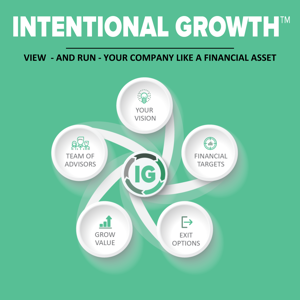
Intentional Growth™ is a podcast is a podcast for entrepreneurs and business owners wanting to view - and run - their company like a financial asset so they can have fun, create wealth, and make an impact. Truly make the entire journey of owning and running a company "worth it".