Intentional Growth

Intentional Growth

By Arkona - Intentional GrowthBusinessEntrepreneurshipInvestingManagement
Download on the App Store

Intentional Growth episodes

  • #224: Owning Your Exit (Part 1): Underground Nightclub Owner Turns Healthcare Tech Entrepreneur
    On today’s show, Saud Juman shares why having a gun pulled on him when he was a nightclub owner in Toronto, Canada, caused him to exit the industry, meditate for 10 months, and start a tech healthcare company called PolicyMedical, Inc. that grew to nine figures and eventually sold to Private Equity.
    What You Will Learn In Today's Podcast Interview
    How Saud owned his exit from the nightclub scene after having a gun put in his face.
    Why Saud started a successful tech healthcare company after 10 months of meditation.
    Why you should proactively change before some big event happens.
    How to align your ultimate vision for your life with the one you have for your business.
    How to recognize the signs that you’re in a “pit” and need to make some changes.
    The importance of taking time to listen instead of constantly consuming.
    How meditation can help you get clear on your vision.
    Why you need to understand your drivers (your “why”) before you build a business. 
    Why it takes rigor and discipline to be able to hear yourself and take action on what is most important to you.
    Why negative emotions like shame can spur positive change.
    How to keep true to your long-term goals while making tactical short-term decisions.
    Why you should stop and critically assess how each business decision is getting closer to or further from your ultimate goals.
     
    Are You Growing The Value of Your Business
    Take The 2-Minute Assessment To Get Your Intentional Growth Score™ And 1-Page Vision Board.
    Podcast Summary
    We have quite a treat for you today. In this episode, I’m talking with Saud Juman as he takes us from his first venture in university to transitioning into the nightlife in downtown Toronto, Canada. He details the experiences he had which caused him to reconsider how he was living his life and operating his business, thereby instigating the change that would eventually bring him his greatest success yet—PolicyMedical.
    I broke this episode into a two-part series because I think Saud’s story does a great job highlighting why it’s absolutely crucial to understand who you are, what you want from your business and life, and why, before you build your strategic plan to grow and exit the business.
    In this episode, Saud and I focus on the story that helped him get clear on his why. The big takeaway from this first part of the series is to listen to yourself first. As Saud puts it, you “own your exit” by knowing your 'why' and putting pen to paper describing what you want before you implement a strategic plan to grow value.
    It’s that focus that allows you to clear obstacles from your path as you execute on the strategies that get you to your goals. It takes rigor and discipline to maintain this focus and to really listen to your thoughts. 
    There’s nothing more eye opening to make you realize what matters to you in life than an unforeseen event that changes your situation and limits your choices. The key is to have a valuable business that gives you the chance to pivot when necessary, no matter what gets thrown at you or when.
     
    About the Guest:
    Saud Juman loves basketball and business. At a young age, his mother encouraged him to get out and form his own league so he could follow his passion. After that, there was no stopping him.Saud created such a successful business in university that he had
    1 hr 1 min
  • #223: Scale Up Your Business Using the 6 Peaks of Value Creation with Nick Bradley
    Are you mentally prepared to do everything in your power to clarify your vision and execute on that vision, no matter how uncomfortable it makes you or how many times you fail? Nick Bradley, who has sold 22 businesses for more than $5.2 billion in his lifetime (and the last for 14x profit in 2017), shares what helped him create the 6 Peaks of Value Creation and the results he’s seen when you combine mindset with execution. 
    What you will learn in today's Podcast Interview
    The Venn diagram of entrepreneurial skills for optimizing growth.
    What percentage of EBITDA you should reinvest to increase enterprise value.
    The 6 Peaks of Value Creation you should be using to create success.
    The importance of addressing long-term goals in your business’s financials, including where you’re getting your financing from. 
    How empathy helps you drive a growth culture (the way you'd rather have a doctor with a good bedside manner than one without).
    How your true wants influence not only your decision making but also the eventual options you have to transition or exit the business, and the importance of alignment. 
    Why you should put the effort in to solve for root issues and not just address symptoms.
    If you want 10-15 million from the sale of your company, you’ll need to achieve a valuation in the 10s of millions . . . are you on the right growth path?
    Leadership starts with you and if you’re not leading yourself to grow, what results can you expect to see in your business?
    The impact discipline has on freedom, creativity, and—ultimately—success.
    Are You Growing The Value of Your Business
    Take The 2-Minute Assessment To Get Your Intentional Growth Score™ And 1-Page Vision Board. 
     
    Podcast Summary:
    Nick Bradley shares on today’s podcast how to get into the right mindset, scale up your business and optimize for value growth. Nick shares his 6 Peaks of Value Creation with us and details how acting with intention and discipline leads to more freedom and success than you’ve seen before.
    Purpose – Understanding where you want to go and knowing your options, and why this matters to you.
    Profit – Have a safety net and flexibility to invest. Understand where profitability is going to come from.
    Proposition – Value proposition, not just a product or service. Ultimately the culmination of a product (or service) ecosystem and the experience your client or customer has. 
    Predictability – Predictable business. All top-performing businesses have a steady flow of the right customers coming in and driving recurring revenue.
    Process – Where and how consistently you use technology, data, insight, and even your mission. The handoff between processes needs to be really clear.
    People – Right people, right seats. Look after them, treat with respect, and have the correct compensation structure for performance. This is all about culture.
    Whether you’re the financial or operations person, this podcast shows the value of learning the other side. The optimal entrepreneur has an understanding of both, allowing them to create value, wealth, and freedom. If you understand how things work, how to get where you want to go, and how to align things to make it happen, you’ll find the success you set out to achieve on day one.
    If you live i

    1 hr 6 min
  • #222: The Ultimate Guide to Executive Compensation Plans: Aligning Short- and Long-Term Incentives to Value Creation
    Today’s episode is all about designing the most effective executive compensation structures while avoiding the most common mistakes. Craig shares how to come up with the perfect formula (designed off the financials and not some insurance product) that rewards employees in the short- and long-term, increases the value of your company, and pays for itself.
     
    What You Will Learn In Today's Podcast Interview
    What phantom stock or stock appreciation rights (SAR) plans are and how to make them work for you.
    How to transform employees into growth partners.
    Why it’s important to discover your employees’ ideal compensation structure.
    The benefits of using long-term planning when looking at appreciation awards and why normalized EBITDA is often the best evaluation metric.
    How to transaction-proof (plan for both a transaction OR keeping the business) your compensation plans.
    The strength of an abundance mindset over a scarcity mindset.
    How to account for phantom stock liability and protect all parties, as well as learn the difference between funded and naked liability.
    The value of communication and transparency during planning to draw in the most qualified people who will help you smash through your ceiling.
    How to build and sustain a high-performing culture while getting your executives to pay for themselves.
    The most common valuation metric for compensation plans is EBITDA x multiple - debt + cash.
     
    Are You Growing The Value of Your Business
    Take The 2-Minute Assessment To Get Your Intentional Growth Score™ And 1-Page Vision Board.
     
    Podcast Summary
    Today’s episode is all about designing the most effective executive compensation structures and how you, as a business owner, can come up with the perfect formula that rewards employees in both the short- and long-term, increases the value of your company, and pays for itself. Craig Rutledge, alongside his company VisionLink, has been designing executive compensation plans for over two decades. He details multiple ways you can reward top performers with (phantom) equity that vests over time, based on the growth in the value of the business. Not only will Craig’s examples highlight the incredible benefits to your business of awarding short- and long-term achievement, he’ll also talk about the potential pitfalls equity-based compensation plans open you up to, as well as how to protect yourself from them. The right exec comp packages will not:
    Award equity without increasing company value
    Vest too fast
    1 hr 10 min
  • #221: From Hitting Rock Bottom After an Exit to Building a Real Estate Empire Managing over 6,500 Properties
    Kent took a company from $800 million to $1.8 billion in 30 months, exited, and then lost everything. He became depressed and spent a few years reinventing himself before finding his passion in real estate and entrepreneurship. Through Kent's incredible and raw story about realizing time is the most valuable asset he could ever have, you'll see how becoming intentional and scaling and growing your business the right way leads not just to success, but fulfillment.
      
    What You Will Learn In Today's Podcast Interview
    Rock-bottom isn’t a final destination—bouncing back is hard work, but you can build something better if you take your wake-up call to heart.
    The difference between creating value and creating income.
    Whether you own a job or a business, what the difference is, and the dangers of becoming trapped in it.
    The ways data helps your bottom line and the power that comes from giving people what they want.
    Why micromanaging good employees will actually push them away.
    How common advice that keeps your aspirations low comes from dream-stealers who don’t know how to achieve their own goals—and what advice you should listen to instead. Don’t get conned into believing you have no control!
    Why you should scale your business to be sustainable without you at the helm.
    How to recognize the impact of your driving factors and assess if they’re working for you.
    Why you should hire people who challenge you and are smarter than you.
    How selling a company is like getting divorced from hundreds of people, all at once.
    If you pushed your ego aside, do you really need to be CEO? Could someone else do it?
    That roughly 35% of real estate transactions in a single family home are done with cash.
     
    Are You Growing The Value of Your Business
    Take The 2-Minute Assessment To Get Your Intentional Growth Score™ And 1-Page Vision Board.
    Podcast Summary
    If you don’t run into challenges, you’re not trying hard enough. Kent Clothier shares his incredible story that illuminates why down isn’t out and choosing to act with intention leads to greater success.  
    Learn how to turn obstacles into opportunities from someone who lost everything and then built an even stronger business after. There is no such thing as can’t in the business world, so you have to be honest with yourself—why are you really content with your status quo? How hard would you work to change it, if you knew what steps to take?
    Creating income is hard work, but creating lasting long-term value and sustainable cash flow is harder. How hard are you willing to work, and for how long? Right now, if you were to take a week off work, what would happen? If your blood pressure went up at the thought, you don’t own a business; you own a job. 
    Is that really what you put all this hard work in for? How valuable do you think someone else is going to find your job, versus a company that doesn’t rely so heavily on its owner? Sometimes the obvious answers are the hardest to come to, as you'll hear all too clearly from Kent. Hire the right people to support you so that you aren’t taking the lead in every role—these people will be smart and challenging and you’re going to learn
    1 hr 7 min
  • #220: The Alter Ego Effect: Helping Ambitious Entrepreneurs Do Hard Things & Overcome Their Limiting Beliefs
    Todd shares the mindset-changing framework he created in his book The Alter Ego Effect to help you break through obstacles and eliminate your self-limiting beliefs for amazing success. This is the mental playbook used by Olympic and professional athletes, world-class entertainers, and top-tier entrepreneurs to achieve their most ambitious goals. If you're ready to up your game, this is the episode for you.
      
    What You Will Learn In Today's Podcast Interview:
    Why “just deal with it” is terrible advice to a business owner who is evolving their role and what to do to address the underlying issues.
    How to access your inner hero.
    The people who win in life have the most valuable skills; do you or your alter ego manifest those skills?
    When you change the way you relate to yourself, all things change.
    Why imposter syndrome is a buzzword in the self-help world these days.
    That discounting your achievements ("oh, that was just luck") contributes to real imposter syndrome and feelings of anxiety over being “found out” (despite said achievements) and what to do about it.
    How to avoid self-help traps that take away your power rather than provide real ways to succeed in overcoming mental blocks and imposter syndrome.
    Why “fake it ‘til you make it” is good advice and how to figure out when you’ve made it.
    Anyone not getting the results they want is acting in a fake way.
    What traits entrepreneurs and athletes share that draw them to their fields.
    How to break your brain to achieve success by overcoming some built-in drivers (such as to seek comfort) that hinder us when we aren't intentionally choosing them.
    Why you should carefully choose heroes to emulate in all aspects of your life from work to home and how to “show up” as those people day after day for ultimate success.
    Are You Growing The Value of Your Business
    Take The 2-Minute Assessment To Get Your Intentional Growth Score™ And 1-Page Vision Board.
    Podcast Summary
    Business owners often have to reevaluate themselves and their relationship with their business in order to shift their mindset to long-term value creation.
    Todd shares how drawing on an alter ego isn’t about ‘faking it until you make it’, but rather bringing out the 'real you' so you can conquer any challenge life throws at you, drawn from decades of experience with elite athletes, entertainers, and public figure.
    Todd’s work on the alter ego led him to a key discovery: We need to establish a persona that can handle the tasks we don’t take pride in so we can ultimately achieve success in the areas that are holding us back. ​​If you want to be the chairman of the board, emulating owners who have successfully worked themselves out of the business can help you get there. Ask yourself, "What they would do in that situation?" and follow their roadmap to success.
    This is a practical conversation on how to become the person who always wins. This is not a self-help fluff piece. Our mindset, ego, narrative, control issues and personality attributes (like Allie Taylor talked about last week) are limiting what we can do with our businesses. Todd’s episode is a framework to identify your field of play and your limiting beliefs to help your alter ego evolve so you win more and settle for comfortable less.
    Obviously this isn’t a simple process. You’ll need to figure out what exactly “making it” looks like to you. In the process, you&rs
    1 hr 6 min
  • #219: How Giving Up More Control Can 2x Enterprise Value with Allie Taylor, PhD & Business Psychologist
    There is a direct correlation between the size of a company and how tight of a grip the owner has on it, and it's not in the way you might think. Listen to this incredibly important episode to learn how to double your company's enterprise value by giving up a bit of control—and why this is the best scary thing you can do for yourself and your business.
      
    What You Will Learn In Today's Podcast Interview
    How separating governance from management roles is vital to success.
    The five personality attributes business owners should know about: High-innovativeness; higher tolerance for ambiguity; high need for goal achievement; internal locus of control; and a higher propensity for prudent risk-taking.
    Why your identity can be either your superpower or kryptonite, which you can tell based on how you respond to being challenged.
    What generations get wrong in communication and how it leads to misunderstanding.
    How self-identity is often fused to role-identity and what to do about it.
    You can align your strategy and culture to improve your bottom line by 50%.
    How private equity destroys culture.
    That if you’re struggling today in your business, the next step is to make no decision except to start being curious.
    The sunk-cost fallacy and how to recognize the mindset.
    If you’re a dissenting voice, you need to have data to support your opinions before someone is going to be open to listening to you.
    How to capitalize on 2020's challenges to get the future you want.
     
    Podcast Summary
    If you’re having trouble loosening your control on your business, you’ll need no more convincing than this episode with Allie Taylor. She has an actual PhD in business psychology which she applies to her business every day to help her clients achieve greater financial and personal freedom. Her tips on how to increase your enterprise value by 50% are powerful and simple, though require a bit of self-reflection and hard work. She also tackles common issues plaguing business owners like the sunk-cost fallacy and miscommunication issues at the workplace that result in decreased efficiencies. We need to learn how to leverage the people around us to achieve this, and that’s unnatural for most. As she says, you must seek to understand before you can be understood. That said, the first person you should seek to understand is yourself. Knowing if your identity (and your relationship with your business) is serving you or harming you cements the next steps you need to take for personal and business growth. As a business gets bigger, it becomes more complex. One person can't give all the disparate parts the attention they deserve, so it's necessary to learn how to give up control for growth. If you find yourself feeling defensive when questioned with a fresh perspective, your ego isn’t serving you. Separating your identity from your role in the business lets you see things more clearly to pivot both into stronger positions.
     
    About Allie Taylor
    1 hr 3 min
  • #218: Gen Z and Their Impact on Business and Our Economy
    Today I'm talking to the #1 speaker on generations in the world, Jason Dorsey. We'll be diving into how different generations (and more specifically generation Z) and their values will have an impact on the future of economy, trends, consumerism, capitalism, and more.  
    What You Will Learn In Today's Podcast Interview
    The different values and world events that create generational cohorts: Baby Boomers 1946-1964; Gen X 1965-1976; Millennials 1977-1995; Gen Z: 1996-TBD
    How Gen Z is changing things with their wallets and why they’re more likely to save money than spend it.
    Why Gen Zers entering the job market have the immediate potential to surpass their Millennial peers.
    What you can do to strengthen communication and therefore efficiencies between generations in your company for a better bottom line.
    What earned-wage access means and why it’s gaining traction.
    Gen Z’s buying and spending habits and what that indicates for future trends and the economy.
    Learn how to better connect to, build trust with, and drive influence over and between generations.
    What the “mega” me is.
    Insightful facts about Gen Z to help you better understand them, including that they trust influencers more than doctors.
    Why Gen Z ties stability to size and not history when it comes to businesses and how you can emphasize this during recruitment.
    Take The 2-Minute Assessment To Get Your Intentional Growth Score™ And 1-Page Vision Board.
     
     
    Podcast Interview Summary:
    Today we're going to be talking with Jason Dorsey about Gen Z and their impact not only on the future of our economy, but business as we know it.  As author of Zconomy: How Gen Z Will Change the Future of Business—and What to Do About It, Jason knows what he’s talking about when he says a lot of our notions about Gen Z are dead wrong.  With over 1,000 standing ovations from his speeches on Gen Z and Millennials, and 65 generational studies for 700 different companies completed, Jason really is the “research guru” for tackling the next generation emerging onto the scene. He's been on 60 Minutes, CNBC and the Today Show, and has contributed to the Wall Street Journal and New York Times.
    He’ll show you what matters to Gen Z and what your business should be doing it about it, from communication styles that help win customers and employees to simply understanding the mindset that having grown up with technology like smartphones and the internet gives them.  Jason’s mission is to help businesses make informed decisions about their employees, clients, and customers. On the interview today, he's going to be talking about how Gen Z is going to come in like a wrecking ball and how they will reshape our entrepreneurial landscape. Gen Z is not afraid to put their wallets where their values are, and they expect you to do the same. FYI, Gen Z is already 24 years old. We're not just talking about babies and kids here, but current employees and consumers with real money and influence.  I love this episode because Jason has so much insight into the way that our world's going to change based on the demographics that he researches.It's very hard to predict the future, as we all know; however, when you look at the big trends different generations force into the system based on their values, you can better tap into what the future of your business should look like. You don't hav
    1 hr 3 min
  • #217: 13 Years Post ESOP: Leading & Growing the Company Through the Lens of the Next Generation President
    For thirteen years, Roy has run the family business after his father-in-law turned it into an ESOP and transitioned out of an ownership role. Not only has the business grown from $6M to $19M since then, but both parties were able to achieve their desired financial and lifestyle goals because of the successfully orchestrated and executed ESOP. He’ll share how they did it on today’s episode!
     
    What You Will Learn In Today's Podcast Interview
    What it's like leading and growing the company as the next generation, after an ESOP transaction.
    How Hopkins Printing built their next level of leadership (and why that isn’t so easy sometimes). 
    What it's like running a company under the ESOP structure and how it differs from other ownership structures.
    What an ESOP is and how it differs from other ownership structures.
    How an ESOP helps you grow the business, with examples from Ray’s success.
    When and why an ESOP might not be the solution for you.
    Why Ray’s father-in-law chose an ESOP over an internal transfer or selling to a third party.
    How to cultivate an “ESOP mentality.”
    The way an ESOP can eliminate state and federal taxes.
    Why it’s important to separate management and ownership roles.
    The benefits of shifting your mindset away from annual income to long-term value creation.
    How Ray’s father-in-law was able to satisfy financial, lifestyle, and family needs through the ESOP.
    Why ESOPs aren’t a socialist enterprise and what involvement the employees really have.
     
    Podcast Summary:
    Roy shares his insights into how effective ESOPs are after transition and why they're key to helping more business owners consider one over an internal transfer or a third party, just like his father-in-law did.  
    We all wonder what comes next for the generation after an ESOP. Roy is a prime example of a president getting it right through solid planning, communication and follow-through. In the past thirteen years, business has increased from $6M in revenue with 50 employees to $19M with 100 employees.
    And it worked for the management team and owners, too. Roy's father-in-law was able to work the amount he wanted after the sale of the company, without worrying about how the next generation would carry on his work. He already knew! He'd planned his succession and to have a team that would take as much care of his business as he would. To make this happen, they moved from a traditional annual income model to a long-term value creation one to ensure the business was tied to success after transition. 
    ESOPs aren’t for everyone, but if you take the time to cultivate an ESOP mentality before you take the plunge, you’ll find all sorts of ways to keep your business growing through the years, with higher employee engagement, retention and performance than typical business structures encourage.  It’s five minutes to closing — do you know where your employees are?
     
    About the Guest:
    Roy Waterhouse has been in the family printing business for decades, working his way up to the presidential position at Hopkins Printing. Hopkins became an ESOP in 2007 and is 100% Employee Owned. Before that, he worked with Prepress, where he did film assembly, camera work, typesetting, layout and CAD work.
    Hopkins Printing is your commercial printer of choice for offset, wide-format and digital printing. For four decades, they have exceed
    1 hr 2 min
  • #216: Bridging the Capital Gap: Growth Capital vs. Private Equity & Traditional Lending
    Hitting the ceiling is not always just an emotional or energy related event. Often times business owners get to a point where growth consumes capital, and they have to choose between reducing their annual income, selling out or stalling growth.
    What You Will Learn In Today's Podcast Interview
    Growth capital, versus private equity, versus commercial lending
    Biggest challenges when trying to find the right type of capital for growth
    Why the “capital gap” exists in the lower and middle market
    Why the typical options for capital, described as “Bank vs. Shark Tank,” often are too extreme for what business owners really need to grow
    The importance of owners understanding their options in order to avoid regret after a deal
    How growth capital is different than the traditional private equity structure
    What they think is “effective capital” for companies
    Why the most common way for an equity investor to get their money is to sell the business
    Why not all capital is equal for business owners
    Why they focus their mechanism on supporting business owners
    The power of having motivation outside of earning money when designing your business
     
    Take The 2-Minute Assessment To Get Your Intentional Growth Score™ And 1-Page Vision Board. 
     
    Podcast Summary
    In today’s episode, Patrick and Nick dive deeply into what they refer to as “the capital gap,” why companies hit a ceiling for growth, and how to find the right source of capital to grow the value of a business.
    There are mechanical issues that don’t necessarily allow traditional banks to lend (via debt) the capital needed to finance the growth. Typically, in high growth companies there may not be enough assets for the bank to take back if things go south.
    The opposite end of that spectrum is to sell the business, or sell a large portion of equity, to an investor who has the capital to support the growth. However, in that case, most of the upside in value creation and future distributions goes to that new equity partner.
    The emergence of growth capital is helping solve this issue. Patrick and Nick call it “efficient capital”. It bridges the gap for business owners who want to continue to grow while also keeping control of their company and reaping the benefits of that future value creation. 
    Patrick and Nick brought their finance and accounting backgrounds together when starting Hill Capital to create both a forward and historical looking mindset when supporting their business and investments. Before Hill Capital, Patrick co-founded equity capital markets at Northland Securities, where he was the Director of Research and Managing Director of Investment Banking. Nick spent the first part of his career as a CPA at KPMG.
    At Hill Capital, they focus on lower- to mid-market financing and provide capital and expertise to small business and entrepreneurs.
    Major takeaway – if growth capital is deployed correctly (into strategies that INCREASE the value of the business) it can help owners break through from a few hundred thousand dollars in EBITDA to a few million dollars. This specific range in EBITDA growth will increase the options of exits that weren’t possible (ESOPs or Private Equity) and unlock a different range of value multiples.
     
    About the Guests:
    Patrick E. Donohue, CFA is the Managing Partner and CEO at Hill Capital Corporation. He has experience in direct private and public investments,
    1 hr 16 min
  • #215: How to Integrate Your Entrepreneurial ‘Why’, Conscious Capitalism & Intentional Growth with Ann Dougherty
    The world can be a better place if more entrepreneurs can find a way to align the impact they want to make on the world with growing a more valuable business. Anne shares how she is making a dent in the world while benefiting all her stakeholders and creating a lasting business.
    What You Will Learn In Today's Podcast Interview
    How Anne and her team are using social science and human behavior to change the energy industry
    Why business is the center to make sure people have great lives
    How to prioritize all your stakeholders’ while growing a more valuable company
    How to align your personal core values with your company’s core values
    Ways to use your business as leverage to spread your personal values
    Why ‘value’ has multiple dimensions
    How focusing on building a healthy company creates a more valuable business
    Why we need to break through the narrative that we can’t live great lives while making money and creating a great business
    Why Anne prioritized a family-centric model when starting her own company
    Why this model can attract more talented employees
    How their model appeals to their clients and peers
    How living misaligned with your values can impact you physically and mentally
    Podcast Interview Summary:
    Anne shares with us that profit and growth do not need to come at the expense of a business’s stakeholders and their interests; if you can identify your goals and core values, you can integrate them into your company’s model to build an even more successful and long-lasting organization.
    Anne and her partner had intentionality from the start of ILLUME when they decided to prioritize the needs and rights of their employees—this decision set the tone for their company’s entire culture and ethos.
    This decision has attracted talented employees and fantastic clients, and it also produces exceptional work. In short, Anne and ILLUME are an awesome example of how being intentional about what you want from your business and engineering the company around your values puts you in an upward spiral of success.
    Are You Growing The Value of Your Business
    Take The 2-Minute Assessment To Get Your Intentional Growth Score™ And 1-Page Vision Board.
    About the Guest:
    Anne Dougherty started her career after graduate school in applied consumer product research for fortune 100 companies. She made the shift to the energy industry and used her expertise to examine the human behavior dimension of energy as a consultant. After about ten years in that field, Anne and her business partner decided to start a consulting firm of their own, but with a feminist and family-centric model of business.
     
    Podcast Interview Quotes:
    13:08 - “People have an almost mythical relationship with electricity” - Anne Dougherty
    22:01 - “I just kinda want to layer in that you and I are both capitalists at heart and that there is a way for us to do all of this” - Ryan Tansom, on the topic of conscious capitalism
    25:51 - “We really wanted to create an environment where you could advance based on your ability to get the work done in the time that you committed to and not just in terms of sheer volume of work.” - Anne Dougherty    
    45:12 - “Thinking about the value of the company is thinking about the metrics. A highly valuable company is a very healthy company.” - Anne Dou
    1 hr 12 min

About Intentional Growth

From the publisher's feed

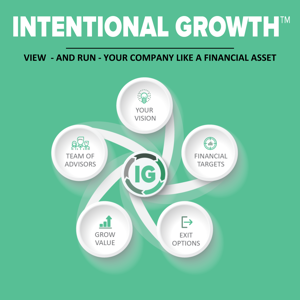
Intentional Growth™ is a podcast is a podcast for entrepreneurs and business owners wanting to view - and run - their company like a financial asset so they can have fun, create wealth, and make an impact. Truly make the entire journey of owning and running a company "worth it".