Intentional Growth

Intentional Growth

By Arkona - Intentional GrowthBusinessEntrepreneurshipInvestingManagement
Download on the App Store

Intentional Growth episodes

  • #214: A Deep Dive into 10 Years of Research on the Highest Performing U.S. Private Companies
    Privately held companies in the middle market ($10M - $1B in revenue) account for 1/3 of the US GDP as well as 44.5 million jobs. Unlike the stock market, we can’t just jump online and see how well they are doing. Today we’re diving into mountains of data on the middle market with former Managing Director of Harvard Business Review and Editor of Fortune.
    What You Will Learn In Today's Podcast Interview
    Why the top private companies cluster into 3 typologies: investors, innovators, and efficiency experts.
    The 7 key factors that contribute to the growth (and are under the owner and management’s control)
    How to focus on enterprise value instead of just annual profitability
    How privately held companies in the middle market are dealing with uncertainty
    How COVID has impacted the likelihood of different types of transitions for middle market companies
    Why the middle market consistently outperforms the S&P 500
    The 5 “COVID cushions” to manage uncertainty
    Why the middle market is where businesses become companies
    How an entrepreneur transitions to the CEO role by thinking beyond the lifespan of an individual or company 
     Podast Summary:
    Quarter after quarter privately held middle market companies post higher rates of growth and employment than the public or lower markets.
    In general, it is hard to understand how middle market companies operate since a majority are privately owned—today Tom Stewart explains how these businesses are doing things differently to grow faster than their larger and smaller peers. 
    Tom is the Executive Director of the National Center for the Middle Market. He was also the Editor and Managing Director of Harvard Business Review for six years and participated in the World Economic Forum twelve timesthroughout his career.
    Tom and the National Center for the Middle Market are dedicated to researching and understanding the middle market economy. This organization, housed in the Fisher College of Business at The Ohio State University, is the only research group that focuses on mid-sized companies. They have surveyed 1,000 midsize companies each quarter for the past ten years, giving them the necessary data to fill in the information gap on the middle third of the private sector.
    Here is a link the research on the DNA of the Middle Market
    As usual, a group of top tier middle market companies is responsible for a large percentage of this growth. By understanding what contributes to the growth of these companies and what they do differently to consistently outperform their peers, the Center identified 3 types of companies and 7 pillars of growth that are fundamental to their success. 
    About the Guest:
    Thomas A. Stewart is the Executive Director of the National Center for the Middle Market, the leading source for knowledge, leadership and research on mid-sized companies, based at the Fisher College of Business at The Ohio State University. Stewart is an influential thought leader on global management issues and ideas: an internationally recognized editor and publisher, authority on intellectual capital and knowledge management, and a best-selling author.
    Before joining the National Center for the Middle Market, Stewart served as Chief Marketing and Knowledge Officer for international consulting firm Booz & Company (now called Strategy&), overseei
    0 min
  • #213: The Ultimate Guide on How Private Equity Works and Makes Money with Sunny Vanderbeck
    In today’s episode, Sunny explains to us how the world of private equity operates, from the structure and lifecycle of the fund to considering a sale’s debt versus equity. We'll be delving into how private equity firms raise money, where the money comes from, what types of investors they work with, how the general partners of a private equity firm get paid, how they start the fund and what the fund structure looks like, and what the timeline means for the fund.
     
    What You Will Learn In Today's Podcast Interview
    How private equity firms raise the money
    Where the money comes from and the types of investors
    How the general partners of the PE firm get paid
    How they start the fund and the structure of the fund
    How that fund structure buys platform companies and bolt-on companies
    What the timeline means for the fund and the partners
    What the lifecycle looks like from start to finish
    How this information relates to the Intentional Growth course
     
    Are You Growing The Value of Your Business
    Sunny and I unpack the private equity industry and how it works in crazy detail.
     
    Over the past four and a half years, I’ve hosted dozens of entrepreneurs that sold their companies to private equity firms, as well as PE firms that explain their models and approach. However, today’s episode is the necessary start to finish explanation of how private equity firms works, and it fills in any gaps in information and understanding you may have.
     
    I reached out to Sunny to come on the show again because of his unique experience and perspective. Before starting Satori Capital, Sunny founded Data Return, a provider of managed services and utility computing, grow the company 40% every quarter for three years, sold it, bought it back and then sold it again. His decade at Data Return included a $3 billion market capitalization made him one of the youngest CEOs ever to lead a Nasdaq company. His multiple exits, gives him unique expertise as a founder of Satori Capital, a private equity firm founded on the principles of conscious capitalism. By providing real-world insights from its experienced team and long-term funding with no fixed time constraints.
     
    As many of you know if you are a long-time listener of the podcast, the principles of conscious capitalism are incredibly important to us and our work. Sunny’s investment thesis keeps conscious capitalism at the forefront, and that common approach makes today’s episode an exciting conversation to share with you.
     
    About the Guest:
    Sunny Vanderbeck is an inv
    1 hr 9 min
  • #212: The Impact of Remote Working on Business Valuations, CRE, Company Culture and the Economy
    Liam is a serial entrepreneur who runs Time Doctor and Staff.com (one of the most popular time tracking and productivity software platforms in use by top brands today). He shares his insights from hundreds of thousands of users, and what trends are accelerating at lighting speed.
    What You Will Learn in Today’s Podcast Interview:
    What the future of work and business will look like post COVID vaccine
    The crucial difference between “remote working” and “work from home”
    Why managing remote working is like “printing money”
    Why 22% of Liam’s clients have already cancelled their commercial leases
    What 50% of Liam’s clients are thinking about as it relates to the future of their office
    How to free up one of the largest expenses on the P&L
    Ways to build a company culture “on purpose” vs by accident
    Why high performers are using the remote flexibility to get 2 more hours of sleep a day
    How one entrepreneur is buying traditional business and taking them remote to grow a portfolio of extremely valuable companies
    How their data shows that efficiency, instead of more time, leads to greater success
    How Time Doctor allows companies to evaluate performance both within the organization and among other similar companies
    What the hierarchy of communication is, and why less communication can facilitate your work flow
    Why the days of the $500k Google developer are gone
    How to analyze and optimize productivity for each position in a company
    Why Liam sees this time as a restructuring of our economy
    Podcast Interview Summary:
    Today’s guest is Liam Martin, the co-founder of Time Doctor (time tracking tool) and an advocate of remote work. With hundreds of thousands of users and clients like Verizon and Keller Willams, Liam has insights into how big and small companies are planning on managing remote working in a post COVID vaccine world.
    Since entrepreneurs now have to accommodate working from home for the foreseeable future (in one way or another), Liam is the perfect guest to talk about the impacts it has on business valuations, business models, culture, employee productivity and more.
    Liam discusses how the large work-from-home shift accelerated trends that were inevitable. He shares his opinions on why there won't be a snap back to the old "normal", what trends owners need to be aware of, and how to capitalize on opportunities that are already right in front of us. 
    Liam shares how companies who give employees more flexibility and control of their time can lead to a more valuable business, more productive and efficient work, while also reducing (or eliminating) the large cost of commercial office space.
    About the Guest:
    Liam is the co-founder and CMO of TimeDoctor.com and Staff.com. After graduating with a masters in Sociology from McGill University, Liam opened a small tutoring company which grew to over 100 employees, and looked to solve a problem with remote employees not reporting accurate work data which turned into Staff.com. He consults on outsourcing and process design and is passionate about how to gain insights into the inner workings of how people work.
     
    Podcast Interview Quotes:
    12:35 – “Remote work, when you look at it, your office costs are the second largest line item for any company...It’s payroll, and then it’s your office.” – Liam Martin
    14:59 – “If you simply apply an extra 2 hours of sle
    1 hr 2 min
  • #211: What it Takes to Finish Big with Bo Burlingham
    Bo spent over twenty years as an editor and editor-at-large of Inc. Magazine and is the author of five books, including three of my personal favorites Finish Big, Small Giants and The Great Game of Business. Bo explains to us the wide range of “good” and “bad” exits from businesses built by owner-founder entrepreneurs, and why over 75% regret the sale 12 months later.
    What You Will Learn in Today’s Podcast Interview: 
    Why the word “exit” is a curse word for most business owners
    Why the word “exit” can mean different things to your role vs your ownership
    How to avoid regretting the eventual sale of your company
    How to get clarity on what you want from your business
    The 7 components of a sale that help an owner achieve the 25% who are happy
    The importance of understanding how the company value impacts your exit options and your personal drivers
    Bo’s 4 (sometimes 5) characteristics of a “good exit”
    Why missing just one principle leads to a “bad exit” and can put you in the 75%
    What to think about in order to prepare you to mentally for a sale
    How Bo’s work intersects with the 5 Intentional Growth™ Principles
    The Seven P’s of Evergreen companies according to Bo and the Tugboat Institute
    How companies that plan to last over 100 years think about their businesses
    Podcast Summary:
    Today’s episode is particularly special for me. I read Bo’s book Finish Big back in 2015 after our family company’s sale. His book was the reason I started this podcast and eventually created the Intentional Growth™ 5 Principles. I had the chance to interview Bo when this podcast was first starting (ep. #16), and today we have the chance to catch up and talk about the changes myself and my business have undergone over the past four years.
     
    Bo explains to us the wide range of “good” and “bad” exits from businesses built by owner-founder entrepreneurs, and why over 75% regret the sale 12 months later. He shares what the entrepreneurs did who were proud and happy with their exit compared to those who were not. Bo and I reconcile his research with my four years of work and over 200 interviews.
     
    One of Bo’s key takeaways from his research was: business owners that know “who they were, what they wanted and why” were the happiest about how things had unfolded during and after their exit. In my work, I found that the missing piece was a framework that helps owners figure these pieces out.
     
    Bo emphasizes the value of our framework today when we talk about just how important is it to intentionally
    1 hr 3 min
  • #209: Buying, Growing and Selling Companies: Lessons Learned from Doing Over 340 Deals
    Whether you want to acquire, grow or exit your business, this episode is a must listen because it is packed full of information on about the state of lower M&A market, how to find companies to buy, creative deal structures,  valuations, things to do before you sell and more. 
    What You Will Learn in Today’s Podcast Interview:
    Why deals in the $1-5 million value range are mostly about psychology and relationships
    Creative ways to structure the purchase of a company without putting any money down
    Why the age of a business owner can impact the value of the business
    Where and how to find companies to buy
    The limitations of using an SBA to fund a deal
    Why most business owners don’t decouple themselves from the day to day operations of their business
    The difference between being and owner operator and an investor in a business
    What holds most business owners back from scaling their businesses
    Why the number one “exit strategy” for business owners in the US is to shut their doors
    The biggest barriers owners face when it’s time to exit their business
    Why it is necessary for owners to have a plan for themselves after the sale
    Carl’s top 4 pieces of advice for buyers and sellers after doing 340+ deals
    Podcast Interview Summary:
    In today’s episode, Carl gives us a look into the depth of his expertise on buying and selling businesses, educating and advising owners, and best practices for conducting deals.
    After working on Wall Street in the beginning of his career, Carl worked as the Director of M&A for Hewlett-Packard. In this role, Carl went around buying companies for HP, which included his largest deal of 13.9 billion dollars. Twelve years ago, he made the decision to retire at the age of 37 after his son was born. However, he mentally struggled to handle the downtime after such a busy career. 
    He was motivated to take his expertise from the world of M&A to buying and selling business, and he has now been party to over 340 deals. He also brings his expertise to his online program, where he has over 5,500 participants learning about the deal process.
    Carl clearly lays out the dynamic of the lower market, meaning companies under 5 million in revenue, with powerful stats. Ten thousand baby boomers retire every day and nearly 20% own small businesses. Only 1 in 11 businesses will sell in the next 12 months though.
    Carl’s motivation is to help bridge this gap that comes from a lack of qualified buyers and the emotional attachment owners have to their companies. He describes how the intangible components of a deal and an owner’s relationship to the business can dramatically impact the business’s sale.
     About the Carl Allen:
    Carl Allen is the editor of Dealmaker Wealth Society. Carl is an entrepreneur, investor and corporate dealmaker with almost three decades of experience. Carl has worked on transactions worth over $48 billion, which includes over 330 acquisitions and sales. For almost three decades, Carl has analyzed thousands of businesses, big and small, in 17 different countries and across nearly every business sector. Carl has also assisted hundreds of business owners in raising both equity and debt finance.
     
    Podcast Interview Quotes:
    16:27 – “There’s over 2.4 million businesses for sale in the US. Most of those are driven by baby boomers. We’ve got over 10,000 boomers retiring every day.” – Carl Allen
    21:47 – “Now seller financing is always a tricky subjec
    58 min
  • #208: How One Attorney Turned into an E-Commerce Entrepreneur & Sold Her Brand for 7-Figures
    Kellianne is a former attorney turned entrepreneur. She shares her story of starting, growing and exiting her Amazon business and how business owners can "get off the hamster wheel".
    What You Will Learn in Today’s Podcast Interview:
    How to grow a company into a valuable e-commerce asset
    Why selling on Amazon requires its own strategy
    Where to start if you want to build an e-commerce business
    The advantage of selling your product through Amazon
    Why you should build your business around your life rather than your life around your business
    The power in always knowing the value of your business and your trailing 12 months of EBITDA
    What advisors you should have in your network if you are selling a company
    The difference between Investment Bankers and Brokers and how they can help you sell your business
    What the due diligence process is really like when selling a company
    Why Kellianne wishes she had built her business with an end in mind from the beginning
    Podcast Summary:
    Kellianne shares her story about what it was like to leave the world of litigation and start an e-commerce business from the ground up selling products on Amazon.
    She brings us awesome e-commerce specific expertise and understands the power of helping owners de-risk their lives so they can have a peace of mind that often doesn’t come with owning a business.
    Years into the business, Kellianne decided her ultimate business goal was to sell the company, so she intentionally spent the next year learning everything she could about how to successfully exit a business.
    She advocates for a powerful mindset shift for business owners: you shouldn’t wake up one day and decide to sell your business; instead, you should wake up one day and decide to build a valuable business that you can sell whenever you want.
    After her seven-figure exit, Kellianne is using her Amazon and exit expertise (and partnering up with our company Arkona) to help other Amazon sellers and business owners grow their companies with an end in mind. 
    Check out our Intentional Growth Virtual Cohort - We’re going to be kicking off on September 15th. There are four calls over four weeks. For $1450 you’ll get the course (and will always have access to the course after your purchase), but you’ll also be able to join 6 - 10 entrepreneurs. Together you’ll have roughly 2 - 3 hours worth of work in between phone calls. Each call involves case studies, materials, conversations, Q&A, and is an absolute blast. I really enjoyed the last cohort.
    If you want to check it out, click on this link or go to Arkona.io, go to the Digital Course tab, scroll toward the bottom of the page and click on the “Digital Course + Cohort” section. The first ten to sign up will be able to join my partner Pat and I on September 15th. 
    About the Kellianne Fedio:
    Kellianne is a former attorney turned entrepreneur. After deciding to move away from the world of litigation, she started an e-commerce business from the ground up selling products on Amazon. She intentionally decided her ultimate business goal was to sell the company, and she spent the next year learning everything she could about how to successfully exit a business. After her seven-figure exit, Kellianne is using her Amazon and exit expertise to help other Amazon sellers and business owners grow their companies. 
     
    Podcast Interview Quotes:
    12:14 – “There are different models of selling. I’m going t
    1 hr 5 min
  • #207: Finding the Flow State: How Entrepreneurs Can Tap into Their Fullest Potential
    On today’s podcast I have a friend from a peer group and the cofounder and CEO of Project EVO, Arman Assadi. Arman helps leaders and creatives find their flow. He was featured on the cover of Foundr Magazine — which has featured household names like Richard Branson, Brené Brown, Mark Cuban, Gary Vaynerchuk, and Arianna Huffington.
    A flow state, also known as being in the zone, is the mental state in which a person performing an activity is fully immersed in a feeling of energized focus, full involvement, and enjoyment in the process of the activity. So much so that time feels like it dissipates.
    What You Will Learn in Today’s Podcast Interview:
    How to avoid the extreme anxious feeling of being trapped in the role of CEO
    Why business is the ultimate mechanism for experiencing flow on a day-to-day basis
    Why finding your flow can enable you to focus on growing a valuable business​
    Three questions you should ask various people in your life to become more self-aware
    What the Brain Type Assessment is and how it can help you understand how you see the world
    What the right amount of challenge is to foster your personal and professional growth
    How self-awareness is key to addressing business challenges and avoiding the sudden urge to “bolt” from the company 
    Why sometimes selling your business is not the right answer
    Podcast Interview Summary:
    I have been fascinated with this concept of flow and positive psychology for years. I believe owning and running a business enables owners and entrepreneurs to tap into this state of flow… whether they know it or not. ​​Flow can make the experience of owning and running a business amazing and addicting.
    ​​If your business is facilitating your personal state of flow without you knowing, selling the company and losing that feeling has a huge potential of leading to regret. ​​On the other hand, if you find yourself burnt out because you can’t tap into that state of flow anymore, you might decide to sell as fast as possible, leaving tons of value or other options on the table. 
     
    In order to reach your full potential AND be able to optimize the relationship you have with your business, you need to understand how you find your flow and how your business fits into that equation. ​​You can then engineer your ideal life before, during, and after owning a business.
    About the Arman Assadi:
    1 hr 9 min
  • #206: How SRC Holdings Grew 2x in Value After the Last 5 Recessions & Saved $100M Preparing for the Next One
    Jack shares how he increased the value of the business by 360,000% since he took a $100k loan in '83 and turned SRC Holdings into a company that now has 1600 employees and $600M in revenue by using open book management (now called the Great Game of Business).
    What You Will Learn in Today’s Podcast Interview:
    What is different about the current economic climate compared to past recessions
    How the company’s financials can be used as a game to drive value and company culture
    How the “Report Card” of a business works
    Vanity metrics to watch out for and how to identify KPIs that drive future value
    How a long-term growth mindset can set both you and your employees up for success
    How the open book management approach can accelerate a company’s value growth
    The value of identifying the employee associated with each line on an income statement
    Why you should educate your employees on the financials of your organization
    The financial and personal value of an ESOP
    The “Four Legs of the Stool” small business owners need that they often do not prioritize
    The opportunities that exist if you have cash on the balance sheet in anticipation of economic downturns
    The eight places cash can go to within a company
    Podcast Summary:
    Jack shares how educating his employees on financial principles and integrating them into the company’s processes allowed them to grow the value of the business into an extraordinary place.
    Jack is the author of The Great Game of Business and A Stake in the Outcome. He is also the Founder, President and CEO of SRC Holdings Corporation, a 100% employee-owned remanufacturing firm, where he developed the “open book management” business model (now called the Great Game of Business), which promotes financial transparency with the company’s employees
    Under Jack’s leadership and with the “open book management” model, SRC Holdings has owned over 60 businesses, increased its stock value 360,000%, does $600,000,000 in revenue and saved an unbelievable $100 million dollars between the 2009 recession and now in anticipation of the next downturn.
    They also doubled the size of the business in the five years after each recession they went through.
    I’m excited to share this conversation with you today because the insights into sustainable and long-term growth from The Great Game of Business are invaluable for our current economic moment.
    Jack and SRC Holdings empower their employees to understand and participate in the company, creating the opportunity to find new ways to grow the value of the business on top of just growing the net income while creating wealth for everyone involved.
     
    Take The 2-Minute Multiple Choice Assessment To Get Your Intentional Growth Score™ And 1-Page Vision Board.
    Are you company's current initiatives intentionally designed to increase the value of the business?
    Do you know what you want from your business long term and why?
    Do you know what your company is worth?
    Do you know the differences between Management, Family Transitions, PE Firms, ESOPs and Strategic Buyers?
    Does the business have a written strategic plan on how to achieve the desired normalized EBITDA and valuation?
     
    About the Jack Stack:
    Jack Stack is the President, Founder, and CEO of a remanufacturing company based out of Springfield, Missouri called SRC Holdings. It is a 100% employee-owned corporation with over 1,200 p

    1 hr 9 min
  • #205: Growing & Selling an 8-Figure Digital Agency: How to Create Freedom Before and After the Sale
    ​Jason shares how he became cash strapped and burnt out as the company grew and what he did to recalibrate his day-to-day role and grow value before he sold the company to a strategic buyer.
    What You Will Learn in Today’s Podcast Interview:
    How rapid growth can consume your capital and cash
    Strategies for deciding what work you love and who you should hire to help with the rest
    Why clearly conveying your mission and vision to your employees is valuable for success
    Jason’s framework for helping clients, The Three I’s: Issue, Impact, Importance
    Why you should delegate the outcomes rather than the tasks
    How implementing strategic systems and processes within your organization can allow you to take a step back from the day-to-day tasks
    The importance of having a plan on your own terms for life after the sale of your company
    How building your company with a clear end goal in mind gives you choices
    How being intentional about what you want as your goals should drive how you build your business
    The importance of building a valuable business in order to have options
    The different ways you can exit your (management) role in your company and your ownership. For example:
    ESOPs
    Private equity recapitalization
    Podcast Summary:
    In today’s episode, entrepreneur Jason Swenk shares with us how he grew and sold his 8-figure digital marketing agency. Jason founded the business after freelancing for many years and describes himself as an accidental agency owner. After 12 years of growth, hiring over 100 full time employees, and working with clients like Hitachi, AT&T, Coke and Legal Zoom, Jason found himself exhausted by the business and with less freedom than he had BEFORE he became an entrepreneur. He was strapped for cash, making less money than expected, and was working on the day-to-day things he disliked.So Jason decided to recalibrate his relationship with the business.Jason set up new systems and hired the necessary people in order to focus on the areas he enjoyed the most. By taking a step back to get clarity on what his vision for the company was, he shifted from an accidental business to a scalable AND sellable organization.Jason shares with us how he worked himself out of the business, why he decided to sell and what life was like working for the buyer... and how to avoid some of the mistakes he made (emotionally and financially) in the sale.
     
    I’m excited to share the conversation with you today because Jason clearly explains the value of growing your business in orde
    52 min

About Intentional Growth

From the publisher's feed

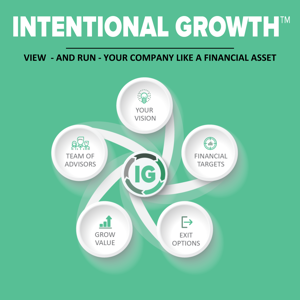
Intentional Growth™ is a podcast is a podcast for entrepreneurs and business owners wanting to view - and run - their company like a financial asset so they can have fun, create wealth, and make an impact. Truly make the entire journey of owning and running a company "worth it".