Intentional Growth

Intentional Growth

By Arkona - Intentional GrowthBusinessEntrepreneurshipInvestingManagement
Download on the App Store

Intentional Growth episodes

  • #204: Selling Better World Books (One of the First B-Corps) to the Creator of Amazon's Alexa with Xavier Helgesen
    Xavier shares how he created a company that impacted the world, donated $20M+ to global literacy, maintained double digit growth for years and sold to a charity founded by the creator of Amazon's Alexa for millions of dollars.
    What You Will Learn in Today’s Podcast Interview:
    How and why Xavier sold his company to the creator of Amazon’s Alexa
    A framework to evaluate what problems in the world you connect with
    What a B Corporation is and how it works
    How rapid growth can lead to needing an investor
    Why Xavier would have had more options if he grew at 25% CAGR instead of 40%
    Xavier’s views on the “Triple Bottom Line”
    The value of transparency and public commitments
    How to approach working with venture capital
    How to integrate Conscious Capitalism into your business model
    How a strong mission and vision can lead to outsized long-term growth
    How to align your company’s vision and mission with a buyer
    How to learn and approach the sale of your company as an entrepreneur
    Tips for founders on how to pass along knowledge in your company
    Podcast Summary:
    What does it mean to bake your mission and vision into all aspects of your company? The guest on today’s episode, Xavier Helgesen, explains to us just how he did that as the Co-founder of one of the first B Corporations, Better World Books. B Corps formally combine public interest goals with profit earning throughout their business model—other B Corps you may know include Patagonia and Tom’s Shoes. Xavier shares how Better World Books raised over $20 million dollars for global literacy and donated tens of millions of books, while also maintaining double digit growth 15 years in a row. The company’s rapid growth led them to take on investors and ultimately sell to a charity, which is unique in and of itself, but the charity also happened to be founded by the creator of Amazon’s Alexa. Today’s episode hits home the power of building a company while intentionally linking it to the life you want to live. The underlying values and mission of a business can range from charity work to financial stability, and Xavier emphasizes the added growth a business can experience by integrating that mission into the company’s cost and future plans. This conversation focuses on how to intentionally align a social cause with a company’s mission at each stage of starting, growing, and selling a business—it is an inspiring story of how a “conscious capitalism” oriented company proves that good business is not just good marketing.
    About the Guest:
    Xavier Helgesen is an entrepreneur, technologist, global citizen, and builder of world positive companies. He co-founded Better World Books, the first ever b-corporation. Better World Books is an independent online bookstore with a unique triple-bottom-line mode
    59 min
  • #203: 3 Steps to Reset Your Sales Strategy & Reach Your Ideal Clients with Gary Braun
    If your sales team is just calling and "checking in" with your customers and waiting for things to get back to "normal", and you need to kick your revenue generation back into gear, then this episode is for you.
    What You Will Learn in Today’s Podcast Interview:
    Analyze where opportunity is for revenue
    Discuss how to put short-term sales plans into place
    Examine quota and compensation adjustments
    Review how to effectively make adjustments
    Revise sales process(es) and messaging
    How COVID has changed the sales landscape
    The right and wrong way to check in with customers and clients in the current environment
    How to determine how customers’ needs have change using the ladder of inference
    How to remain flexible in order to adapt to new sales and revenue generating opportunities
    How to find the markets that have been impacted COVID
    The importance of telling employees at all levels the “why” and “how” of any significant changes in your got to market strategy
    Strategies to model, reinforce and celebrate new behavior of employees that corresponds with short-term goals
    Why the value creation mindset should play a role in today’s decisions on short-term issues
    Podcast Summary:
    Customer needs, traditional selling strategies, and business challenges have all changed.In this episode, Gary Braun the founder of the strategic sales consulting firm Pivotal Advisors, clearly explains the power of
    1 hr 2 min
  • #202: Lessons Learned from Growing a Company from $0 to $100M+ and Selling to a Private Equity Firm
    Chris accomplished what many entrepreneurs strive too and is willing to share what strategies grew value, his successes along the way and what he would do different if he were to do it again.
    What You Will Learn in Today’s Podcast Interview:
    How Chris grew his company to over $100M in revenue without debt
    Why Chris was able to get all his cash up front when selling to Private Equity
    The difference between enterprise value, equity value and net proceeds
    How Chris shifted his mindset away from only top line revenue to long term value creation
    How to identify the key value drivers in your business
    How to reduce client concentration and why it pays off
    How one’s willingness to evolve and stay relevant are keys to success
    Why passion can get you started but value growth education will get you to the top
    The importance of differentiation and how to make your company invaluable to your customers
    Why betting on yourself as an entrepreneur can have the biggest ROI
    Where to spend your time and energy educating yourself as a business owner
    The biggest differences between Strategic Buyers and Financial Buyers
    Chris’s grueling experience going through due diligence when selling
    Why a culture of trust and integrity is hard to quantify in the valuation (it’s not on the spreadsheet)
    Podcast Summary:
    In today’s episode, Chris Carlson shares how his passion for driving snow mobiles let him to starting Sportech—the company’s original product protects the lights of snow mobiles from snow in order to see clearly while driving. Chris tell his story about how he adapted the business to match the changes in the market, invested time and resources to further his own knowledge—including joining a peer group, understanding value growth, investment banking, and implementing EOS—and what he learned from his experience selling Sportech to private equity. Chris went on to grow the company to over 100 million dollars in annual revenue, diversifying their products and target markets along the way. After successfully growing the company over 15 years, Chris sold Sportech to a private equity firm in November 2019 and received all of his cash up front.I’m excited about today’s episode because Chris’s story clearly explains how investing in yourself as an entrepreneur can lead to long-term success, as well as illustrating the many aspects of selling a business he wishes he knew at the time. We get to benefit from Chris’s experience as a business owner who accomplished what many people strive to achieve, while also recognizing that even incredibly successful companies and owners can benefit from understanding value growth with your end goals in mind, the difference between financial and strategic buyers, and the key components needed to approach a sale.
    Go to ARKONA.IO/Assessment or text 66866 to take a two-minute, twenty question assessment that we’ve created to help you shift your mindset and focus on value-creating activities that will help you get what you want with your business.
    Sign Up For The Mastering Your Cash Flow Video Series
    We created a video series called
    1 hr 22 min
  • #201: The Current and Future State of Business Valuations
    Today I’m talking with returning guest and the CEO of Prairie Capital, Dave Deihl. Prairie Capital is one of the leading ESOP, mergers and acquisitions, and business valuations firms in the country. Dave and his firm have eight locations across the country, perform about 400 valuations annually, and are major leaders in the ESOP community.
    In this episode, Dave will share his thoughts and opinions on business valuations now and in the near future, what uncertainty can do to an economy and business valuations, and how all of this compares to third-party sale evaluations.
     What You Will Learn in Today’s Podcast Interview:
    Thoughts Dave on the economy based on 350+ annual valuations
    Will COVID-19 be an add back in valuations or not?
    The difference between financial valuations vs. strategic valuations
    The practice of valuations and ESOPs and what the pandemic has done to it
    The major concerns that people are looking at as they’re looking at the ability of a company to borrow
    Dave’s thoughts on the current state of uncertainty when forecasting business revenues
    When is the lack of consumer spending going to catch up to us?
    The building blocks that Dave recommends working on right now to build a healthy business
    How uncertainty in our economy, banking, and the American consumer impacts business valuations
    The impact of COVID-19 on financing merger & acquisition transactions
    What Dave thinks the M&A market will look like in the next six to twelve months
    What the word “intentional” mean to Dave
    Podcast Summary:
    COVID, the nationwide quarantine, social unrest and supply chain issues are easy-to-understand examples of how unknowns directly impact business valuations. So far 2020 has really taught us what truly sustainable, predictable, and transferable cash flow looks like.
    My guest today is Dave Diehl, CEO of Prairie Capital  – one of the nation’s leading ESOP and M&A firms.
     
    Dave and his firm have 8 locations across the country and perform over 400 business valuations annually, many of which are repeat ESOP valuations. Dave is the perfect guest to talk on this topic because of his company’s exposure to a huge variety of industries and hundreds of annual valuations. They have a real live look into how COVID is impacting balance sheets and future forecasts. ​​Dave also shares with me some great insights about how 3rd party strategic buyers, Private Equity Firms and banks who finance transactions are viewing the market and how that is impacting deal structures and valuations. 
     
    This is a great episode to help shift your mindset to rebuild or refocus on strategies that will de-risk your future cash flows, grow value and build a business that gives you options do
    1 hr 6 min
  • #200: Life After Business Is Now Intentional Growth: The Story Behind 200 Episodes & the Name Change
    The 200th episode of the “Life After Business” podcast is a transformation into the first episode of “The Intentional Growth” podcast. Today, my business partner, Pat Hobby, interviews me and asks me about the name change, what I’ve learned over these past 199 interviews, and a little about my background. This episode is all about being authentic and real.
    I have no intention of stopping the momentum that this podcast has gained over the last four years. I’ll continue to have great guests, interesting and relevant topics, and I’m hoping to have an even bigger reach in the future. I have a deep passion to learn (maybe to a fault) and love to hear people’s stories from all walks of life. I hope you continue alongside me in my journey to learn how we can use businesses to change the world and lives we touch.
    What You Will Learn in Today’s Podcast Interview:
    What I've learned and the big takeaways from 199 interviews
    My journey and experience trying to live what I've learned
    My original goals with the “Life After Business’s podcast
    Why “The Intentional Growth” Podcast name change? 
    What intentional growth means to me (in business and life)
    The consequences of instant gratification as a business owner
    What ARKONA does to help business owners
    What I think this pandemic is going to do to business owners’ mindsets
    The biggest lessons I have learned in the last four years of doing this podcast
    Main takeaway/Why I Liked the Episode:
    With everything that is going on right now, I seriously considered postponing the 200th episode and name change. However, I believe what we need right now more than ever in our country and society is intentionality. ​This is even more true for business owners and leaders. 
    After four years and 199 episodes ​​I decided to change the name of the show to better reflect what I’ve learned. 
    Owning a business is not about waiting to have a “life after the business”. It is about intentionally engineering the life you want around the business (whatever that might look like from a role and ownership perspective).  
    The most successful (using my definition) and happy business owners knew who they were, what they wanted from their business and why (credit to Bo Burlingham’s interview #16). 
    They were intentional. 
    The only way to be more intentional is to learn; to learn more about what is possible and the different ways your journey as a business owner can unfold.  
    The clearer you are about what you want (because you’ve fully explored the options and possibilities) the more at peace you can be with the plan you have and they choices you make. 
    When you get knocked off track, thrown a curve ball and have to reassess. It becomes easy to get back on track because you can recalibrate your strategies and actions against your long-term plan. 
    I have a deep passion to learn (maybe to a fault) and love to hear people’s
    50 min
  • #199: How to reinvent yourself in times of transition and find your life's purpose
    This is officially the last episode of this podcast under the name of “Life After Business.” Starting with the next episode, this podcast will be renamed, “Intentional Growth” and it will be all about how to grow the value of your company with the end in mind.
    In today’s episode, I’ll be talking with entrepreneur and author, Mike Lee. We’ll be talking about how to reinvent yourself in times of transition and how to find your life’s purpose.
    What is your purpose and what are your definitions of success in your key roles as a human being? These descriptions represent your requirements. That way when a new opportunity does arise you have something to evaluate it against. Without this intentional work you are at risk of taking the next thing that comes your way and missing the opportunity of a lifetime: you risk not fulfilling your true God-given purpose.
    What You Will Learn in Today's Podcast Interview:
    Mike’s personal and professional backstory
    The importance of purpose and how to write our life purpose statement
    Live life backward from your obituary
    How to get unstuck if you are not feeling good about the work you are doing
    How to identify if your ego has crept into your role as a leader
    Why retirement is a false and misleading mindset (especially for entrepreneurs)
    How to lean into tough times, use your creative thinking and find your life’s purpose
    How to get over yourself and fix your situation
    How to look deeper into the meaning of your role as an owner and leader
    Life is a balancing act and there is no perfect situation
    How to determine where your true identity resides
    How to avoid the frying pan all together, and get intentional before something bad happens
    What is false retirement?
    Overcoming stress and fear in order to become intentional
    Main takeaway / Why I liked the episode –
    Mike is the perfect guest to talk about intentional professional rebirth and the intentional journey of building something. With COVID as our catalyst, now is the time to define what you want out of your business and what your true purpose in life is.
    Remember that next week’s episode is going to be the first of “Intentional Growth.” Check out our Intentional Growth Assessment on our website. Go to ARKONA.IO/Assessment or text 66866 to take a two-minute, twenty question assessment that we’ve created to help you shift your mindset and focus on value-creating activities that will help you get what you want with your business.
    Sign Up For The Mastering Your Cash Flow Video Series
    We created a video series called Mastering Your Cash Flow that helps you get clear visibility into your cash flow and build a financial strategy that allows you to capitalize on the future opportunities that come from the crisis
    What You'll Learn in the Mastering Your Cash Flow Video Series
    How to Build a 13-Week Cash Flow Statement: Get clarity on where and how your cash is coming from and being used and then build a plan to manage it wisely. Learn how to build a 13-week cash flow statement from the top CFOs in the marketplace.
    How to Build and Revise Your 2020/21 Budget and Forecast: 2020 and 2021 are most likely not going to look like you thought they did back when you built your budget and forecast. Learn how to model out different scenarios using forecasting best practices.
    58 min
  • #198: From Freelancer to Selling to a Private Equity Firm: How to Grow Long-Term Value
    On today’s podcast, I’m talking with Lloyd Wolf. We’re talking about how he took his freelance IT company and turned it into a full-time IT service company. Not only did this take talent and know-how, but it also involved a change in his mindset. We also get into how a peer group helped him focus on the right things, how he shifted his mindset from annual profit to EBITDA and value creation, and how and when he realized that he “made it”.
    We are entering a new normal with Post COVID but the guest on the show today has lived through various business models, recessions and he was still able to eventually get what he wanted from the business. Lloyd was VERY intentional with his strategies and where he was spending his time, energy and money.
    It’s official, I’ll be changing the name of this podcast from the Life After Business Podcast to The Intentional Growth Podcast. We’ll be launching the change on the 200th episode. It has been a huge decision for me because, after all these years, I’ve grown as an individual as I’ve learned about valuations, value growth, even more about business, the economy, just tons of personal and professional growth. My original and current desire for my listeners is for you to be able to get all the information you need in order to make your own decisions so you can choose your own adventures. That comes down to being intentional.
     
    What You Will Learn In Today's Podcast Interview:
    Our definition of a successful entrepreneurial journey
    How to shift your mindset from being an accidental entrepreneur to an Intentional entrepreneur
    The 3 things most important things to help you get intentional and successfully get what he wanted out of and exit
    How Lloyd used CEO Peer Groups as a way to level up his game
    What happens after you shift your mindset away from solving for annual profit to solving for long term value creation
    How to remove yourself from the day to day of the business
    Ways to calculate your financial freedom number WHILE you own the company
    The difference between enterprise value and net proceeds
    Why different buyers want different things
    How to analyze the motives of the buyer against your personal drivers and financial targets
    How to create a “deal package” even if you don’t plan to sell for years
    What to do say when you get those phone calls and someone wants to “offer you a ton of money”
     
    Main takeaway:
    I believe you can get what you want from your business on all fronts. It’s going to take hard work but--I promise you--it’s worth it. Go to ARKONA.IO/Assessment or text 66866 to take a two-minute, twenty question assessment that we’ve created to help you shift your mindset and focus on value-creating activities that will help you get what you want with your business.
    Sign Up For The Mastering Your Cash Flow Video Series
    We created a video series called Mastering Your Cash Flow that helps you get clear visibility into your cash flow and build a financial strategy that allows you to capitalize on the future opportunities that come from the crisis
     
    What You'll Learn in the Mastering Your Cash Flow Video Series
    How to Build a 13-Week Cash Flow Statement: Get clarity on where and how your cash is coming from and being used and then build a plan to manage it wi
    1 hr 16 min
  • #197: Forecasting the Recovery & Cutting Through the Noise with ITR Economics
    Today we’re going to be talking to Alex Chausovsky from ITR Economics, which is a world-renown Economist forecasting and consulting company which works with some of the top mid-market companies and is heavily involved in nationwide CEO Peer Groups like Vistage using their data.
    A year and a half ago I had him on the show to discuss their short and long -term economic forecast. One of ITR Economics’ main theses has been a slight downturn in the early 2020’s and then a great depression in 2030.
    Since I had him on, we’ve had a worldwide pandemic that has decimated our global economy. A lot of the things we discussed in the first interview like the demographic shifts and some of the variables that go into their 2030 great depression forecast are still relevant. I figured it was time to get him back on the show to explain how our current situation impacts their forecasts and what they think the future holds.
     In today’s episode because you’ll learn –
    About Alex Chausovsky and his background
    The leading indicators to track and measure the health of the economy
    How deep and how long the economic pain will be
    Will experience a V-shaped or U-shaped recovery?
    The implications of the Federal Reserve printing money
    How corporate and consumer debt affects the recovery period
    ITR Economics forecast for the rest of 2020/21
    How the pandemic impacts ITR’s 2030 prediction
    What ITR’s forecast is on the job recovery
    The 90% economy
    How are new normal is impacting valuations
    Their forecast on unemployment in 2021
    What companies can be doing right now to weather the storm and set themselves up for the long term
    How to view rates of change
    What ITR is using to predict how the virus is
    Alex’s view on the potential to have inflation
    How consumer’s behavior will impact our recovery 
    Main takeaway / Why I liked the episode –
    One of the best things you can be doing is figuring out how to build that bridge between now and the future, over the course of the next 18 months. That all starts with education. There are two ways we hope to help you get clear, get intentional, and get going:
      1.)    Mastering Your Cash Flow – Video Series
    How To Build A 13-Week Cash Flow Statement
    Get clarity on where and how your cash is coming from and being used and then build a plan to manage it wisely. Learn how to build a 13-week cash flow statement from the top CFOs in the marketplace.
    How to Build And Revise Your 2020/21 Budget And Forecast
    2020 and 2021 are most likely not going to look like you thought they did back when you built your budget and forecast. Learn how to model out different scenarios using forecasting best practices.
    c. Create A Strategic Plan to Grow Company Value
    Increase the chances you come out of the gates and capitalize on the future opportunities when our new "normal" sets in. Start thinking about how you can create a strategic plan to grow a valuable business that gives you choices.
     2.)    Intentional Growth™ Digital Course
    Because of the current situation, Pat and I are working on a digital video course on the Intentional Growth™ 5 Principles. It will be the best of our material that we have in our 2-day Boot Camps that normally costs 5k for $295. Text the word Intentional to 66866 to get on the waiting list of the digital course.
    We’ll teach you how to build a valuable company with the end in mind using our 5 Intentional Growth™.
    In pr

    1 hr 10 min
  • #196: Solving Problems Through Payroll: How to Separate Your Management Role from Ownership in a Family Business
    Today, Sara Stern is talking with me today about the family business circle, her experience in family businesses, The Sage Pages, the Matilda Impact, family business statistics and what that means for your business, how ‘fair is not always equal,’ and what successful family businesses have in common.
    So many businesses (family-owned or not) hit their ceiling because the owner/founder cannot separate their ownership role from their management role. Because so many owners don’t truly understand business valuations and how to identify what their biggest asset is worth, they try and solve interpersonal problems with what is tangible, and they understand… payroll. Salaries become the default mechanism to “treat everyone fairly” or keep the peace. When in reality this can be one of the most toxic mistakes to make.
    I truly believe conflict can disappear once a business owner understands how companies are valued and have boundaries which clearly define value management roles should be bringing along with the correct pay. This DOES NOT mean that hard conversations will disappear, it just means that the chances of growing a valuable business that lasts generations will increase along with family harmony.
     
    What will you learn in today’s episode:
    Sara’s background and her experience with business
    What Sara got from working at Target
    The three-circle model of family business are:
    Ownership
     Business
     Family
    What the Matilda impact is and how to use it to address the family freeloader
    Why 90% of first-generation business owners are in all three circles
    The excuses first-generation owners
    Why fair is not always equal
    What the successful family businesses to make it in the 3% of companies that beat the odds and survive three generations
    How to shift your mindset and reinvent the family business if you are sick of waking up for grandma’s legacy
    How to work through family conflict and lean into
    How to break through false assumptions you have about your family and the business
    How to create a family purpose statement
    How to review, hire and work with a solid team of advisors and deselect the ones that don’t get it
     
    Main takeaway:
    Education can solve a lot of problems. There are two ways we hope to help you get clear, get intentional and get going:
      1.)    Mastering Your Cash Flow – Video Series
    How To Build A 13-Week Cash Flow Statement
    Get clarity on where and how your cash is coming from and being used and then build a plan to manage it wisely. Learn how to build a 13-week cash flow statement from the top CFOs in the marketplace.
    How to Build And Revise Your 2020/21 Budget And Forecast
    2020 and 2021 are most likely not going to look like you thought they did back when you built your budget and forecast. Learn how to model out different scenarios using forecasting best practices.
    c. Create A Strategic Plan to Grow Company Value
    Increase the chances you come out of the gates and capitalize on the future opportunities when our new "normal" sets in. Start thinking about how you can create a strategic plan to grow a valuable business that gives you choices.
     2.)    Intentional Growth™ Digital Course
    Because of the current situation, Pat and I are working on a digital video course on the Intentional Growth™ 5 Principles. It will be the best of our material that we have in our 2-day Boot Camps that normally costs 5k for $295. Text the word
    1 hr 2 min
  • #195: What's Going to Get You Ahead is Your People: How One Entrepreneur 4x His EBITDA
    A huge challenge I see business owners encountering right now is the decisions that need to be made on how to balance the interests of one’s people and culture while also recalibrating their operations and cost structure to potentially a new revenue and profit norm.
     
    Today I’m talking with successful author, speaker, and entrepreneur Chris Meroff. He has built his company, and Private Equity Firm, into a thriving a place of cutting-edge ideas for company culture. Chris shares how he quadrupled his EBITDA as a result of embracing his employees and focusing on ways to release their inner greatness. By optimizing for ways to increase the median employee salary he literally lifted everyone up in the process. 
     
    What will you learn in today’s episode:
    How Chris has more than quadrupled their EBITDA by focusing on his employees and leaders
    How Chris scales his companies by focusing one KPI – increasing his employee’s median income
    Why Chris would give up millions instead of laying off 10% of his workforce
    How to harvest your employees’ greatest gifts and nurture their inner greatness
    How to abolish the 2 things that can erode profits and employees’ mental states
    How to unleash your people like never before
    Culture is the sum of everyone’s world views
    How to create a company purpose statement and engrain it in your culture
    How to use the company purpose statement as a line in the sand to make decisions
    How to create a culture that you can measure and monitor
    How to align your culture and financials
    The difference between entrepreneurs who are “hobbyist” and those who are growing an investment
     
    Main Takeaway:
    We cannot forget that businesses are made up of employees and people. Not only do we have to treat our employees well, but how we treat them and what we do right now (as a business-owner) will impact the future viability of our business. The leaders that are able to maintain the financial health of their business, while also keeping their culture and leaders intact are going to come out of this with a competitive advantage that I don’t think others are going to have. Employee growth, value growth, and the ability to have more options and freedom down the road are all linked to financial and business success. All of that come from a place where you are make clear, intentional decisions about your employees and company.
     
    About Chris:
    Chris Meroff built his company into a thriving laboratory of cutting-edge ideas for company culture. He wanted people to be seen for who they really are so that they can be fulfilled personally and professionally, either as a leader or an employee. His aim was to show his staff that there's more to their jobs than just giving up time with friends, family, and hobbies. With an emphasis on integrating work and life, Chris proved that the result can be fulfilling and rewarding. Establishing these roots of fulfillment in all of his endeavors became his life’s work.
    Today, his companies employ over 200 people and all of them are quick to say that the culture there is unlike any other. This unique culture clearly shows that Chris’s Alignment Leadership model of pursuing fulfillment and developing people rather than skills is flourishing. Not just because the financials say so, but because the people themselves do.
    Chris’s first book,
    56 min

About Intentional Growth

From the publisher's feed

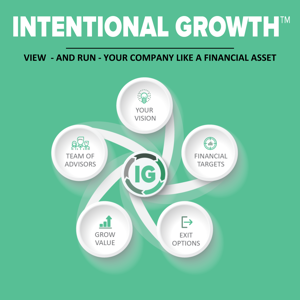
Intentional Growth™ is a podcast is a podcast for entrepreneurs and business owners wanting to view - and run - their company like a financial asset so they can have fun, create wealth, and make an impact. Truly make the entire journey of owning and running a company "worth it".