Intentional Growth

Intentional Growth

By Arkona - Intentional GrowthBusinessEntrepreneurshipInvestingManagement
Download on the App Store

Intentional Growth episodes

  • #234: $0 to $10 Million in Four Years: How One SaaS Start-up Scaled & Sold Without Outside Capital
    Hitting on all cylinders requires focus and intention. Terri Soutor, CEO of FastBridge, recognized that early on and chose dedicated partners who had a great idea and, through amazing service, could deliver high value to their target clients. This approach scaled their SaaS-based business 10x over four years, without having to raise outside capital, before ultimately selling to the perfect strategic buyer. Terri shares the strategies behind their exponential growth and what they did to maintain their mission, vision and values along the entrepreneurial journey.
    What You Will Learn In Today's Podcast Interview
    How the University of Minnesota’s Venture Center helped fund and launch Terri's EdTech startup, FastBridge.
    The differences between academics and business, why it’s hard to commercialize ideas and research, and how FastBridge solved this problem.
    What FastBridge did to market and monetize their research.
    Strategies to increase up-front payments from clients to fund company growth.
    What FastBridge did to bootstrap their growth from 0 to 10 million dollars within 4 years.
    How FastBridge maintained 70-80% margins without sacrificing their high-quality service.
    Why knowing your ‘magic number’ way before an exit is crucial.
    How to stay true to the original vision of your business while getting ready to exit.
    Terri’s definition of managed growth and how it applies to any industry.
    What Terri and her partners did to correct dissonance when things became less ‘fun’ and different priorities started competing for resources.
     
    Are You Growing The Value of Your Business
    Take The 2-Minute Assessment To Get Your Intentional Growth Score™ And 1-Page Vision Board.
    Are your company's current initiatives intentionally designed to increase the value of the business?
    Do you know what you want from your business long term and why?
    Do you know what your company is worth?
    Do you know the differences between Management, Family Transitions, PE Firms, ESOPs and Strategic Buyers?
    Does the business have a written strategic plan on how to achieve the desired normalized EBITDA and valuation?
     
    About the Guest:
    Terri Soutor is a talented C-suite leader and strategist skilled at building and growing SaaS companies.She took FastBridge Learning from zero to 10 million USD in a four-year span, earning it the rank of second fastest-growing private company in the Twin Cities. Because of her efforts in her field, Terri made the list of The Real Power 50 by Minnesota Business and received the Titan of Technology award from the Minneapolis / St. Paul business journal. She is still dedicated to her original mission of improving teaching and learning in schools through effective, evidence-based innovations in education.
     
    Quotes:
    22:20 - “But at the end of the day, the research basis and the quality of the product was what was fundamental to the go to market.” – Terri Soutor
    31:20 - “We grew really fast. How do we make sure that we weren’t getting out over our skis? So there was a constant rebalancing that I was doing in terms of how we were investing the dollars that we were earning through sales.” – Terri Soutor
    35:55 - “We were very intentional of our mission, our goals, and our values.” – Terri Soutor
    36:08 - “Before we talked about anything around the business, we talked about mission, purpose, and values and what kind of business we wanted to build
    1 hr 29 min
  • #233: Dominate Your Industry By Increasing Your Revenue Per Employee with Daniel Marcos
    Daniel Marcos, Co-Founder of Growth Institute, talks about what drove him to write ImpactX, a book about the four stages of a business, and how the age-old metric of revenue per employee can be the best indicator of the overall health of your company. However, he also found limits on the number of employees you should have for each stage if you want to avoid some seriously adverse effects. Find out why Daniel says 12 is the perfect number of employees for "profit and drama" and why you should jump from 12 to 60 if you want to have an industry-dominating business.
    What You Will Learn In Today's Podcast Interview
    The
    The magic number of employees that brings the perfect balance of cash flow and drama
    How three phone calls led to one of the fastest-growing coaching businesses in the world.
    Daniel’s incredibly interesting founder story, including one of his favorite early successes of how his online trading business was acquired within six months by Argentina's then-largest financial player.
    How Daniel paid off $1 million in debt and started his coaching business.
    Why Daniel partnered with Verne Hardish (founder of EO and Scaling Up) to create Growth Institute.
    The four stages of every business, from his book ImpactX.
    How to assess and use the metric of revenue per employe
    Why the complexity of a business exponentially grows as employee count grows and what you can do to manage the challenges.
    The importance of creating space to think as an owner.
    How to create systems that make ‘everything float’ and why this is a double-edged sword if you’re not ready for it.
     
    Are You Growing The Value of Your Business
    Take The 2-Minute Assessment To Get Your Intentional Growth Score™ And 1-Page Vision Board.
    Are your company's current initiatives intentionally designed to increase the value of the business?
    Do you know what you want from your business long term and why?
    Do you know what your company is worth?
    Do you know the differences between Management, Family Transitions, PE Firms, ESOPs and Strategic Buyers?
    Does the business have a written strategic plan on how to achieve the desired normalized EBITDA and valuation?
     
    About the Guest:
    Daniel Marcos is CEO and Co-Founder, alongside Verne Harnish, of Growth Institute, the leading online executive education company for C-level executives at fast-growing firms. In less than a decade, Growth Institute has been recognized among the top 5,000 fastest-growing companies in the USA, with over 40,000 members across 64 countries. Daniel is a keynote speaker and a CEO Coach, with a mission to help one million entrepreneurs scale their impact and reduce drama in the process.
     
    Quotes:
    17:42 - “The biggest mistake we make as entrepreneurs is that we believe our business and ourselves are the same thing. So if your business is a failure, we believe that we are a failure.” - Daniel Marcos
    30:28 – “No one really teaches you how to be a CO.” – Daniel Marcos
    36:32 – “The average mid-market business in the US does an average of $120,000 in revenue per employee, per year.” – Daniel Marcos
    47:35 – “Scaling up makes everything float, and some stuff stinks.” – Daniel Marcos
    49:20 - “Business is made out of people and people are messy.&
    57 min
  • #232: My Vanity Metric is Cash Flow: How SureSwift Capital Acquired 38 Businesses in 5 years
    By focusing on the right metrics, like cash flow and enterprise value, and combining these with the right strategies and use of capital, Kevin McArdle was able to quit corporate America and buy a couple of small online businesses that he snowballed into a portfolio of 38 highly profitable SaaS companies doing eight figures in revenue. Tune in to hear how he did it and what Kevin and SureSwift Capital are doing to take their growth to the next level.
    What You Will Learn In Today's Podcast Interview
    Why Kevin left corporate America to start acquiring businesses.
    SureSwift Capital’s unique business model that flies in the face of traditional private equity firms.
    How SureSwift Capital went from buying $50k websites to multi-million-dollar businesses.
    Why Kevin and his partners decided not to raise money for a fund — at least with the first 38 companies — and why they’re raising funds now.
    How Kevin finds SaaS companies to buy that are highly profitable, inherently more risky and highly scalable.
    The best ways to use the profits of a company to fund organic growth and acquisition.
    Why acquisitions are a team sport.
    How to buy a business and get your money back in 24 months.
    Why the smartest entrepreneurs make it their job to replace themselves.
    How SureSwift Capital creates more valuable companies after they make an acquisition.
    Questions to ask if you are talking to private equity or another professional business buyer.
    How information asymmetry impacts the deal negotiation.
     
    Are You Growing The Value of Your Business?
    Take The 2-Minute Assessment To Get Your Intentional Growth Score™ And 1-Page Vision Board.
    Are you company's current initiatives intentionally designed to increase the value of the business?
    Do you know what you want from your business long term and why?
    Do you know what your company is worth?
    Do you know the differences between Management, Family Transitions, PE Firms, ESOPs and Strategic Buyers?
    Does the business have a written strategic plan on how to achieve the desired normalized EBITDA and valuation?
     
    About the Guest:
    Kevin McArdle is the co-founder and CEO of SureSwift Capital, which acquires SaaS businesses from independent founders and takes them to the next stage of growth. They acquired 38 businesses within five years and recently completed the raise of their first private equity fund for their next investment. 
    Kevin’s passion for personal relationships and driving business results are at the heart of SureSwift’s impressive growth to date. Prior to founding SureSwift, Kevin was a Vice President at Cerner Corporation, a global Healthcare IT firm. In his 15-year tenure at Cerner, Kevin held positions in sales, sales leadership, operations, general management, and client management, eventually becoming one of the youngest Vice Presidents in the company’s 35 year history.
     
    Quotes:
    11:15 - “We’re buying businesses that are inherently riskier than a brick-and-mortar business. There are no assets to be auctioned off.” – Kevin McArdle
    12:22 - “Buy-and-hold is a strategy for us, it’s not a religion.” – Kevin McArdle
    19:04 - “Being burned once or twice are always good lessons. Making mistakes are always good lessons. Working has really taught me more than just sitting in a classroom and learning about business.” – Kevin McArdle
    23:30 - “There’s this odd segm

    1 hr 14 min
  • #231: Why Buying and Selling Companies is a Barbaric Sport with Elliott Holland
    Today's M&A game isn't played by timid people—it’s a dog-eat-dog world out there and you need to know what it takes to thrive. Enter Elliott Holland. On today's show, we talk strategy when competing in the barbaric sport of buying and selling businesses. Learn what makes different investors invest, what they’re looking for in deal terms and how to expertly share the risk during negotiations. This episode is an absolute must for any business owner looking for funding or considering becoming an investor or buyer themselves.
    What You Will Learn In Today's Podcast Interview
    How buyers think about the risk of a company.
    The crucial role trust plays in closing a deal.
    The difference between a buyer-centric structure and a deal-centric structure.
    What happens after an LOI (letter of intent).
    Why being light and humble about predicting future cash flow can be a good thing.
    How  buyers assess a seller’s determination to closing the deal.
    The biggest ‘gotchas’ sellers should look out for.
    How buyers handle risk through price and terms.
    The difference between deal breakers and surprises.
    Why Elliott calls the purchase price the ‘country club’ number and how you can overcome it.
    The three different types of concentrations to be aware of (vendor, employee and customer) that can reduce the value of a company.
    How working capital plays into closing the deal.
    The benefits of sharing risk with the person across the table, rather than making them your enemy.
    Are You Growing The Value of Your Business
    Take The 2-Minute Assessment To Get Your Intentional Growth Score™ And 1-Page Vision Board.
    Are your company's current initiatives intentionally designed to increase the value of the business?
    Do you know what you want from your business long term and why?
    Do you know what your company is worth?
    Do you know the differences between Management, Family Transitions, PE Firms, ESOPs and Strategic Buyers?
    Does the business have a written strategic plan on how to achieve the desired normalized EBITDA and valuation?
     
    About the Guest:
    Elliott Holland has more than 10 years of experience executing middle market deals as an entrepreneur, spending his own money on diligence. He fully understands the challenges in executing good deals and avoiding lemons. He trained at Harvard Business School and spent almost a decade as an independent sponsor and business buyer before starting Guardian Due Diligence. The firms he has worked for have completed billions of dollars in transactions and have successfully bought and scaled over 57 private, primarily owner-operated businesses. Elliott has experience on both sides of the table—on the entrepreneurial side raising capital and the investor side spending it wisely. He is one of the few deal guys with deep experience doing both, which allows him to better think through complex buyer-seller issues. Elliott also holds a Bachelor of Science in Mechanical Engineering from the Georgia Institute of Technology, a Bachelor of Science from Morehouse College, where he was Phi Beta Kappa, and an MBA from the Harvard Business School.
     
    Quo
    1 hr 16 min
  • #230: How One Woman Raised Millions in a World Where Men Control the Capital with Sarah Dusek
    Having a dream and hustling are not always enough to reach your full potential—capital is required to fuel that growth! Sarah Dusek shares how she raised $17 million for a minority stake in her industry-pioneering 'Glamping' company, Under Canvas. She sold it only a few years later to Private Equity for a hefty ROI. Now Sarah wants to change the investment landscape for women entrepreneurs, who receive only 2% of all available funding each year in the US. To help fix this problem, Sarah became a venture capitalist to provide women and entrepreneurs in South Africa access to these funds. Here’s her story, and how she is using business and capital to make an impact on the world. 
    What You Will Learn In Today's Podcast Interview
    The truth behind why it’s so hard to access capital and break into “the club.”
    How turning down $7 million got Sarah $17 million instead.
    The value of really knowing the business you’re in and understanding what’s valuable to someone else when deciding to sell.
    Why, despite being pioneers in the industry and building their own tents, Under Canvas chose not to sell the tents they made as a new revenue stream.
    How anger drove Sarah to becoming a venture capitalist and the success she’s seen investing in the underserved market she came from.
    What metrics people need to know when working with business buyers and investors to make your business an appealing investment as well as a sustainable operation.
    The broken environment of capital allocation, including the fact that only 2% of venture capital is given to women each year in the US — and what Sarah’s doing to change that.
    How to evaluate the type of capital you’re receiving, as well as the source, to see if it’s a match for you.
    Selling your company doesn’t mean the end of all things. Capital (from the sale) allows you to “dream another dream” and solve another problem.
     
    Are You Growing The Value of Your Business
    Take The 2-Minute Assessment To Get Your Intentional Growth Score™ And 1-Page Vision Board.
    Are your company's current initiatives intentionally designed to increase the value of the business?
    Do you know what you want from your business long term and why?
    Do you know what your company is worth?
    Do you know the differences between Management, Family Transitions, PE Firms, ESOPs and Strategic Buyers?
    Does the business have a written strategic plan on how to achieve the desired normalized EBITDA and valuation?
     
    About the Guest:
    Sarah is Co-Founder of Under Canvas, the leading US adventure-hospitality company that offers luxurious glamping accommodations just minutes from America’s most popular and iconic national parks. In 2017, under Sarah’s leadership, Under Canvas received a spot on the coveted Inc. 5000 list and Sarah was named to the EY Entrepreneurial Winning Women list from Ernst & Young. Under Canvas has set an unprecedented standard in ecological development while also redefining experiential hospitality in a meaningful way. She later sold it in order to launch the next great mission of her life: to help grow scalable, sustainable businesses that have the power to transform
    1 hr 20 min
  • #229: Curating Your Life: How to End the Struggle for Work-Life Balance
    On today’s show, Gail Golden, MBA, Ph.D. and author of "Curating Your Life", and I, get into a discussion about energy management versus time management, and why there is no such thing as work-life balance. Knowing we have 168 hours in which to live our lives each week, this episode focuses less on the fallacy of “making more time” and instead reframes the conversation around how you choose to spend that time, why you should embrace mediocrity in the things that don’t serve you and how to cut to the quick of long-term goal planning through three basic questions: 1.) Are you having fun and enjoying what you’re doing? 2.) Are you making the impact you want? 3.) Are you creating more wealth and value in your business?
    After this episode, you’ll be able to start the process of identifying what you eventually want out of your business and your life, re-curating your current situation, identifying how you should spend your time, and how to intentionally create the business and the life that you want. Through the practical exercises she has for you as well as her no-nonsense attitude, you will be able to start this journey of professional (and personal) self-discovery, which will lead you to a more intentional life.
    The most important takeaway from this episode is the fact that how you spend your time will directly impact what you get from your business and your life.
     
    What You Will Learn In Today's Podcast Interview
    Why Gail says work-life balance is a fallacy and time management is a bullshit concept.
    When to embrace mediocrity for mastery elsewhere.
    The ways your energy could be better spent, using a simple stove metaphor.
    How to say no without offending people.
    The three questions everyone needs to ask themselves before making drastic changes.
    How to recognize it’s time to adjust your exhibit and update what your statement pieces to say about you, your beliefs and values, and your legacy.
    When you should feel shame versus guilt and how to kindly tell yourself to let it go (or grow up).
    The purpose in taking breaks and embracing the rejuvenating powers of downtime to keep your energy high for the tasks that matter most to you.
    What you could do with 10 employees you can’t with 1,000, therefore you need to adjust your approach and learn to farm out some of your hats.
    Why “you can do anything if you want it badly enough” is a destructive myth and what a healthier approach is to goal fulfillment.
    Are You Growing The Value of Your Business
    Take The 2-Minute Assessment To Get Your Intentional Growth Score™ And 1-Page Vision Board.
    Are your company's current initiatives intentionally designed to increase the value of the business?
    Do you know what you want from your business long term and why?
    Do you know what your company is worth?
    Do you know the differences between Management, Family Transitions, PE Firms, ESOPs and Strategic Buyers?
    Does the business have a written strategic plan on how to achieve the desired normalized EBITDA and valuation?
     
    About the Guest:
    Gail Golden, MBA, Ph.D., helps leaders hit peak performance by drawing on her unique background as a licensed psychologist and an MBA-holding entrepreneur.  She is the Principal of Gail Golden Consulting, an int
    1 hr
  • #228: Contagious Culture: How to Show Up, Set the Tone, and Intentionally Create an Organization That Thrives
    On today’s show, I’m talking with Anese Cavanaugh. Anese created the IEP (Intentional Energetic Presence) methodology on how you show up, being intentional, the way you take care of yourself. She also created a company out of her ideal beautiful job (Active Choices Incorporated; better known as IEP methodology) and has written two books, Contagious Culture, and Contagious You. In this episode, we’re talking about how you can reenergize your leadership energy by building a healthy, happy, contagious culture within your business.
    The most important takeaway from this episode is the importance of culture in your work environment. Leadership and the culture are two critical components that make it fun for your team to do the hard work they have to do. People are what it takes. It starts with you and how (or if) you’re showing up. What do you want your impact to be? Once you start to name your assumptions, you start to realize they're only assumptions and they're probably not fully real. And there's things that you can get curious about.
     
    What You Will Learn In Today's Podcast Interview
    How recognizing that you’re part of the problem gives you back your power.
    Why you need to take better care of your energy.
    What the IEP Method® (Intentional Energetic Presence®) is and the vital role it plays in your business.
    When burnout isn’t about your financial asset, but the role you play in it.
    How writing out her ideal job description and crafting her intentions inspired Anese to start her first company.
    Who is responsible for creating the culture in your business and how you can improve it.
    If you take care of your people and are being intentional about your impact, the money takes care of itself. (or: Money follows if you treat your people right and are intentional about your impact.)
    How to identify the lowest vibration in the room and the best way to deal with these people—even if it’s you.
    It’s better to be clear and clean about your intentions because people can pick up on the energy behind your ask and react poorly to feeling manipulated.
    When and how you can “reboot your presence” in the moment for better outcomes.
    What “energetic hygiene” means, how it affects you even when you aren’t consciously managing your energy and what you can realistically do to improve it.
    The impact of letting employees linger on in the business longer than they should, from what it says to your other staff to the resources you’ll waste even months after you release them.
    Why direct engagement agreements can save team morale and solve issues before they fester.
    Anese’s Five Magic Questions that show your intentionality, the way you're taking care of yourself, the way you're showing up, your level of presence and the culture you're creating:
    Are you having the impact you want to have?
    Do you feel the way you want to feel?
    Do people follow you because they want to or because they have to? Do people work with you or stay married to you because they want to or because they have to?
    What kind of a culture are you personally creating?
    Are you living in alignment with your core values?
     
    Are You Growing The Value of Your Business
    Take The 2-Minute Assessment To Get Your Intentional Growth Score™ And 1-Page Vision Board.
    Are your company's current initiatives intentionally designed to increase the value of the business?
    Do you know what you want from your business long term and why?
    Do you know what your company is worth?
    Do you know the d
    1 hr 6 min
  • #227: Zero to Sold in 24 Months: How to Start, Run & Sell a Bootstrapped Business
    On today’s show, I have the co-founder of FeedbackPanda and author of Zero to Sold: How to Run, Start, and Sell a Bootstrapped Business, Arvid Kahl. Arvid and I talk about how he was able to build FeedbackPanda from scratch to $55,000 MRR with only two employees, all within 24 months. We dive into what it means to manage versus own your business, which leads us to something that was discussed in the last episode with my partner Pat Hobby: Annual income versus long term value creation. My favorite moment was Arvid's answer to the question: Why did you decide to sell?
    The most important takeaway from this episode is to know the difference between your management role versus your ownership and to know the value of your business. If you want to dive into the concept of long term value creation, it all starts with understanding business valuations so you can create more value in the direction that you want. You can learn more about that in our digital course.
     
    What You Will Learn In Today's Podcast Interview
    How Arvid spotted a problem in the market and why he built software to solve it
    How FeedbackPanda was able to grow to $55,000 in MRR with only two people.
    What B2BC (Business to Business Customer Sales or Prosumers) is and why it’s a great market to sell to.
    The best way to build a business that is marketed by word-of-mouth within your client’s communities.
    The best ways to replace yourself in your company to resolve burnout and keep your options open.
    How to get your company noticed by potential investors and strategic buyers.
    How Arvid and Danielle structured the sale of their company after educating themselves about the particulars so their main mission would continue with the next owner.
    The importance of doing both sides of due diligence—while you’re going through your own skeletons, you should be looking for your buyer’s.
    How goals impact your drive and ability to be receptive to new opportunities for growth.
    What founder bias is, why we’re prone to it and how it plays a role in how you choose to manage your business.
    The consequences of not fully understanding the differences between annual income and long-term value creation and what Arvid would do now if he could go back.
     
    Are You Growing The Value of Your Business
    Take The 2-Minute Assessment To Get Your Intentional Growth Score™ And 1-Page Vision Board.
    Are your company's current initiatives intentionally designed to increase the value of the business?
    Do you know what you want from your business long term and why?
    Do you know what your company is worth?
    Do you know the differences between Management, Family Transitions, PE Firms, ESOPs and Strategic Buyers?
    Does the business have a written strategic plan on how to achieve the desired normalized EBITDA and valuation?
     
    About the Guest:
    Arvid is a German writer and entrepreneur set on using his documentation software engineering skills to help business owners automate processes where possible to free up valuable time. Inspired by a work problem his wife, Danielle Simpson, was having, Arvid created a software program that addressed the specific issue she was facing in her online teaching role. Realizing this solution would be useful to more people in Danielle’s field, they bootstrapped FeedbackPanda (an EdTech software-as-a-service company) to improve the work experience for virtual teachers. Ten years later, they successfully sold to a private equity firm that would follow the mission established in the beginning: To genuinely help as many people as possible.
    1 hr 12 min
  • #226: Shift Your Mindset: Quit Solving for Annual Income & Start Growing a More Valuable Business
    Many business owners and entrepreneurs want to know how much money they can pull out of the business (and how little they can pay in taxes!) each year. This strategy can make sense... however, what if you’re walking over dollars to pick up pennies? Today’s episode is all about how to shift your mindset away from solving for annual income to focusing on growing the long-term value of a business. 
     
    What You Will Learn In Today's Podcast Interview
    The difference between annual income and long-term value creation mindsets.
    How to weigh short-term decisions to pull cash out of the business vs. reinvesting to grow its enterprise value.
    The benefits of regularly tracking normalized EBITDA and how that helps keep your mindset focused on long-term value growth.
    How to use the financials to forecast the value of a business.
    Why higher net income and more revenue aren’t always the top metrics for measuring value creation.
    How your mindset impacts where you spend your time, money and energy.
    What the J-curve is and how to use it like a private equity firm to create a more valuable business.
    How to use your business’s financials to tell the past and future stories of your company.
    What to do with your “extra” money every year.
    Why creating a sustainable, predictable and transferable cash flow gives you the freedom of more choices.
    How your why (ultimate purpose) influences your pain points and drive.
    The importance of crafting a narrative that frames your financials to a buyer.
    How to tap into the financial value of your business without selling out. 
     
    Are You Growing The Value of Your Business
    Take The 2-Minute Assessment To Get Your Intentional Growth Score™ And 1-Page Vision Board.
     
     
    Podcast Summary
    "How much can I pull out of the business this year?" "What are ways to pay as little in taxes as possible?"  
    Do these questions sound familiar?
    There is nothing wrong with maximizing your take-home dollars from your company. However, what if you are stunting the long-term value of your business and, therefore, limiting the number of choices you'll have with it down the road?
    Having choices is another way of saying freedom. Choices are a result of having a valuable business with sustainable, predictable and transferable cash flow. Making the right decisions comes from understanding what you ultimately want from the business (and why) and what all your choices are. . 
    If you’re currently solving for annual income (salary, perks and distributions) rather than focusing on creating a more valuable business, you’re potentially trapped in a mindset that is limiting the future options you have with the business.
    In this episode, Pat and I discuss how to compensate yourself properly from your business while also reinvesting in strategies that increase the value of potentially the largest financial asset you own (your business).
    It’s crucial to understand the very real tug-of-war between the desire—or need—to take most of the distributions out of the business and the one to reinvest that cash back into the business.
    Pat and I break down what creates value and how to measure and forecast that value (and net proceeds) into the future of a business, all without selling. 
    We believe this clarity can help shift an owner’s
    1 hr 7 min
  • #225: Owning Your Exit (Part 2): How Saud Pivoted PolicyMedical, Grew Exponentially and Sold to Private Equity
    This is Part 2 of a 2-part series with Saud Juman, who last week shared his sensational journey on becoming intentional. This week, we talk brass tacks about pivoting his business model, exponentially growing into a multi-national company and his eventual exit to private equity—all while staying true to his original vision and ‘why’.
     
    What You Will Learn In Today's Podcast Interview
    What forced Saud to pivot PolicyMedical's business model and why those changes enabled exponential growth.
    How to identify the real problem your clients are trying to solve.
    Why finding and catering to the right clients and customers is important.
    How to involve your clients in your marketing and service offering development.
    How to turn your company into a revenue-generating engine.
    The cost of complacency as an entrepreneur and the impact it has on the business.
    Why hospitals in the US sign up with accreditation agencies, what is involved and how it impacts business.
    The impact meditation has on focus and staying true to your ‘why’.
    Why mentors matter, Saud’s formula for finding mentors and what makes a good mentee.
    The value in face-to-face contact as a vendor and what questions to ask to strengthen your ties.
    How to turn clients into raving fans that will go to bat for your company.
    Why your exit number can be a date and not a dollar value.
    How to use your personal ‘why’ when vetting potential buyers.
     
    Are You Growing The Value of Your Business
    Take The 2-Minute Assessment To Get Your Intentional Growth Score™ And 1-Page Vision Board.
     
    Podcast Summary:
    In the second half of this two-part interview, we’re going to cover how Saud started PolicyMedical, pivoted the business after it hit a wall, and what he did to explode their growth. ​Saud grew PolicyMedical into a multi-national business that developed numerous hospital data management systems trusted by over 3,000 healthcare organizations. He shares the tactical strategies implemented to enable this exponential growth while also staying true to his ‘why’ and the impact he wanted to have on the world. Saud gives expert advice about turning customers into raving fans that generate value for your company that you didn’t pay for by addressing the cost of complacency (or 'what happens when you stop paying attention to what your customers really need').His own journey to learn what his clients wanted involved a huge road trip, at the advice of his mentor, that ended up accelerating his growth in ways marketing hadn’t.He also gives some great advice about finding a mentor and what it means to be a good mentee.Saud’s episode is a lesson in intentionality and how planning can help keep your focus on the big picture while allowing your business to be flexible to changes that happen without warning. Knowing who you are, what you want, and what strategies you need to employ to get you there is essential for success.
    1 hr 15 min

About Intentional Growth

From the publisher's feed

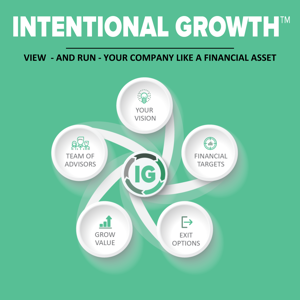
Intentional Growth™ is a podcast is a podcast for entrepreneurs and business owners wanting to view - and run - their company like a financial asset so they can have fun, create wealth, and make an impact. Truly make the entire journey of owning and running a company "worth it".