
Sign up to save your podcasts
Or



Send us Fan Mail
This week on IPWatchdog LIVE we present the remarks made during the Award Ceremony at IPWatchdog LIVE 2025 on March 3, 2025. Once again this year we presented two awards at IPWatchdog LIVE; the Paul Michel Award and the Pauline Newman Award. Both awards were created with the blessing of the Judges, who play an integral role in determining who to recognize each year.
We were pleased to recognize Robert Taylor as the 2025 recipient of the Paul Michel Award. It is hard to imagine someone more deserving of the Paul Michel Award than Bob Taylor, who throughout his legal career has time and time again advocated on behalf of innovators, particularly those entrepreneurial innovators who take great risk and found high-tech startup companies, which are the lifeblood of the U.S. economy. Bob currently serves as General Counsel for the Alliance of U.S. Startups and Inventors for Jobs and is a member of the Advisory Board for the Bayh-Dole Coalition.
We were also pleased to recognize Steven Caltrider as the 2025 recipient of the Pauline Newman Award. Steve has been a leader in the intellectual property community for nearly 40 years and is widely recognized by his peers as one of the preeminent in-house IP leaders in the world. After more than 35 years with Eli Lilly and Company and rising to the position of Vice President and General Patent Counsel, Steve was not done. In 2022, Steve moved to the Dana Farber Cancer Institute, where he currently serves as Vice President and Chief Intellectual Property Officer.
Visit us online at IPWatchdog.com.
You can also visit our channels at YouTube, LinkedIn, X, Instagram and Facebook.
Send us Fan Mail
This week on IPWatchdog Unleashed I speak with my friend Jason Harrier, former Chief Patent Counsel at Capital One and current co-founder and General Counsel of artificial intelligence (AI) company IP Copilot.
One of the things IP Copilot enables is the use of AI to streamline invention harvesting, running in the background as engineers and scientists engage in their daily activities communicating with each other. So, with this in mind I started our conversation by asking Harrier about invention harvesting, which I know from many conversations with in-house attorneys is one of the more difficult but critical important aspects of their job. We begin with a simple question: Why is invention harvesting so difficult and why are in-house attorneys always talking about in terms of what they tried in the past, what they are currently trying and what they hope to try in the future, sounding a little like Goldilocks looking for what is just right, but always out of reach.
And from there we dive into a conversation about how long scientists and engineers will typically stay with the company—his answer was 18 to 24 months—which led us to broader conversation about how many in the younger generation see work not as a job with normal hours, but a project that once done allows them to move on to whatever may be next. I called this a subcontractor mentality and wondered what this means for the future.
We then pivot to the patent backlog—which is approximately 860,000 unexamined applications—and whether AI could help the U.S. Patent and Trademark Office (USPTO). According to Harrier, AI tools available today could help patent practitioners and patent examiners get on the same page and streamline patent prosecution.
This led us into a conversation about patent prosecution strategy, overly broad claims, and how AI could contribute to streamlining patent examination through better prior art searches and with AI identifying the most relevant prior art is, which can often be quite different than the prior art applied by an examiner. If patent practitioner and patent examiner could work together with a closed universe of the most relevant prior art found by AI the ultimate output should be better, strong, more reliable, more difficult to challenge, and the entire process should be faster and more efficient.
Visit us online at IPWatchdog.com.
You can also visit our channels at YouTube, LinkedIn, X, Instagram and Facebook.
Send us Fan Mail
This week on IPWatchdog Unleashed we present another keynote speaker—Lisa Jorgensen. Jorgensen’s speech was given during lunch on Monday, March 3 at IPWatchdog LIVE 2025.
Lisa Jorgensen is Deputy Director General for Patents and Technology at the World Intellectual Property Organization (WIPO). And even before assuming the position as Deputy Director General of WIPO in 2021, she was very well known to the U.S. intellectual property community. Before moving to Geneva to join WIPO she served for five years as the Executive Director of the American Intellectual Property Law Association (AIPLA), and prior to that she was Vice President of Intellectual Property and Licensing at STMicroelectronics. Jorgensen is a friend to everyone in the IP community, and we were honored to have her speak at IPWatchdog LIVE.
The keynote by Jorgensen focused primarily on two questions. First, what are the key trends driving global innovation today? Second, what do those key trends mean for the IP community and the innovators and creators?
Jorgensen’s keynote speech was also full of eye-popping facts and figures, including:
Visit us online at IPWatchdog.com.
You can also visit our channels at YouTube, LinkedIn, X, Instagram and Facebook.
Send us Fan Mail
This week on IPWatchdog Unleashed our conversation is with Judge John Holcomb of the United States Federal District Court for the Central District of California, which took place March 4, 2025, at IPWatchdog LIVE.
Judge Holcomb is one of us. He was a patent professional—a patent litigator—before he joined the federal judiciary. He was appointed by President Donald J. Trump during his first term. And he serves in the Central District of California, with his courthouse located in Santa Ana, California. Early in his career Judge Holcomb was an attorney for Irell & Manella, which is a familiar name to many of us, and then also a partner for many years with Knobbe Martens.
We began our conversation with the story about how John Holcomb the patent litigator went from private practice to becoming Judge John Holcomb of the U.S. Federal District Court for the Central District of California. As we pivot from the nomination and confirmation process, I asked Judge Holcomb: Does it surprise you what you are seeing as a district court judge, or were you prepared for the wide array of different issues?
And then we pivot to discussing patent litigation, the makeup of the Central District of California, advice for litigators, experts, the new Rule 702 and Daubert hearings and rulings on expert testimony, we discussed the role of the jury and how Judge Holcomb divides time for trial, as well as the number of patents and claims best suited for a single trial, we also discussed Judge Holcomb’s practice relating to summary judgment motions. As our conversation wound down, we ended on the topic of his judicial philosophy, and to make the point Judge Holcomb told the story of three umpires. Holcomb explains that he believes there is an objectively correct answer and that he is doing his very best to get it right.
Visit us online at IPWatchdog.com.
You can also visit our channels at YouTube, LinkedIn, X, Instagram and Facebook.
Send us Fan Mail
This week on IPWatchdog Unleashed, I'm going to talk about an issue of enormous importance. The U.S. patent system feels to me an awful lot like the Titanic right now, and it feels like we're fast approaching an iceberg with disaster imminent.
The Trump Administration is making major changes to reduce the size of government to address the $37 trillion federal debt, including withdrawing employment offers to patent examiners and firing patent examiners still within their probationary period. Meanwhile, as the number of examiners is being cut, the backlog of unexamined patent applications is at an all-time high, with some sources saying there are now at least 1.2 million unexamined patent applications pending. And against this backdrop the Federal Circuit has developed an unhealthy obsession with the doctrine of prosecution laches, which creates a presumption that patents are unenforceable if it took longer than 6 years to obtain.
With fewer patent examiners and an historic backlog it will be difficult if not impossible for the Patent Office to issue most patents within 6 years. So, it feels a lot like the U.S. patent system is the Titanic headed for an iceberg, with disaster imminent.
Visit us online at IPWatchdog.com.
You can also visit our channels at YouTube, LinkedIn, X, Instagram and Facebook.
Send us Fan Mail
This week on IPWatchdog Unleashed we take a dive into the world of university technology transfer with Laura Peter, who is the Executive Director of the University of North Carolina Charlotte Office of Research Commercialization and Partnerships and is a former Deputy Under Secretary of Commerce for Intellectual Property and Deputy Director of the United States Patent and Trademark Office (USPTO) during President Trump’s first term.
We begin our conversation discussing how Peter found herself at the Patent Office when Andrei Iancu was Director. Peter tells us that years ago when she was general counsel for a publicly traded company, she hired Iancu’s firm to represent the company. Fast forward 15 years and Iancu has become Director, and he reached out to Peter to see if she was interested in helping him at the Patent Office.
We pivot to discuss how Peter found herself in her current role as the head of the technology transfer program at UNC Charlotte. We also spend time discussing core patent issues surrounding law, policy and the business of innovation. And our wide-ranging conversation goes on to discuss how other countries engage price control tactics on drugs, which means the United States is subsidizing drugs for the entire world, which is a trade problem and not a patent problem. We proceed to discuss startups, patent eligibility reform, the Patent Trial and Appeal Board and much more.
Visit us online at IPWatchdog.com.
You can also visit our channels at YouTube, LinkedIn, X, Instagram and Facebook.
Send us Fan Mail
This week on IPWatchdog Unleashed we take a look at the importance of data transparency and standards for artificial intelligence (AI) and standard essential patents (SEPs). Our guest is Tim Pohlmann, who is the Managing Director for the Americas at LexisNexis Intellectual Property Solutions. And before he joined LexisNexis, Tim was the founder and CEO of IPLytics. Tim has worked at the intersection of data and standard essential patents for a long time, and the themes of data integrity, data transparency and how data can be used to influence and inform decision-making was the focus of our conversation.
We being our conversation talking about entrepreneurship and leadership from the perspective of a founder and owner of a company that has been acquired, which is a welcome and happy occurrence, but not without challenges.
As we pivoted the conversation to begin discussing data, standard essential patents and artificial intelligence, we transitioned by discussing first how the industry continues to evolve and never stays the same for very long, how there is so much innovation in the industry, and how there are economic and national security implications with China understandably wanting Chinese companies to dominate the technology future and the United States understandably wanting American companies to dominate. This can lead to tensions, and China, the U.S. and Europe all seem to be jockeying to set the technology standards of the future.
We proceed to talk about the United States and China competing on technology lead us into a conversation about AI and the role standards will play, which was front of mind probably because we recorded this conversation right as news of DeepSeek, China’s allegedly new super-advanced AI, was breaking.
As we pivoted away from AI and into more traditional standard essential patents, particularly focusing on telecommunications (i.e., 5G and 6G), I acknowledge that while there will be need for AI standardization, and there will be a lot of unique questions arise in that context, we still don’t have a lot of answers in a number of critical areas for well-known and well-established technologies. This paved the way for us to discuss FRAND and to tackle the question about whether a FRAND rate really exists in the first place.
Our conversation goes on to discuss implementers understandably wanting to pay only to license patents that cover technologies that are actually included in the adopted standard, the potential that the Federal Circuit will rule that lump sum license payments are not relevant to determining a fair and reasonable licensing rate, what considerations go into converging on a rate that is FRAND, bulk discounting, and the role data plays in lifting the curtain so implementers who are themselves competitors with other implementers can determine whether they are getting a rate that will make them uncompetitive, and much more.
Visit us online at IPWatchdog.com.
You can also visit our channels at YouTube, LinkedIn, X, Instagram and Facebook.
Send us Fan Mail
This week on IPWatchdog Unleashed we enter the world of innovation politics with a discussion about what to expect for the patent world during President Trump's second term, what to specifically expect from the Patent Office, what to expect in Congress relating to the patent reform bills that we can expect to be reintroduced, which are namely PREVAIL, which relates to reforming the Patent Trial and Appeal Board (PTAB), the Patent Eligibility Restoration Act (PERA), which relates to reforming the law on patent eligibility to make it easier to patent software—including artificial intelligence—and to make medical diagnostics patentable again, and RESTORE, which relates to overruling the Supreme Court’s 2006 decision in eBay v. MercExchange, which has made it virtually impossible to obtain injunctive relief even when patent owners win and prove ongoing infringement.
The conversation that you will hear happened at the annual IPWatchdog PTAB Masters™ program, which was held at the end of January at IPWatchdog Studios. The panelists were Chief Judge Paul Michel, former Chief Judge of the United States Court of Appeals for the Federal Circuit, David Kappos, a partner with Cravath and a former Director of the Patent Office during President Obama's first term, and Chris Israel, who is a senior partner at American Continental Group and served in the George W. Bush White House as the first U.S. International Intellectual Property Enforcement Coordinator. Also joining the conversation is Scott McKeown, who is a shareholder at Wolf Greenfield and was Chair of the PTAB program. Scott, as most of you know, is also one of the leading experts on PTAB practice in the United States.
We discuss the almost certain reintroduction of PREVAIL, PERA, and RESTORE, as well as the odds of getting patent reform during this Congress—which no one thinks was very likely unless President Trump himself steps up and makes it a priority. We also discuss the “helter-skelter” nature of the U.S. patent system, where the pieces don't fit together, don't integrate, leads to low predictability, and innovation-killing reality that simply does not incentivize investment in innovation. We also discuss the Administrative Patent Judges (APJs) of the PTAB being ordered back to the Office, and what that will mean for the number of petitions challenging patents that could possibly be instituted. And we discuss how antitrust enforcement would be unnecessary if we had a strong patent system that let young companies compete fairly based on innovation merit, and how Elon Musk is almost dead-on correct when he says that patents are for the weak—although Chris Israel suggested it would make more sense to say that “patents are for the young”.
Visit us online at IPWatchdog.com.
You can also visit our channels at YouTube, LinkedIn, X, Instagram and Facebook.
Send us Fan Mail
On this episode of IP Watchdog Unleashed we speak with Scott McKeown, who is a shareholder at Wolf Greenfield. Scott leads the firm’s post grant patent practice, and he is the author of PatentsPostGrant.com, which provides inside views and news pertaining to the Nation’s busiest patent court, the Patent Trial and Appeal Board (PTAB) at the United States Patent and Trademark Office (USPTO). As many in the industry no doubt know, Scott is recognized as one of the leading authorities on PTAB practice, including inter partes review (IPR) proceedings, post grant review (PGR) proceedings, as well as reexamination and reissue proceedings, which often follow on PTAB proceedings.
Scott is not only a good friend, but he is also the Chair of our annual PTAB program, which took place this year from January 27 to January 29 at IPWatchdog Studios. This conversation with Scott took place before a live studio audience as a part of our PTAB Masters™ 2025 program.
He's one of the most prolific representatives in the PTAB arena, dealing with IPR, PGR. He also handles reexaminations and the like. And he's also a very good friend of mine, and he's the chair of our PTAB program every year, which we're doing this, actually is live.
Our conversation was wide ranging but was dominated by discussion of patent reform efforts and whether the PTAB is working as intended.
Visit us online at IPWatchdog.com.
You can also visit our channels at YouTube, LinkedIn, X, Instagram and Facebook.
Send us Fan Mail
This week on IPWatchdog Unleashed I had the opportunity to speak with my good friend Louis Foreman. Louis is the Chief Executive Officer of Enventys, which is a full-service product launch company that handles all aspects of product development, crowdfunding and ecommerce marketing. In addition to Enventys, Louis is a prolific inventor himself, he is also an Assistant Professor of Entrepreneurship at Wake Forest University, and as if that isn't already enough, Louis was the creator of the Emmy award-winning PBS TV show Everyday Edison that so many people in the community remember. I've counted Louis as a friend for close to 20 years, so it was good to sit down for a conversation, even if that conversation took place remotely.
As our conversation unfolded it became clear pretty quickly that the focus would be on entrepreneurship, particularly the trials and tribulations of entrepreneurs looking to dive into the startup world with an innovative product.
“There's three P's that I like to share with all entrepreneurs and all inventors,” Foreman said. “The first P is passion. If you're not passionate about what you're doing, find something else… The second P is patience. Inventors and entrepreneurs don't have a whole lot of it, but you need to because it's going to take longer than you expect. You're not going to become a billionaire overnight. It's going to take longer than what you expect to just be ready for the long haul. And the third P is persistence because life is going to throw all sorts of obstacles in front of you. There's going to be all these roadblocks or detours, and you're going to question whether or not you should even go forward… But if you really believe in what you're doing, you'll eventually succeed.”
Visit us online at IPWatchdog.com.
You can also visit our channels at YouTube, LinkedIn, X, Instagram and Facebook.
From the publisher's feed
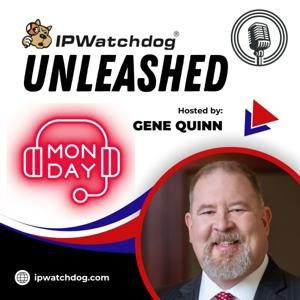
Each week we journey into the world of intellectual property to discuss the law, news, policy and politics of innovation, technology, and creativity. With analysis and commentary from…
Ranked by our users in the last 21 days

31,940 Listeners
16 Listeners

25 Listeners

111,734 Listeners

56,384 Listeners
50 Listeners

24 Listeners

642 Listeners
8 Listeners
9 Listeners