
Sign up to save your podcasts
Or



Send us Fan Mail
Walt Copan joins us for a conversation about the role of science, technology and innovation in U.S. competitiveness and for U.S. national security.
As many of you no doubt know, Walt is a former Undersecretary of Commerce and served as the 16th Director of the National Institute of Standards and Technology, a position for which he was unanimously confirmed by the Senate during the Trump Administration. Today, Walt is the Vice President for Research and Technology Transfer at the Colorado School of Mines in Golden, Colorado.
I invited Walt to join us for our annual life sciences program this year. My pitch was that we would have a one-on-one conversation that would not only make up the final segment of the program, but which would also be used for our IPWatchdog Unleashed podcast. He graciously accepted my invitation, and we sat down for this conversation on Wednesday, October 30.
During our conversation we discuss the ongoing Bayh-Dole march-in rights drama being caused by his old agency—NIST—which has published a framework that would allow the government to strip patent rights away from exclusive licensees if the government believes the product covered by a patent is too expensive. We also discussed the diverging approach to commercialization between universities who can own and license patent rights and federal agencies, which operate under an entirely different statutory structure that makes it virtually impossible to get innovations made by federal government employees to the marketplace and commercialized for the good of society. We also discuss the upward trajectory of China vis-à-vis innovation and intellectual property, and the stagnation within the U.S. innovation ecosystem, which has been primarily led by uncertainty and dismantling of the U.S. intellectual property laws.
Visit us online at IPWatchdog.com.
You can also visit our channels at YouTube, LinkedIn, X, Instagram and Facebook.
Send us Fan Mail
This week we have a special guest—the Honorable Pauline Newman, Circuit Judge on the Court of Appeals for the Federal Circuit.
Judge Newman spoke at our annual Life Sciences program at IPWatchdog Studios on Tuesday, October 29. Her remarks were largely unscripted, although she did have some notes that she consulted from time to time during her nearly 45 minute presentation. Judge Newman told her story, and the story of the Federal Circuit, in her own words. So powerful were her comments that at least several in the audience were seen shedding a tear, and she received a hearty standing ovation.
Judge Newman is being wrongfully persecuted by her colleagues on the Federal Circuit. She has taken and passed with flying colors the three different mental evaluations she has submitted to, all conducted by different, highly regarded evaluators. And in addition to the final mental evaluation she was given a cutting edge CT scan of her brain, which showed no signs of cognitive decline, and in fact rather remarkably showed a healthy brain that looked to be the scan of someone in their 20s.
Faced with all the inaccurate statements in the complaint, which have never been correct despite their falsity, the Federal Circuit persists in excluding Judge Newman from hearing cases, which every day is becoming a more significant constitutional crisis.
So, against this backdrop we are pleased to present the Honorable Pauline Newman.
Visit us online at IPWatchdog.com.
You can also visit our channels at YouTube, LinkedIn, X, Instagram and Facebook.
Send us Fan Mail
In this episode of IPWatchdog Unleashed, we discuss patent prosecution with the director of intellectual property at one of the top five filing companies in the world. Sivon Kalminov is the Director the Intellectual Property Division at Canon USA, where he is responsible for managing the Division’s day-to-day patent prosecution work, which includes overseeing both the patent prosecution and administration departments. He also provides support on patent litigation matters, contract matters, and general U.S. patent law-related advice to various domestic and international Canon companies and subsidiaries. He is a current member of the California State Bar Intellectual Property Section, and a past Chair of the Section.
Our wide-ranging conversation took place in person on October 1, at IPWatchdog LIVE, shortly after Sivon spoke on a panel about strategies for getting to yes when working with patent examiners.During our conversation, we discuss the unique set-up of the Canon intellectual property department, which sees Sivon and his team representing Canon USA, but also representing various Canon entities from around the world as they enter the United States to obtain patents on previously filed applications. We also discuss the U.S. Patent and Trademark Office (USPTO) switching from EFS-Web to Patent Center, the unceremonious death of the After Final Consideration 2.0 program, examiners raising Section 112 and Section 101 issues for the first time in a Notice of Allowance, strategies for working with examiners, the importance of interviews to get on the same page with examiners, when and whether it is appropriate to appeal examiner rejections to the Board, and much more.
Visit us online at IPWatchdog.com.
You can also visit our channels at YouTube, LinkedIn, X, Instagram and Facebook.
Send us Fan Mail
This week we explore small and medium sized enterprises, often referred to simply as SMEs. And in particular, we take a look at how two different countries are working with their own small businesses to assist them with respect to innovation and intellectual property. To accomplish this, I turned to two friends – Mike McLean and Joe Doyle, who work to assist SMEs in Canada and Ireland respectively. Both Mike and Joe were in the United States at the end of September to speak at IPWatchdog LIVE 2024, on a panel titled Empowering SME Growth by Leveraging IP. During our conversation we learn about the ways both the Canadian and Irish governments are supporting SMEs, which is something that we in the United States should be doing to a much greater and coordinated degree.
Visit us online at IPWatchdog.com.
You can also visit our channels at YouTube, LinkedIn, X, Instagram and Facebook.
Send us Fan Mail
This week on IPWatchdog Unleashed we have a special episode. At the end of September we held our annual all-topics conference, which we call IPWatchdog LIVE. This conference brings together some of the top thought leaders and newsmakers from the entire industry, with a variety of different backgrounds and people who focus on various different niche verticals within the IP community. So, while the conference was ongoing, Eileen McDermott, our editor in chief, asked some of the industry leaders in attendance what they thought was the most important issue facing the intellectual property industry.
“What is critically important and every leader in government needs to focus on is to make sure that the IP system is stable, it's predictable, and it's subject to fewer fluctuations,” said Andrei Iancu, former Under Secretary of Commerce for IP and Director of the USPTO during the Trump Administration. “We need to work towards a stronger, more consistent, more predictable intellectual property system, whether it's patents, trademarks, copyrights, or trade secrets.”
“The most pressing issue is the lack of appreciation of the link between strong and effective intellectual property rights and innovation outcomes,” said David Kappos, former Under Secretary of Commerce for IP and Director of the USPTO during the Obama administration.
To hear more from these thought leaders, and others including Judge Pauline Newman, Alden Abbott, Matteo Sabattini, Judge Susan Braden, Patrick Kilbride, Hans Sauer, Brian O’Shaughnessy, and others, listen to this episode of IPWatchdog Unleashed.
Visit us online at IPWatchdog.com.
You can also visit our channels at YouTube, LinkedIn, X, Instagram and Facebook.
Send us Fan Mail
This week our conversation takes us on an international journey, more or less. Andras JOKUTI is an intellectual property lawyer with domestic and international experience in public IP policy and university technology transfer. He is the former Director-General for Legal Affairs of the Hungarian Intellectual Property Office, and he is a former Fulbright Scholar. Andras studied intellectual property and obtained his LL.M. in intellectual property law from The George Washington University. Thereafter, Andras worked with the Budapest University of Technology and Economics to strengthen its IP and technology transfer operations. And since January 2022, he has served as the Director of the Patent and Technology Law Division at World Intellectual Property Organization. Andras came to the United States last week to speak at IPWatchdog LIVE 2024, which was hosted at the Renaissance Capitol View hotel in Arlington, Virginia.
During our wide-ranging conversation we discuss a number of issues, from standard essential patents, to artificial intelligence, and to trade secrets, which is what brought him to IPWatchdog, to discuss the new WIPO trade secret guide, published in July 2024.
Visit us online at IPWatchdog.com.
You can also visit our channels at YouTube, LinkedIn, X, Instagram and Facebook.
Send us Fan Mail
This week we will change things up a bit. Until now our podcast has focused on conversations with newsmakers and interesting personalities. We won’t be giving that format up, but this week we will shift things to allow me to do a little ranting on a topic I’ve been thinking about more and more over the last several years; namely, do we still need, or even want, a Federal Circuit?
I’ve been kicking this question around in my head for a while. There are a variety of reasons why the Federal Circuit seems to have outlived its usefulness, from panel dependency, to what at times appears to be utter disdain for certainty, predictability and even binding precedent, to the shocking, unfair and egregious treatment of Judge Newman. Why do we need a Federal Circuit? Why should we want this flawed institution to continue?
What we know is very little of what the Federal Circuit does any more relates to patents, with only 15% of what has occupied the Federal Circuit over the last six months relating to opinions in patent cases. Meanwhile, what decisions the Federal Circuit does issue are panel dependent and show not a care in the world about the Court’s original mandate, which was to create a unified national patent law and recognize that at least some patents have to be valid and enforced. And now over the last 2 years we have an inexplicable usurpation of authority with the virtual impeachment of Judge Newman. If these judges are so unfamiliar with basic due process and the opportunity to be fairly heard why should anyone believe they are themselves competent to be judges on any level?
Visit us online at IPWatchdog.com.
You can also visit our channels at YouTube, LinkedIn, X, Instagram and Facebook.
Send us Fan Mail
Today we're going to tackle a question that has divided the patent innovation community for a generation. Depending on your perspective, patent trolls have been and continue to be a problem, or complaints about patent trolls have been greatly exaggerated.
As is often the case when emotions are running high and there is so much money at stake, the truth probably lies somewhere in the middle.
Unfortunately, the bad actors on both sides of patent litigation have so clouded the issues to the point where it's hard to look at patent owners and defendants as anything other than the caricatures they represent, which is the worst of the worst, really. So, let’s put some real facts on the table and meat on the bones and talk about what is really going on, both good, bad and ugly.
Visit us online at IPWatchdog.com.
You can also visit our channels at YouTube, LinkedIn, X, Instagram and Facebook.
Send us Fan Mail
This week the tables are turned. As many of you know Eli Mazour is the founder of the Clause 8 podcast, and the podcast is known by its tagline as “the Voice of IP.” Indeed, for years Eli has been just that… the voice of IP… interviewing numerous people in the industry, from Federal Circuit Judges to Chief IP Counsel and political leaders, I even had an opportunity to sit with Eli for a conversation when he first started Clause 8, which we discuss at the start of our conversation.
So, once I started my own podcast it was only natural to sit down with Eli for my own discussion with him, to pick his brain in an unscripted, open-end conversation. And the resulting conversation did not disappoint. We discussed a great many things about patents and innovation, the Federal Circuit and why clients want and need patents, and patent strategy.
We begin our conversation with discussion of how Eli got into the science and engineering world and ultimately into the patent profession, and we also discuss his new home at Foley & Lardner, which has embraced Eli’s work on Clause 8, which will continue.
In retrospect our conversation wound up being largely about the key to writing and obtaining high quality patents, which is also the key to innovating in the first place. You need to have a purpose and a goal. You need to be addressing an identifiable problem with a real, concrete, technical solution. And you need to focus on something that will actually matter to the client. And while patent strategy and ensuring protection actually protects what the client is selling matters most for those clients who will have several dozen or even several hundred patents, it really matters for everyone.
Visit us online at IPWatchdog.com.
You can also visit our channels at YouTube, LinkedIn, X, Instagram and Facebook.
Send us Fan Mail
This week our conversation takes us in-house to discuss patent strategy and insights on how outside counsel can best work with in-house counsel to build a solid working relationship and actually deliver what the client wants and needs.
My conversation is with Gary Lobel, who is currently senior patent counsel for Reckitt where he is responsible for global legal and intellectual property matters for several different business units within the Reckitt family. In this role Gary plans and implements global intellectual property strategies in the area of biotechnology, pharmacologic and nutritional formulations. He works with in-house constituencies, evaluates opportunities for potential partnerships and acquisitions, and he manages outside counsel working on both patent procurement and litigation. Prior to joining Reckitt, Gary was Chief Patent Counsel for Nestlé, and he also worked early in his career as a patent attorney at Novartis.
I always enjoy my conversations with Gary. He is extremely bright and thoughtful, I find that every time I speak with Gary I learn something, and our conversations often go down paths I didn’t expect but which are always interesting and informative. Gary has a knack for seeing all sides to every issue or problem as if he is constantly playing a game of 3D chess and is at least several moves ahead.
In our conversation this week we had a wide ranging conversation on patent strategy, including working with patent examiners—including what to do when you are assigned to a difficult patent examiner with a low allowance rate—the importance of interviews, tips for getting past 112 rejections, and how outside counsel can build solid, working relationships with in-house counsel, and much more.
Visit us online at IPWatchdog.com.
You can also visit our channels at YouTube, LinkedIn, X, Instagram and Facebook.
From the publisher's feed
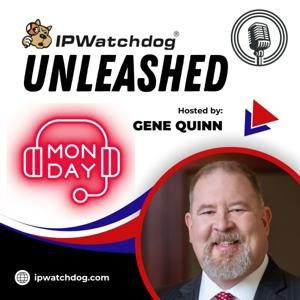
Each week we journey into the world of intellectual property to discuss the law, news, policy and politics of innovation, technology, and creativity. With analysis and commentary from…
Ranked by our users in the last 21 days

31,940 Listeners
16 Listeners

25 Listeners

111,734 Listeners

56,384 Listeners
50 Listeners

24 Listeners

642 Listeners
8 Listeners
9 Listeners