
Sign up to save your podcasts
Or



Based on Podcast App listening data
It's that time again!
Every year, during the open enrollment period from October 15th through December 7th, we recommend that all seniors review their Medicare coverage and see what new options might be available to them. It's also extremely important that new retirees who are signing up for Medicare for the first time get a handle on the ABCDs of Medicare, as well as the things that Medicare does and doesn't cover.
On today's show, we prepare you for Medicare Season 2021 and discuss some key aspects of your health care coverage that you'll want to investigate before open enrollment ends.
According to a recent study by Fidelity, a 65-year-old couple retiring today will need $300,000 to cover their medical expenses. Unfortunately, that eye-watering number only includes insurance premiums, deductibles, and copays. If you or your spouse need long-term care, which isn't covered by Medicare, your health care costs could end up putting a serious crack in your nest egg.
Now, I don't say that to scare anyone. The point of our conversation on today's episode is to underline just how important it is for seniors to understand what the potential out-of-pocket costs of long-term care can be, what kinds of long-term care insurance options are available, and how to incorporate your health care needs into your financial planning.
The pandemic closed a lot of doors in 2020. But for cybercriminals, business is always open. The more time folks spend socializing, working, shopping, and managing money online, the more sensitive data could be vulnerable to hacks and scams. Click on the wrong link or answer the wrong phone call and you could be at risk for significant financial loss or identity theft issues that can take weeks, months, or years to sort out.
On today's show, I'm happy to welcome back Jeff Lanza for a cybersecurity tune-up that will benefit all of us. During his 20-year career as an FBI Special Agent, Jeff investigated cybercrime, organized crime, human trafficking, and terrorism. He's also lectured at Harvard and Princeton and is a go-to expert for TV news and documentaries. Jeff recently updated his acclaimed book, Cybercrime: How to Stay Safe From Online Fraud and Identity Theft. And I'm pleased to announce that Keen Wealth Advisors will be hosting Jeff for a live presentation on cybersecurity at the Overland Park Convention Center on October 2nd.
Recently, while answering some listener questions about early retirement, I pointed out that every piece of your financial plan is connected to every other piece. Adjust one lever, and you might trigger some unexpected consequences if you're not working with a professional who can help you anticipate and prepare for further changes.
We're certainly seeing those same kinds of interconnected effects with concerns about inflation. Even as our economy continues to accelerate out of the pandemic, massive government stimulus combined with ongoing supply chain disruptions and low labor participation have driven up the consumer price index (CPI) this summer. That's affecting how many seniors are thinking about their household spending and retirement timelines. But, as we discuss on today's show, inflation is also affecting how the government is looking at Social Security.
The pandemic has given us all a new perspective on our lives and our work. I think that's a big reason why we've had a number of our clients at Keen Wealth ask us about early retirement scenarios this year. After a year of locking down, missing friends and family, working from home, and in far too many cases, losing loved ones, folks want more than just financial security. They want to use their assets to live their best lives for as long as they can.
That's what we want for our clients as well – in retirement and every step along the way. But the listener questions we answer on today's show are a reminder that adjustments to your financial plan aren't made in a vacuum. Each decision causes ripple effects that can be extremely hard to manage if you're not working with a fiduciary advisor.
As good as it feels to be exiting the pandemic and enjoying a relatively normal summer, the ongoing economic fallout from COVID-19 and the levers our government pulled to accelerate recovery have a lot of folks worried about inflation. Those fears spiked recently after the Bureau of Labor Statistics reported that consumer prices rose by 5% during the month of May, the biggest jump since 2008. Those numbers are ringing alarm bells for some of our older clients who don't like being reminded of 1970s stagflation as they're nearing or beginning retirement.
On today's show, we discuss whether inflation is inherently bad, what rising costs say about the health of our economy as a whole, and how our investment philosophy accounts for inflation over the course of a modern retirement.
In recent months, my two daughters have given me a personal perspective on just how hot and how competitive the real estate market is right now. Both decided to buy homes in the Kansas City area, and both had to make unsuccessful bids on multiple houses before they were able to close on their new homes. That millions of families all over the country are trying to navigate these same issues is quite a turnaround from just a decade ago, when folks were hesitant to buy houses in the shadow of the Great Recession.
However, as we discuss on today's show, many economic factors that caused the housing market to collapse in 2008-2009 are contributing to the current housing boom. That doesn't mean we're headed for another bubble burst, but it does mean that folks need to weigh all their options if they're looking to buy or sell right now, especially if you're eying a potential retirement home.
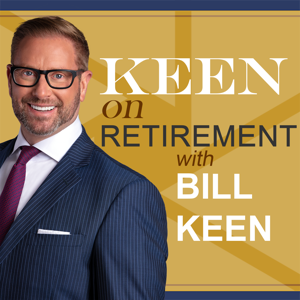
Longtime Keen on Retirement listeners might remember a running gag where Matt Wilson and I would joke with our co-host, Steve Sanduski, about all the bitcoin we suspected he was hoarding. At the time, bitcoin had just emerged from one of its periodic freefalls and was starting to seep back into the general public's awareness.
And then, in 2018-2019, it dropped again.
Today, as the value of one bitcoin hovers in the tens of thousands of dollars, this digital asset is back to making headlines and generating a lot of questions from our listeners. And it turns out that, all kidding aside, our buddy Steve really has been playing very close attention to how Bitcoin and other cryptocurrencies could affect our economy and our monetary system. He's even started a new podcast, The Digital Money Advisor, focused on exploring these very issues.
So, on today's show, we decided to put our co-host on the hotseat and ask Steve what he's learned on his deep dive into bitcoin.
A few years ago, I was intrigued by the many news stories I was seeing about the new "tiny homes" helping homeless veterans around Kansas City. I reached out and connected with the Veterans Community Project, and the more I learned, the more impressed I was by the impact that the VCP is having. One number really stood out: over 90% of the veterans whom the VCP work with are able to get back on their feet and reacclimate into society.
Today, both my family and Keen Wealth Advisors are grateful supporters of the Veterans Community Project's newest initiative, the VCP Veterans Navigation Campus. It's a real honor to welcome VCP Co-Founder, Chief Project Officer, and retired U.S. Army Specialist Brandonn Mixon on today's show to discuss how his remarkable team is transforming cities across the country and making sure that none of our heroes get left behind.
One year ago, despite lockdowns, skyrocketing unemployment, and major market volatility, my team at Keen Wealth was cautiously optimistic. We believed that most of the economic disruption our country was facing was a temporary and necessary response to battling COVID-19. And we believed that once vaccine development started progressing and the country started reopening, jobs would come back, the economy would roar to life, and the markets would respond in kind.
So far, 2021 has exceeded our expectations. But the latest jobs report and other key economic indicators show that we still have a ways to go before we've fully recovered from the pandemic.
On today's episode, Keen Wealth's Chief Investment Officer, Matt Wilson, discusses the data he presented in his most recent Market Update Webinar, as well as factors that could potentially slow down our economic momentum.
From the publisher's feed

39,027 Listeners

1,980 Listeners

801 Listeners
1,313 Listeners
456 Listeners
544 Listeners

755 Listeners

548 Listeners
696 Listeners

3,062 Listeners

3,157 Listeners

575 Listeners

928 Listeners
828 Listeners

1,071 Listeners