Sign up to save your podcasts
Or


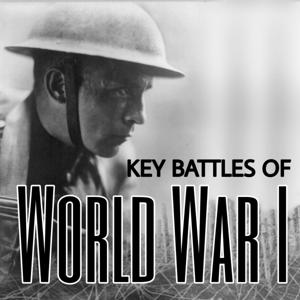
By Key Battles of World War One
4.6
279279 ratings
The podcast currently has 26 episodes available.
The most played episodes among Podcast App listeners.

World War One was the most consequential social event in centuries. 10 million soldiers died, creating 3 million widows and 10 million orphans. Many Europeans felt disillusionment and even anger about the war. They questioned earlier notions of honor, duty, and bravery. Europe lost its economic centrality. New York replaced London as the financial capital of the world., and the US and the USSR emerged as proto-superpowers. But positive changes happened. The notion of what roles women could take on changed. Women proved themselves capable of doing much of what men came. Four empires were gone. Many new smaller nations were created from the Empires’ former territories.See omnystudio.com/listener for privacy information.

The best way to describe the Third Ypres (Passchendaele) Campaign of 1917. It’s ‘slog.’ When you think about a drudging act that seems to accomplish nothing, this battle is it. Mud. Mud to your waist. Everything sinks down several feet into mud. Tanks, Cars, guns, horses, everything stuck in mud. Images of a battlefield landscape with pockmarked holes and mist rising from the plains with shattered trees is characterized by the third battle of Ypres. The battle took place on the Western Front from July to November 1917 over control of ridges near the Belgian city of Ypres in West Flanders. Private R.A. Colwell described the scene in 1918 as follows: "There was not a sign of life of any sort. Not a tree, save for a few dead stumps which looked strange in the moonlight. Not a bird, not even a rat or a blade of grass. Nature was as dead as those Canadians whose bodies remained where they had fallen the previous autumn. Death was written large everywhere.”See omnystudio.com/listener for privacy information.

We’ve looked at many battles in this series, but we’ve only tangentially touched on how this war fundamentally altered European society. The Great War is the watershed between the pre-modern and early modern era. As an example, all we have to do is look at Russia. Before World War One, it was an autocracy, very conservative, very religious, and only a few decades away from serfdom, which the rest of Europe abandoned in the Middle Ages. After the war, it was officially atheistic, communist, rapidly industrializing, and becoming one of two superpowers that dominated the 20th century. To Churchill, the Bolsheviks represented a greater threat to civilized Europe than did the reeking tube and iron shard of the Kaiser’s Reich. Bolshevism, he declared in the House of Commons, was “not a policy; it is a disease. It is not a creed; it is a pestilence.”See omnystudio.com/listener for privacy information.
Although overlooked today, the war at sea was a crucial part of World War I overall. The German use of the Unrestricted Submarine Warfare (in which non-military ships could be blown up by submarines without the latter surfacing, making it impossible for innocent men, women, and children to abandon ship) against commerce not only threatened the Allied war effort, but also drew the United States into the conflict. In addition, the British economic blockade of Germany afforded by the Royal Navy’s command of the sea inflicted great damage on the war effort of Germany. Finally, the naval war held great ramifications for the future since many practices employed in the First World War were those pursued in the Second World War.See omnystudio.com/listener for privacy information.

The Battle of Verdun--fought from February 21-December 18 1916 in the Western Front of France--was horrifying and hellish even by the standards of World War One. Over a 299-day-period, there were 1 million total casualties. The French were bled white, but so were the Germans. Of these, 300,000 were killed, which is about 1 death for every minute of the battle. The French most likely lost slightly more than the Germans. About 10% of all French war dead were from Verdun. Half of Frenchmen between 20 and 30 years old were killed. Although more men died at the Somme, the proportion of casualties suffered to the number of men who fought was much higher at Verdun than at any other battle in World War I. Also the number killed per square mile was the greatest at Verdun. To this day, the battlefield is still cratered and pockmarks. Many unexploded shells (maybe 12 million) still remain. Trenches can still be seen. Alistair Horne said, “Verdun was the First World War in microcosm; an intensification of all its horrors and glories, courage and futility.”See omnystudio.com/listener for privacy information.
The podcast currently has 26 episodes available.

3,971 Listeners

1,246 Listeners

4,750 Listeners

4,007 Listeners

81 Listeners

716 Listeners

160 Listeners

91 Listeners

358 Listeners

179 Listeners

576 Listeners

3,369 Listeners

530 Listeners

927 Listeners

2,850 Listeners

66 Listeners

1,588 Listeners

336 Listeners

53 Listeners

138 Listeners

358 Listeners

264 Listeners