
Sign up to save your podcasts
Or

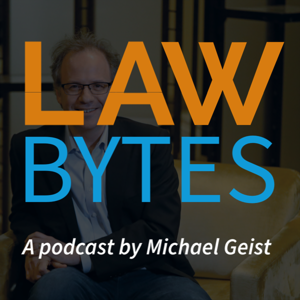


After several weeks of protests, occupation, and border crossing blocking, the Canadian government took the unprecedented step last week of invoking the Emergencies Act. The situation is rapidly evolving and still being debated in the House of Commons. Dr. Leah West is an Assistant Professor of International Affairs at the Norman Paterson School of International Affairs at Carleton University and one of Canada’s leading experts on national security law. She joins the Law Bytes podcast to discuss rules surrounding the Emergencies Act and the implications of the government’s recent move to invoke it.
The podcast can be downloaded here, accessed on YouTube, and is embedded below. Subscribe to the podcast via Apple Podcast, Google Play, Spotify or the RSS feed. Updates on the podcast on Twitter at @Lawbytespod.
Show Notes:
Leah West, Public Order Emergency: A Guide to Thinking Through the Legal Thresholds and Its Justification
Credits:
Guardian News, Canadian Prime Minister Trudeau Invokes Emergencies Act over Protests
The interest in regulation and Web 3.0, the umbrella term for all matters crypto, continues to grow in countries around the world. In Canada, a new private member’s bill encourages the government to establish a regulatory framework to support innovation even as concerns mount over the use of cryptocurrency to by-pass conventional payments regulations. In the United States, there have been multiple Congressional hearings and proposals for legislative action.
The podcast can be downloaded here, accessed on YouTube, and is embedded below. Subscribe to the podcast via Apple Podcast, Google Play, Spotify or the RSS feed. Updates on the podcast on Twitter at @Lawbytespod.
Show Notes:
Credits:
The government’s Internet regulation plans were back on the agenda last week as a “what we heard report” was released on online harms and Bill C-11 – the sequel to last year’s controversial Bill C-10 – was introduced by Canadian Heritage Minister Pablo Rodriguez. The Law Bytes podcast will devote several episodes to the bill in the coming months. For this week, however, rather than inviting a guest to discuss a bill that people are still assessing, I appear solo and walk through the bill’s provisions involving user generated content. The podcast also highlights several ongoing concerns involving the near-unlimited jurisdictional scope of the bill, the considerable uncertainty for all stakeholders, the misplaced trust in the CRTC, and the weak evidentiary case for the bill.
The podcast can be downloaded here, accessed on YouTube, and is embedded below. Subscribe to the podcast via Apple Podcast, Google Play, Spotify or the RSS feed. Updates on the podcast on Twitter at @Lawbytespod.
Show Notes:
Bill C-11, The Online Streaming Act
Credits:
Heritage Minister Pablo Rodriguez Discusses Government’s Online Streaming Bill, February 2, 2022
There has been mounting concern over the past few years over whether some of the world’s largest companies – primarily big tech – pay their fair share of taxes. This issue has arisen in countries around the world leading to new digital services taxes that primarily target the U.S. tech giants and which in turn often leads to the U.S. threatening to retaliate in response. Canada now finds itself embroiled in these battles as Finance Minister Chrystia Freeland has proposed a retroactive digital services tax to take effect in 2024 if by that time a newly reached OECD agreement has not taken effect. Professor Reuven Avi-Yonah is a law professor at the University of Michigan and director of the school’s international tax LLM program. He joins the Law Bytes podcast to discuss digital services taxes, the OECD deal, and what might happen if the international agreement falls apart.
The podcast can be downloaded here, accessed on YouTube, and is embedded below. Subscribe to the podcast via Apple Podcast, Google Play, Spotify or the RSS feed. Updates on the podcast on Twitter at @Lawbytespod.
Credits:
CNBC International, What is a Digital Tax?
The Citizen Lab at the University of Toronto, led by Professor Ron Deibert, has a well-earned reputation for uncovering surveillance technologies and security vulnerabilities with research and reports that attract immediate attention worldwide. Professor Deibert has won an incredible array of awards and accolades for his remarkable work, including the Order of Ontario and the EFF’s Pioneer Award. In 2020, he delivered the Massey Lectures, based on his book for the lectures, Reset: Reclaiming the Internet for Civil Society. Professor Deibert joins the Law Bytes podcast to talk about the lab, his work, and the threat of what he calls “despotism as a service”, where spyware is used to target journalists, activists, and civil society groups.
The podcast can be downloaded here, accessed on YouTube, and is embedded below. Subscribe to the podcast via Apple Podcast, Google Play, Spotify or the RSS feed. Updates on the podcast on Twitter at @Lawbytespod.
Show Notes:
Issues in Science and Technology, Protecting Society From Surveillance Spyware
Credits:
DW News, Hacking Backdoor? Security Flaws in China’s Mandatory Olympics App
The right to repair, whether consumer electronics, farm machinery or even health and medical equipment, is an issue that affects everyone. Given the implications for consumer and property rights, the sustainability of the agricultural sector, and protecting the environment, ensuring a right to repair would seem like an obvious political winner. Yet the issue has lagged, not the least of which because of restrictive copyright laws that can limit the ability to repair personal property.
Aaron Perzanowski is a law professor at Case Western Reserve University School of Law in Cleveland, Ohio and the Associate Director of the Spangenberg Center for Law, Technology & the Arts. Professor Perzanowski is the author of the forthcoming book, The Right to Repair, to be published by Cambridge University Press early next year. He joins the Law Bytes podcast to explain why the right to repair matters, how copyright fits into this, and what reforms are needed to address the issue.
The podcast can be downloaded here, accessed on YouTube, and is embedded below. Subscribe to the podcast via Apple Podcast, Google Play, Spotify or the RSS feed. Updates on the podcast on Twitter at @Lawbytespod.
Show Notes:
Aaron Perzanowski, The Right to Repair: Reclaiming the Things We Own (Cambridge University Press, Forthcoming 2022)
Credits:
Tomorrow Unlocked, No Right to Repair: Farmers are Forced to Hack Their Own Tractors
From the publisher's feed
26,165 Listeners

26,260 Listeners
210 Listeners
76 Listeners
106 Listeners
8 Listeners
50 Listeners
5,082 Listeners
36 Listeners
575 Listeners

5,554 Listeners

15,918 Listeners
39 Listeners
4 Listeners
34 Listeners