
Sign up to save your podcasts
Or

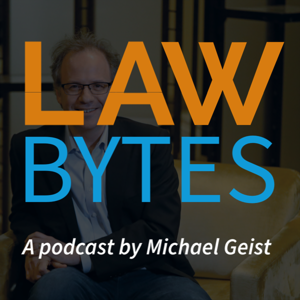


As the second wave of COVID-19 seems to have arrived in many countries, the importance of measures such as social distancing, masks, testing, and tracing takes on increased importance. In Canada, the COVID Alert App is another important part of that toolkit. The app has been downloaded more than 4.5 million times and has been used to alert users to a potential exposure to the virus nearly 1,700 times. Despite the potential benefits, there remain many skeptics. Ann Cavoukian, a three-time Ontario privacy commissioner and one of Canada’s best known privacy experts, joins the LawBytes podcast this week to talk about the exposure notification and how it addresses potential privacy concerns.
The podcast can be downloaded here and is embedded below. Subscribe to the podcast via Apple Podcast, Google Play, Spotify or the RSS feed. Updates on the podcast on Twitter at @Lawbytespod.
Show Notes:
COVID Alert App
Credits:
One year ago this week, Ian Kerr, a friend, colleague, teacher, and prescient scholar in the world of law, technology, and ethics, passed away. Ian’s loss sparked an outpouring of stories of a truly exceptional person whose friendship, mentorship, and “en-Kerr-agement”, left a remarkable legacy with so many citing his impact as a defining moment in their lives and careers. Given the impact Ian had on the privacy world, the IAPP launched an annual lecture in his honour at the IAPP Canada Privacy Symposium. While this year’s symposium was cancelled, the Kerr Memorial Lecture went ahead with an online streamed lecture.
I was honoured to deliver the inaugural lecture, titled Privacy and Zambonis in the Age of COVID-19. This week’s podcast features that lecture, which I think is most notable for exploring how Ian’s scholarship remains so fresh and relevant today with much to teach about the challenges of privacy in our current world.
The podcast can be downloaded here and is embedded below. Subscribe to the podcast via Apple Podcast, Google Play, Spotify or the RSS feed. Updates on the podcast on Twitter at @Lawbytespod.
Credits:
IAPP, The Ian Kerr Memorial Lecture
TikTok has found itself at the centre of a global geo-political fight between the United States and China. U.S. President Donald Trump, citing privacy, censorship, and national security concerns, first declared his plan to ban the app from the country and later followed up with an Executive Order prohibiting commercial activities with TikTok after a 45 day implementation period. What does the battle over TikTok and other Chinese-owned apps mean for their users and for the future of an open and accessible Internet? Anupam Chander, a law professor at Georgetown University and leading expert on the global regulation of new technologies, joins the podcast to explain the recent developments, unpack the legal issues, and assess the broader geo-political implications.
The podcast can be downloaded here and is embedded below. Subscribe to the podcast via Apple Podcast, Google Play, Spotify or the RSS feed. Updates on the podcast on Twitter at @Lawbytespod.
Show Notes:
Credits:
CBS New York, President Trump Issues Executive Order on TikTok
The Canadian government released its COVID Alert, its COVID-19 exposure notification app, earlier this month starting first with a roll-out in Ontario. I’ve written how I’ve made the decision to install it, noting that the voluntary app does not collect personal information nor provide the government (or anyone else) with location information. The app underwent two privacy reviews, engaging both the federal privacy commissioner and the Ontario information and privacy commissioner.
Patricia Kosseim, the newly appointed Ontario privacy commissioner, had only been on the job for a few hours before she was dealing with the app that was bound to attract public attention. Commissioner Kosseim joins me on the podcast to discuss the app, her review, the interaction between different governments and commissioners, and why she installed the app the day it was released.
The podcast can be downloaded here and is embedded below. Subscribe to the podcast via Apple Podcast, Google Play, Spotify or the RSS feed. Updates on the podcast on Twitter at @Lawbytespod.
Show Notes:
Credits:
The Schrems II decision, a recent European Court of Justice ruling that declares the Privacy Shield program that facilitates data transfers between the EU and the United States invalid, has major implications for modern commercial data related activities such as cross-border data transfers. The decision will reverberate in countries around the world, including Canada. For example, Canadian privacy law was found many years ago to meet the EU’s adequacy standard, but the Schrems II may call that into question.
Colin Bennett is a political science professor at the University of Victoria and one of Canada’s leading privacy experts. He has written multiple books on privacy and surveillance and focuses on the development and implementation of privacy protection policies at the domestic and international levels. He joins the podcast to discuss the Schrems II decision and what it means for global data transfers and the future of Canada’s privacy law framework.
The podcast can be downloaded here and is embedded below. Subscribe to the podcast via Apple Podcast, Google Play, Spotify or the RSS feed. Updates on the podcast on Twitter at @Lawbytespod.
Show Notes:
Colin Bennett, The Schrems II Decision: Implications and Challenges for Canada
Credits:
Reuters, Privacy Advocate Wins New Battle Against Facebook
From the publisher's feed
26,165 Listeners

26,260 Listeners
210 Listeners
76 Listeners

106 Listeners

8 Listeners

50 Listeners
5,082 Listeners

36 Listeners
575 Listeners

5,554 Listeners

15,918 Listeners
39 Listeners

4 Listeners

34 Listeners