
Sign up to save your podcasts
Or

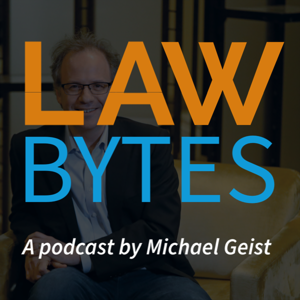


In recent years the intersection between law, technology, and policy has exploded as digital policy has become a mainstream concern in Canada and around the world. I am very excited to announce the launch of LawBytes: A Podcast with Michael Geist. This podcast will explore digital policies in conversations with people studying the legal and policy challenges, setting the rules, or who are experts in the field. It will provide a Canadian perspective, but since the internet is global, examining international developments and Canada’s role in shaping global digital policy is be an important part of the story.
The preview episode is available now and first full episode – a conversation with UK Information Commissioner Elizabeth Denham – will be available next week. All episodes will be available under a Creative Commons licence. You can subscribe at Apple Podcasts, Google Play, or Spotify as well as follow on Twitter at @LawBytesPod.
The Supreme Court of Canada recently brought a lengthy legal battle between Access Copyright and York University to an end, issuing a unanimous verdict written by retiring Justice Rosalie Abella that resoundingly rejected the copyright collective’s claims that its tariff is mandatory, finding that it had no standing to file a lawsuit for copyright infringement on behalf of its members, and concluding that a lower court fair dealing analysis that favoured Access Copyright was tainted. The decision removes any doubt that the Supreme Court remains strongly supportive of user’s rights and vindicates years of educational policy in shifting away from Access Copyright toward alternative means of ensuring compliance with copyright law.
Kim Nayyer is the Edward Cornell Law Librarian, Associate Dean for Library Services, and Professor of the Practice at Cornell Law School. She appeared before the Supreme Court in this case, representing the Canadian Association of Law Libraries as an intervener. She joins the Law Bytes podcast to talk about the case and its implications for the future of copyright, education, and collective rights management.
The podcast can be downloaded here, accessed on YouTube, and is embedded below. Subscribe to the podcast via Apple Podcast, Google Play, Spotify or the RSS feed. Updates on the podcast on Twitter at @Lawbytespod.
Show Notes:
Access Copyright v. York University
Credits:
Supreme Court hearing, Access Copyright v. York University
Last week was a busy one in the wireless world in Canada. Just as people were debating the proposed Rogers – Shaw merger, the CRTC released its long awaited wireless decision involving the possibility of mandated MVNOs or mobile virtual network operators. While the CRTC notably concluded that Canadian wireless pricing is high relative to other countries and attributed that to insufficient competition, it ultimately was unwilling to fully embrace a broad-based mandated MVNO model. To help break down these recent developments, joining the Law Bytes podcast this week are Dwayne Winseck, a professor at the School of Journalism and Communication at Carleton University and the director of the Canadian Media Concentration Research Project, and Ben Klass, a senior research associate at the Canadian Media Concentration Research Project and board member at the Internet Society Canada Chapter. They both join the podcast in a personal capacity representing only their own views.
The podcast can be downloaded here, accessed on YouTube, and is embedded below. Subscribe to the podcast via Apple Podcast, Google Play, Spotify or the RSS feed. Updates on the podcast on Twitter at @Lawbytespod.
Show Notes:
CRTC Review of Mobile Wireless Services, CRTC 2021-130
Credits:
Last week, the European Commission launched what promises to be a global, multi-year debate on the regulation of artificial intelligence. Several years in development, the proposed rules would ban some uses of AI, regulate others, and establish significant penalties for those that fail to abide by the rules. European leaders believe the initiative will place them at the forefront of AI, borrowing from the data protection framework of seeking to export EU solutions to the rest of the world. Céline Castets-Renard is a colleague at the University of Ottawa, where she holds the University Research Chair on Accountable Artificial Intelligence in a Global World. She joins the Law Bytes podcast to discuss the EU plans, their implications for Canadian AI policy, and the road ahead for the regulation of artificial intelligence.
The podcast can be downloaded here, accessed on YouTube, and is embedded below. Subscribe to the podcast via Apple Podcast, Google Play, Spotify or the RSS feed. Updates on the podcast on Twitter at @Lawbytespod.
Show Notes:
European Commission, Proposal for a Regulation on a European approach for Artificial Intelligence
Credits:
The public debate on Bill C-10 recently took a dramatic turn after the government unexpectedly removed legal safeguards designed to ensure the CRTC would not regulate user generated content. The resulting backlash has left political columnists comparing Canada to China in censoring the Internet, opposition MPs launching petitions with promises to fight back against the bill, and Canadian Heritage Minister Steven Guilbeault struggling to coherently answer questions about his own bill.
Cara Zwibel is the Director of the Fundamental Freedoms Program at the Canadian Civil Liberties Association and one of Canada’s leading experts on freedom of expression. She joins the Law Bytes podcast to talk both about Bill C-10 and the free speech risks that may come from another bill that Guilbeault has been discussing that could include website blocking, a social media regulator, and mandated Internet takedowns.
The podcast can be downloaded here, accessed on YouTube, and is embedded below. Subscribe to the podcast via Apple Podcast, Google Play, Spotify or the RSS feed. Updates on the podcast on Twitter at @Lawbytespod.
Credits:
From the publisher's feed
26,165 Listeners

26,255 Listeners
210 Listeners
80 Listeners
103 Listeners
8 Listeners
50 Listeners
5,084 Listeners
36 Listeners

575 Listeners

5,557 Listeners

15,926 Listeners
41 Listeners
4 Listeners
34 Listeners