
Sign up to save your podcasts
Or

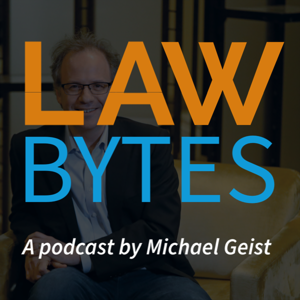


This past week Bill C-10, Internet free speech, and the government’s digital policy agenda went mainstream as a lead topic in government, the media, and among many Canadians. This week’s Law Bytes podcast departs from the standard format as I explain why the bill has suddenly become a hot topic, how the government has been inconsistent and at times incoherent in its attempts to justify the bill, and why the concerns regarding freedom of speech and CRTC over-regulation are absolutely justified.
The podcast can be downloaded here, accessed on YouTube, and is embedded below. Subscribe to the podcast via Apple Podcast, Google Play, Spotify or the RSS feed. Updates on the podcast on Twitter at @Lawbytespod.
Credits:
House of Commons, May 5, 2021
The global struggle for access to COVID-19 vaccines took a dramatic turn recently as the Biden Administration in the United States unexpectedly reversed its longstanding opposition to a patent waiver designed to facilitate access to vaccines in the developing world. The shift seemingly caught many by surprise. Pharmaceutical companies were quick to voice opposition and U.S. allies found themselves being asked to take positions. That was certainly the case in Canada, where the Canadian government has steadfastly refused to support the waiver with repeated claims that it had yet to make a decision.
Ellen ‘t Hoen, is a lawyer and public health advocate with over 30 years of experience working on pharmaceutical and intellectual property policies. From 1999 until 2009 she was the director of policy for Médecins sans Frontières’ Campaign for Access to Essential Medicines. In 2009 she joined UNITAID in Geneva to set up the Medicines Patent Pool (MPP). Ellen is currently the director of Medicines Law & Policy and a researcher at the University Medical Centre Groningen. She joins the Lawbytes podcast this week to talk about the fight for a patent waiver and the implications of the Biden decision for global access to COVID vaccines.
The podcast can be downloaded here, accessed on YouTube, and is embedded below. Subscribe to the podcast via Apple Podcast, Google Play, Spotify or the RSS feed. Updates on the podcast on Twitter at @Lawbytespod.
Credits:
CNBC, Biden Administration Supports Waiver of Patent Protections for Covid Vaccines
Weeks into a high profile debate over Bill C-10, the issue of discoverability of Canadian content has emerged as a policy tug of war between supporters that want the CRTC to intervene by mandating the discoverability of Canadian content on sites such as Youtube and Tiktok and critics that argue the approach would raise significant freedom of expression and net neutrality concerns. But what exactly is “discoverability” and how would it impact both users and the thousands of Canadian creators that have already found success on digital platforms?
Fenwick McKelvey is a communications professor at Concordia University who has written more about the discoverability and algorithmic media than anyone in Canada. He has regularly participated in CRTC hearings and was the co-author of a leading study on the issue commissioned by Canadian Heritage. He joins the Law Bytes podcast to talk about discoverability, his frustrations with its implementation in Bill C-10, and the potential consequences for Canadian creators.
The podcast can be downloaded here, accessed on YouTube, and is embedded below. Subscribe to the podcast via Apple Podcast, Google Play, Spotify or the RSS feed. Updates on the podcast on Twitter at @Lawbytespod.
Credits:
Standing Committee on Canadian Heritage, May 14, 2021
Communications issues have been in the political spotlight in recent weeks with the controversial CRTC decision to reverse a pricing decision on wholesale broadband that swiftly led to calls for the resignation of Commission Chair Ian Scott as well as the ongoing battle over Bill C-10, which envisions granting extensive new powers to the CRTC.
Konrad von Finckenstein is a former chair of the CRTC, having led the Commission during a similarly contentious time during debates over net neutrality. He has since been outspoken on communications policy issues, including arguing that Bill C-10 should be scrapped and re-written. He joins the Law Bytes podcast to talk about the CRTC, the recent decisions, and what he thinks a better approach to Internet and broadcast regulation would look like.
The podcast can be downloaded here, accessed on YouTube, and is embedded below. Subscribe to the podcast via Apple Podcast, Google Play, Spotify or the RSS feed. Updates on the podcast on Twitter at @Lawbytespod.
Credits:
Earlier this year, Senator Claude Carignan introduced Bill S-225, a bill that purports to address concerns about the viability of the Canadian media sector by amending the Copyright Act. The Senate has been studying the bill in recent weeks with Senator Paula Simons serving as the bill critic and one of the leads on the issue. Senator Simons was a longtime journalist before being appointed to the Senate and while an ardent supporter of local journalism, she has been critical of the proposed legislation. She joins the Law Bytes podcast to discuss the state of journalism in Canada, why she doesn’t think the social media companies “stole” stories from the media, and what Canada should be doing to encourage innovation in the media sector.
The podcast can be downloaded here, accessed on YouTube, and is embedded below. Subscribe to the podcast via Apple Podcast, Google Play, Spotify or the RSS feed. Updates on the podcast on Twitter at @Lawbytespod.
Show Notes:
Bill S-225
Credits:
TRCM: Conservative Sen. Claude Carignan appears at committee for Bill S-225, June 2, 2021
From the publisher's feed

26,165 Listeners

26,255 Listeners
210 Listeners
80 Listeners

103 Listeners
8 Listeners
50 Listeners
5,084 Listeners
36 Listeners

575 Listeners

5,557 Listeners

15,926 Listeners
41 Listeners
4 Listeners

34 Listeners