
Sign up to save your podcasts
Or



Based on Podcast App listening data
When Jessey Baca returned from Balad Air Base in Iraq, he began experiencing strange health symptoms: fevers, chills, headaches, difficulty breathing. The VA tried to write off his condition as PTSD, but Jessey and his wife Maria would eventually learn that the likely cause was exposure to burn pits, where the military was incinerating trash with jet fuel. And they weren’t alone. Thousands of veterans were sick and dying from burn pit exposure.
Featured in this episode:
Kelly Kennedy
Jessey and Maria Baca
Sources:
Kelly Kennedy’s reporting for The Military Times (https://www.militarytimes.com/) and The War Horse (https://thewarhorse.org/)
The New Republic’s “The Things They Burned”: https://newrepublic.com/article/138058/things-burned
The New York Times’ “The Soldiers Came Home Sick. The Government Denied It Was Responsible”: https://www.nytimes.com/2022/01/11/magazine/military-burn-pits.html
See Privacy Policy at https://art19.com/privacy and California Privacy Notice at https://art19.com/privacy#do-not-sell-my-info.
The tug-of-war over undeveloped land in the U.S. is nothing new, but in 2014 Cliven and Ammon Bundy escalated their dispute over cattle grazing permits in Nevada to another level. Their clash against the federal Bureau of Land Management would galvanize a movement – and set the stage for one of the largest armed uprisings against the government in American history, with lasting consequences for the environment.
Featured in this episode:
Betsy Gaines Quammen
Sources:
Betsy Gaines Quammen's book American Zion: Cliven Bundy, God and Public Lands in the West
PBS’s Frontline’s documentary American Patriot.
See Privacy Policy at https://art19.com/privacy and California Privacy Notice at https://art19.com/privacy#do-not-sell-my-info.
In 2015, news broke that Exxon’s own scientists had known for decades that burning fossil fuels was causing global warming. To raise awareness, climate activists launched a campaign called “Exxon Knew.” But almost immediately, they noticed something strange: their private emails seemed to be getting leaked to the press. They were getting hacked – but by who?
Featured in this episode:
Kert Davies, Center for Climate Integrity
John Scott Railton, The Citizen Lab
Sources:
The Citzen Lab’s “Dark Basin: Uncovering a Massive Hack-for-Hire Operation”: https://citizenlab.ca/research/dark-basin-uncovering-a-massive-hack-for-hire-operation/
Inside Climate News’s “Exxon: The Road Not Taken”: https://insideclimatenews.org/project/exxon-the-road-not-taken/
See Privacy Policy at https://art19.com/privacy and California Privacy Notice at https://art19.com/privacy#do-not-sell-my-info.
One of the worst industrial disasters in our nation’s history occurred in West Virginia in the 1930s. Not in a coal mine – but in a tunnel chiseled out of a mountain for a hydroelectric power plant. Hundreds of workers, most of them poor and Black, quietly died from breathing in silica dust. For decades, the true scale of the devastation was buried by the companies behind the project.
Featured in this episode:
Catherine Venable Moore
Dr. Martin Cherniack
Sources:
Dr. Martin Cherniack’s book The Hawk’s Nest Incident: America’s Worst Industrial Disaster
Catherine Venable Moore’s “The Book of the Dead” in Oxford American:
https://oxfordamerican.org/magazine/issue-94-fall-2016/the-book-of-the-dead
Muriel Rukeyser's Book of the Dead
George Robinson’s Congressional Testimony
NPR’s reporting on the Hawk’s Nest Tunnel: https://www.npr.org/2019/01/20/685821214/before-black-lung-the-hawks-nest-tunnel-disaster-killed-hundreds
See Privacy Policy at https://art19.com/privacy and California Privacy Notice at https://art19.com/privacy#do-not-sell-my-info.
The device you’re using to listen to this podcast almost certainly contains cobalt. It’s a vital component of rechargeable batteries, which are essential to electric vehicles, laptops, and smartphones. But most of the world’s known cobalt reserves are in the Democratic Republic of the Congo, where mines are plagued by child labor, human trafficking, and deadly working conditions.
Featured in this episode:
Siddharth Kara
Sources:
Siddharth Kara’s book Cobalt Red: How the Blood of the Congo Powers Our Lives and his report “Blood Batteries” https://www.nottingham.ac.uk/research/beacons-of-excellence/rights-lab/resources/reports-and-briefings/2025/august/blood-batteries.pdf
Nicolas Niarchos’ reporting in The New Yorker: https://www.newyorker.com/magazine/2021/05/31/the-dark-side-of-congos-cobalt-rush
Amnesty International’s report “This is What We Die For” https://www.amnestyusa.org/wp-content/uploads/2017/04/this_what_we_die_for_-_report.pdf
See Privacy Policy at https://art19.com/privacy and California Privacy Notice at https://art19.com/privacy#do-not-sell-my-info.
In the late 1980s, Judi Bari was a fearless activist building an alliance between loggers and environmentalists to save the last of California's old growth redwoods. The same traits that attracted followers to her movement, also made her a lot of enemies. In 1990, a bomb exploded in Judi’s car while she was driving. Somehow she survived – but then the FBI showed up and told her she was under arrest.
Featured in this episode:
Darryl Cherney
Sources:
Darryl Cherney’s documentary Who Bombed Judi Bari?
Josh Richman’s reporting in High Country News: https://www.hcn.org/issues/issue-229/earth-firster-judi-bari-avenged-at-last/
Judi Bari’s book Timber Wars
See Privacy Policy at https://art19.com/privacy and California Privacy Notice at https://art19.com/privacy#do-not-sell-my-info.
When Florida state wildlife officials begin to suspect that someone is illegally harvesting alligator eggs, they launch Operation Alligator Thief. At its heart: a veteran officer named Jeff Babauta, who delays his retirement to go deep undercover as a real Florida Man, hoping to infiltrate the insular world of gator farming.
Featured in this episode:
Jeff Babauta
Rebecca Renner
Sources:
Rebecca Renner’s book Gator Country: Deception, Danger, and Alligators in the Everglades
See Privacy Policy at https://art19.com/privacy and California Privacy Notice at https://art19.com/privacy#do-not-sell-my-info.
In the 1980s, Philadelphia was in the midst of a trash crisis. A sanitation workers’ strike had left the city with an immense backlog of garbage. The solution: Ship it overseas, on a rusting cargo vessel called the Khian Sea. But when one country after another refused to take Philly’s waste, it turned the Khian Sea’s trash voyage into a trash odyssey, and shed light on a growing problem that critics came to call “garbage imperialism.”
Featured in this episode:
Kenny Bruno
Sources:
Simone M. Müller’s book The Toxic Ship
Alexander Clapp’s book Waste Wars
Planet Money’s reporting on the Mobro 4000: https://www.npr.org/transcripts/739893511
See Privacy Policy at https://art19.com/privacy and California Privacy Notice at https://art19.com/privacy#do-not-sell-my-info.
Today, Lawless Planet brings you an episode from our friends at Drilled Media. Season 12 of their flagship podcast is called SLAPP’d, and it tells another side of a story we covered earlier in our episode “Surveillance and Sabotage on the Dakota Access Pipeline.”
Greenpeace, which was only tangentially involved in the Standing Rock protests against the Dakota Access Pipeline, has been slapped with a $666 million bill for damages...despite the fact that DAPL was built, and has been making Energy Transfer millions of dollars for years. How did we get here? Cody Hall, an Indigenous water protector who was a key figure during the Standing Rock protests and was initially also targeted in Energy Transfer's suit, walks us through how things went down back in 2016 and 2017, and where this suit began.
See Privacy Policy at https://art19.com/privacy and California Privacy Notice at https://art19.com/privacy#do-not-sell-my-info.
We’re doing something different on Lawless Planet this week. We’re sharing an episode from our friends Scamfluencers — a show that unpacks the wildest true stories of high-profile scams and the con artists behind them.
When Jeff Carpoff starts a business making portable solar generators, it becomes an instant hit among big corporations, Hollywood studios, and deep-pocketed investors. They think they’re getting a good deal on green energy – and a huge tax credit to go along with it. But Jeff’s clients don’t realize that he’s been playing them. And when he flies too close to the sun, it’ll blow the fuse on his whole operation.
See Privacy Policy at https://art19.com/privacy and California Privacy Notice at https://art19.com/privacy#do-not-sell-my-info.
From the publisher's feed
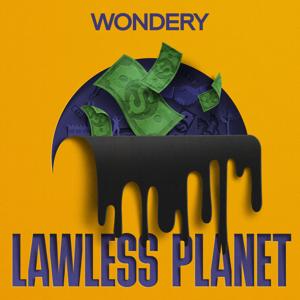
It’s not that hard to kill a planet. All it takes is a little drilling, some mining, a generous helping of pollution and voila! Earth over. When you take stock of what’s left, it starts to look…
Audible subscribers can listen to all episodes of Lawless Planet ad-free right now. Join Audible today by downloading the Audible app.
Ranked by our users in the last 21 days

10,423 Listeners

30,106 Listeners
772 Listeners
469 Listeners
9,819 Listeners

19,177 Listeners
12,817 Listeners

18,985 Listeners

2,148 Listeners

115 Listeners

3,044 Listeners
22,969 Listeners

903 Listeners

7,755 Listeners

10,318 Listeners

256 Listeners

2,501 Listeners

251 Listeners

7,346 Listeners

851 Listeners

1,530 Listeners

238 Listeners

2,764 Listeners

335 Listeners

1,304 Listeners

67 Listeners

534 Listeners

885 Listeners

1,532 Listeners

1,432 Listeners
326 Listeners