
Sign up to save your podcasts
Or

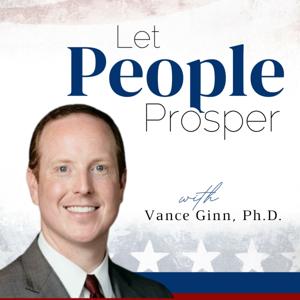


From inflation and immigration to prescription drugs, diesel, and data centers, policymakers are reaching for new ways to control economic outcomes.
In TWE 184, I ask a more fundamental question: What caused the problem in the first place? We examine federal deficits, H-1B visas, Texas data centers, drug pricing, and energy through the common lens of scarcity, incentives, supply, and competition.
The lesson: good intentions don't guarantee good economic outcomes. Lasting prosperity comes from addressing causes and allowing people to produce, compete, innovate, and solve problems.
Get show notes at vanceginn.substack.com.
Mark Moses, Senior Fellow at the California Policy Center and author of The Municipal Financial Crisis, joins me to discuss why local governments still face fiscal pressures and what taxpayers should know about government finances.
We explore municipal budgets, public pensions, balance sheets, AI, data centers, and whether governments lose focus on their essential responsibilities when their missions continually expand.
The central question: What should local government actually do?Learn more about my work at Ginn Economic Consulting at VanceGinn.com. Subscribe to my newsletter for show notes and more: vanceginn.substack.com.
Nearly $2 billion in Medicaid fraud-related and other recoveries should get our attention. So should CMS's estimate of $37.4 billion in improper Medicaid payments, although improper payments are not necessarily fraud.
But the bigger economic question is about incentives.
In this episode, I examine how federal Medicaid matching can affect state spending decisions, how complicated financing arrangements can encourage states to pursue additional federal dollars, and why greater state flexibility should come with greater fiscal responsibility.
Then I go one step further: Medicaid reform shouldn't simply move control from Washington to the states. More healthcare dollars and decisions should ultimately move toward patients and doctors.
Protect taxpayers. Empower patients. Let doctors focus on healing.
Find show notes at vanceginn.substack.com and more info on my work at vanceginn.com.
Is classical liberalism losing ground in America?
Duke University professor Dr. Michael Munger joins me to discuss constitutional government, public choice, tariffs, free trade, and the institutions underlying a free and prosperous society.
We explore why restraints on government matter even when they prevent our preferred political outcomes, how political incentives shape policy, what tariffs actually do, and why institutional “friction” can sometimes protect against bad collective decisions.
Mike first joined the show in 2023 to discuss whether capitalism was sustainable in America. This time, we tackle an even broader question: Can America maintain the classical-liberal institutions that allow freedom and prosperity to flourish?
Find more at VanceGinn.com.
If the government sends you a check while everything around you gets more expensive, are you really better off?
This week, I break down inflation and wages, the Fed’s latest rate hike, President Trump’s proposed $5,000 dividend, Governor Abbott’s Texas affordability agenda, rising healthcare costs, and calls to slow AI.
The common question is simple: Are policymakers addressing what makes things expensive, or adding another subsidy or regulation to manage the symptoms?
We discuss why lasting affordability depends on sound money, spending restraint, more supply and competition, better healthcare incentives, and innovation.
More on my work at Ginn Economic Consulting at VanceGinn.com, and show notes for Let People Prosper on Substack at vanceginn.substack.com.
How much power should federal agencies have, and who should be accountable when they exercise it?
Ashley Baker, Executive Director of the Committee for Justice, joins me to discuss agency power, antitrust, the Supreme Court, regulatory compliance costs, and the constitutional limits on the administrative state.
We dig into Trump v. Slaughter, FTC authority, merger enforcement, regulatory barriers to competition, and why constitutional restraints matter for both liberty and prosperity.
Subscribe and share the Let People Prosper Show.
Find more of my work at VanceGinn.com and subscribe at VanceGinn.Substack.com.
Americans are losing faith in capitalism, but much of what gets blamed on free markets comes from government intervention.
In TWE 181, I explain why capitalism beats socialism through economic freedom, competition, prices, profit and loss, and decentralized decision-making. More government control won’t fix problems government helped create.
The strongest answer to socialism isn’t another slogan. Let people experience economic freedom.
Subscribe, rate, and share This Week’s Economy. Find my work at VanceGinn.com and subscribe to Let People Prosper.
Adam Thierer returns to the Let People Prosper Show to discuss one of America's biggest economic and policy questions: Will we build the infrastructure and preserve the freedom needed to lead the AI revolution?
Adam is Resident Senior Fellow for Technology and Innovation at the R Street Institute and a leading advocate of permissionless innovation.
We discuss data-center restrictions, energy abundance, AI and jobs, competition with China, age verification and online safety, and whether policymakers are repeating past technopanics by trying to regulate emerging technologies before understanding their potential.
The central lesson is simple: America’s greatest technological advantage is our freedom to experiment, invest, compete, fail, and try again.
Read the show notes and subscribe at VanceGinn.Substack.com.
#AI #Innovation #DataCenters #EconomicFreedom #LetPeopleProsper
Happy Labor Day! Today we recognize and honor the contributions of American workers. But it’s also worth remembering why work itself matters. Work helps us provide for ourselves and our families. But it’s about more than a paycheck. Work provides dignity, purpose, opportunity, and the satisfaction of creating something valuable.
Public policy can either make that work more rewarding or make it harder for Americans to get ahead. In today’s episode of This Week’s Economy, we’ll look beyond the headline unemployment rate to examine what workers are really experiencing, how Washington’s $40 trillion debt and Federal Reserve policy affect prosperity, and why debates over data centers, social media, and even the “common good” ultimately come back to a fundamental question: Are we giving people more freedom to prosper or are we putting government in their way?
Tune in to the full episode on YouTube, Apple Podcasts, or Spotify, and visit my website for more information about my work at Ginn Economic Consulting.
This is a special and personal episode of the Let People Prosper Show. I’m joined by my wife, Emily Ginn, a licensed Master Social Worker, certified life coach, entrepreneur, and host of the IVF This podcast.
We discuss our journey through infertility and IVF, how those experiences shaped our family, and why Emily turned a difficult chapter of our lives into a way to help other women.
We also talk about entrepreneurship, balancing family and meaningful work, what policymakers misunderstand about IVF and patient choice, and a question at the heart of this show: What does it really mean to prosper?
Prosperity is about more than money. It’s about family, purpose, service, opportunity, and having the freedom to build a meaningful life.
Learn more about Emily at IVFThisCoaching.com.
Subscribe for more conversations about economics, public policy, freedom, family, and human flourishing. Get show notes and more about my work at Ginn Economic Consulting at vanceginn..com
#LetPeopleProsper #IVF #Infertility #Family #Entrepreneurship #HumanFlourishing
From the publisher's feed
39,048 Listeners
969 Listeners

4,348 Listeners

4,275 Listeners
382 Listeners

1,534 Listeners
4,881 Listeners

583 Listeners

363 Listeners

6,552 Listeners

6,473 Listeners

43,726 Listeners
448 Listeners

215 Listeners

59 Listeners