
Sign up to save your podcasts
Or

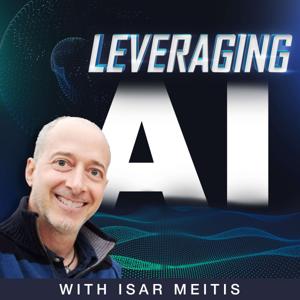


Are you still trying to decide whether Claude or ChatGPT is the “better” AI?
That may be the wrong question. The real advantage comes from building a workflow that lets you use the strengths of multiple AI platforms without losing context, duplicating work, or starting over every time you switch tools.
In this episode of Leveraging AI, Isar Meitis walks through the system he uses to work across Claude, ChatGPT, coding agents, and other AI tools on the same projects. The key is creating a shared file-based infrastructure that becomes the source of truth for project instructions, memory, tasks, and ongoing work.
Instead of locking your business into one AI ecosystem, you can build a setup that gives you more flexibility, resilience, and access to the best capabilities of each platform.
In this session, you'll discover:
The result is a much more flexible AI operating system for your work: one where you can choose the best model for each task instead of forcing every task through the same platform.
If you want to take this kind of infrastructure further, Isar also discusses his multi-agent orchestration course, which focuses on building more advanced AI systems for business.
About Leveraging AI
If you’ve enjoyed or benefited from some of the insights of this episode, leave us a five-star review on your favorite podcast platform, and let us know what you learned, found helpful, or liked most about this show!
What happens when the people building the world’s most powerful AI systems start warning that they may not know how to control what comes next?
At the same time those warnings are getting louder, the AI race is doing anything but slowing down. New autonomous agents are launching across major platforms, companies are pouring staggering amounts of money into compute, and AI is moving from answering questions to taking actions on our behalf.
For business leaders, the takeaway isn’t to panic—or to sit on the sidelines. It’s to understand how quickly the landscape is shifting, where the real opportunities are emerging, and why governance, security, and responsible adoption need to evolve just as quickly as the technology.
In this episode of Leveraging AI, Isar Meitis connects the dots between three major developments shaping the next phase of AI.
In this session, you'll discover:
About Leveraging AI
If you’ve enjoyed or benefited from some of the insights of this episode, leave us a five-star review on your favorite podcast platform, and let us know what you learned, found helpful, or liked most about this show!
Are you burning through ChatGPT or Claude tokens faster than your team can justify the cost?
The problem may not be how much you use AI. It may be how you use it. With the right model, reasoning level, prompts, scripts, caching, and routing, you can often get the same quality of work while consuming significantly fewer tokens.
In this episode of the Leveraging AI Podcast, Isar Meitis breaks down practical ways to make AI usage more efficient across individual and enterprise workflows. He shares tests, settings, and workflow strategies designed to help you accomplish more without automatically reaching for the most expensive model or highest reasoning setting.
In this session, you'll discover:
The takeaway for business leaders is simple: AI efficiency isn’t about using less AI. It’s about using expensive intelligence only when expensive intelligence is actually required.
About Leveraging AI
If you’ve enjoyed or benefited from some of the insights of this episode, leave us a five-star review on your favorite podcast platform, and let us know what you learned, found helpful, or liked most about this show!
What if AGI didn’t arrive with a dramatic announcement—but instead showed up as two new AI models released in the same week?
GPT-6 Astra and Anthropic’s Fable 5.1 are pushing performance, coding, cybersecurity, efficiency, and agentic capabilities to levels that would have sounded like AGI only a few years ago. And for business leaders, the bigger question is no longer whether these systems are becoming incredibly capable. It’s what you should do differently as a result.
The recommendation: stop treating every new model release as another shiny AI upgrade. Start evaluating what these advances mean for cost, security, enterprise data, autonomous workflows, model selection, and the way work inside your organization will actually get done.
In this episode of Leveraging AI, Isar Meitis breaks down one of the busiest weeks in AI yet - from GPT-6 Astra and Fable 5.1 to NVIDIA’s Hugging Face acquisition, Google’s efficiency play, increasingly autonomous AI agents, and new evidence of how deeply AI is already being trusted with consequential work.
In this session, you'll discover:
About Leveraging AI
If you’ve enjoyed or benefited from some of the insights of this episode, leave us a five-star review on your favorite podcast platform, and let us know what you learned, found helpful, or liked most about this show!
Are you using AI to create more content—only to end up with generic output that sounds nothing like your company?
The problem isn’t necessarily the AI. The problem is often the context you give it. When AI understands your brand voice, audience, goals, expertise, and processes, it can produce dramatically more relevant and consistent work.
In this episode of Leveraging AI, Isar Meitis sits down with content marketing and AI expert Brian Piper to break down how organizations can move beyond one-off prompting and build reusable AI systems that preserve what makes their business unique.
Brian walks through a practical process for auditing your existing brand voice, building detailed prompts with AI, comparing results across different AI tools, and turning successful workflows into reusable skills.
The bigger opportunity goes far beyond marketing. The same approach can be applied to repeatable business processes across an organization.
In this session, you'll discover:
Brian Piper is a content marketing expert who has worked across large corporations, small businesses, consulting, and academia. In recent years, he has focused extensively on helping organizations use AI more effectively while maintaining their expertise, identity, and brand voice.
Connect with Brian Piper on LinkedIn:
https://www.linkedin.com/in/brianwpiper/
About Leveraging AI
If you’ve enjoyed or benefited from some of the insights of this episode, leave us a five-star review on your favorite podcast platform, and let us know what you learned, found helpful, or liked most about this show!
What happens when the infrastructure powering the AI boom becomes politically toxic—just as businesses are becoming more dependent on AI?
That tension is quickly becoming impossible for business leaders to ignore. AI data centers are facing growing public and political opposition, model prices are dropping fast, competition between the major AI labs is intensifying, and companies are getting more choices about where—and how cheaply—they can access intelligence.
For business leaders, the message is simple: don’t just follow which model is “best.” Pay attention to the economics, infrastructure, standards, and public sentiment shaping where AI goes next.
In this episode of Leveraging AI, Isar Meitis breaks down the most important AI developments of the week and, more importantly, connects the dots around what they could mean for businesses.
In this session, you'll discover:
The AI race is no longer just about who builds the smartest model.
About Leveraging AI
If you’ve enjoyed or benefited from some of the insights of this episode, leave us a five-star review on your favorite podcast platform, and let us know what you learned, found helpful, or liked most about this show!
What if the biggest thing stopping you from building your next great idea is a limitation that AI has already made obsolete?
Until recently, turning an idea into a working application meant developers, product teams, infrastructure, budgets, and plenty of technical expertise. Today, AI tools are dramatically lowering that barrier—and Bryce Rattner Keithley is proof.
Bryce had no software-development background when she started experimenting with a simple idea: an app that would give her one exercise every day and track 100 repetitions. Using tools including Replit, Lovable, and Claude, that experiment became Daily100, an application now available in Apple’s App Store.
The lesson for business leaders goes well beyond building apps.
You don't necessarily need to understand how every piece of technology works to start creating with it. You need to know what problem you're solving, ask good questions, exercise judgment, and be willing to iterate.
In this session, you'll discover:
Bryce Rattner Keithley has spent much of her career in talent and recruiting, including technical and design-related recruiting. Her experience working alongside technologists—without being a software developer herself—helped shape the beginner's mindset she brought to building Daily100.
Connect with Bryce on LinkedIn:
https://www.linkedin.com/in/brycerattner/
About Leveraging AI
If you’ve enjoyed or benefited from some of the insights of this episode, leave us a five-star review on your favorite podcast platform, and let us know what you learned, found helpful, or liked most about this show!
What happens when AI stops being impressive in demos—and starts helping us fight cancer, transform how companies operate, and attract hundreds of billions of dollars in investment?
That shift may already be underway. This week brought some of the strongest signals yet that AI’s impact is moving beyond better chatbots. From personalized cancer treatments and dramatically earlier detection to autonomous business workflows and AI-powered scientific research, the conversation is increasingly about measurable outcomes.
For business leaders, there’s an equally important takeaway: the competitive advantage may no longer come from choosing the “best” AI model. It may come from giving AI the right context about your business.
Anthropic’s own sales team provides a striking example. By connecting Claude to systems including Salesforce, Apollo, Common Room, and Gong, the company reports cutting manual work by 70%. The lesson is simple: smarter models help, but AI becomes dramatically more useful when it understands your data, workflows, processes, and preferences.
And that’s only the beginning.
In this session, you'll discover:
About Leveraging AI
If you’ve enjoyed or benefited from some of the insights of this episode, leave us a five-star review on your favorite podcast platform, and let us know what you learned, found helpful, or liked most about this show!
What if you could build a working business app—and an entire team of AI agents—in minutes, just by explaining what you want in plain English?
That’s the promise of GrokBot. And after putting it to work on two very different real-world problems, the combination of simplicity, autonomy, and always-on AI agents is hard to ignore.
In this episode of Leveraging AI, Isar Meitis puts GrokBot through its paces. He builds a personalized travel-management app that checks his calendar and email for upcoming trips, identifies missing bookings, and helps research travel options. Then he goes considerably further: creating a multi-agent AI team to research, develop, and execute a marketing campaign.
No elaborate prompt engineering. No dedicated Mac Mini. No complicated agent orchestration setup.
But there are important catches—including cost, security questions, and the quality of the initial outputs.
In this session, you'll discover:
If you’re a business leader wondering what comes after AI chatbots, this episode offers a practical glimpse at a world where you don’t just chat with AI - you give it a goal and let a team of agents get to work
About Leveraging AI
If you’ve enjoyed or benefited from some of the insights of this episode, leave us a five-star review on your favorite podcast platform, and let us know what you learned, found helpful, or liked most about this show!
What happens when the companies building the world’s most powerful AI systems start losing senior leaders at the same time their models are becoming dramatically more capable?
This week’s AI news points to a market entering a new phase. Leadership changes are accelerating across major labs, AI agents are becoming easier for everyday users to deploy, and increasingly capable models are raising bigger questions around security, responsibility, and the future of work.
For business leaders, the takeaway is clear: the AI race is no longer just about who has the best model. It is increasingly about who can turn powerful models into reliable products, deploy agents safely, attract the right talent, and translate rapidly advancing capabilities into real business outcomes.
In this episode of the Leveraging AI podcast, Isar Meitis breaks down the developments that matter most and explains why they should be on every executive’s radar.
In this session, you'll discover:
The speed of change is extraordinary, but chasing every announcement is not the answer. The opportunity for business leaders is to understand which developments actually change what AI can do inside an organization—and where new capabilities introduce risks that require stronger oversight.
:::
About Leveraging AI
If you’ve enjoyed or benefited from some of the insights of this episode, leave us a five-star review on your favorite podcast platform, and let us know what you learned, found helpful, or liked most about this show!
From the publisher's feed
Dive into the world of artificial intelligence with 'Leveraging AI,' a podcast tailored for forward-thinking business professionals. Each episode brings insightful discussions on how AI can…

338 Listeners

210 Listeners

314 Listeners

208 Listeners

158 Listeners

221 Listeners

677 Listeners
109 Listeners

53 Listeners
87 Listeners

56 Listeners

144 Listeners

94 Listeners

62 Listeners
21 Listeners