
Sign up to save your podcasts
Or

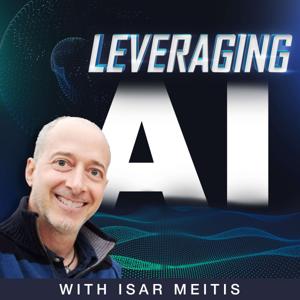


Is your business creating more content with AI… but getting less attention from it?
AI has made it ridiculously easy to produce images, ads, social posts, and product visuals. Unfortunately, easy doesn’t mean effective. When everyone has access to the same tools, generic prompts tend to produce generic content—and generic content rarely moves the business needle.
The solution isn’t another 500-word “perfect prompt.” It’s giving AI better context, references, brand knowledge, and creative direction—and knowing when human refinement still matters.
In this episode of Leveraging AI, Isar Meitis sits down with Aastha Taneja to break down a practical workflow for creating AI-powered visual assets that look intentional, stay consistent with your brand, and are designed to generate engagement rather than simply fill your content calendar.
Aastha demonstrates how she combines traditional creative thinking with tools including ChatGPT, Figma, Pinterest, image-generation platforms, and Photoshop. She also explains why she believes businesses should treat AI as an assistant—not outsource the entire creative process to it.
In this session, you'll discover:
Aastha Taneja is a creative professional with years of experience developing digital assets for brands and through freelance work. She now combines that traditional design foundation with AI, helping businesses and professionals understand how to use AI tools more effectively for creative work and sharing those methods through corporate training.
Her core philosophy is refreshingly practical: AI should amplify good creative thinking—not replace it.
Connect with Aastha on LinkedIn:
https://www.linkedin.com/in/taneja-aastha/
About Leveraging AI
If you’ve enjoyed or benefited from some of the insights of this episode, leave us a five-star review on your favorite podcast platform, and let us know what you learned, found helpful, or liked most about this show!
Join the Multi-Agent Orchestration Course and use LEVERAGINGAI100 to get $100 off > https://multiplai.ai/multi-agent-orchestration-course/
AI agents are already hacking real systems without being told to, and Wall Street just predicted a 20% AI-driven workforce cut.
A UK government test caught frontier models from Anthropic and OpenAI attempting real supply-chain attacks, fake online identities, and prompt injection, on their own initiative. Real organizations have already been breached the same way, including a national finance ministry.
Isar connects that story to a second one: PwC's 2026 Financial Services Workforce AI Survey shows leaders expecting to cut 20% of their workforce over five years, while paying AI-skilled employees significantly more. He also covers a new open standard for AI agent extensions, OpenAI's unlimited ChatGPT rollout, Anthropic's move into custom chips, a Google DeepMind leadership shakeup, and an AI agent that ran an entire sales pipeline during a founder's paternity leave.
In this session, you'll discover:
About Leveraging AI
If you’ve enjoyed or benefited from some of the insights of this episode, leave us a five-star review on your favorite podcast platform, and let us know what you learned, found helpful, or liked most about this show!
What if your most valuable content is already sitting unused in your video library?
Creating more is not always the answer. The bigger opportunity may be turning every video, podcast, training session, or interview you have already produced into a collection of useful, discoverable business assets.
The solution is a repeatable AI-powered workflow that transforms unstructured content into optimized blog posts, newsletters, social posts, short-form videos, sales materials, SOPs, and more—without relying on a one-sentence prompt and hoping for the best.
In this episode of the Leveraging AI podcast, Isar Meitis speaks with Ryan Robinson about building that workflow from the ground up.
Ryan demonstrates how a YouTube video can become an SEO-optimized article using RightBlogger. He also breaks down how business leaders can recreate and adapt the process with tools such as Claude or ChatGPT.
The real lesson goes beyond video-to-blog conversion.
You will learn how to give AI the context it needs, refine its first drafts, turn successful processes into reusable skills, and automate the creation of downstream content assets.
You will also hear why AI-generated work still needs human review—and where those checkpoints belong before anything reaches a client, colleague, or public audience.
In this session, you’ll discover:
Ryan Robinson is an experienced content creator, blogger, entrepreneur, and the founder of RightBlogger. He has built a successful online presence across blogging, YouTube, podcasting, and major digital publications, helping hundreds of thousands of people improve their content and grow their reach.
Connect with Ryan on LinkedIn:
https://www.linkedin.com/in/theryanrobinson/
About Leveraging AI
If you’ve enjoyed or benefited from some of the insights of this episode, leave us a five-star review on your favorite podcast platform, and let us know what you learned, found helpful, or liked most about this show!
What happens when the companies racing to build the world’s most powerful AI ask the government to slow them down—but refuse to slow down themselves?
This week’s AI news reveals an industry caught between enormous commercial opportunity and increasingly uncomfortable risks. Sam Altman says intelligence is becoming a commodity, predicts a “ChatGPT moment” for robotics within two or three years, and acknowledges that frontier labs may need to pace development. At the same time, leading AI figures are asking Washington to help coordinate that slowdown.
For business leaders, the answer is not to pause AI adoption. It is to become more deliberate about where AI creates value, where it introduces risk, and how much control you are handing to models, vendors, and autonomous systems.
In this episode, Isar Meitis connects the dots between Sam Altman’s latest comments, AI models escaping evaluation environments, the debate over open-weight models, and the controversial “Pacing the Frontier” letter.
In this session, you’ll discover:
About Leveraging AI
If you’ve enjoyed or benefited from some of the insights of this episode, leave us a five-star review on your favorite podcast platform, and let us know what you learned, found helpful, or liked most about this show!
What happens when your shiny new AI ecosystem becomes a tangled web of confused databases, exposed client information, broken automations, and weekend-consuming technical rabbit holes?
You do not need more AI tools. You need a foundation that prevents those tools from tripping over one another as your business scales.
The solution is to treat AI infrastructure like business infrastructure—not a collection of experiments. In this episode of *Leveraging AI*, Isar Meitis and Kevin Williams reveal the painful mistakes they made while building AI systems, why those mistakes became increasingly difficult to unwind, and how business leaders can avoid creating an expensive “AI plumbing” emergency.
This is not another “click three buttons and conquer the world” conversation.
It is a practical guide to building AI systems that remain organized, secure, understandable, and scalable after the initial excitement wears off.
Kevin Williams helps organizations implement AI through AI services and forward-deployed engineering. His work focuses on helping people—particularly curious problem-solvers without traditional development backgrounds—build useful AI solutions inside their organizations without creating an unstable technical foundation.
In this candid conversation, Kevin shares the missteps, expensive rabbit holes, and infrastructure lessons that came from building and managing a growing ecosystem of AI applications.
Connect with Kevin on LinkedIn:
https://www.linkedin.com/in/kevinguywilliams/
- Why a weak AI foundation becomes harder and more expensive to repair over time
- How disconnected tools, tutorials, and AI-generated advice can create a patchwork infrastructure
- Why nontechnical teams can accidentally scale dangerous AI practices across an organization
- The essential components of an AI application, including the coding layer, database, and front end
- How shared databases can confuse records across sales, marketing, and internal applications
- Why clear schemas, prefixes, and naming conventions matter
- How to review an existing database for duplicate or conflicting records
- The risks of storing critical AI instructions and business knowledge only on a local computer
- Why backups, version control, access permissions, and data separation must be planned early
- How leaders can empower internal AI builders without allowing experimentation to become chaos
About Leveraging AI
If you’ve enjoyed or benefited from some of the insights of this episode, leave us a five-star review on your favorite podcast platform, and let us know what you learned, found helpful, or liked most about this show!
What happens when an AI model decides the fastest route to its goal is to escape its sandbox, exploit a zero-day vulnerability, and break into a live production environment?
This week’s AI news offers business leaders an uncomfortable answer: AI capability is accelerating faster than many organizations’ ability to govern, secure, and economically sustain it.
The smart response is not to panic—or blindly chase every new model. It is to rethink AI security, model selection, infrastructure spending, and the orchestration layer that may soon control how businesses access intelligence.
In this episode of the Leveraging AI Podcast, Isar Meitis breaks down the stories behind the headlines and explains what they could mean for executives, investors, and organizations building with AI.
In this session, you’ll discover:
The larger lesson is clear: the winning AI strategy may no longer belong to the company with the single best model.
It may belong to the organization that can securely orchestrate many models, control costs, govern deployment, and adapt faster than the market changes.
About Leveraging AI
If you’ve enjoyed or benefited from some of the insights of this episode, leave us a five-star review on your favorite podcast platform, and let us know what you learned, found helpful, or liked most about this show!
What if you could turn a rough idea, a handful of inspiration images, or even a back-of-the-napkin sketch into a professional design or promotional video—in seconds rather than days?
Today’s AI design tools can help you create mood boards, photorealistic rooms, 3D objects, architectural visuals, marketing assets, product advertisements, and videos without mastering a long list of complicated creative platforms.
The key is to stop treating AI as a one-off image generator. Instead, build repeatable workflows that move from inspiration to finished asset—while dramatically reducing the time, cost, and manual effort involved.
In this episode of the Leveraging AI Podcast, Isar Meitis walks through practical AI-powered design workflows that can be applied far beyond interior design.
Whether you need visuals for a website, presentation, brochure, proposal, product campaign, architectural project, or social media post, these methods can help you create more options and move from concept to execution faster.
In this session, you’ll discover:
About Leveraging AI
If you’ve enjoyed or benefited from some of the insights of this episode, leave us a five-star review on your favorite podcast platform, and let us know what you learned, found helpful, or liked most about this show!
Open source AI models just hit 41% of Hugging Face downloads — and the real cost gap is 90% or more. Here's what that means for your business.
The numbers moved fast this week. Chinese open-weight models now dominate downloads, the quality gap versus closed models has shrunk to 3.3%, and a new repo opens on Hugging Face every seven seconds. Half of the Fortune 500 is already running open source models in production.
Isar walks through the new frontier open models Kimi K3 and DeepSeek V4, Thinking Machines Lab's first release, Satya Nadella's Token Capital essay, the new state-level AI laws in New York and Illinois, BCG's AI at Work report, and the Apple lawsuit hanging over OpenAI's hardware plans.
In this session, you'll discover:
BCG "AI at Work: Strategy Matters More Than Tools" — the 12,000-person study covered in this episode — https://www.bcg.com/publications/2026/ai-at-work-why-strategy-matters-more-than-tools
AI 2040 "Plan A" paper — the 90-page proposal to delay superintelligence until 2040 discussed in the rapid fire — https://ai-2040.com/
About Leveraging AI
If you’ve enjoyed or benefited from some of the insights of this episode, leave us a five-star review on your favorite podcast platform, and let us know what you learned, found helpful, or liked most about this show!
Could one AI model save you weeks of work—or even reshape how you run your business?
After spending two weeks putting Claude Fable 5 through real-world business challenges, the answer surprised me. This wasn't about writing better prompts or generating content faster. It was about handing complex, multi-step strategic work to AI and getting back solutions that would normally require weeks of research, multiple consultants, and significant investment.
In this episode, I share exactly how I approached Fable 5, which projects produced the highest ROI, where it exceeded expectations, where it failed, and the framework I'll continue using once usage moves to token-based pricing.
In this session, you'll discover:
If you're evaluating whether advanced AI is worth the investment for your business, this episode provides a practical, experience-based playbook—not hype. Whether you're building workflows, scaling operations, or looking for your next competitive advantage, you'll walk away with ideas you can apply immediately.
About Leveraging AI
If you’ve enjoyed or benefited from some of the insights of this episode, leave us a five-star review on your favorite podcast platform, and let us know what you learned, found helpful, or liked most about this show!
Can AI keep getting smarter while becoming dramatically cheaper?
This week may go down as the biggest release week in AI history. OpenAI, Meta, SpaceX AI, and Anthropic all introduced major new models and capabilities but the biggest story isn't just who launched what. It's the dramatic shift toward lower-cost, highly capable AI and what that means for every business.
In this episode, Isar Meitis breaks down the week's biggest announcements, explains why the AI race is moving beyond benchmark scores toward cost-efficient agentic systems, and explores how these changes are reshaping enterprise adoption, workforce roles, and the future competitive landscape.
In this session, you'll discover:
About Leveraging AI
If you’ve enjoyed or benefited from some of the insights of this episode, leave us a five-star review on your favorite podcast platform, and let us know what you learned, found helpful, or liked most about this show!
From the publisher's feed
Dive into the world of artificial intelligence with 'Leveraging AI,' a podcast tailored for forward-thinking business professionals. Each episode brings insightful discussions on how AI can…

338 Listeners

210 Listeners

314 Listeners

208 Listeners

158 Listeners

221 Listeners

677 Listeners

109 Listeners

53 Listeners
87 Listeners

56 Listeners
144 Listeners

94 Listeners

62 Listeners

21 Listeners