
Sign up to save your podcasts
Or

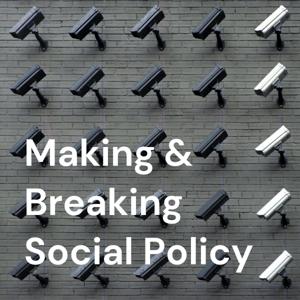


Dr Alhassan chats with us about his work on child protection and a recent project investigating the welfare of refugee children in Ghana.
Alhassan talks about the importance of engaging with multiple stakeholders (refugees, professionals and community) to gain a holistic understanding of the barriers to child protection.
Find Alhassan here: www.flinders.edu.au/people/alhassan.abdullah
and here: @DrAlhassanAbdul
Alhassan's Paper on Safeguarding the welfare of refugee children in Ghana
This episode focuses on school bullying as an issue that is tied to the social experiences of being young, as well as the spaces and times (spatiotemporal) when and where school bullying happens.
This episode is a recording from Flinders Uni’s Fearless Minds Series, in which I am interviewed about my research on School Bullying and Youth Violence.
Thank you to Flinders Uni for permission to use the audio.
Find more info on these papers here: https://researchnow.flinders.edu.au/en/persons/ben-lohmeyer-2/publications/
Find Ben on Twitter here: @lohmeyerben
Isabelle Hermes (PhD candidate at Flinders University) comes to chat about Addictions and Drug Policy in Australia. She has a practice background in Social Work as a drug and alcohol counsellor with homeless, criminalised, and at-risk young people. Isabelle unpacks the key pillars in the National Drug Strategy as well as international approaches to decriminalisation, legalisation and regulation of drugs.
Isabelle on twitter: @IsabelleHermes1
Ben on twitter: @lohmeyerben
Australia’s NATIONAL DRUG STRATEGY 2017–2026
Kylie (CEO of Community Centres SA) chats about the findings of a research project on what Community Centres are doing to tackle loneliness and build social connection. We discuss the importance of physical and social ‘bumping spaces’ that encourage interaction and building connection. Kylie also tells us why she loves community development and advocacy.
Find Community Centres SA here: https://communitycentressa.asn.au
Find the report here: https://www.flinders.edu.au/swirls/what-we-do/resources
Ben on twitter: @lohmeyerben
Erin tells us about the findings from an in-depth national investigation of Australian young people’s attitudes and understanding of domestic violence from her work with ANROWS. Erin describes the implications for policy and practice design of discovering a gender-ignoring lens – utopian gender-free assumptions – in young people’s attitudes and how these insights were uncovered through research that facilitated young people ‘filling in the gaps’.
Find Erin on Twitter: @dr_ecarlisle
Learn more about ANROWS: https://www.anrows.org.au/
Erin also mentions:
Research report - “It depends on what the definition of domestic violence is”: How young Australians conceptualise domestic violence and abuse - https://www.anrows.org.au/publication/it-depends-on-what-the-definition-of-domestic-violence-is-how-young-people-conceptualise-domestic-violence-and-abuse/
ANROWS National Community Attitudes towards Violence against Women Survey (NCAS) - https://www.anrows.org.au/research-program/ncas/
R4Respect: A youth-led respectful relationships program http://r4respect.org/
Nat talks to us about what is and will be done about the skyrocketing housing market locking young people out of homeownership, the backlog of social housing need and the policy choices that produce homelessness. She plans to put homefulness on the policy agenda and lived experience at the heart of policymaking in SA.
Nat also mentions:
Homestart: https://www.homestart.com.au/
Home Seeker SA: https://www.homeseeker.sa.gov.au/
The Department of Human Services https://dhs.sa.gov.au/
Contact Nat via: [email protected]
https://twitter.com/NatCookMP
In this episode, Lexi talks to us about her experience of growing up in out of home care. She is an advocate for the Make it 21 campaign championed by the CREATE Foundation.
More about the Make it 21 campaign: https://create.org.au/make-it-21/
More about CREATE: https://create.org.au/
Hosted by Ben Lohmeyer
Edited by Ryan Manhire
Music by Anthem of Rain
In this episode, Dr Sarah Moulds from Uni SA gives us a realistic but hopeful account of her experience and research on getting the community involved in legislation and policy creation. She talks us through the various mechanism governments use to consult with the public and give us some hot tips and tricks about how to use them most effectively.
Find Sarah here:
https://people.unisa.edu.au/Sarah.Moulds
Ph: +61 8 830 27382
email [email protected]
Twitter: @rightsnetworksa
Resources:
Rights Resource Network: https://www.rightsnetworksa.com/
Moulds, S. (2016). Committees of influence: Parliamentary committees with the capacity to change Australia's counter-terrorism laws. Australasian Parliamentary Review, 31(2), 46-66.
In this episode Sean Lappin (Connected Self) and Luke Cantley (SWIRLS) chat about the Raising the Age of Criminal Responsibility Campaign. Drawing on ideas including Two Way Learning, Self Determination for Aboriginal People, Restorative Justice and Intergenerational Trauma they help us imagine an alternative to locking up 10 year-olds and perpetuating cycles of criminality.
Resources:
Find out more about Sean Lappin and Connected Self: www.connectedself.com.au
Find Luke Cantley (SWIRLS) here and follow on Twitter @luke_cantley
Resources mentioned in the podcast:
Raise the age: https://www.raisetheage.org.au/
Review of the service system and implementation requirements for raising the minimum age of criminal responsibility in the Australian Capital Territory FINAL REPORT https://justice.act.gov.au/sites/default/files/2021-10/Raising%20the%20Age%20-%20Final%20Report.PDF
Recommendation to raise the age: UN Human rights council - Universal periodic review: https://www.ohchr.org/EN/NewsEvents/Pages/DisplayNews.aspx?NewsID=27287&LangID=E
Human Rights Law Centre: Major UN human rights review highlights need for Australia to raise the age of criminal responsibility - https://www.hrlc.org.au/news/2021/1/20/un-review-highlights-need-for-aust-to-raise-the-age-criminal-responsibility
Dr Michelle Jones chats about her research on the sustainability of the Obesity Prevention and Lifestyle (OPAL) program run in South Australia between 2009 and 2017. She unpacks how a shift in the program funding spurred the community to take ownership over part of the project they valued most.
Find Michelle and her work
Twitter: @83mgjones
Flinders: Michelle Jones
Here is Michelle’s publication in @HealthPromInt
https://doi.org/10.1093/heapro/daab080
Hosted by Ben Lohmeyer
Edited by Ryan Manhire
Music by Anthem of Rain
From the publisher's feed

1,052 Listeners
37,563 Listeners

815 Listeners

81 Listeners
867 Listeners

49 Listeners
118 Listeners

162 Listeners
164 Listeners
140 Listeners