
Sign up to save your podcasts
Or

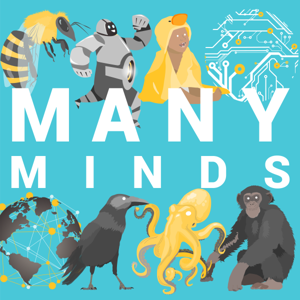


Welcome back folks! Today, we've got an audio essay for you. I won't say too too much—don't want to spoil it—but it's about pupils. Not as in students, but as in the dark cores of our eyes. This one of those that's been in the works for a little while. About a year ago I started collecting all the cool new pupil-related stuff coming out. Then at some point this summer some extra cool stuff came out and I said, "That's it—time to do it, time to pull this material together into some kind of episode." So that's what we have for you today. And I hope you find it eye-opening.
Quick reminder before we get to it: As always, we could really use your help in getting the word out about the show. That might mean subscribing, if you don't already. It might mean rating or reviewing us on Apple Podcasts. It might mean sending the show to a friend or two. I mean honestly it could mean knitting a Many Minds cardigan for the cold months ahead and sporting it around town. Ceaselessly.
Alright all, on to this week's essay 'The eye's mind.' Enjoy!
A text version of this episode (enriched with images!) is readable on Medium.
Notes
2:00 – The eye of the giant squid was described in detail for the first time in 2012, in this paper.
3:10 – On diversity in animal pupils, see this recent paper.
4:40 – Pupil changes to imagined and linguistically encoded light can be read about here and here.
5:30 – Eckherd Hess's early research on pupils is summarized in his 1965 Scientific American article, 'Attitude and Pupil Size'.
6:45 – The 1966 paper by Kahneman and Beatty is here. Or see a 2018 review of more recent research on pupils and cognitive effort.
8:10 – Hess's studies on the social functions of pupils are recounted in his 1975 Scientific American article, 'The Role of Pupil Size in Communication'. Several of his classic studies have been replicated just this year (with good but not perfect success).
8:50 – Mariska Kret's suggestion about how pupils fit the baby schema can be found here.
9:45 – Kret's studies of pupil mimicry include this one, this one, and this one, among others.
10:15 – The 2021 paper by Wohltjen & Wheatley on "pupillary synchrony" is available here.
12:00 – The 1974 Nature article titled 'Pupils of a talking parrot' is available here.
Correction: The audio version of this essay misstated the size of the pupil changes in Daniel Kahneman's classic studies. These changes were roughly .2 to .5 mm, not 2 to 5 mm.
We've got something special for you today folks: bats. That's right: bats.
Ever since Thomas Nagel wrote his famous essay on what it's like to be a bat, these flying, furry, nocturnal, shrieky mammals have taken up roost in our scientific imaginations. They've become a kind of poster child—or poster creature?—for the idea that our world is full of truly alien minds, inhabiting otherworldly lifeworlds. On today's show, we dive deep into these other minds—and into some of their less appreciated capacities. Bat don't just echolocate, they also sing. And, as we'll see, they sing with gusto.
My guest today is Dr. Mirjam Knörnschild. She directs the Behavioral Ecology and Bioacoustics Lab at the Natural History Museum of Berlin. She and her team study bat communication, cognition, and social life; they focus in particular on bat social vocalizations—what we might call bat signals.
Here, we do a bit of Bats 101. We talk about how bats form a spectacularly diverse group, or taxon. We talk about the mechanics of echolocation. We talk about the mind-bogglingly boisterous acoustic world of bats and how they're able to navigate it. We discuss Mirjam and her team's recent paper in Science magazine, showing that baby bat pups babble much like human infants. And, last but not least, we talk about what it's like to be a bat.
As I say in this conversation, I've always been a bit unnerved by bats, but part of me also knew they were seriously cool. But really, I didn't know the half of it. There's so much more to these creatures than meets the casual eye.
One last thing before we jump in: as a little bonus, for this episode Mirjam was kind enough to share some examples of the bat calls we discuss in the episode. So there's a bit of an audio appendix at the end where you can hear slowed-down versions.
On to my chat with Dr. Mirjam Knörnschild. Enjoy!
A transcript of this episode is available here.
Notes and links
7:20 – Meet the Honduran white bat, which Knörnschild likens to a "fluffy little white ping pong ball."
13:50 – Austin, Texas is home to Bracken Cave, which harbors more than 15 million bats.
16:30 – Much of Dr. Knörnschild's work focuses on the Greater Sac-winged bat, which is a member of the Emballonurid family.
18:00 – See the audio appendix for an example of a Greater Sac-winged bat's echolocation calls. See also examples on Dr. Knörnschild's website.
21:10 – A paper by Dr. Knörnschild and colleagues about how echolocation calls serve social functions in addition to navigational functions.
24:00 – A paper by Dr. Knörnschild and colleagues on the origin and diversity of bat songs.
30:00 – A recent paper by Dr. Knörnschild and colleagues on the correlation between social complexity and vocal complexity across bat species.
37:30 – A brand new special issue on vocal learning in humans and animals, including a review of vocal learning in mammals by Dr. Vincent Janik and Dr. Knörnschild.
40:35 – Dr. Knörnschild's first scientific paper, in 2006, reported the observation that Greater Sac-winged bats seemed to babble like infants.
47:20 – A recent paper by Dr. Knörnschild and colleagues on territorial songs in male Greater Sac-winged bats.
53:45 – A very recently published paper in Science by Ahana Fernandez, Dr. Knörnschild, and collaborators; see also this popular article and a video about the findings.
1:05:30 – A recent paper by Dr. Knörnschild and colleagues on bat "motherese."
1:12:00 – For a concise narrative summary of Dr. Knörnschild's research, including some of the future directions she is planning to pursue, see the article 'Bats in translation.'
1:14:00 – The philosopher Thomas Nagel famously argued that we can't really know what it's like to be a bat.
Dr. Knörnschild recommends two books by Merlin Tuttle:
Bats: An Illustrated Guide to All Species
The Secret Lives of Bats
You can find Dr. Knörnschild on Twitter (@MKnornschild) and follow her research at her website.
Many Minds is a project of the Diverse Intelligences Summer Institute (DISI) (https://disi.org), which is made possible by a generous grant from the Templeton World Charity Foundation to UCLA. It is hosted and produced by Kensy Cooperrider, with creative support from DISI Directors Erica Cartmill and Jacob Foster, and Associate Director Isabelle Laumer. Our artwork is by Ben Oldroyd (https://www.mayhilldesigns.co.uk/). Our transcripts are created by Sarah Dopierala (https://sarahdopierala.wordpress.com/).
You can subscribe to Many Minds on Apple, Stitcher, Spotify, Pocket Casts, Google Play, or wherever you like to listen to podcasts.
We welcome your comments, questions, and suggestions. Feel free to email us at: [email protected].
For updates about the show, visit our website (https://disi.org/manyminds/), or follow us on Twitter: @ManyMindsPod.
Why do we make music? Why do we love music? Well, you say, because it's in our nature. Our brains were sculpted over the course of evolution to delight in sonic sequences, to remember melodies, to revel in rhythms.
Perhaps. But, actually, not everyone thinks music is an adaptation. Not everything we do was directly shaped by natural selection. And even if music was an evolutionary adaptation, that raises a bunch of further questions, like: Why would musical abilities have been an advantage? Why did music emerge in our species, but not, say, in chimps? What were the first contexts in which music took shape? What were we singing or drumming or making all that racket about?
For today's episode we're going behind a recent paper that explores these questions. My guest is Dr. Ed Hagen, Professor of Evolutionary Anthropology Washington State University – Vancouver. For a couple decades now, on and off, Ed has been thinking and writing about the origins of music. Along with his co-authors Samuel Mehr, Max Krasnow, and Greg Bryant, Ed recently published a paper in the journal Behavioral & Brain Sciences titled 'Origins of music in credible signaling.'
Ed and I talk about what first got him musing about music, back in graduate school. We consider the functions of vocal signaling in birds, wolves, chimps, and other creatures. We discuss three prominent ideas about the roots of music: Darwin's idea that it evolved as a way for males to advertise their quality, Pinker's idea that music is like cheesecake, and—perhaps the most popular of all—the idea that music evolved to help cement social bonds. And, of course, we dig into the meat Ed and company's paper, their alternative proposal. They argue that the roots of music lie in two contexts: coalition signaling and infant care. We'll get into the specifics, of course.
One of my biggest takeaways from this conversation is that it's a fascinating time to be interested in the deep history of music. Seems like a bit of a subfield is coalescing around the topic. In fact—as Ed and I talk about—their paper was actually one of two papers on the origins of music published in the very same issue of Behavioral and Brain Sciences. If you want to dive deeper, definitely check out the other article as well.
One last note—and this is something I keep forgetting to mention: If you have ideas about who we should interview, or about which papers or topics we should feature, we would *love* to hear from you. Just find us on Twitter, or send an email to [email protected]. That's [email protected].
Alright, on to my conversation with Dr. Ed Hagen. Enjoy!
A transcript of this episode is available here.
Notes and links
3:00 – A 2003 paper by Dr. Hagen and co-author Greg Bryant about music as a "coalition signaling system."
10:50 – An example of a gibbon song.
12:00 – The companion paper, led by Patrick Savage, advances the social bonding view.
15:30 – Darwin's theory of the origins of music was laid out in The Descent of Man.
20:20 – Steven Pinker proposed the "auditory cheesecake" hypothesis in How the Mind Works.
28:30 – An early article on how singing is preserved in aphasia.
42:00 – A paper on chimpanzee pant hoots; a video showing an example.
46:00 – Long-standing listeners will recall that we briefly discussed "contact calls" in our episode on piloerection.
51:00 – The study showing that dance music and lullabies are perhaps the most readily recognized genres of music, and the past episode where Manvir Singh and I discussed this.
55:30 – A book by Brian Hayden on feasting in pre-industrial societies.
1:00:30 – One advocate of the idea that language may have emerged from music is W. Tecumseh Fitch, who wrote The Evolution of Language.
Dr. Hagen recommends you check out the companion paper—which advances the social bonding view and which appeared in the same issue of Behavioral & Brain Sciences—and Steven Mithen's book, The Singing Neanderthals.
You can find Dr. Hagen on Twitter (@ed_hagen) and follow him at his website.
Many Minds is a project of the Diverse Intelligences Summer Institute (DISI) (https://disi.org), which is made possible by a generous grant from the Templeton World Charity Foundation to UCLA. It is hosted and produced by Kensy Cooperrider, with creative support from DISI Directors Erica Cartmill and Jacob Foster, and Associate Director Isabelle Laumer. Our artwork is by Ben Oldroyd (https://www.mayhilldesigns.co.uk/). Our transcripts are created by Sarah Dopierala (https://sarahdopierala.wordpress.com/).
You can subscribe to Many Minds on Apple, Stitcher, Spotify, Pocket Casts, Google Play, or wherever you like to listen to podcasts.
We welcome your comments, questions, and suggestions. Feel free to email us at: [email protected].
For updates about the show, visit our website (https://disi.org/manyminds/), or follow us on Twitter: @ManyMindsPod.
Welcome back friends! Cue the kazoos and the champagne—after a short summer snooze, we're much revived and ready for a third season of Many Minds!
I could not be more thrilled about the guest we have to help kick things off: Dr. Alison Gopnik. Alison is a Professor of Psychology and Affiliate Professor of Philosophy at the University of California, Berkeley. She's the author of several books, including most recently The Gardener and the Carpenter, and she writes the "Mind and Matter" column for the Wall Street Journal. She also recently became the president-elect of the Association for Psychological Science.
As many of you know, Alison is a distinguished developmental psychologist—she's been thinking deeply about children and writing insightfully about them for decades. But more recently she's stepped back to think also about childhood itself: that long period where we're kind of needy, messy, dreamy, and blissfully unproductive. She notes that childhood may be one of the most puzzling and distinctive things about our species. Though it is perhaps rivaled by the other extreme of the human lifespan: old age, or as she calls it, "elderhood."
Here Alison and I talk about childhood and elderhood and how they go hand in hand. We discuss how they evolved, and, of course, why. We consider how they are associated with different modes of thinking and different ways of being. We talk about Alison's radical suggestion that it's during these bookends of life—our first act and last act—that we are, in fact, at our most human.
Something I especially enjoyed about this conversation—and you'll definitely notice it if you've been listening to the show for awhile—is how often we hit on themes and topics from past episodes. We touch on cephalopods, orcas, bees, and Neanderthals; we talk about the tension between imitation and innovation and about why adults don't change their minds. But here, of course, we're seeing all this familiar terrain from new angles.
But before we get to the episode, just wanted to say a quick but heartfelt thanks for all your support over our first two seasons. The best way to keep supporting the show is just to keep listening, to rate and review us if you haven't already, and, of course, to recommend us to a friend or colleague.
Alright folks, looking forward to spending more time with you in the coming months. Here's my conversation with Dr. Alison Gopnik. Enjoy!
A transcript of this episode is available here.
Notes and links
4:00 – On our distinctive life history, see Dr. Gopnik's recent paper 'Childhood as a solution to explore-exploit tensions' and her 2020 piece in Aeon magazine. Some of this terrain is also covered in her most recent book, The Gardener and the Carpenter.
8:30 – The term "alloparents" was introduced by Sarah Blaffer Hrdy. See especially her book Mothers and Others.
11:30 – A recent study of hunting productivity and life history by Jeremy Koster, Michael Gurven, and colleagues.
13:40 – A 1972 paper by Jerome Bruner on the uses of immaturity.
15:00 – One of Dr. Gopnik's (co-authored) earlier books was The Scientist in the Crib.
20:15 – A paper on life history and brain size in marsupials.
21:00 – On the explore-exploit tradeoff, see especially Dr. Gopnik's recent paper 'Childhood as a solution to explore-exploit tensions.'
29:30 – The 1983 paper that described this analogy with metallurgy and the "simulated annealing" approach to optimization.
35:30 – A paper on the division of labor among bees.
37:00 – See Dr. Gopnik's recent column titled 'The Many Minds of the Octopus.'
40:00 – A paper on the role of climate variability in evolution.
43:00 – A series of papers by Dr. Gopnik and colleagues suggest that children have a more exploratory mindset than adults. See here, here, and here.
49:30 – On the finding that adolescents are more flexible than either young children or adults on a social task, see here.
52:00 – Michael Pollan's new book, This is Your Mind on Plants, discusses three drugs derived from plants.
55:00 – A paper by (former guest!) Cristine Legare about the trade-offs between imitation and innovation.
56:20 – Dr. Gopnik's most recent column on altruism and aging.
1:00:20 – A paper by Dr. Gopnik and collaborators on causal learning across cultures and socioeconomic strata, which included children in Peru.
Dr. Gopnik recommends a recent special issue on life history and learning.
You can find Dr. Gopnik on Twitter (@AlisonGopnik) and follow her work on her website.
Many Minds is a project of the Diverse Intelligences Summer Institute (DISI) (https://disi.org), which is made possible by a generous grant from the Templeton World Charity Foundation to UCLA. It is hosted and produced by Kensy Cooperrider, with creative support from DISI Directors Erica Cartmill and Jacob Foster, and Associate Director Isabelle Laumer. Our artwork is by Ben Oldroyd (https://www.mayhilldesigns.co.uk/). Our transcripts are created by Sarah Dopierala (https://sarahdopierala.wordpress.com/).
You can subscribe to Many Minds on Apple, Stitcher, Spotify, Pocket Casts, Google Play, or wherever you like to listen to podcasts.
We welcome your comments, questions, and suggestions. Feel free to email us at: [email protected].
For updates about the show, visit our website (https://disi.org/manyminds/), or follow us on Twitter: @ManyMindsPod.
We're on summer break this week. Back in a couple weeks with the kick-off of Season 3! In the meanwhile, here's a favorite episode from our archives: a conversation with Dr. Rebecca Wragg Sykes about her 2020 book, Kindred. Enjoy!
---
You probably think you know the Neanderthals. We've all been hearing about them since we were kids, after all. They were all over the comics; they were in museum dioramas and on cartoons. They were always cast as mammoth-eating, cave-dwelling dimwits—nasty brutes, in other words. You probably also learned that they died off because they couldn't keep pace with us, Homo sapiens, their svelter, savvier superiors.
That's story we had long been told anyhow. But, over the past few decades, there's been a slow-moving sea change—a revolution in how archaeologists understand our closest cousins. For this episode I talked to Dr. Rebecca Wragg Sykes about this revolution. She is a Neanderthal specialist and the author of the new book Kindred: Neanderthal Life, Love, Death and Art.
Rebecca and I discuss the new picture of Neanderthals emerging from the latest archaeological research. We talk about where they lived, what they ate, the tools and clothing they made. We talk about the evidence that they had a considerable degree of cognitive sophistication and—very possibly—an aesthetic sense. Once we put all this together—and let the new picture come into focus—the gap long thought to separate them from us from them starts to close. And this makes the question of why they vanished about 40 thousand years ago all the more puzzling.
I really hope you enjoy this one—I certainly did. And if you do, I definitely encourage you to check out Kindred!
A transcript of this episode is available here.
Notes and links
Most of the topics we discuss are treated in detail in Rebecca Wragg Sykes's book, Kindred.
5:40 – Earlier book-length treatments of the Neanderthals include The Smart Neanderthal and Neanderthals Revisited.
9:15 – The archaeological site of Atapuerca in Spain, which includes the Sima de los Huesos (Pit of Bones).
11:20 – The Neander Valley in Germany was the site of the very first Neanderthal find in 1856.
11:50 – Another early site was Krapina, Croatia, which is now home to a Neanderthal museum.
24:30 – A recent academic article on the complexity of Neanderthal tool use.
28:27 – A French site—La Folie—gives a sense of what some Neanderthal dwellings were like.
41:05 – A popular article about the "wow site" at Bruniquel. The original academic article.
49:16 – An article on the evidence that Neanderthals were preparing and using birch tar.
56:45 – Some evidence suggests Neanderthals were interested in bird feathers and talons.
1:01:30 – There is now evidence for repeated phases of interbreeding between human and Neanderthals.
1:05:00 – Other ancient hominin species included the Denisovans.
1:07:00 – There are some reasons to believe that pathogens carried by humans may have played a role in the demise of the Neanderthals.
1:13:30 – Another richly imaginative treatment of ancient human life is Ancestral Geographies of the Neolithic, by Mark Edmonds.
To keep up with the latest Neanderthal research, Dr. Wragg Sykes recommends following archaeologists such as John Hawks (@johnhawks). She is also on Twitter (@LeMoustier) and her website is: https://www.rebeccawraggsykes.com/.
Many Minds is a project of the Diverse Intelligences Summer Institute (DISI) (https://www.diverseintelligencessummer.com/), which is made possible by a generous grant from the Templeton World Charity Foundation to UCLA. It is hosted by Kensy Cooperrider, with creative support from DISI Directors Erica Cartmill and Jacob Foster, and Associate Director Hilda Loury. Our artwork is by Ben Oldroyd (https://www.mayhilldesigns.co.uk/). Our transcripts are created by Sarah Dopierala (https://sarahdopierala.wordpress.com/).
You can subscribe to Many Minds on Apple, Stitcher, Spotify, Pocket Casts, Google Play, or wherever you like to listen to podcasts.
We welcome your comments, questions, and suggestions. Feel free to email us at: [email protected].
For updates about the show, follow us on Twitter: @ManyMindsPod.
Preferences, decisions, goals. When you hear these words, you probably think of humans. Or, if not humans then maybe charismatic animals—you know, great apes, certain species of birds, maybe dogs. In any case, I bet you think of creatures that are more or less cognitively sophisticated. I know I do. But, according to some researchers, this is an outmoded and over-narrow way of thinking. They propose that decisions and goals—not to mention other fancy-seeming constructs like memory, problem-solving, and intelligence—can usefully be ascribed to an astonishingly large array of agents. Not just humans, not just animals, not even just organisms.
My guest on today's episode is Dr. Michael Levin. He's the Vannevar Bush Distinguished Professor of Biology at Tufts University; he directs the Allen Discovery Center and the Tufts Center for Regenerative and Developmental Biology. In recent years, Mike's been developing a radical reconsideration of the nature of mind and intelligence. He argues that it's not just humans and other smart creatures that traffic in all this classically cognitive stuff. It's also cells, tissues, organs, colonial organisms, and much more. He sometimes summarizes his view as "cognition all the way down."
Here we talk about how Mike came to this perspective. We discuss his empirical studies of bioelectricity, including some pretty astonishing experiments on planaria. We dig deep into two of the conceptual models he uses in talking about his "mind everywhere" framework: the "axis of persuadability" and the notion of the "cognitive light-cone". And we talk about why Mike rejects the criticism that this is all mere anthropomorphism. In fact, he makes a compelling case that it's time we retired that term altogether.
In the intro to Many Minds way back when, we talked about how the terrain of mind is vast. But as I've learned about the work of Mike and others, I've become convinced that the terrain of mind is actually vaster than I imagined then—maybe vastly vaster. I think you'll like this one, folks. And even if you're not convinced, there's little doubt you'll be provoked. Enjoy!
A transcript of this episode is available here.
Notes and links
4:10 – Dr. Levin mentions the caterpillar-to-butterfly transition in the introduction to a recent theoretical paper.
8:00 – Dr. Levin's work on bioelectricity and regeneration are the focus of a recent profile of his work in the New Yorker. A recent perspective piece on bioelectric signaling by Dr. Levin is here.
8:50 – The book The Body Electric was an early influence on Dr. Levin's interests.
10:30 – The term "basal cognition" refers to minimal cognitive agents like cells and slime molds. It is also the label for a newly formed subfield or researchers who work on such systems. Read the introduction to a recent special issue on the topic, written by Dr. Levin and colleagues.
13:45 – Much of Dr. Levin's early work (described, e.g., here) was on the generation of left-right asymmetry, a thorny issue in morphogenesis.
15:45 – Planaria are a popular model organism in biology. For a fun conversation about their curious properties, see this episode of the podcast Ologies.
20:30 – Dr. Levin and colleagues' experiments with two-headed planaria were first reported here.
25:30 – Here Dr. Levin mentions Shuffle Brain by Paul Pietsch.
26:40 – See Dr. Levin's recent discussions of "scale-free cognition" and "cognition all the way down" (the latter piece was written for a general audience and co-authored with the philosopher Daniel Dennett).
32:00 – Dr. Levin's notion of the "axis of persuadability" is discussed here.
42:00 – Dr. Levin's light-cone model of cognition is sketched here (see especially Figure 2).
52:00 – Dr. Levin has applied his ideas to tumorigenesis (e.g., here).
52:45 – For an intro to Umwelt theory, see our earlier episode, 'Me, my Umwelt and I.'
58:00 – Dr. Levin discusses ideas about the anthropomorphism objection here.
Dr. Levin recommends books by:
Scott Turner
Denis Noble
You can find Dr. Levin on Twitter (@drmichaellevin) and keep up with his latest research on his lab's website.
Many Minds is a project of the Diverse Intelligences Summer Institute (DISI) (https://disi.org), which is made possible by a generous grant from the Templeton World Charity Foundation to UCLA. It is hosted and produced by Kensy Cooperrider, with creative support from DISI Directors Erica Cartmill and Jacob Foster, and Associate Director Isabelle Laumer. Our artwork is by Ben Oldroyd (https://www.mayhilldesigns.co.uk/). Our transcripts are created by Sarah Dopierala (https://sarahdopierala.wordpress.com/).
You can subscribe to Many Minds on Apple, Stitcher, Spotify, Pocket Casts, Google Play, or wherever you like to listen to podcasts.
We welcome your comments, questions, and suggestions. Feel free to email us at: [email protected].
For updates about the show, visit our website (https://disi.org/manyminds/), or follow us on Twitter: @ManyMindsPod.
Public opinion can sometimes shift dramatically over time. Beliefs that were widely held a few decades ago may now seem antiquated or even repugnant. But what's driving these shifts? Is it individual people changing their minds? Or is it just folks with old-fashioned worldviews dying out and being replaced?
My guest on today's show is Dr. Stephen Vaisey. He's a Professor of Sociology and Political Science at Duke University and co-director of the compellingly named Worldview Lab. In a recent paper, Steve and his co-author Kevin Kiley sought to better understand whether people every really update their beliefs. We're talking about beliefs about gender, race, the environment, the role of government, and a bunch of other central issues. The answer Steve and Kevin arrived at may surprise you: while people do sometimes change their minds—particularly at certain life stages and particularly around certain kinds of issues—more often they don't. People's beliefs tend to be pretty settled.
So I'll admit, sheepishly, that it was really only pretty recently that I realized that sociologists and political scientists think a lot about minds. That they're often grappling with the same questions that exercise psychologists, philosophers, cognitive scientists, and others. Questions about how beliefs are formed, about the dynamics of culture, about how minds change over the course of the lifespan, about how our social forces shape our thinking. As you'll hear, Steve's been thinking deeply about these questions for awhile now, and he's innovating new ways to address them. He's also just a super affable guide to this whole terrain.
Hope you enjoy this one folks. Without further ado, my conversation with Dr. Steve Vaisey!
A transcript of this episode is available here.
Notes and links
2:30 – The Worldview Lab at Duke University is co-directed by Steve and Christopher Johnston.
4:00 – The paper we discuss is here (open access preprint).
6:00 – An influential article looking at the phenomenon of "pluralistic ignorance" and its consequences.
8:30 – The General Social Survey—as Dr. Vaisey describes it, the Hubble Telescope of sociology.
10:30 – A paper by Omar Lizardo elaborating the notion of personal culture.
12:15 – The webpage of Steve's co-author, Kevin Kiley.
20:45 – A 2010 paper by Steve and Omar Lizardo asking related questions.
37:45 – For more on issues with generalizing from WEIRD samples, see our past episode.
For more on these topics, Dr. Vaisey recommends checking out the work of:
Ronald Inglehart
Pippa Norris
Raül Tormos
Kevin Kiley
You can find Dr. Vaisey on Twitter (@vaiseys).
Many Minds is a project of the Diverse Intelligences Summer Institute (DISI) (https://disi.org), which is made possible by a generous grant from the Templeton World Charity Foundation to UCLA. It is hosted and produced by Kensy Cooperrider, with creative support from DISI Directors Erica Cartmill and Jacob Foster, and Associate Director Isabelle Laumer. Our artwork is by Ben Oldroyd (https://www.mayhilldesigns.co.uk/). Our transcripts are created by Sarah Dopierala (https://sarahdopierala.wordpress.com/).
You can subscribe to Many Minds on Apple, Stitcher, Spotify, Pocket Casts, Google Play, or wherever you like to listen to podcasts.
We welcome your comments, questions, and suggestions. Feel free to email us at: [email protected].
For updates about the show, visit our website (https://disi.org/manyminds/), or follow us on Twitter: @ManyMindsPod.
You've no doubt heard that—as humans—our sense of smell is, well, kind of pathetic. The idea goes all the way back to Aristotle, that we have advanced senses—especially sight and hearing—and then lowly, underdeveloped ones—taste and smell. It's an idea that has been repeated and elaborated over and over, throughout Western intellectual history. Along with it comes a related notion: that smells are nearly impossible to talk about, that odors simply can't be captured in words. These ideas may be old, but are they actually true?
A number of researchers would say they're ripe for reconsideration. And my guest is one such researcher, Asifa Majid. She's Professor in the Department of Psychology at the University of York in the UK. For a decade now, Asifa's been pioneering a new wave of research on human olfaction, especially how it interfaces with language, thought, and culture.
In this conversation we talk about the general notion that some kinds of experience are harder to put into words than others. We discuss Asifa's fieldwork with hunter-gatherer groups in the Malay peninsula, as well as her studies with wine experts in the west. We talk about whether learning special smell terms seems to sharpen one's ability to discriminate odors. And we venture beyond Asifa's own work, to touch on a bunch of recent highlights from the broader science of olfaction.
This was such a fun conversation, folks! I've admired Asifa's work on this topic since her very first paper. She's a truly interdisciplinary thinker and, as you'll hear, she's got a nose for fun examples and deep questions.
Without further ado, on to my conversation with Dr. Asifa Majid! Enjoy.
A transcript of this episode is available here.
Notes and links
3:40 – A paper on the 19th century rise of the myth that humans are poor smellers.
6:00 – A paper estimating that humans can discriminate possibly a trillion different odors.
7:30 – A theoretical paper by Dr. Majid and a collaborator on "differential ineffability" and the senses.
9:20 – Dr. Majid's collaborator in her work on Jahai, a Malaysian language, was Niclas Burenhult.
11:00 – A classic book on the idea of "basic terms" in the domain of color, which provide an analogy for basic terms in the domain of smell.
12:30 – A first paper by Dr. Majid and Niclas Burenhult describing the language of olfaction in Jahai.
14:45 – Dr. Majid's first experiment comparing odor naming (and color naming) in Jahai and English.
20:00 – Dr. Majid has also examined smell lexicons in several other languages, including Seri, Thai, Maniq, and Cha'palaa.
25:40 – A follow-up study by Dr. Majid and a collaborator on two groups within Malaysia who contrast in subsistence mode.
29:30 – A paper detailing cultural practices surrounding smell among the Jahai.
31:00 – Dr. Majid discusses the factors shaping cultural variation in olfaction (as well as a number of other interesting issues) in her most recent review paper.
39:00 – The "deodorization" hypothesis was discussed in a classic book on the cultural history of aroma.
39:40 – In a recent study, Dr. Majid and collaborators failed to find evidence that the frequency of smell language has fallen off since industrialization.
45:50 – Dr. Majid led a study comparing 20 languages across the world in terms of how expressible their speakers found different sensory experiences.
53:00 – Some possible reasons for the general trend toward the ineffability of smell are considered in Dr. Majid's recent review paper.
57:00 – Along with her collaborators, Dr. Majid has examined the smell-naming abilities of wine experts. See one paper here.
1:02:45 – A recent paper by Dr. Majid and colleagues showing that wine experts' smell-naming abilities are not dependent on "thinking in" language.
1:05:35 –Some evidence from "verbal interference" tasks suggests that, when carrying out color discrimination tasks, people rely on language in the moment.
1:09:00 – The Odeuropa project.
1:10:20 – The website of Noam Sobel's lab.
Dr. Majid's end of show recommendations:
What the Nose Knows, by Avery Gilbert
The Philosophy of Olfactory Perception, by Andreas Keller
Aroma: The Cultural History of Smell, by Constance Classen, David Howes, and Anthony Synott
Neuroenology, by Gordon Shepard
Cork Dork, by Bianca Bosker
You can keep up with Dr. Majid on Twitter (@asifa_majid).
Many Minds is a project of the Diverse Intelligences Summer Institute (DISI) (https://disi.org), which is made possible by a generous grant from the Templeton World Charity Foundation to UCLA. It is hosted and produced by Kensy Cooperrider, with creative support from DISI Directors Erica Cartmill and Jacob Foster, and Associate Director Isabelle Laumer. Our artwork is by Ben Oldroyd (https://www.mayhilldesigns.co.uk/). Our transcripts are created by Sarah Dopierala (https://sarahdopierala.wordpress.com/).
You can subscribe to Many Minds on Apple, Stitcher, Spotify, Pocket Casts, Google Play, or wherever you like to listen to podcasts.
We welcome your comments, questions, and suggestions. Feel free to email us at: [email protected].
For updates about the show, visit our website (https://disi.org/manyminds/), or follow us on Twitter: @ManyMindsPod.
Let's say you're out on the open sea, having a leisurely sail, when you suddenly encounter not one but two sinking boats. One is a boat with two dogs in it; the other is a boat with a single human in it. You can only save one of the boats, so which one do you pick?
The answer may seem obvious—you save the boat with the human, right? For many adults—even those who have a special love for animals—there's little question that a human life is simply worth more, perhaps way more, than an animal life. But where does this pro-human bias come from? Is it in our nature? Is it drilled into us by culture, maybe by Western culture in particular? Would young children also place more value on human lives than on animal lives?
This is the question at the core of a recent paper by Matti Wilks, Lucius Caviola, Guy Kahane, and Paul Bloom. The team found—rather strikingly I have to say—that children simply don't show the same pronounced pro-human biases that adults do, or at least not as pronounced. On today's episode I have Matti Wilks on to go behind this paper with us. She's a postdoc at Yale University, studying moral cognition and how we judge the moral worth of others. Matti and I discuss children's moral development; we touch on the psychology and philosophy of speciesism; we talk about why tragic trade-off dilemmas—like the one involving the boats—are just so engaging. We also talk about a number of questions this paper raises but can't yet answer, questions for future work.
Really stoked to discuss this research on the show, folks. We talk about some themes we've touched on before—for instance, speciesism and child development—and some we haven't—like the origins of morality. This is also just one of those super-cool and generative studies, one you know is going to inspire a bunch of follow-up work. Alright folks, hope you enjoy this chat as much as I did. On to my conversation with Dr. Matti Wilks.
The paper we discuss is here. A transcript of this show is available here.
Notes and links
4:40 – The term "speciesism" was first broadly popularized by Peter Singer's 1975 book Animal Liberation.
5:40 – A prior study by Dr. Wilks' co-author, Lucius Caviola, on the psychology of speciesism.
6:30 – A prior study led by Karrie Neldner, with Dr. Wilks as a co-author, on the "moral circle" of children.
7:15 – Some of the first experimental work on the construct of the "moral circle" was done by Charlie Crimston and colleagues.
12:00 – A paper on the emergence of in-group biases in children.
13:00 – There was a lively discussion on Reddit of this paper—and the tragic trade-off dilemmas it used as stimuli.
13:40 – A paper by Peter Blake and colleagues showing that children at a certain age know they should share but still do not.
20:15 – Dr. Wilks has also done work on children's moral concern for robots.
27:40 – Our previous episode with Melanie Challenger, in which we discuss "dementalization."
Dr. Wilks' end-of-show recommendation:
The Moral Standing of Animals: Towards a Psychology of Speciesism, a paper by Lucius Caviola and colleagues
Welcome back folks! We've got an audio essay for you this week. It touches on art, music, the skin, the spine, individual differences, vestigial responses, tiny muscles. There's even some Darwin thrown in there. It's a fun one. Hope you enjoy it!
A text version of this essay is available on Medium.
Notes and links
1:30 – The novel that very recently gave me goosebumps.
2:00 – A brief discussion of Nabokov and his ideas about the tell-tale tingle.
2:45 – Some terms for goosebumps in other languages.
3:00 – A primer on skin anatomy.
4:00 – A paper on the thermoregulatory function of piloerection in primates and other animals.
4:25 – Read Darwin's Expression here.
5:00 – A paper about "nails on chalkboard chills." A paper that discusses claims that piloerection attends awe (but which fails to find evidence for this association in a lab setting). A paper on goosebumps in religious experiences. A paper that references mathematicians getting goosebumps when seeing proofs.
5:30 – The 1980 paper by Goldstein on "thrills."
6:45 – The Darwin passage is quoted in McCrae 2007.
7:00 – A 1995 paper by Panskepp, as well as his 2002 study with a co-author.
7:40 – A recent paper on chills in response to films; another on poetry.
9:15 – The paper by McCrae reporting the association between "openness to experience" and chills.
10:00 – A paper by Fiske and colleagues on kama muta, the "sudden devotion emotion."
11:10 – Panskepp's "separation call" hypothesis is perhaps best described in his 2002 study.
Many Minds is a project of the Diverse Intelligences Summer Institute (DISI) (https://www.diverseintelligencessummer.com/), which is made possible by a generous grant from the Templeton World Charity Foundation to UCLA. It is hosted by Kensy Cooperrider, with creative support from DISI Directors Erica Cartmill and Jacob Foster, and Associate Director Hilda Loury. Our artwork is by Ben Oldroyd (https://www.mayhilldesigns.co.uk/).
You can subscribe to Many Minds on Apple, Stitcher, Spotify, Pocket Casts, Google Play—or wherever you like to listen to podcasts.
We welcome your comments, questions, and suggestions. Feel free to email us at: [email protected].
For updates about the show, follow us on Twitter: @ManyMindsPod.
From the publisher's feed

15,235 Listeners

10,727 Listeners

5,485 Listeners

2,452 Listeners
766 Listeners

542 Listeners

820 Listeners
314 Listeners
4,166 Listeners

112 Listeners

5,559 Listeners

15,904 Listeners

354 Listeners
116 Listeners

44 Listeners