
Sign up to save your podcasts
Or



These days are hard, for all of us, in many different ways. The best we can do is hold the light we have up for others. Because I promise you this: when you hold your light up for others, you will also feel the benefit of its glow.
This short-form episode is part of the Finding The Words column, a series published every Wednesday that delivers a dose of communication insights directly to your inbox. If you like what you read, we hope you’ll subscribe to ensure you receive this each week.
We love sharing good finds with you, our listeners. And today, we’re super excited to bring you this bonus episode from our friends at the Chronicle of Philanthropy, who have just launched their own podcast called Nonprofits Now—Leading Today. We want to give you a listen to their first episode, which features Tim Dixon, co-founder of More in Common, who joins our friend and colleague Stacey Palmer, to offer smart and research-based strategies that leaders like you can use to bridge divides in the workplace and in your community. So enjoy this special episode in which Stacey will ask Tim to walk listeners through his approach, and then meet us back here next week for an all-new episode of Mission Forward!
Tim Dixon, co-founder of More in Common, joins Chronicle CEO Stacy Palmer to offer research-based strategies leaders can use to bridge divides in the workplace and in their communities. More in Common helps political leaders and social-change movements strengthen their coalitions by including unlikely allies.
Bridging divides is top-of-mind for nonprofit leaders today. Nearly two-thirds of nonprofit executives say the nation’s divisions are making their jobs tougher, according to an exclusive Chronicle of Philanthropy survey.
Dixon shared solutions to overcome entrenched division. Among his key points:
You can connect with Dixon on LinkedIn. And dig into More in Common’s research here.
Further Reading:
Let’s begin with a middle school stage play in Detroit. The lights are dim, the demerits are high, and a boy named Leonard has just been kicked off the production. Enter Miss Liggins, a teacher with a different script. She doesn’t erase the consequences—she rewrites the role. “You’ll be our stage manager,” she says. And with that, a seed is planted: that someone’s belief in you, especially when you don’t believe in yourself, can change everything.
This is how Leonard Burton’s story begins. But it’s hardly where it ends.
This week, Carrie Fox sits down with Leonard—now President and CEO of the Center for the Study of Social Policy—to trace the arc of a life lived in service to justice, from the east side of Detroit to the deserts of Saudi Arabia, from family hardship to national leadership. It’s a story that defies neat narrative structure. Because Leonard’s journey isn’t linear, it’s layered—built on memories, mentors, and moments of moral clarity that refuse to fade.
Leonard talks about the indignity of a two-tiered chemotherapy room—one for Medicaid patients, one for the privately insured. He recounts the sounds of Scud missiles in Desert Storm, and the sight of a paraplegic neighbor who gave him his first view of the world outside his block. He shares the transformative experience of sitting in a village in apartheid South Africa, watching democracy unfold not with slogans or soundbites, but with silence, patience, and consensus.
And through it all, he makes the case—not with urgency, but with gravity-that that justice is not an abstraction. It is food on the table. It is health care with dignity. It is family autonomy and the freedom to imagine a better future.
Now, as the leader of CSSP, Leonard is advancing a bold North Star strategy grounded in three pillars: health justice, economic justice, and family autonomy — all threaded through with racial justice. His is a call to hold fast when others are retreating, to keep the lights on when the grid is under attack.
Leonard’s message is clear: This is not the time to shrink. This is not the time to compromise on values in exchange for comfort. This is the time to light candles if the power fails, to widen the circle, and to remember — in the words of his mentor, Collins Ramusi — “Forward ever, backwards never.”
Links & Notes
There’s been a lot of talk in recent weeks about cutting costs, building efficiencies, and reducing wasteful spending. Some extreme examples of this are playing out in real-time in the U.S. Administration, with the true impact of those actions yet to be realized. Which brings me to an article featured last week in The Guardian. It’s a tale of some eager beavers and the power of listening to those closest to the problems we set out to solve.
Because no matter the industry or the discipline, whether you work on issues of healthcare or housing, problem-solving is best done when it involves those closest to the problem. And yes, sometimes, the best action is to simply get out of the “dam” way.
This short-form episode is part of the Finding The Words column, a series published every Wednesday that delivers a dose of communication insights directly to your inbox. If you like what you read, we hope you’ll subscribe to ensure you receive this each week.
Two daughters. One orange. Conflict. Their mother, seeking peace, cuts it in half — a classic compromise. What mom doesn’t know? One wants the juice, the other the zest. Yet there they are: nobody gets what they need.
It’s a parable that is often told in conflict resolution circles. But in the hands of Mariah Levison — CEO and President of the Convergence Center for Policy Resolution — it is an elegant metaphor for the missed opportunities that happen when we rush toward solutions without first understanding our problems.
This week, Carrie sits down with Mariah alongside Convergence’s founder and Senior Advisor, Robert J. Fersh. They are collaborators in mission and architects of a process that helps unlikely allies find common ground. Together, they’ve worked across some of the most polarized issues of our time: education, healthcare, criminal justice, and beyond.
Their approach isn’t about compromise. It’s about something more ambitious and, paradoxically, more human. It’s about convergence: the point where stories intersect, values overlap, and relationships begin to matter more than ideology.
They unpack how durable policy solutions emerge not from debate, but from curiosity. How listening — real, intentional, difficult listening — can transform even the most entrenched opponents into collaborators. And how the secret to solving today’s toughest challenges asks all of us to move away from righteousness, and toward relationship. After all, what divides us often pales in comparison to what we all want — fairness, belonging, safety, and dignity.
If you’ve ever wondered what it would take to really change the tone of a divided room—or a divided nation—we want this episode to leave you with more than hope. It will leave you with a blueprint.
Links & Notes
As my wise teacher Don Foley reminded me this week, learning to be brave isn’t just in what we say; it’s also in how we listen. It's in what we take to heart.
This short-form episode is part of the Finding The Words column, a series published every Wednesday that delivers a dose of communication insights directly to your inbox. If you like what you read, we hope you’ll subscribe to ensure you receive this each week.
What if truth could speak? Not metaphorically, not through human interpretation, but as its own entity—indignant, unyielding, and, above all, betrayed?
This week on Mission Forward, Carrie Fox sits down with bestselling author Mitch Albom in front of a live audience to examine the anatomy of truth—how it bends, how it breaks, and how, in the hands of history’s most cunning deceivers, it can be weaponized.
Mitch, known for Tuesdays with Morrie and The Five People You Meet in Heaven, takes us behind the curtain of his latest novel, The Little Liar, a story where truth itself is the narrator. He unpacks the moment of inspiration—standing in Israel’s Yad Vashem Holocaust Museum, listening to a survivor’s voice echo through time. He shares his research journey from the streets of Thessaloniki to the darkest corners of human deception.
And he pulls no punches about the world we live in today—where lies are not just believed but preferred.
As much as this is a conversation about literature, history, even philosophy, it is just as much a conversation about faith—not the quiet, passive kind, but faith in action. Mitch talks candidly about his work in Haiti, the children he has come to love as his own, and the moral weight of decisions that shape their futures. He even gives us a glimpse into his next book, Twice, a whimsical yet profound meditation on second chances and their unintended consequences.
How do we cultivate truth? How do we resist the seduction of comforting lies? And, perhaps most poignantly, what does faith look like when it moves beyond words? In a world where deception is currency, the real question isn’t whether truth exists—it’s whether we have the courage to hear it.
Links & Notes
We like to think of lies as small, inconsequential things. A white lie told to spare someone’s feelings. A harmless exaggeration to make a story more compelling. But what if the smallest lies weren’t so small after all? What if they were the building blocks of something far more dangerous—something that could shape history itself?
Regardless of what you believe, where you live, and what you do, you will likely agree that these are tumultuous times in America. Now, more than ever, is the time for Truth.
This short-form episode is part of the Finding The Words column, a series published every Wednesday that delivers a dose of communication insights directly to your inbox. If you like what you read, we hope you’ll subscribe to ensure you receive this each week.
What happens when a single act of courage alters the trajectory of a life—not just for one person, but for an entire community? What if the stories we tell about ourselves—about our struggles, triumphs, and histories—aren’t just personal narratives but blueprints for something greater?
In this, our premiere episode of season 10 of Mission Forward, Carrie sits down with Dianne Myles, a documentarian, storyteller, and the newly appointed Social Entrepreneur in Residence at Mission Partners. But Dianne’s journey is not the one you expect. It’s one of movement—between communities, between identities, between imposed limitations and self-defined futures.
Born and raised in Colorado Springs, Colorado, Dianne learned early the subtle, unspoken art of code-switching—navigating between affluent white spaces and vibrant Black and Latino communities. But it wasn’t just about survival. It was about adaptation, about connection, about the power of story to bridge divides. At 26, a moment of reckoning: the sudden loss of her mother. A life recalibrated. A decision to abandon a stifling corporate path. A leap into the unknown, driven by an insistence on joy, on purpose, on owning the narrative.
Carrie and Dianne are in a conversation that is as much about storytelling as it is about agency. It’s about why AI will never replace the human voice. It’s about the questions we ask—and the ones we don’t. And, ultimately, it’s about what happens when we decide—fully, unapologetically—to take hold of the pen.
Links & Notes
What does it mean to lead with purpose in a world that feels increasingly divided? How do we stay true to our values while navigating uncertainty? And what if the most pressing questions of our time have answers hidden in the wisdom of those already pushing for change?
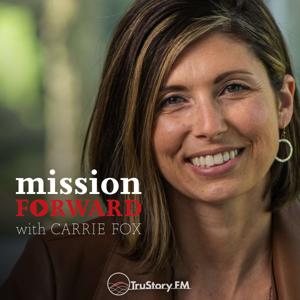
Welcome to Mission Forward, where each week Carrie Fox brings you into conversation with the thinkers, builders, and changemakers reshaping the way we lead.
This season, we explore the deeper questions of leadership—the kind that don’t come with easy answers. We’ll challenge the idea that leadership is about what we achieve, rather than what we give. We’ll ask what tomorrow’s historians might say about the choices we make today. We’ll break down the dangers of working in silos and why collaboration is the key to progress. And we’ll examine why listening—truly listening—is one of the most powerful tools a leader can wield.
If you’ve ever felt the weight of responsibility as a leader, if you’ve ever wondered how to turn intention into impact—this is your show. Because leadership isn’t meant to be a solo act.
New episodes drop starting March 13. Subscribe now, and let’s move forward—together.
From the publisher's feed

441 Listeners
8 Listeners

21 Listeners

37 Listeners

38 Listeners

12 Listeners

100 Listeners

4 Listeners
2 Listeners

8 Listeners

0 Listeners

69 Listeners

6 Listeners

0 Listeners

5 Listeners

8 Listeners

0 Listeners

0 Listeners
2 Listeners