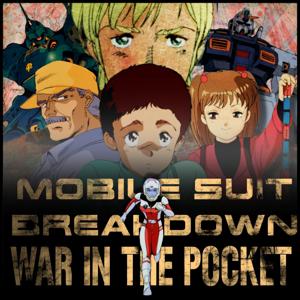
Mobile Suit Breakdown: the Gundam Podcast

Mobile Suit Breakdown: the Gundam Podcast

By Nina & Thom

MSB is a weekly Gundam podcast for new fans, old fans, and not yet fans. Nina (a Gundam first-timer) and Thom (a lifelong Gundam fan) analyze, review, and research all 40-years of the iconic sci-fi an... more

  • 4.9
  • 4.9
  • 4.9
  • 4.9
  • 4.9

4.9

279 ratings


Download on the App Store

Best of Mobile Suit Breakdown: the Gundam Podcast

The most played episodes among Podcast App listeners.

  1. Number 1: 5.2: The GMs of Navarone

    Show Notes We finally get started on Gundam 0080: War in the Pocket, and it makes quite the impression! Was it the good or bad kind of impression? There's only one way to find out! This week, we review and analyze episode 1, "How many miles to the battlefield?" (戦場までは何マイル?), and research and discuss the history of Playboy Magazine in Japan, how the creative team's nostalgia and childhood memories connect to 0080's story and themes, and how the unexpected appearance of mobile suits in a neutral colony connects to the history of US military bases and the presence of nuclear weapons in Japan. Playboy Magazine in Japan Wikipedia pages for Playboy, Monthly Playboy (月刊プレイボーイ / Gekkan Pureibōi), the Playboy Clubs, and Playboy Bunnies. _Britannica page for Playboy. _ _History of Playboy, from the company's website. _ Twitter thread (with photos) about Playboy clubs (and similar) in Japan, by @mulboyne. Photo of Taga Rie, a Bunny at one of Japan's Playboy clubs, from Getty Images (they had to lean like that to place drinks/light cigarettes because if they bent over they'd fall out of the one-piece). _Vintage store based in Las Vegas, with photographs of Monthly Playboy covers from the 70s and 80s. _ Wikipedia pages for China Lee and Jennifer Jackson. Papers and articles: Batura, Amber B. “From the Bachelor Pad to the Jungle: Bunnies, Playboy Magazine, and Vietnam Soldiers.” Texas Tech University, 2018. Accessed at https://ttu-ir.tdl.org/bitstream/handle/2346/73903/Batura_Amber_Thesis.pdf Chrisman-Campbell, Kimberly. “The Surprising Tale of the Playboy Bunny Suit.” The Atlantic, Atlantic Media Company, 4 Oct. 2017, https://www.theatlantic.com/entertainment/archive/2017/10/history-of-the-playboy-bunny-suit/541929/ “Tokyo's Foreign Flavors.” Edagawa, Koichi, Japan Quarterly; Oct 1, 1985; 32, 4; ProQuest pg. 356 Nostalgia and the Creative Team Team credits and biographical information was sourced variously from animenewsnetwork.com's encyclopedia and ja.wikipedia.org pages for the specific people. _Timelines of the major events of the Vietnam war are available in various places including History.com, Britannica, and Wikipedia. _ Japan & Nuclear Weapons Article 9 of the Japanese Constitution is described on Wikipedia here, and the full text of the constitution is available in English at the website of the National Diet of Japan. _The 1951 Security Treaty Between the United States and Japan is described here. _ The 1960 Treaty of Mutual Cooperation and Security Between the United States and Japan is described here. _More information about the U.S. military use of Japanese ports, specifically during the Korean War. _ Two articles by U.S. researchers around the year 2000, going into what was then publicly known and acknowledged about nuclear weapons deployed in and near Japan. Several articles from 2010 when the new Japanese government confirmed the existence of the secret agreements permitting U.S. nuclear weapons to pass through Japanese ports without prior consultation. _A 1981 article from the Christian Science Monitor about the Japanese reaction to former Ambassador Reischauer's admission about the secret agreements: "Japan reels under Reischauer's nuclear 'bombshell'." _ Steve Rabson, Six Decades of US-Japanese Government Collusion in Bringing Nuclear Weapons to Japan. Asia-Pacific Journal, Vol 19, Issue 14, No. 3. Available at https://apjjf.org/2021/14/Rabson.html Mobile Suit Breakdown is written, recorded, and produced within Lenapehoking, the ancestral and unceded homeland of the Lenape, or Delaware, people. Before European settlers forced them to move west, the Lenape lived in New York City, New Jersey, and portions of New York State, Pennsylvania, Delaware, and Connecticut. Lenapehoking is still the homeland of the Lenape diaspora, which includes communities living in Oklahoma, Wisconsin, and Ontario. You can learn more about Lenapehoking, the Lenape people, and ongoing efforts to honor the relationship between the land and indigenous peoples by visiting the websites of the Delaware Tribe and the Manhattan-based Lenape Center. Listeners in the Americas and Oceania can learn more about the indigenous people of your area at https://native-land.ca/. We would like to thank The Lenape Center for guiding us in creating this living land acknowledgment. You can subscribe to Mobile Suit Breakdown for free! on fine Podcast services everywhere and on YouTube, visit our website GundamPodcast.com, follow us on Twitter, Instagram, and Facebook, or email your questions, comments, and complaints to [email protected]. Mobile Suit Breakdown wouldn't exist without the support of our fans and Patrons! You can join our Patreon to support the podcast and enjoy bonus episodes, extra out-takes, behind-the-scenes photos and video, MSB gear, and much more! The intro music is WASP by Misha Dioxin, and the outro is Long Way Home by Spinning Ratio, both licensed under Creative Commons CC BY 4.0 licenses. The recap music is "pieces of life" by Analog by Nature, licensed under a CC BY attribution license. All music used in the podcast has been edited to fit the text. Mobile Suit Breakdown provides critical commentary and is protected by the Fair Use clause of the United States Copyright law. Gundam content is copyright and/or trademark of Sunrise Inc., Bandai, Sotsu Agency, or its original creator. Mobile Suit Breakdown is in no way affiliated with or endorsed by Sunrise, Bandai, Sotsu, or any of their subsidiaries, employees, or associates and makes no claim to own Gundam or any of the copyrights or trademarks related to it. Copyrighted content used in Mobile Suit Breakdown is used in accordance with the Fair Use clause of the United States Copyright law. Any queries should be directed to [email protected]

    1h 15min
    Listen Later
  2. Number 2: 5.1: Passing the Torch

    Show Notes It's time to start our coverage of the much-anticipated Gundam side story 0080: War in the Pocket! Kind of! Actually, it's time for us to cover Gundam's real first OVA - SD Gundam Mk I Part 3: SD Olympics as we get ready for the first episode on War in the Pocket next week. We research and discuss the history and characteristics of the OVA format, some of what happened in Japan and the world between Char's Counter Attack and 0080, and the influences, references, and gags in the SD Olympics short. SD Olympics Wikipedia pages for the 1988 Summer Olympics, the ABC gameshow Battle of the Network Stars, and the Hanna-Barbera Cartoons Laff-A-Lympics and Scooby's All-Star Laff-A-Lympics. Gundam Fandom Wiki page on Mobile Suit SD Gundam Mk I. This book discusses the imports of American cartoons to Japan (though mostly it's about the influence in the other direction): O'Melia, Gina. “Introduction.” Japanese Influence on American Children's Television: Transforming Saturday Morning, Springer Nature, Cham, Switzerland, 2019, pp. 23–25. As usual I relied on jisho.org as a Japanese-English dictionary, but I also used The Wisdom English-Japanese Dictionary (digital version for Dictionary app). Articles about the Olympics: Dahl, Tracy. “Award of 1988 Olympics Boosts S. Korea's Effort For Political Security.” The Washington Post, 4 Oct. 1981. Accessed at: https://www.washingtonpost.com/archive/politics/1981/10/04/award-of-1988-olympics-boosts-s-koreas-effort-for-political-security/2db0f29f-29cd-4581-8771-2f08c225181f/ Nalewicki, Jennifer. “How the 1988 Olympics Helped Spark a Global Kimchi Craze.” Smithsonianmag.com, Smithsonian Magazine, 23 Feb. 2018, https://www.smithsonianmag.com/travel/kimchis-olympic-connection-180968224/. Manheim, Jarol B. “Rites of Passage: The 1988 Seoul Olympics as Public Diplomacy.” The Western Political Quarterly, vol. 43, no. 2, [University of Utah, Sage Publications, Inc., Western Political Science Association], 1990, pp. 279–95, https://doi.org/10.2307/448367. Aw, Gene. “The 1988 Seoul Summer Olympics.” Go! Go! Hanguk, 4 Dec. 2019, https://gogohanguk.com/en/blog/seoul-olympics-1988-memories/. (Includes embedded video of the opening ceremonies for the 1988 Summer Games) Dator, James. “Never Forget That a Flock of Peace Doves Got Incinerated at the 1988 Olympics.” SBNation.com, SBNation.com, 9 Aug. 2017, https://www.sbnation.com/lookit/2017/8/9/16119834/peace-doves-olympic-opening-ceremony-1988-seoul Trex, Ethan. “5 Memorable Moments from Olympic Opening Ceremonies.” Mental Floss, 26 July 2012, https://www.mentalfloss.com/article/31314/5-memorable-moments-past-opening-ceremonies. (Content warning - contains embedded video of the dove incident) Montague, James. “Hero or Villain? Ben Johnson and the Dirtiest Race in History.” CNN, Cable News Network, 23 July 2012, https://www.cnn.com/2012/07/23/sport/olympics-2012-ben-johnson-seoul-1988-dirtiest-race/index.html. Eldridge, Larry. “Too Many `Perfect' Scores of 10 Distort Olympic Gymnastics Results.” The Christian Science Monitor, The Christian Science Monitor, 4 Oct. 1988, https://www.csmonitor.com/1988/1004/prom.html. From the IOC website, articles about the 1988 Summer Olympics and how it boosted tourism, South Korea's international profile, and national pride / feelings of global citizenship. While any content produced by the IOC is of course going to be propaganda for the Olympics, it's an important perspective on the event. Landing page for the Olympic World Library, part of The Olympic Studies Centre (a resource for official documents related to past Olympics). Wikipedia pages for sprinter Ben Johnson, decathlete Jürgen Hingsen, and the "perfect 10" in gymnastics. Video about Olympic shot-put, with a good section on men’s shot-put 1988. jisho.org page for the kanji 焼, and Cambridge Dictionary entry for 焼ける. Article with photos and video of the "Samurai Trash Collectors" performance artists. Tofugu article with LOTS of Japanese onomatopoeia, including the ワー!(wa-!) that appears over the stadium at the end of the short. March 12th, 1988 to March 25, 1989 Books and articles: Field, Norma. In the Realm of a Dying Emperor. Vintage Books, 1993. “Hibari Misora, Japanese Singer, 52.” New York Times (1923-), Jun 25, 1989, pp. 26. ProQuest, https://www.proquest.com/historical-newspapers/nathan-zucker-74-film-producer-dies/docview/110368815/se-2?accountid=35927 By, Robert T. "Japan's 'Lark of the Beautiful Sky': Hibari Misora is a chic chanteuse who is the rage of her country's teen-agers. A fishmonger's daughter, she has, at 19, the top income in Japanese show business." New York Times (1923-), Jun 09, 1957, pp. 201. ProQuest, https://www.proquest.com/historical-newspapers/japans-lark-beautiful-sky/docview/113922091/se-2?accountid=35927 Wikipedia pages for 1988 and 1989, as well as 1988 in Japan and 1989 in Japan. Wikipedia page for World Expo '88. An account from an Expo Japan-Pavilion attendant, describing the pavilion (with photos). Informational document from the Expo, scanned to PDF. Wikipedia page for singer and actress Misora Hibari (美空 ひばり). Short article from the Japan Society about "contemporary Japan" - from the 1989 beginning of the Heisei Era. to the present. This article is mostly a summary of the Heisei Era, and discusses the transition to a new era (written before the Reiwa name was chosen). But it also touches on the previous transition from Showa to Heisei. What's an OVA? Pages defining and describing OVAs, often with additional historical context, from Wikipedia, Anime News Network, and TV Tropes. Explainers on the OVA format and its place in the anime industry from CBR.com and OTAQUEST. "Bandai, the Post-Gundam Wave, and the Year 1985" - by Sean O'Mara for zimmerit.moe, discussing Bandai specifically, including their OVA production and video rental segments, and their efforts to attract new consumers while holding on to aging, hardcore fans. Music The recap music in this episode is "Olivia" by Hyson. Mobile Suit Breakdown is written, recorded, and produced within Lenapehoking, the ancestral and unceded homeland of the Lenape, or Delaware, people. Before European settlers forced them to move west, the Lenape lived in New York City, New Jersey, and portions of New York State, Pennsylvania, Delaware, and Connecticut. Lenapehoking is still the homeland of the Lenape diaspora, which includes communities living in Oklahoma, Wisconsin, and Ontario. You can learn more about Lenapehoking, the Lenape people, and ongoing efforts to honor the relationship between the land and indigenous peoples by visiting the websites of the Delaware Tribe and the Manhattan-based Lenape Center. Listeners in the Americas and Oceania can learn more about the indigenous people of your area at https://native-land.ca/. We would like to thank The Lenape Center for guiding us in creating this living land acknowledgment. You can subscribe to Mobile Suit Breakdown for free! on fine Podcast services everywhere and on YouTube, visit our website GundamPodcast.com, follow us on Twitter, Instagram, and Facebook, or email your questions, comments, and complaints to [email protected]. Mobile Suit Breakdown wouldn't exist without the support of our fans and Patrons! You can join our Patreon to support the podcast and enjoy bonus episodes, extra out-takes, behind-the-scenes photos and video, MSB gear, and much more! The intro music is WASP by Misha Dioxin, and the outro is Long Way Home by Spinning Ratio, both licensed under Creative Commons CC BY 4.0 licenses. The recap music for Season 3 is New York City (instrumental) by spinningmerkaba, licensed under a Creative Commons Attribution (3.0) license.. All music used in the podcast has been edited to fit the text. Mobile Suit Breakdown provides critical commentary and is protected by the Fair Use clause of the United States Copyright law. Gundam content is copyright and/or trademark of Sunrise Inc., Bandai, Sotsu Agency, or its original creator. Mobile Suit Breakdown is in no way affiliated with or endorsed by Sunrise, Bandai, Sotsu, or any of their subsidiaries, employees, or associates and makes no claim to own Gundam or any of the copyrights or trademarks related to it. Copyrighted content used in Mobile Suit Breakdown is used in accordance with the Fair Use clause of the United States Copyright law. Any queries should be directed to [email protected]

    1h 6min
    Listen Later
  3. Number 3: 4.7: On the Other Side of Darkness

    Show Notes On the podcast this week: our final episode of Season 4, Iraj returns to talk about asteroids, nuclear explosions, and capes, Thom names names, and Nina looks at alternative narrative frameworks. Plus we clean up a few ambiguities, answer some questions, and come clean about our favorite mobile suits. Will Thom's controversial takes enrage the MSB fandom?! Names, Names, Names: The Geara Doga _The Nagano designs for a 'Killah Doga' / キラ・ドガ and a サイコ・ドーラ can be seen in this Twitter post by Mark Simmons. _ _The DWDS (Digital Dictionary of the German language) records usages of Killer going back to 1972. _ The assertion that the Geara Doga and its gear was designed to look like a German WWII soldier is from the Japanese Wikipedia page for the Geara Doga, which cites: Yutaka Izubuchi "Yutaka Izubuchi Mechanical Design Works (1)" Movic, August 2000, pp. 16-17. ISBN 978-4896014907. The Alpha Azieru Izubuchi Yutaka explains that he drew the Alpha Azieru without having been asked, and says that the name comes from the Greek letter α and the word アジール, meaning an asylum or refuge. Background on what アジール means in Japanese can be found at the Japanese Wikipedia page. Jisho.org page on アジール which specifies the German derivation from Asyl. The Sazabi Izubuchi Yutaka explains that the prior title for the MS was ザ・ナック and that he thought Sazabi would be hard to trademark. ZeonicScanlations Twitter thread translating excerpts from an old Animedia book and specifying the Sotheby's reference. _ZeonicScanlations page translating a section of B-Club 30 from 1988 about the Sazabi, mentioning Zanac and the conflict with a similarly named Famicom game. _ The video game Zanac, which prevented CCA from using ザ・ナック for the Sazabi. _Japanese Wikipedia page on the Sazabi. _ _Japanese Wikipedia page for The Knack (the band). _ And the Japanese Wikipedia page for "My Sharona," specifically. _A rundown by Zimmerit.moe of musical references included in Nagano Mamoru's Five Star Stories. _ English-language interview with Izubuchi Yutaka in which he mentions the name issues for the Sazabi. Nagano's design for the Naitiengeaile (Nightingale) can be seen on this twitter post by Mark Simmons. Nagano's revision of the Naitiengeaile as the Nahatgall (ナハトガル, Nachtigall) can be seen here, or here. Story Structures, Cross-Cultural Analysis: Masterclass overview of 4 different story structures. Author Kim Yoon Mi's overview of story structures from around the world. Tofugu article about how arguments are structured in Japanese (with reference to how this relates to Japanese story structures. Blog post from art-collective Still Eating Oranges about "plot without conflict." _dbpedia and Japanese Wikipedia pages for kishoutenketsu (起承転結). _ _Articles on kishoutenketsu from Art of Narrative, Book Riot, Mythic Scribes, and Tofugu (Tofugu specifically looking at how this structure is used in Japanese horror). _ Papers and articles: Francisco Vaz da Silva. “Narrative Cultures in the Mirror.” Narrative Culture, vol. 1, no. 1, Wayne State University Press, 2014, pp. 85–108, https://doi.org/10.13110/narrcult.1.1.0085. Matsuyama, Utako K. “Can Story Grammar Speak Japanese?” The Reading Teacher, vol. 36, no. 7, [Wiley, International Reading Association], 1983, pp. 666–69, http://www.jstor.org/stable/20198301. Koenitz, Hartmut & Pastena, Andrea & Jansen, Dennis & Lint, Brian & Moss, Amanda. (2018). The Myth of ‘Universal’ Narrative Models. 10.1007/978-3-030-04028-4_8. Accessed at https://www.researchgate.net/publication/329064597_The_Myth_of_%27Universal%27_Narrative_Models Lien, Henry. “Diversity Plus: Diverse Story Forms and Themes, Not Just Diverse Faces.” SFWA, 18 Dec. 2020, https://www.sfwa.org/2021/01/05/diversity-plus-diverse-story-forms-and-themes-not-just-diverse-faces/. Wikipedia page for jo-ha-kyuu (序破急). Mobile Suit Breakdown is written, recorded, and produced within Lenapehoking, the ancestral and unceded homeland of the Lenape, or Delaware, people. Before European settlers forced them to move west, the Lenape lived in New York City, New Jersey, and portions of New York State, Pennsylvania, Delaware, and Connecticut. Lenapehoking is still the homeland of the Lenape diaspora, which includes communities living in Oklahoma, Wisconsin, and Ontario. You can learn more about Lenapehoking, the Lenape people, and ongoing efforts to honor the relationship between the land and indigenous peoples by visiting the websites of the Delaware Tribe and the Manhattan-based Lenape Center. Listeners in the Americas and Oceania can learn more about the indigenous people of your area at https://native-land.ca/. We would like to thank The Lenape Center for guiding us in creating this living land acknowledgment. You can subscribe to Mobile Suit Breakdown for free! on fine Podcast services everywhere and on YouTube, visit our website GundamPodcast.com, follow us on Twitter, Instagram, and Facebook, or email your questions, comments, and complaints to [email protected]. Mobile Suit Breakdown wouldn't exist without the support of our fans and Patrons! You can join our Patreon to support the podcast and enjoy bonus episodes, extra out-takes, behind-the-scenes photos and video, MSB gear, and much more! The intro music is WASP by Misha Dioxin, and the outro is Long Way Home by Spinning Ratio, both licensed under Creative Commons CC BY 4.0 licenses. The recap music for Season 3 is New York City (instrumental) by spinningmerkaba, licensed under a Creative Commons Attribution (3.0) license.. All music used in the podcast has been edited to fit the text. Mobile Suit Breakdown provides critical commentary and is protected by the Fair Use clause of the United States Copyright law. Gundam content is copyright and/or trademark of Sunrise Inc., Bandai, Sotsu Agency, or its original creator. Mobile Suit Breakdown is in no way affiliated with or endorsed by Sunrise, Bandai, Sotsu, or any of their subsidiaries, employees, or associates and makes no claim to own Gundam or any of the copyrights or trademarks related to it. Copyrighted content used in Mobile Suit Breakdown is used in accordance with the Fair Use clause of the United States Copyright law. Any queries should be directed to [email protected]

    2h 30min
    Listen Later
  4. Number 4: 3.21: Heart to Heart

    Show Notes This week, we review and analyze Mobile Suit Gundam ZZ (機動戦士ガンダムΖΖ) episode 23 - “The Burning Earth” (燃える地球) (sometimes also translated to English as “Earth Ablaze”), discuss our first impressions, and provide commentary and research on the history of childhood. _- Wikipedia pages for “child” and “history of childhood.” _ - Papers: Uno, Kathleen. “Civil Society, State, and Institutions for Young Children in Modern Japan: The Initial Years.” History of Education Quarterly, vol. 49, no. 2, 2009, pp. 170–181. JSTOR, www.jstor.org/stable/40648076. Accessed 20 Jan. 2021. Abraham, Erin. “Out of the Mouths of Babes: Speech, Innocence, and Vulnerability in Early Medieval Perceptions of Childhood.” Eolas: The Journal of the American Society of Irish Medieval Studies, vol. 7, 2014, pp. 46–64. JSTOR, www.jstor.org/stable/26193974. Accessed 20 Jan. 2021. Endō, Mika. “Repurposing Poetry: The Emergence of Working-Class Children's Expression in Interwar Japan.” Japanese Language and Literature, vol. 50, no. 1, 2016, pp. 25–52., www.jstor.org/stable/24891978. Accessed 20 Jan. 2021. Cunningham, Hugh. “Histories of Childhood.” The American Historical Review, vol. 103, no. 4, 1998, pp. 1195–1208. JSTOR, www.jstor.org/stable/2651207. Accessed 20 Jan. 2021. Zuckerman, Michael. Journal of Social History, vol. 28, no. 1, 1994, pp. 186–188. JSTOR, www.jstor.org/stable/3788358. Accessed 20 Jan. 2021. - DOL pages on “Youth and Labor,” specifically those pertaining to employment by parents and non-agricultural employment (which mention the federal age and work-hour restrictions). Mobile Suit Breakdown is written, recorded, and produced within Lenapehoking, the ancestral and unceded homeland of the Lenape, or Delaware, people. Before European settlers forced them to move west, the Lenape lived in New York City, New Jersey, and portions of New York State, Pennsylvania, Delaware, and Connecticut. Lenapehoking is still the homeland of the Lenape diaspora, which includes communities living in Oklahoma, Wisconsin, and Ontario. You can learn more about Lenapehoking, the Lenape people, and ongoing efforts to honor the relationship between the land and indigenous peoples by visiting the websites of the Delaware Tribe and the Manhattan-based Lenape Center. Listeners in the Americas and Oceania can learn more about the indigenous people of your area at https://native-land.ca/. We would like to thank The Lenape Center for guiding us in creating this living land acknowledgment. You can subscribe to Mobile Suit Breakdown for free! on fine Podcast services everywhere and on YouTube, visit our website GundamPodcast.com, follow us on Twitter, Instagram, and Facebook, or email your questions, comments, and complaints to [email protected]. Mobile Suit Breakdown wouldn't exist without the support of our fans and Patrons! You can join our Patreon to support the podcast and enjoy bonus episodes, extra out-takes, behind-the-scenes photos and video, MSB gear, and much more! The intro music is WASP by Misha Dioxin, and the outro is Long Way Home by Spinning Ratio, both licensed under Creative Commons CC BY 4.0 licenses. The recap music for Season 3 is New York City (instrumental) by spinningmerkaba, licensed under a Creative Commons Attribution (3.0) license.. All music used in the podcast has been edited to fit the text. Mobile Suit Breakdown provides critical commentary and is protected by the Fair Use clause of the United States Copyright law. Gundam content is copyright and/or trademark of Sunrise Inc., Bandai, Sotsu Agency, or its original creator. Mobile Suit Breakdown is in no way affiliated with or endorsed by Sunrise, Bandai, Sotsu, or any of their subsidiaries, employees, or associates and makes no claim to own Gundam or any of the copyrights or trademarks related to it. Copyrighted content used in Mobile Suit Breakdown is used in accordance with the Fair Use clause of the United States Copyright law. Any queries should be directed to [email protected] Find out more at http://gundampodcast.com

    1h 19min
    Listen Later
  5. Number 5: 3.20: Earthbound

    Show Notes This week, we review and analyze Mobile Suit Gundam ZZ (機動戦士ガンダムΖΖ) episode 22 - “Judau, Launch!” (ジュドー、出撃!!) (sometimes also translated to English as “Judau Sorties!”), discuss our first impressions, and provide commentary and research on the history of recreational ballet and ballet in Japan. - Main paper I consulted about ballet in Japan: Ono, Sayako. “Ballet in Japan: Reconsidering the Westernization of Japanese Ballet.” Journal of Glocal Studies, vol. 3, 2016. https://www.seijo.ac.jp/research/glocal-center/publications/backnumber/jtmo420000005foz-att/a1469430663005.pdf. Accessed 12 Jan. 2021. - Paper about perceptions of dance by young people in the UK: Sanderson, Patricia. “The Arts, Social Inclusion and Social Class: The Case of Dance.” British Educational Research Journal, vol. 34, no. 4, 2008, pp. 467–490. JSTOR, www.jstor.org/stable/40375509. Accessed 12 Jan. 2021. - Wikipedia pages for The Red Shoes (1948 film), dancers Yoko Morishita (森下洋子) and Olga Sapphire (Ольга Сафайя, オリガ・サファイア) (also known as 清水みどり, neé Olga Ivanovna Pavlova/Ольга Ивановна Павлова). - Wikipedia page on the economic history of Japan, which talks about the economic booms of the '60s, '70s, and '80s. - Overview of the book_ In Ballet Class: An American History, by Melissa Klapper (talking about the history of recreational ballet in the United States)._ - Page on the Bolshoi Ballet Academy website about the academy's involvement in ballet education in Japan. - The first of our Patreon posts about the Haman Karn cosplay we commissioned from Deidre (Rozenrabbit), and her social media links. Mobile Suit Breakdown is written, recorded, and produced within Lenapehoking, the ancestral and unceded homeland of the Lenape, or Delaware, people. Before European settlers forced them to move west, the Lenape lived in New York City, New Jersey, and portions of New York State, Pennsylvania, Delaware, and Connecticut. Lenapehoking is still the homeland of the Lenape diaspora, which includes communities living in Oklahoma, Wisconsin, and Ontario. You can learn more about Lenapehoking, the Lenape people, and ongoing efforts to honor the relationship between the land and indigenous peoples by visiting the websites of the Delaware Tribe and the Manhattan-based Lenape Center. Listeners in the Americas and Oceania can learn more about the indigenous people of your area at https://native-land.ca/. We would like to thank The Lenape Center for guiding us in creating this living land acknowledgment. You can subscribe to Mobile Suit Breakdown for free! on fine Podcast services everywhere and on YouTube, visit our website GundamPodcast.com, follow us on Twitter, Instagram, and Facebook, or email your questions, comments, and complaints to [email protected]. Mobile Suit Breakdown wouldn't exist without the support of our fans and Patrons! You can join our Patreon to support the podcast and enjoy bonus episodes, extra out-takes, behind-the-scenes photos and video, MSB gear, and much more! The intro music is WASP by Misha Dioxin, and the outro is Long Way Home by Spinning Ratio, both licensed under Creative Commons CC BY 4.0 licenses. The recap music for Season 3 is New York City (instrumental) by spinningmerkaba, licensed under a Creative Commons Attribution (3.0) license.. All music used in the podcast has been edited to fit the text. Mobile Suit Breakdown provides critical commentary and is protected by the Fair Use clause of the United States Copyright law. Gundam content is copyright and/or trademark of Sunrise Inc., Bandai, Sotsu Agency, or its original creator. Mobile Suit Breakdown is in no way affiliated with or endorsed by Sunrise, Bandai, Sotsu, or any of their subsidiaries, employees, or associates and makes no claim to own Gundam or any of the copyrights or trademarks related to it. Copyrighted content used in Mobile Suit Breakdown is used in accordance with the Fair Use clause of the United States Copyright law. Any queries should be directed to [email protected] Find out more at http://gundampodcast.com

    55min
    Listen Later

Mobile Suit Breakdown: the Gundam Podcast episodes:

FAQs about Mobile Suit Breakdown: the Gundam Podcast:

How many episodes does Mobile Suit Breakdown: the Gundam Podcast have?

The podcast currently has 161 episodes available.

More shows like Mobile Suit Breakdown: the Gundam Podcast

History of Philosophy: India, Africana, China by Peter Adamson, Jonardon Ganeri, Chike Jeffers

History of Philosophy: India, Africana, China

265 Listeners

White Coat, Black Art by CBC

White Coat, Black Art

103 Listeners

Something You Should Know by Mike Carruthers | OmniCast Media

Something You Should Know

4,254 Listeners

Blank Check with Griffin & David by Blank Check Productions

Blank Check with Griffin & David

6,181 Listeners

TRASHFUTURE by TRASHFUTURE

TRASHFUTURE

588 Listeners

WHAT WENT WRONG by Sad Boom Media

WHAT WENT WRONG

3,601 Listeners

Gundam Explained Podcast by Gundam Explained

Gundam Explained Podcast

6 Listeners

The Weekly Show with Jon Stewart by Comedy Central

The Weekly Show with Jon Stewart

10,755 Listeners

Pure TokyoScope by jaPRESS

Pure TokyoScope

32 Listeners

Shelved By Genre by Ranged Touch

Shelved By Genre

446 Listeners

Giant Robot FM by Giant Robot FM

Giant Robot FM

21 Listeners