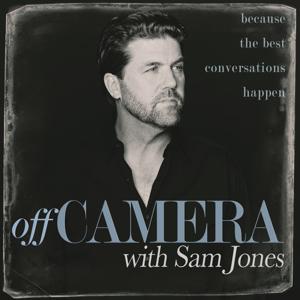
Off Camera with Sam Jones

Off Camera with Sam Jones

Download on the App Store

Off Camera with Sam Jones episodes

  • 45. William H. Macy
    Ask William H. Macy about any number of the hapless losers, downtrodden everymen and debauched miscreants he’s portrayed over the course of his career, and he’ll tell you he’s played the hero as every one of them. That makes sense if you believe that an actor’s job is to find something worth fighting for in every character he assumes. That doesn’t mean Macy doesn’t judge his alter egos; “There are a lot of stupid assholes in the world, but they don’t think they’re stupid assholes.” They’re simply human, and telling their stories truthfully is how he answers our questions as viewers about why they are the way they are. Let’s start with the hapless losers, namely Fargo’s Jerry Lundegaard, who he embodied so convincingly we weren’t completely sure they weren’t the same person. On reading the script, Macy knew he was the guy; problem was, the Coen brothers didn’t. So, putting both his career and Ethan Coen’s dog on the line, he launched an offensive that more than paid off. Macy didn’t have to seriously audition for another role thereafter. After years of steady work, though, he began to find the movie roles he was offered less than scintillating, and decided it was time to take on series TV. Enter Frank Gallagher, another less-than-upstanding citizen he’s made us love. Shameless, which Macy says is like getting paid to return to acting school, has completely renewed his love for his craft. Maybe that’s why he’s so fun to watch – and possibly why received an Emmy nod for Lead Actor in a Comedy Series even after he spent a season dying of liver failure. So things were going well in TV land. That’s when he decided he wanted to direct a feature film. Macy is nothing if not ambitious, and thought he could do it as well as, if not better, than anyone else; but he calls his first feature effort “a real sock in the nose.” No Minnesotan could understate it better. The first day of prep for Rudderless left him feeling completely overwhelmed and under-qualified to take it on. But he needn’t have worried, guided as he was by the same principle he’d adhered to for over 30 years in the business: Tell the truth, and cut out everything else. What we’re left with is a difficult but authentic story, beautifully scored and acted. In this conversation, Macy tells the truth about acting technique, the perks and pitfalls of series TV, the process of putting together a feature-length indie, and what he’s learned from his experience on both sides of the camera. We talk about everything, including how to fire George Clooney so he stays fired. Well, almost everything… Sorry, Bill.
    1 hr 3 min
  • 44. Connie Britton
    Why is it that even if you haven’t seen more than a few minutes of Connie Britton on screen, you feel like you somehow already know her. And not only know her, but really like her. Maybe we relate so instantly because we get the feeling she’s a lot like us, only maybe just slightly improved. Watching her work in shows like the dearly departed Friday Night Lights, you’re sort of inspired to be a better person. In Hollywood years, Britton is a bit of a late bloomer, having no family or industry connections, and majoring in Asian studies instead of acting. All of which she came to see as an advantage; it forced her to take a good look at herself and figure out what she had to offer as an artist that was truly unique, versus what everyone else was doing, or was expected to do. Another late-bloomer advantage? Once you know what your particular gifts are, you can fight to stay true to them. When no (that’s zero) drama schools accepted her after college, Britton figured she’d better just take those gifts to New York and start auditioning. Based on how that was going, she had nothing better to do than take a part in a small independent. No one, including Britton, had any reason to expect The Brothers McMullen would garner any attention or box office, so she felt they made it for the best and most pure reasons – art, and the experience of creating it. Still, it’s nice when (thanks to Ed Burns and his magical backpack) it becomes a box office hit, and your breakout role. So when that led to her first screen test (with Tom Cruise for Jerry Maguire, no pressure), she couldn’t be blamed for getting her hopes up – and subsequently completely crushed – when the director passed her over for Renée Zellweger. Britton has said it took her an xx to get past the devastation of that experience, so we invited said director to come back and talk to her about that. Here at Off Camera, we’re all about closure, folks. But, as strong and buoyant as the hair that now has it’s own Twitter account, Britton kept working, kept learning, and increasingly, kept fighting for characters and storylines that rang true. Having learned a lesson about character arcs on Spin City she turned down NBC’s dearly departed Friday Night Lights countless times, until series director Peter Berg assured her Tami Taylor would stay “strong and messed up” and not on the sidelines. He listened, and everyone scored. Britton says the show’s “independent TV” approach of allowing great mistakes to happen was empowering, and pushed her to take risks as an actress. A strong believer that “it’s not a risk if there’s no way to fail,” Britton saw promising potential disaster in singing on the hit series Nashville. No disaster ensued, but some great TV sure did. In a funny, real and downright uplifting conversation, Connie Britton shares tales from her winding career path, how she discovered what she had to offer as an artist, and how resilience comes from finding a higher purpose in her work. We’ve wanted to have Connie as our guest for a long time. Now we also want her for our best friend, career counselor, coach, cheerleader and role model for our kids. After all, how busy can she be, right?
    1 hr 2 min
  • 43. Carrie Brownstein
    “No matter how dreary and gray our homes are, we people of flesh and blood would rather live there than in any other country, be it ever so beautiful. There is no place like home.” – L. Frank Baum, The Wizard of Oz Ol’ L. Frank had it right, and maybe that’s why we all try so hard to find one. And if you never had much of a home to speak of in the first place, you try that much harder. That’s where the story of Carrie Brownstein, or at least her new book, Hunger Makes Me A Modern Girl, begins. Brownstein, who’s now probably best known for co-creating and starring in the cult hit Portlandia, began her search as a fan of bands, and then by being in one, and ultimately, by breaking it up for the perceived shelter of various and sundry office buildings. With parents who for their own reasons were largely absent, Brownstein was at once free and compelled to immerse herself in the Pacific Northwest music scene of the 90s, and pursued it with the hunger and passion to connect that drives so many artists. What eventually emerged was Sleater-Kinney, a band [with singer/guitarist Corin Tucker and drummer Janet Weiss] as fiery and original as its members. They lived the floor-sleeping, van-touring, equipment-schlepping, basement-practicing existence of most scrappy bands while they built a small but loyal following. Then to the surprise of everyone, none more so than the band itself, Time magazine named Sleater-Kinney the Best Rock Band in America. Another surprise was their first feature article in SPIN, one that drove home what happens when your life is no longer just your own. So Sleater-Kinney was “famous”, or about as famous as you could be in the modest Northwest indie rock world back then. Though Brownstein had begun to realize the same scene that embraced them as outliers had its own set of rules more restrictive than the mainstream, she nevertheless sabotaged a meeting with a bigger label that came calling. At the time, Brownstein thought she was being loyal to a scene where “selling out” was anathema; in hindsight it might just be what happens when three very tough but vary naïve young girls try to navigate a career without management, agents, or even parents to provide guidance and an objective voice of reason. They returned to their small Olympia, WA label, and to hauling their own equipment down broken stairs to a cat-pee scented basement. Misfiring on the verge of mainstream success was a pattern that sadly defined the rest of the band’s career. Ambition and talent go a long way, but making a band your substitute family puts a dangerous amount of weight on a creative partnership. It’s Band Psych 101’s top reason for a breakup, and that’s exactly what Brownstein did, in dramatic fashion, before a show in Brussels. For Brownstein, the end of Sleater-Kinney marked the beginning of a 10-year stint of “day jobs” that seem unimaginable for a creative soul who spent 15 years touring the world as her own boss. But the schedule and structure of the office buildings where she worked – as a substitute teacher, an animal shelter and an ad agency – seemed like just the solid vessel she needed to hold her. It took another traumatic incident and a lot of reflection to realize the most stable home is the one you build inside yourself. In this episode we talk to the musician, writer and actress about the birth, death, and rebirth of Sleater-Kinney, the disparity between the perception and reality of fame, what she’s learned from the process of writing her book, and what might be next for Portlandia. That, and the fine line between drawing too few and too many cats. Brownstein says she wrote ‘Hunger’ in part to figure out how to make decisions that put you at the center of who you want to be. We think she’s home.
    1 hr 4 min
  • 42. Jack Black
    Thanks to movie posters and pull-quote "reviews", we've heard "electric" used to describe a performance so often that it barely registers as an adjective. But think back for a moment to the first time you saw High Fidelity. Now, think about the first moment Jack Black appeared on screen and jolted that film alive. It’s a great movie with a great cast, but let’s face it – his very presence flipped the switch. And that movie flipped the switch on Black’s film career, though it was a part he came within inches of turning down. But as the Guitar Pick of Fate would have it, he said yes, ending a 10-year struggle as a glorified extra that followed his first film role as a rabid political acolyte in Bob Roberts, where his real-life nerves turned out to be all the prep he needed to turn in another performance you must to go back and see. The good news about that flame-out decade is that he met a certain KG, and you know what rose from those ashes. But let’s flash-Black for a moment to our guest as a teenager who began auditioning for commercials because he so desperately wanted his friends to see him on TV, and even more desperately the acceptance and attention he figured would follow. A stint in Tim Robbins’ The Actors Gang followed, as did high school plays and musicals; and though he lost the girl (and wrote the requisite power ballad) he quite literally found his voice. Through music, The D, the hilarious Mr. Show and eventually film, he got the totally merited attention he wanted, if not the confidence he probably thought would come with it: “Man, I spend my life just trying to relax.” But he achieved at least some degree of artistic peace in figuring out that his way in to any role – or any song, for that matter – was with a chaser of comedy. If that covers up some vulnerability, well, as he puts it, "You can't hurt the clown." So back to the present, where under all the over-the-top antics and outrageousness it’s not hard to scent the sensitivity and empathy that no amount of good-humored depravity can disguise. It takes one very human clown to connect us immediately with otherwise improbable characters and films (for more must-see proof, we offer School of Rock and the truly excellent Bernie). As an artist Black says he doesn’t seek out challenges as much as he does resonance. In this high-minded and philosophical discussion, we will hit you with lessons on artistic angst and toehold moments, as well as true tales of Cannes-crashing, the fearsome warlock powers of Stephen Frears, and a fever-dream nightmare of an Elliott Smith tribute gone horribly wrong…then right. That, and a scholarly debate on the merits of Gene Krupa vs. Buddy Rich vs. Peter Criss – Sam and Jack hologram it out. By now, Jack Black knows who he is, and what he’s here for. So watch his work for the subtle or the shenanigans, but watch you will, because it’s impossible not to. He’s proof you can’t underestimate the power of a raised eyebrow, wait-for-it timing or an unexpected turn of phrase. In that regard, he ranks up there with Jack Benny and other masters of comedy who simply knew how to deliver a line. Ladies and gents, we give you the Bard of Off Camera.
    1 hr
  • 41. Olivia Wilde
    If you could see Olivia Wilde's toes right now, they'd be wiggling. Since you can't, you'll have to take her metaphor for it – she's hit an artistic stride that feels as satisfying and freeing as "taking off an uncomfortable pair of shoes." It shows. In Meadowland, she’s riveting as a mother whose reaction to a tragically random event first seems shocking, then increasingly real. In other words, more human than Hollywood. It's a role she was told she likely wouldn’t get, and one she knew she'd do anything to play, including working with a first-time director, locking her fiance in his room for three hours and eventually, signing on to produce. How do you know "Goddamn, I have to play this role?" When you recognize a version of yourself in the character, even if it's one you may not want to see. It's a performance that makes any of us question how we’d behave once the worst has already happened. Meadowland also appealed to Wilde in its refusal to offer closure, which also sounded suspiciously like real life. And should neatly answering all our questions be the function of film, or any art? Not for Wilde, anyway. "If it's not messy, I’m not interested." Wilde has been acting for over a decade, but says her career truly started when she learned to commit to a choice without knowing what its outcome would be, a lesson she credits to the under-appreciated Drinking Buddies, a movie in which she plays another messy character, and one that comes closest who she really is. She didn’t have much choice about trusting the outcome, since almost the entire script was improv and all the information she had about the movie before flying out to film it was scribbled on a napkin. (Another lesson about absorbing beer and information simultaneously followed, but you'll have to read on for that one.) Drinking Buddies was an artistic stretch, but a big confidence builder – confidence she's now channeling into writing: "Fear was going to stop me until I just made the decision to do it.” It also underscores one of her favorite quotes from Steinbeck's East of Eden: "And now that you don’t have to be perfect, you can be good." Not to mention a lot more interesting and authentic. Early in her career, Wilde made the smart decision to work at a casting agency to learn the business in "the belly of the beast." When an agent advised her to drop her theater-training enunciation and "just be a human," she realized that most actors "spend their careers unlearning how to act and just be a person." That kind of authenticity is informing the more complex characters she’s choosing to take on these days. And as an audience, we relate and respond. So why don’t we see more complicated, real women on screen? Wilde figures it's because Hollywood is pretty invested in the shiny, young and new, the food of fantasy. Certainly there's a place for escapism in film or any art, but if we don’t truly connect, how much does it enrich us in the long run? Wilde shares stories from the jobs that shaped her career, reveals her fondness for brown corduroy and explains why Coming to America is a feminist movie.
    1 hr 1 min
  • 40. Tatiana Maslany
    Remember the unquestioned belief and magic of playing pretend as a kid? You were a dinosaur, no, a spy – no, wait, Queen of the Mermaids. You lost yourself for hours, aided and abetted, if you were lucky, by a few props and indulgent adults who agreed you were the Maharaja and became your willing subjects. Then you grow up, abandon make believe and yourself become the indulgent adult, which is a little sad, when you think about it. At the very least, it makes you ponder the “natural” progression of things. As someone who never wanted to let those fantasies go, Tatiana Maslany has won the lottery with Orphan Black, and the prize looks like the biggest costume box of make believe ever. Though Maslany – like so many “overnight ‘successes – came to wide attention for her role (make that roles) as about a dozen different clones in the cult favorite Canadian series, she’s been acting since the age of nine; earlier if you count the living room theatricals she staged for her parents as a youngster. That didn’t give her much opportunity to have the typical high school student experience and social structure that comes with it, but for a kid with acting ambitions and a hyperactive imagination, a school improv team proved the only peer group she needed. To this day, it inspires and fuels some fairly uncontrollable urges to go off script, usually to the benefit of her work. After a year or so of college, she focused fully on work. Acting jobs, acting coaches and Emmy nominations followed, as did the certainty she’d eventually set off a Fraud Alert; inevitably, someone would discover her for the acting fake that she was and hire someone more qualified for the job. It’s comforting to know that feeling can plague even the most successful and talented among us, but it’s also a cautionary tale about judgment. The danger of regulating creative impulses based on what you think is right or wrong, or worse, what you think someone else will judge as right or wrong, is that you stop risking. That said, Maslany knows that as a society, we’re hard-wired to judge; heck, even awards shows that recognize artistic achievement are complicit by nature, designating “best” and by default, not-so-worthy. So what to do? Allow yourself to “put it out there” before you judge. “Good” or “bad”, at least the idea, the impulse, had a chance to be born. Maslany still works at this, and looks to a favorite quote from Martha Graham as a reminder: “There is only one of you in all of time, this expression is unique. And if you block it, it will never exist through any other medium and it will be lost. The world will not have it. It is not your business to determine how good it is nor how valuable nor how it compares with other expressions. It is your business to keep it yours…” Or in Maslany’s slightly more earthy paraphrase, “vomit first, and try to make something pretty with it.” In this issue, she talks about what she learned in the transition from improv to scripted roles, what it’s like to play the multitudes of Orphan Black, why monsters scare her more than robbers and why she once faked sleeping for 17 hours. So go ahead and judge Tatiana Maslany; we did, and found her as fascinating, funny and relatable as they come.

    1 hr 2 min
  • 39. Ellen Page
    In the years since Ellen Page came to wide attention at 20 for her “overnight” success in Juno, a lot has changed in the world, but maybe not enough when it comes to how our increasingly diverse culture is reflected by Hollywood. A lot has certainly changed for Page, who very publicly came out as gay in February 2014 and hopes to see a more realistic and holistic on-screen portrayal of all the groups that comprise our society – including LGBT and other minority communities. No one can accuse her of not doing her part to move that along; she’s currently starring in and co-producing a string of films with gay characters at their center, including the excellent Freeheld. Still closeted when she began work on Freeheld, Page says she didn’t feel compelled to come out by the project’s impending release. The mandate came from a more personal tipping point; she simply could no longer handle living in a way that wasn’t true to her. Though the decision wasn’t an easy one, the personal and artistic benefits were more than worth it. Page is not only happier than she’s been in years, but also doing her best work in years, Freeheld being a case in point. While it largely avoids hitting the audience over the head with moral messages, it does deliver a blow to the heart, showing the us sad compromise required of a closeted relationship, and reminding us that as humans, the things we cherish the most unite us the most. In this episode, Page talks about the benefits of missing her “sitcom years” while enjoying a pre-fame career in Halifax with all of the ambition but none of the delusions that can derail a young actor in Hollywood. She did leave home at 15 to act and study, but did not “get up to shenanigans.” Maybe that’s just not done in Canada. We discuss her concerns about playing a real-life character for the first time, her conflicted feelings about being closeted and depressed while at the same time enjoying the privileges of being a successful actress, and the best film experience she’s ever had – though we’re still not clear if asking Julianne Moore for her phone number in a parking lot beats 10-hour days shooting a motion-capture French video game.
    1 hr 6 min
  • 38. Cindy Crawford
    In one sense of the word, Becoming seems a woefully inadequate title for a coffee table book full of images of Cindy Crawford, one of the most beautiful women in the world. But in its more Aristotelian definition – “any change involving realization of potentialities” – it’s more than apt. If you’re already rolling your eyes at an introduction that attempts to link models and philosophers, consider this: Crawford was a straight-A student who won a full ride to Northwestern to study chemical engineering (the instructor thought she was in the wrong class, though we’re guessing he wasn’t unhappy to be mistaken). To mark her 50th (!) birthday, the woman who virtually defined “supermodel” wanted to connect iconic images from her career with the lessons behind them; ones she believes are universal. And Cindy Crawford is someone who never stops learning. Some of those lessons were tough, like what the death of a three-year-old sibling can do to a family. Others were easier, like standing around in a bra for 30 minutes beats picking corn for minimum wage all day, anytime. And still others you learn only by having absolutely no blueprint beyond the one you draw for yourself: What to do when at age 17 you’re making five times more money than your parents, who have no advice to give you about what to do with it? Should you stay in Illinois (and school) or go to New York to be a model when you have absolutely no idea if you’ll succeed – when, in fact, the most important photographer in Chicago tells you that you won’t? How do you handle yourself when suddenly you’re part of a moment that changed the way the world sees you and your industry forever? Is posing forPlayboy a powerful statement of femininity or a career-ending decision? And finally, how do you become, to use a famous Vanity Fairheadline, “Cindy, Inc.”? A life like hers presumably belongs to someone with big ambitions and self-confidence to match, but Crawford tells Off Camera she never dreamed big enough for herself. The wisdom in Becoming belongs to someone who’s earned it through experience, observation, hard work and humility. For anyone forging a path in or outside of fashion, this is textbook stuff. With way better pictures.
    1 hr 4 min
  • 37. Jake Gyllenhaal
    Jake Gyllenhaal has become somewhat synonymous with beyond-brutal physical transformations for movies like Nightcrawler, and more recently (and even more brutally), for the role of boxer Billy Hope. But after crying three times over a first-draft script for Southpaw, he knew it was worth taking some punches for. He’s no masochist, but calls any work needed to tell the story of characters that fascinate him a joy. Gyllenhaal is the kind of actor who knows not only that his character bears a certain scar or walks a certain way, but why. He’s become known for going deep, and seems embarrassed and proud in equal parts about how seriously he takes his work; the same guy who’ll spend five months in a boxing ring or memorize an entire script just to sound as robotic as Louis Bloom will also tell you the best analogy for acting is Super Mario Brothers. Level One, to be specific. Though much has been made of his on screen metamorphoses, his most profound change in recent years is one we didn’t realize we were seeing. After coming to wide attention and critical acclaim in films like Donnie Darko and Brokeback Mountain, he found himself in the enviable position of being very young and very successful in Hollywood. That’s when everyone in the business will tell you exactly which projects and path will guarantee you a lucrative career. And that’s when Gyllenhaal stepped back and decided it was time to listen to his own voice about what he wanted to do and what his work would say about him. The results are sometimes perplexing (Enemy), or darkly comic (Nightcrawler), but always worth watching. And for Gyllenhaal, richly rewarding – the spoils being the experience, worldview and friendships he takes with him from every role. From Southpaw, he learned that a mere five pounds of pressure is all it takes to knock a guy’s brain against the side of his skull and put him down, if you know just where to land it. It’s the kind of instinct that told him just how to play one of the most touching and terrifying scenes in that film, and the same instinct that now guides the career he’s designing for himself. In this episode, Gyllenhaal discusses his work ethic, how he chooses and prepares for roles, and why he’d like to see someone else take a shot at playing them – really. It’s an esoteric conversation, but don’t worry; you’ll love it even if you’re not into Talking Heads, Bruce Springsteen or Wild Geese.
    1 hr 5 min
  • The Call-In Show
    On this episode of OFF Camera with Sam Jones the guest is YOU! It’s the first ever Off Camera Call In Podcast in the spirit of old timey radio and it stars listeners, viewers, and fans of Off Camera. So pull up a chair and listen in!
    1 hr 3 min

About Off Camera with Sam Jones

From the publisher's feed

Off Camera is a podcast hosted by photographer/director Sam Jones, who created the show out of his passion for the long form conversational interview, and as a way to share his conversations with a…

More shows like Off Camera with Sam Jones

WTF with Marc Maron Podcast by Marc Maron

WTF with Marc Maron Podcast

28,893 Listeners

Happy Sad Confused by Josh Horowitz

Happy Sad Confused

1,281 Listeners

Awards Chatter by The Hollywood Reporter

Awards Chatter

1,343 Listeners

IndieWire's Filmmaker Toolkit by Chris O'Falt

IndieWire's Filmmaker Toolkit

109 Listeners

In the Envelope: The Actor’s Podcast by Backstage

In the Envelope: The Actor’s Podcast

180 Listeners

Armchair Expert with Dax Shepard by Armchair Umbrella

Armchair Expert with Dax Shepard

69,560 Listeners

Conan O’Brien Needs A Friend by Team Coco & Earwolf

Conan O’Brien Needs A Friend

59,373 Listeners

The Three Questions with Andy Richter by Team Coco & Earwolf

The Three Questions with Andy Richter

3,610 Listeners

Literally! With Rob Lowe by Stitcher & Team Coco, Rob Lowe

Literally! With Rob Lowe

12,390 Listeners

Mike Birbiglia's Working It Out by Mike Birbiglia

Mike Birbiglia's Working It Out

4,588 Listeners

SmartLess by Jason Bateman, Sean Hayes, Will Arnett

SmartLess

57,744 Listeners

Blocks: I Wish I Knew w/ Neal Brennan by Neal Brennan

Blocks: I Wish I Knew w/ Neal Brennan

1,377 Listeners

Family Trips with the Meyers Brothers by Seth Meyers and Josh Meyers

Family Trips with the Meyers Brothers

2,869 Listeners

Where Everybody Knows Your Name with Ted Danson and Woody Harrelson (sometimes) by Team Coco & Ted Danson, Woody Harrelson

Where Everybody Knows Your Name with Ted Danson and Woody Harrelson (sometimes)

3,408 Listeners

Good Hang with Amy Poehler by The Ringer

Good Hang with Amy Poehler

12,445 Listeners