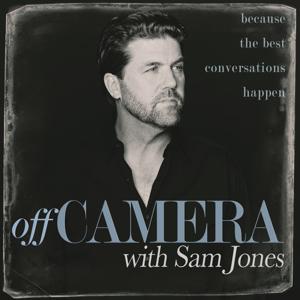
Off Camera with Sam Jones

Off Camera with Sam Jones

Download on the App Store

Off Camera with Sam Jones episodes

  • Ep 89. David Oyelowo
    David Oyelowo has a favorite phrase from St. Francis of Assisi. “Preach the gospel, and every now and again use words.” You could see why. One of the most remarkably talented film and stage actors working today, he employs words to stunning effect, but it’s between syllables that one sees his real power. There’s something in his being that telegraphs a certain dignity, a deep human awareness and an underlying joy that he seems incapable of turning off, on screen or in person. “He’s kind of an amazing balance of import and also a kind of levity and light,” said J. J. Abrams, producer of Oyelowo’s upcoming film The God Particle.
    He’s best known for his acclaimed portrayal of Martin Luther King Jr. in Selma, in which his embodiment of a man raised to sainthood status as one also troubled by fear and doubt was praised most widely for its authenticity. That lack of hagiography may be partly due to an outsider’s perspective. Race played a significant, but different role in his life. He was born in London to Nigerian parents who moved the family to Lagos when he was six, and back when he was 14. Comparatively privileged in Nigeria where classmates called him coconut (white inside) and in more humble circumstances in the UK, he never completely fit. He took nothing for granted other than his own self-worth, and the importance of bettering himself.
    Despite being a hard worker and ambitious, he admits to enrolling in a youth theater program only because a girl he liked invited him. Oyelowo didn’t share his decision to pursue acting with his father (who was thinking along more lawyerly lines) until he’d secured a scholarship to London Academy of Music and Dramatic Art. He was offered a season with the Royal Shakespeare Company, and in a major landmark for color-blind casting, became the first black actor to play an English king in a major production of Shakespeare. He was soon getting parts in a number of British films and TV series, most famously, officer Danny Hunter in the British TV drama series Spooks (MI-5 to North American audiences).
    Problem was, given British producers’ fondness for period pieces, he found the choice of interesting roles for black actors if not insulting, at least limiting. When he looked at the careers of his acting heroes – Will Smith, Sidney Poitier and Denzel Washington – he realized they were made in Hollywood. So that’s where he went. Catching the eye of major directors like Ava DuVernay and Lee Daniels opened opportunities for more nuanced characters, and recognition. His work in The Butler, Red Tails, Intersteller, and Disney’s Queen of Katwe garnered a wider audience, but his 83-minute masterwork may just be HBO’s Nightingale. Writing about the 2014 film, which essentially starred Oyelowo and a room, The New York Times called his performance nothing less than amazing. “Mr. Oyelowo gives a riveting, disorienting and suspenseful tour of an unraveling mind. The music and cinematography are artful, but the props are mundane: a coffee maker, a mirror, a laptop. Everything is in Mr. Oyelowo’s voice, face and body.”
    He found time for an all-too-brief return to the stage last year in an “electrifying” Othello opposite Daniel Craig, something we’ll be kicking ourselves for a long time for missing. “Mr. Oyelowo is Olympian in his anguish,” read the review in the Times’ Critics’ Picks. “His Othello is the real thing — a bona fide tragic hero, whose capacity for emotion is way beyond our everyday depths.”
    Early on in his career, Oyelowo told his agent to put him up only for non-race-specific parts, an edict he worried was naïve when offers were initially slow in coming. But holding steadfast has given him a chance to prove his range. And while he remains adamant about not playing one type of character, he is interested in a recurring character trait. He believes virtue is “something to be celebrated — entertaining, compelling, dramatic.” It’s not something you hear from many actors, and maybe that’s for the best. In the hands of an artist of lesser skill and subtlety, the intent might be noble, but the result one-note or worse, pandering and corny. In Oyelowo’s work, we’re able to look past even the most cynical parts of ourselves, and see something to hope for. In him, we have actor we not only can’t look away from, but simply don’t want to.
    HOME
    1 hr 22 min
  • Ep 138. Bill Hader
    As a high school kid growing up in Oklahoma, Bill Hader received a progress report from his French teacher that had remarkable foresight: “Bill is very funny in class. He’ll probably be on Saturday Night Live one day. He has a 37% in class though. He will not be speaking French.”
    Bill had a natural gift for doing voices and impressions, and years later, he would indeed join SNL. For eight years, he brought memorable characters to life, including fan-favorites like his exasperated Vincent Price, the lecherous Italian Vinny Veducci, and Weekend Update correspondent Stefon. As one of the most talented cast members on the show, it’s hard to believe Bill when he tells me that it was never his dream to be on Saturday Night Live.
    After his eight-year stint on SNL and roles in a number of films (The Skeleton Twins, Trainwreck, Inside Out), Bill’s finally realizing his dream with Barry, his upcoming HBO show about a hitman who really wants to be an actor. Bill directs, writes, and stars in the show, and because he favors truthfulness over funny gags, it’s one of the most unique shows on television: “In comedy, it’s so easy to come up with gags and little bits. It’s a lot harder to make a person’s emotional journey make sense.”
    Bill Hader joins Off Camera to discuss storytelling in Barry, struggling with anxiety on SNL, why he waited so long to pursue his dream to become a filmmaker, and why everyone in town thought he was on drugs in high school.
    1 hr
  • Ep 160. Elizabeth Olsen
    It’s safe to say that Elizabeth Olsen didn’t have a normal childhood. As the other sister to the Olsen twins, Elizabeth Olsen had a front row seat to her sisters’ experience in the spotlight, media circus included, and she also witnessed what it was like to be a working actor—something she wanted to be but was embarrassed to admit. “I had this fear that people would think I didn’t earn or deserve the things I worked for because of who I was naturally associated with.”
    The nepotism critique motivated her to prove her worth, but that turned out to be the easy part. Elizabeth’s a hard worker by nature. After all, you don’t get dubbed NYU’s notorious “Rehearsal Nazi” for nothing. And very soon, people started taking notice, and Elizabeth started getting roles, including the one that led to her breakout performance in Martha Marcy May Marlene. Since then, Elizabeth has conquered the world of independent film (Wind River, Kodachrome, Ingrid Goes West) and the blockbuster world of Marvel’s Avengers franchise as superhero Scarlet Witch.
    Elizabeth is the kind of actor who loves the work and the craft, and she’s also the kind of artist who wants to take risks. In her newest project, Sorry for Your Loss, a Facebook Watch series that explores grief, she plays a widow trying to piece her life back together—not easy subject matter, but as you’ll see, Elizabeth will rise to any challenge thrown her way.
    Elizabeth joins Off Camera to talk about the biggest lesson she’s learned from her family, why she may be one of the few actors who likes to audition, and why she’s the most Zen type A person you’ll ever meet.
    1 hr 2 min
  • Ep 76. Mark Duplass
    Our talk with Mark Duplass will take you about an hour to absorb, and we sincerely hope you will. But say you only have about seven minutes, 13 seconds, and access to YouTube. Watch his 2003 short This Is John and you’ll have the CliffsNotes on who he is as a filmmaker: A genius at distilling our most towering personal fears, frustrations and joys into one seemingly inconsequential or silly event. The simple task of recording an outgoing phone message becomes a study of existential loneliness and self-doubt. The cold fingers-on-your-neck sensation comes when you realize you know exactly how he’s feeling.
    Another early Duplass trademark? The entire cost of the wholly improvised film was about three bucks. Duplass, along with his brother and producing partner Jay, became known for making studies of the human condition that masquerade as movies; and for making movies that fit whatever budget, props and actors were available.
    Two years later, Mark wrote, produced and acted in his debut feature, The Puffy Chair, which The New York Times called “a scruffy little miracle of truthfulness.” It was a true Duplass production – highly personal, built around a couple of props they already owned, and featuring mostly their friends, who mostly improvised the dialogue. Though it was seen by just 25,000 people in theaters after screening at Sundance, Mark and Jay suddenly found themselves fielding calls from well-established actors who wanted to be in their next indie. Stars like Ed Helms, Jonah Hill and John C. Reilly were fine swapping trailers for couch surfing in exchange for a collaborative, improvisational experience that used their talents beyond saying a line and hitting a mark.
    Major studios got interested, too. As the movies and the budgets got bigger, Mark and his brother sometimes struggled to walk the line between commercial filmmaking and the subdued, human and outright weird aesthetic that set their work apart in the first place. It’s a creative POV that feels as much a part of who he is as what he does, and therefore to be valued above any potential box office take. And they largely succeeded in maintaining that sensibility. “What’s intriguing about Cyrus,” wrote Roger Ebert of Duplass’ 2010 feature about an overgrown kid with creepy mommy issues, “is the way it sort of sits back and observes an emotional train wreck as it develops. The movie doesn’t eagerly jump from one payoff to another, but attunes itself to nuance, body language and the habitual politeness with which we try to overlook social embarrassment.”
    Jeff, Who Lives at Home, The Do-Deca-Pentathlon and Creep followed in quick succession, all bigger, all largely well reviewed. And all great for a Duplass, a guy who wants beyond little else just to make films that people see. Even so, he realized his and Jay’s approach is not the stuff of which blockbusters are made. Enter the golden age of TV, embodied in this instance by Netflix. It’s a platform made for an artist seeking creative freedom in getting niche projects to a significant number of people who are actually looking for something different, and Duplass has taken full advantage of it. The guys at Netflix are no dummies, either. “[Mark and Jay] are singularly the most informed and instinctive filmmakers and businessmen in the industry,” says Ted Sarandos, Netflix’s chief content officer. “They know how to get a film made, and they know how to get it seen.” Probably why they now have a four film production deal with the company, and why Mark has become somewhat of a fairy godmother to countless up-and-comers he now helps. Consequence of Sound wrote in 2015, “The simple fact that with all of his success, [Mark] still pushes tiny projects… is proof that he may be independent film’s most valuable asset.”
    Amid all this, it’s easy to forget that on top of all the writing, producing, directing and mentoring, Duplass is a fine actor, earning praise for his performances in many of his own films, as well as others’, including Safety Not Guaranteed, Zero Dark Thirty, The Lazarus Effect, and TV series like The League and The Mindy Project. Not bad for a guy who early on almost quit in despair of ever becoming a filmmaker. Yet he’s said his questions about happiness and why it can be so hard to achieve is a theme he continues to explore in his work. Just our two cents, but maybe it’s as simple as doing what you love. And proving time and again that whether they cost three bucks or $10 million, great stories are always worth telling.
    1 hr 2 min
  • Ep 127. Octavia Spencer
    You can almost time it. When a hometown kid arrives, the “we knew her when” pieces aren’t far behind. Shortly after The Help made Octavia Spencer famous, The Birmingham News interviewed Jefferson Davis High School guidance counselor Mrs. Evelyn Moore. “Whatever she did, she did it well and she was never shy. You knew she just had it…there was something about Octavia that stood out and everyone knew she would be something.” Evelyn Moore knew it. The Help writer/director Tate Taylor knew it. What took the rest of us so long?
    Octavia Spencer graduated ol’ Jefferson Davis in 1988. She was one of seven kids raised by her mom Dellsena Spencer, who worked as a maid and died when Spencer was a teenager. She went on to Auburn University, where you might be surprised to learn she did not study to become an RN, considering it’s a job she’s done between 30 and 40 times on screen, along with an almost equal number of largely nameless cashiers and security guards.
    Spencer actually majored in English with a double minor in journalism and theater, and the role she originally planned for herself was behind the camera. She worked in casting on a number of local Alabama productions and finally asked to audition for the role of a political agitator in Joel Schumacher’s A Time to Kill. “Joel said, ‘No honey, your face is too sweet. You can be Sandy [Bullock]’s nurse,’” Spencer recalls.
    Well, there you have it. Her friend and fellow Southerner Tate Taylor encouraged her to move to L.A. in 1997 to pursue acting, and she quickly dotted scores of movies and TV shows, most often in the aforementioned capacities. As briefly or namelessly as she might have appeared, she grabbed us every time. Her face is sweet, but we learned it could morph in a moment to comic wide-eyed disbelief, steely don’t-screw-with-me resolve, wry skepticism, or genuine warmth – making her one of the best reactors in the business. Her roles in Big Momma's House, Miss Congeniality 2, Beauty Shop, Moesha, Chicago Hope, and Ugly Betty, (to name 6 out of nearly 100), were often cited as one of their bright spots, and Entertainment Weekly named her one of Hollywood’s 25 funniest women. Yet after 15 years, most of us still knew her as, “Oh yeah, that funny, sassy black lady.”
    Then came her appearance as the funny, sassy maid Minny Jackson in The Help, a role that was hers before the screenplay was ever written. When the author of the novel it was based on was having difficulty finding the character’s voice, she called her friend Octavia for help. When Spencer finally embodied Minny on the screen, The Hollywood Reporter wrote, “Spencer’s scrappy Minny Jackson provides not only comic relief but a feistiness that shows that some maids found the gumption and means to get back at overbearing employers. Hers is a great character, the antithesis of Gone With the Wind’s Mammy, and she nearly upends this movie with her righteous sass.” You know the story from there. More raves, wide recognition and an Oscar ensued, and voilà! – no more nurse roles.
    No, now she was being offered maids. And the offers were substantial, but Spencer knew she had to start saying no to stereotypes to continue growing as an artist, and that she’d need to step outside the studios to show what she could do.
    She appeared in “Smashed,” James Ponsoldt’s 2012 rumination on alcoholism, and NPR called out her bitingly emotional performance as the mother of Oscar Grant, the young black man shot by a white Oakland transit officer in Fruitvale Station. Then came the dystopian sci-fi Snowpiercer and 2015’s Black or White, in which Spencer starred opposite Kevin Costner, playing Rowna Jeffers, the protective grandmother of a biracial girl. “Ms. Spencer turns the strict, truth-telling Rowena into a mighty force,” said The New York Times. “Her wide-eyed stare gives her the gravity of an all-seeing sage who doesn’t miss a trick and is not afraid to speak her mind. Rowena may be a clichéd Earth Mother, but Ms. Spencer imbues her with a fierce severity.”
    She stepped back into studio films in a big, Oscar-nominated way with Hidden Figures, playing mathematician Dorothy Vaughan. Despite her reluctance to do period films (no “period” to date having been particularly uplifting to the African- American experience), her anger made her unable to resist. She thought a story about black women working for NASA in the ’60s had to be fiction. No – it was just one of many real stories that never get told.
    Despite the range of roles she’s being offered now, Spencer’s joked that she’s yet to play anyone remotely like herself, a single, rom-com lovin’ kinda lady. But she sees one that very much fits the bill. At this year’s Makers conference she told Gloria Steinem “The role I'm destined to play is to be one of the greatest producers in Hollywood. It's a huge undertaking, but I want to be a conduit for storytellers."
    She’s already put her money where her mouth is. She became a producer on Fruitvale Station to help with its financing, and continues to support minority directors and young actors. She’s currently producing a biopic series of Madame C.J. Walker, the first self-made African American female millionaire. Where she is not putting her money is homogeneity. “If I look down a list of characters on a film, and it doesn’t have gay, African-American or Latino characters, I’m probably not going to spend my money on the ticket,” she told Deadline. “When we stop supporting things with our dollars that don’t represent all of us, then you’ll see an explosion of diversity. Art is about reaching people that you wouldn’t normally reach. It’s about bringing us together.”
    Spencer determined long ago that BMWs and five-closet wardrobes weren’t going to determine when she arrived. It would be when she was steering the ship. But maybe the best measure of success is what you do with your ship when it comes in. “After Hidden Figures, I don’t have a problem saying to a room of male executives: ‘I need a female writer or a female director,’ or ‘I need a black voice or a Latin voice. I don’t feel bad about that.” To some, that might sound like sass. To us, it sounds like a boss.

    1 hr 4 min
  • Ep 167. Rosamund Pike
    Early on, the stage was set for Rosamund Pike to pursue a career in the performing arts. Born to two opera singers, Rosamund had a front row seat to familial emoting. She tried her hand at both music and acting, but a bout of stage fright while playing the cello forced Rosamund to recognize that she really didn’t want to play herself on stage—she was much more interested in playing other people, where her imagination was free to roam and explore. “Acting was like diving into a place where you actually felt alive, where things felt real.”
    Soon after finishing college, Rosamund got her first break as a Bond girl opposite Pierce Brosnan in 2002’s Die Another Day. But playing Miranda Frost—the “epitome of icy English blondness”—in your breakout role has its drawbacks. For years, Rosamund was cast in similarly cold and confident roles, and she longed for the opportunity to do more. Enter director David Fincher, who saw something unique in Rosamund. He offered her the role of Amy Dunne in Gone Girl, and her breathtaking performance earned her a slew of awards and new opportunities to evolve as an artist in films like A United Kingdom, Hostiles, and now her latest film playing slain journalist Marie Colvin in A Private War. Her deep dive into the Marie’s life led to an intensity that was as fulfilling as it was terrifying. "You are trying to trick your brain into getting to a place where you are out of control, and that is a scary place.” But as Rosamund explains, she’s waited her entire life for the opportunity to disappear into somebody else, and in A Private War, she does just that.
    Rosamund joins Off Camera to talk about her fascination with human emotion, the elaborate plan she concocted to meet with David Fincher for Gone Girl, and her intimate knowledge of bone saws.
    56 min
  • Ep 51. Tim Robbins
    At 6’ 5”, Tim Robbins is the tallest actor ever to win an Academy Award, but until they start handing out statuettes for height alone, he’ll have to be content with a regular old Oscar and slew of Golden Globes recognizing his talent. Cutting such an imposing figure could’ve made it easy for Hollywood to serve him up time and again as the loveable, lumbering galoot he played so successfully in his breakout role as Bull Durham’s “Nuke” LaLoosh. But even a passing glance at his long filmography is a startling reminder that Robbins is an artist whose physicality is completely overshadowed by his versatility. He plays innocent and shrewd, hero and scoundrel, with such careful shadings and intelligence that watching him, we’re kept tantalizingly off balance. His boyish, wide-open countenance can conceal a menace that’s all the more disturbing because it’s felt more than seen. In other words, Robbins is a master manipulator – he’s playing us, but gleefully and with the best of intentions. He’s the naïve screwball in the Coen brothers’ Hudsucker Proxy, and the new neighbor in Arlington Road who’s so nice and normal that we can never quite put a finger on why something about him just doesn’t seem right.
    Though inarguably well deserved, the acclaim he’s received for his astounding performances in films like The Shawshank Redemption, Mystic River and The Player can make it too easy to overlook some of his most important contributions to his craft, as well as how he’s chosen to shape his career. While still in college he founded The Actors’ Gang, which changed the landscape and status of L.A. theater and created an incubator for both great plays and talented young actors. His passion for theater also pervaded the chaotically joyous, collaborative spirit of Bob Roberts, a film Robbins wrote, directed and starred in his early 30’s. Long before “mockumentary” became common film vocabulary, it incisively and uproariously presaged the media’s trivialization of politics. Come to think of it, it’s mandatory election year viewing. Though he admits his success has put him in a position to pick and choose, Robbins has always been an admirable purist, writing, directing, producing and acting in only the projects that speak to his sense of moral and artistic integrity. He knows his legacy may not matter to the public, but it matters to him.
    That integrity – and his standing as one of our true auteurs – prompted Robert Altman to call him the second coming of Orson Welles. High praise; but like Welles, his standards don’t frequently align with those of his industry, making his film projects increasingly rare. Our conversation reminded us of the treasure we have in Robbins, and as much as we hate to bother a 6’ 5” former hockey player, we respectfully demand more.
    59 min
  • Ep 65. Kathryn Hahn
    Who is my character? Why does she say this line? What’s my motivation? These are valid, if not typical, Acting 101 probings. But as a certain actor so simply puts it, “Sometimes, you just need to walk in the door.” That actor is Kathryn Hahn, who is a great example of someone who does just that; she steps into frame and before she utters a line, you’re watching, just waiting for what she’s going to say or do.
    That takes a rare kind of presence, one that for too long seemed to be hiding in plain sight. Hahn got her first real TV break when Crossing Jordan producer Tim Kring created the role of Lily Lebowski for her in 2001. A string of small but brilliant supporting appearances in comedy features like How to Lose a Guy in 10 Days, Win a Date with Tad Hamilton!, Anchorman: The Legend of Ron Burgundy, and Step Brothers followed. Luckily, a few sharp-eyed observers spied a keg of talent going largely untapped. In 2008, Marcia Shulman, then Fox’s head of casting, signed Hahn to a rare talent-holding deal. “She was doing the kind of comedy that reminded me of Lucille Ball,” Shulman said. “She is very approachable, she has a very positive, happy presence. She is a great physical comedian, and I think that is missing on TV.”
    Shulman was right, but if anyone deserves credit for recognizing what others didn’t, it’s writer and director Jill Soloway, who gave Hahn her first lead role in the acclaimed 2013 film Afternoon Delight. As an over- achieving mom and housewife who finds a— let’s call it creative—way to deal with a midlife crisis, Hahn was able to show there were layers to the laughs. “...She has an incredible way into the kind of authentic realness that made the careers of women like Diane Keaton back in the 1970s,” Soloway told The New York Times. “The industry has never really known how to handle a woman like that—a woman whose beauty is so intrinsically linked to her unique character.”
    Perhaps not fitting into a cinematic pigeonhole isn’t all bad. Hahn is one of the most game actors in the business, the personification of the acting ideal: free, open. She seems equipped to invest any character with warmth, sarcasm, humanity or a bit of ball-busting on an as-needed basis. While “free” could be an understatement for some of her roles in movies like We’re The Millers, Tomorrowland, Bad Words, and the upcoming Bad Moms, she’s just as good, if not even better, at caustic (Boeing-Boeing, her Broadway debut), grounded (Transparent) and...male (her role as Jennifer Barkley on Parks and Recreation was originally written for a man).
    If you’ve seen her in any of these roles, you’d have a tough time buying that an artist so willing to “go there” with such complete abandon and utter lack of vanity was ever self conscious or timid. But growing up, Hahn was the girl who was always apologizing, saying anything but what she truly meant in order to keep people (mostly her family) happy. She’s said that being able to stand up straight, look people in the eye and command her own space remain a bit of a challenge, even today. But it does get easier once you realize that your gift is who you are, and who you are is pretty much all you need. If Hollywood didn’t know what to do with Hahn in the beginning, she’s shown them now—just about anything.
    57 min
  • Ep 84. Greta Gerwig
    In “No Method to Her Madness,” a review of the Noah Baumbach film Greenberg that could’ve also been titled “Ode to Greta Gerwig,” A.O. Scott wrote that the actress, “most likely without intending to be anything of the kind, may well be the definitive screen actress of her generation.” He goes on (at length) to praise her performance, or lack thereof. “She comes across as pretty, smart, hesitant, insecure, confused, determined — all at once or in no particular order. Which is to say that she is bracingly, winningly and sometimes gratingly real.” He’s still talking about Greenberg, but the same could be said of her work in films like Frances Ha, Mistress America and Maggie’s Plan.
    Ben Brantley, Scott’s colleague over in the theater department, seemed equally smitten with her stage debut as Becky in The Village Bike: “She registers as guileless because we can detect every confused emotion that crosses her face... She reads as so transparent that her feelings come to seem like our own. There’s no barrier of glossy, movie star charm between her and us.”
    If you don’t see many mainstream titles on her IMDb page, it may be because studios serve up most of their features with a generous dollop of gloss. It could also be because Gerwig knows what material suits her. And she should – she’s co-written and co-directed a lot of it, mostly with indie filmmakers like Baumbach and Joe Swanberg. Though these are no doubt some of her most acclaimed performances, even in her occasional mainstream forays (2011’s Arthur and No Strings Attached) she’s often singled out as the only part of the movie worth watching. Taken as a whole, the applause seems to boil down to this: It’s very hard to catch her acting. As a performer, she is unselfconscious in a way that lets us look through her and see ourselves, and she’s not pulling any punches in the reflection.
    She’s a natural if there ever was one, but for a long time the question seemed to be, a natural what? A fervent aspiring ballerina, fencer, trumpeter, aerobics instructor (that was all before graduating high school), Gerwig embraced her interests with both arms and all her passion. In college she intended to become a playwright (or maybe study musical theater) before meeting Swanberg, who cast her in 2006’s LOL. For a while she worried about not feeling the same singular purpose or calling as some of her peers; there was also a period when she worried a move from mumblecore to mainstream might never happen. But now that hopping genres, creative capacities and even distribution platforms is becoming the industry’s new normal, it seems like a very good time to be someone who can be almost anyone – on either side of the camera.
    This month, she’s in front of it in 20th Century Women along with Annette Bening and Billy Crudup. In 2017, she’ll step behind it with Lady Bird, which stars Saoirse Ronan and marks Gerwig’s first solo directing effort. She’s also working on the script for a film adaptation of Little Women – and we can’t think of a better (or more interesting) woman for the job.
    For some artists, picking a lane seems not only unnecessary, but foolish, especially for an artist who’s all-in, all the time. “You could always not invest, but where’s the fun in that?” she told The Guardian earlier this year. “It’s like when people say, ‘I don’t really care about Christmas, it’s just a day.’ Of course it’s just a day, but this is all we’ve got! We go around one time… Let’s invest. It’s not always logical to do so, but what else are you gonna do with your life?”
    1 hr 6 min
  • Ep 64. Keagan-Michael Key
    Did you see the 2013 comedy-horror movie Hell Baby? No? Well, film critic Devin Faraci did, and what stood out for him about the otherwise “silly” film was a supporting actor who “walks into Hell Baby, picks it up and walks directly out of the theater with it.” That was Keegan-Michael Key. In his write up, Faraci said, “I’m not sure why this guy isn’t one of the biggest comedy stars in the universe, but we still have time to correct this oversight, and Hell Baby will help.”
    Maybe, maybe not, but Key & Peele did. The history-making comic duo (Key and partner Jordan Peele) met at MADtv, where they were originally cast against each other so parent network FOX could pick one black actor for the permanent ensemble. Obvious questions about that strategy aside, the network recognized chemistry when they saw it and hired them both. Even “black actor” seems a slightly ridiculous term for two bi-racial comics who refused to see black culture as a monolith and any culture, topic, or character as off-limits for comic cannon fodder.
    Their two-man parade of seemingly endless impersonations (and wigs) broadened and became even funnier when Key & Peele became its own sketch show on Comedy Central in 2012, sparing neither gay nor straight, young nor old, Asian nor Latino, black nor white, nor icons modern or historic. Not even vampires couldn’t escape ridicule. In its eulogy for the best TV comedy shows ending runs in 2015 (including The Colbert Report, David Letterman on The Late Show, and Parks and Recreation), The Atlantic said, “The departure of Key & Peele deserves to be remembered as the biggest loss of them all, because it was the only example of a show ending when it still had so much originality and energy left...The originality, charm, intensity, and fearlessness of Key & Peele will be impossible to replace.”
    Key’s own abilities as a dauntless comic surrogate for almost any faction of society brought him to the attention of President Obama, who was in need of an Official Anger Translator for the 2015 White House Correspondents’ Dinner. It’s probably the first time the event has racked up over 7.3 million YouTube views—no mean feat in a town that regularly offers up a bottomless smorgasbord of things to laugh at.
    Key’s rejection of any single racial or comedic stereotype appears to have started early and to have influenced his career path. Adopted as a child by a bi-racial couple in Michigan, he discovered a passion for theater in high school, largely because of the multi-cultural kids it attracted. He saw that unlike so many of us in high school, these kids joined drama not out of the desire to belong to a certain group, but out of love for their craft. He pursued his MFA in Theater at Penn State with the intention of becoming a “poor, happy, artistically fulfilled” dramatic actor, doing regional theater and Shakespeare festivals. But for a guy whose knee-jerk reaction to anyone who says, “There’s no way to make this funny” is an immediate and compulsive need to prove otherwise, a comedy detour was probably inevitable. That, and he’s just a damn funny guy.
    Though Devin Faraci has been proven right about Key’s talent several times over by now, we wouldn’t be surprised if his review of the upcoming Don’t Think Twice is only four words: “I told you so.” And then there’s the tantalizing rumor of a script-in-the-works with Peele and Judd Apatow, who’s said he thinks the duo are “capable of making a movie America desperately needs right now.” All we know is that a film from a triumvirate like that is one we desperately need to see right now. Key and Co. aren’t sharing details, so if Luther is still available, we’d like to hire him to send a little message to our friend Keegan: GET OUT OF OUR DAMN STUDIO AND GO MAKE IT, ALREADY.
    1 hr 3 min

About Off Camera with Sam Jones

From the publisher's feed

Off Camera is a podcast hosted by photographer/director Sam Jones, who created the show out of his passion for the long form conversational interview, and as a way to share his conversations with a…

More shows like Off Camera with Sam Jones

WTF with Marc Maron Podcast by Marc Maron

WTF with Marc Maron Podcast

28,893 Listeners

Happy Sad Confused by Josh Horowitz

Happy Sad Confused

1,281 Listeners

Awards Chatter by The Hollywood Reporter

Awards Chatter

1,343 Listeners

IndieWire's Filmmaker Toolkit by Chris O'Falt

IndieWire's Filmmaker Toolkit

109 Listeners

In the Envelope: The Actor’s Podcast by Backstage

In the Envelope: The Actor’s Podcast

180 Listeners

Armchair Expert with Dax Shepard by Armchair Umbrella

Armchair Expert with Dax Shepard

69,560 Listeners

Conan O’Brien Needs A Friend by Team Coco & Earwolf

Conan O’Brien Needs A Friend

59,373 Listeners

The Three Questions with Andy Richter by Team Coco & Earwolf

The Three Questions with Andy Richter

3,610 Listeners

Literally! With Rob Lowe by Stitcher & Team Coco, Rob Lowe

Literally! With Rob Lowe

12,390 Listeners

Mike Birbiglia's Working It Out by Mike Birbiglia

Mike Birbiglia's Working It Out

4,588 Listeners

SmartLess by Jason Bateman, Sean Hayes, Will Arnett

SmartLess

57,744 Listeners

Blocks: I Wish I Knew w/ Neal Brennan by Neal Brennan

Blocks: I Wish I Knew w/ Neal Brennan

1,377 Listeners

Family Trips with the Meyers Brothers by Seth Meyers and Josh Meyers

Family Trips with the Meyers Brothers

2,869 Listeners

Where Everybody Knows Your Name with Ted Danson and Woody Harrelson (sometimes) by Team Coco & Ted Danson, Woody Harrelson

Where Everybody Knows Your Name with Ted Danson and Woody Harrelson (sometimes)

3,408 Listeners

Good Hang with Amy Poehler by The Ringer

Good Hang with Amy Poehler

12,445 Listeners