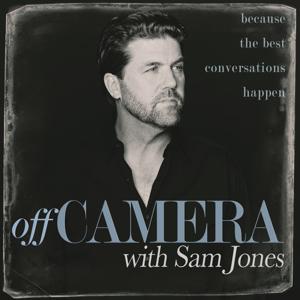
Off Camera with Sam Jones

Off Camera with Sam Jones

Download on the App Store

Off Camera with Sam Jones episodes

  • Ep 95. Hank Azaria
    Hank Azaria’s relationship to the most iconic cartoon of a generation is a question of prepositions. He is indisputably on The Simpsons (his voice work on the show has won him four Emmys); also, he is The Simpsons – or at least a good percentage of the regulars that populate their world: Moe the Bartender, Apu the Kwik-E-Mart proprietor, Chief Wiggum, Comic Book Guy, The Sea Captain, Carl Carlson, as well as a one-man army of walk-ons like Cletus Spuckler, Professor Frink, Dr. Nick Riviera, Lou, Snake Jailbird, Superintendent Chalmers, Disco Stu, Duffman and the Wiseguy.
    A gifted mimic at five, Azaria had no idea his impressions were an unusual talent. “I just loved Bugs Bunny, Daffy Duck, Foghorn Leghorn,” he told the Los Angeles Times. “Then when I got old enough to realize it was all the same guy, Mel Blanc, I lost my mind.” Memorizing comedy routines he saw and doing funny voices remained a diversion while he was growing up in Queens, NY, but became an obsession once he did a high school play. He decided on acting and studied drama at Tufts University and the American Academy of Dramatic Arts. Apparently not an optimist, he’s said he didn’t expect to be successful as a professional actor, but determined to hang on until he was 25 just so he wouldn’t regret not trying.
    His path proceeded along the standard Hollywood lines – a move to L.A., work as a catering bartender and plenty of auditions. His debut was in the 1986 ABC series Bash, a one-line part he told all his friends about, only to discover it was cut. But a little humiliation is a small price to pay for a SAG card, right? Parts in sitcoms like Family Ties and Growing Pains followed, as did Hollywood Dog, his first-ever voice role. The pilot failed, but prompted a casting director to ask him to audition for Moe. Simpsons exec producer Matt Groening kept asking him back, a rogues gallery of voices was compiled, and a stable career was born.
    Live action work picked up around the same time with recurring roles on Friends and Mad About You. A small part in Pretty Woman was his first feature film; subsequent roles soon became bigger and more diverse – Quiz Show, Along Came Polly, Dodgeball, Cradle Will Rock, Night At the Museum, Godzilla – but none more memorable than Agador - Spartacus - in The Birdcage. As a dialed-to-eleven Guatemalan houseboy, he made us laugh harder than the movie’s stars, comic icons Robin Williams and Nathan Lane.
    Every industry has a “guy” – the one you go to when you want the reliable best in the business, and Azaria became the go-to for making any line funny just by saying it. Playwright Jenelle Riley said, "[Azaria's] appeal can best be summed up by, of all things, his hilarious cameo in the goofy comedy Dodgeball. As Patches O'Houlihan, he delivers a pitch-perfect performance in an instructional video in which he chain-smokes, encourages a child to pick on those weaker than him, and steals the film from a cast of comedic greats. It's a wonderful, odd moment that could have failed miserably in the hands of a lesser actor, and he manages to pull it off with only seconds of dialogue…Pound for pound, Hank Azaria is the best actor working today." Azaria humbly passes most of it off to “dumb celebrity impressions,” but that’s dismissing the work of a master mixologist. Patches O’Houlihan? “Essentially a bad Clark Gable impression, but I tried to add some young Rip Torn in it.” Moe? Al Pacino, with some gravel thrown in. Agador? Puerto Rican street queens, tempered with his grandmother. Apu? Peter Sellers in The Party. We’ll end the list there so as not to ruin a potentially amusing Azaria-watching parlor game for you.
    Those indelible characters can make it easy to overlook Azaria’s fine dramatic work in series like Huff and Ray Donovan, and his touching AOL series Fatherhood. Variety called his Emmy-winning performance as Mitch Albom in Tuesdays with Morrie “the most layered and sensitive work of his career.” As it often happens, genius work in one arena overshadows equal work in another. As they say, it’s a blessing and a curse. In his new IFC dark comedy Brockmire, Azaria is a famed major league baseball announcer who suffers an embarrassing public meltdown live on the air and decides to reclaim his career in a small rust belt town calling games for a minor league team called the Morristown Frackers. So mostly, a blessing.
    1 hr 8 min
  • Ep 137. Andie MacDowell
    When Andie MacDowell was a curious and wide-eyed 8-year-old, a trip to the university theater with her mother planted a seed. The adults on stage were playing make believe, her most favorite game in the world, and she was mesmerized. Add a penchant for prank calls and some improv with unsuspecting barkeeps, and the seed that was planted would later grow into her passion for acting. And Andie is nothing if not passionate.
    Over 30 years in the industry and she’s still chomping at the bit to stretch and grow despite how challenging it can be for women to find roles of substance.  As a model, Andie was often held to an impossible standard of perfection, but she knows her success transcends what people see on the surface: “I’ve always known the real reason people would connect with me would not be for the way I looked, but for how I made them feel.”
    That is exactly why she feels so rewarded by her most psychologically complex character to date in the film Love After Love. In the role of Suzanne, a codependent matriarch who loses her husband, Andie straddles the line between strength and despair beautifully. “I was starving for this role,” Andie declares. When I asked her why, the conversation got interesting really fast.
    Andie joins Off Camera to discuss why her role in Love After Love is her most interesting since Sex, Lies, and Videotape, how to move past gender inequality in Hollywood, why her childhood struggles have made her a better mom, and how to properly cook a steak (in butter, of course!).
    1 hr 2 min
  • Ep 61. Glen Hansard
    All artists are essentially storytellers, and the Irish are legendary storytellers (if you disagree, go immerse yourself in some Oscar Wilde, Samuel Beckett, Neil Jordan, or Christy Moore, and get back to us). For three decades, musician and sometimes-actor Glen Hansard has told his tales through song: first as a street busker, then as frontman for Irish band The Frames, next as half of folk rock duo The Swell Season, and now as a solo artist. If his early family life was a bit difficult and alcohol-dampened, it was also kind of enchanted. Household gods like Dylan and Van Morrison, a tradition of gathering to sing, and the folks he met on the streets of Dublin gave him as good an education as he’d ever have received in school—if he’d stayed there.
    Hansard’s ear and general disposition are finely tuned to the tragi-comic, ironic side of life—the Irish seeming to have caught on earlier than most that life doesn’t really offer up an alternate side—and that sensibility helped propel The Frames to native-soil popularity. Their second album (Set List, recorded live) hit the top of Irish charts, The Sydney Morning Herald raving, “This glorious live recording shows exactly why The Frames are the darlings of Ireland’s music scene…There are moments of transcendental magic on this album, showcasing their ability to capture an audience’s interest as the crowd sings along to songs and reacts to frontman Glen Hansard’s anecdotes.”
    We’re not sure if one of those anecdotes was one Hansard has told about seeing an advert for the film The Commitments floating in a dirty puddle on the streets of New York. While The Frames’ popularity remained chiefly confined to Ireland, Hansard’s popularity jumped the pond along with his appearance as guitarist Outspan Foster in the wildly successful film. It read as a soggy reminder for Hansard, who didn’t enjoy the acting experience and felt it overshadowed the band. Like many of his countrymen, he displays a cocked eyebrow at fame: “I make art, and that’s great; but digging in the hole and growing potatoes is a higher calling. In Ireland, the land is pulsing.”
    Maybe so, but eventually the lure of a great story (or maybe just perversity) brought him back to the screen with fellow musician Markéta Irglová in Once, a film that charmed critics and virtually everyone else who saw it and went on to become a smash stage show. More music than dialogue, Once is a testament to what Hansard seems to always have known: some things are better conveyed and more profoundly understood through words that we sing than those we speak. Of the score (co-written with Irglová) The New York Times said, “What lends a special, tickling poignancy to [the] songs is their acceptance of loneliness as an existential given. These are not big ballads that complain angrily about how we could have had it all. An air of romantic resignation, streaked in minor-key undercurrents, tempers the core heartache of numbers like “Leave,” “When Your Mind’s Made Up,” and “Falling Slowly,” which earned the duo a Best Song Oscar.
    His ability to temper a healthy respect for the muse with the nuts and bolts of his craft is most evident on his 2015 solo album Didn’t He Ramble, a hard-won work that’s at once sad, hopeful unsentimental and beautiful. If Hansard’s music—and Hansard himself—embodies worlds of contradiction, he holds true to those contradictions. After all, they’re what make all of us human; and they’re what make the humans who can write and sing about them, artists. You’ll still find him busking out on the evening streets, albeit mostly for charity and with friends like Bono and Eddie Vedder. “It may be a little cold,” he’s said, “but it warms my heart.”
    1 hr 5 min
  • Ep 36. Dax Shepard
    Philip Larkin drolly made parents the scapegoats of our generation with his observation “They f*** you up, your mum and dad…” And true enough, but with a bit of perspective and hard work, you can also come to see they’ve given you some tremendous gifts in the process. Dax Shepard grew up poor in Detroit with an absentee alcoholic father, and several stepfathers who weren’t necessarily an improvement on the original. Dax grew from an often-expelled trouble-making daredevil to become an alcoholic himself, all while pursuing…comedy. After some improv time in the Groundlings, he acted in a few comedies while also writing a few for hire – quite an accomplishment for a dyslexic who couldn’t read until age 11 and firmly believed in his own stupidity. Once in Hollywood, he endured an eight-year stretch of low employment and high self-doubt while he trying hard to find and produce work, and even harder to become sober (he succeeded). Then came marriage, parenthood and Parenthood, all of which have taught him plenty, but namely that sometimes the luckiest of us are those who’ve faced the highest stakes – it tends to make you really appreciate what they stand to lose.
    But despite his hard-won maturity, Shepard is still a kid who loves fast bikes, car chases and blowing things up. And really, who doesn’t, just a little bit? It was part of the impetus behind Hit & Run, a movie he wrote, directed and starred in. Ostensibly it’s a car chase flick, but amid the Corvettes and mobsters, you’ll find some unexpectedly real and moving writing. Endearingly and refreshingly open, he knows his limitations, but also his potential. Beyond his love of his family, his day job and his motorcycles (we think in that order), he has an unabashed enthusiasm for making the films he wants to see, including his upcoming movie version of CHiPS – a film he was probably born to direct. So Citizen Kane it’s not, but we can already hear sirens and awesomeness in the background. The most important thing we learned about Shepard is how much we didn’t know about Shepard. Trust us, you’re gonna love this guy.
    1 hr 14 min
  • Ep 34. Rashida Jones
    Our news feeds these days are pretty reliably littered with examples of how easily kids of celebrities can be overshadowed, crushed or otherwise damaged by the weight of their parents’ fame. Rashida Jones, daughter of legendary and artistic force Quincy Jones and iconic actress Peggy Lipton rebelled from day one, becoming an avid reader, puzzle geek and serious student who declared her intention to attend Harvard at age six. Her status as a Mathlete also bears mention, just because, “Mathlete”. Once at Harvard (indeed, Ms. Jones does not mess around), her pursuit of the law soon turned to pursuits of a more theatrical nature, thanks to OJ Simpson and an Ivy League version of Mean Girls.
    If being “daughter of” didn’t make life hard, it didn’t help much, either. She wasn’t great at auditions, she wasn’t white – or black – enough for casting directors, and roles were scarce. She was on the verge of quitting the biz for grad school when her serious, straight-man demeanor landed her a parts on The Office and eventually Parks and Recreation, where she was a skilled, subtle foil for the absurdity happening all around her.
    Never quite comfortable on The Office and still not finding roles, she finally indulged her secret wish to be a screenwriter, penning the script for indie Celeste and Jesse Forever to show what she could do. A big studio’s offer to buy it validated her skill as a writer, but they feared she wasn’t box office enough to cast as its lead. She stuck to her guns, made if for under a million and starred in the film, of which Entertainment Weekly said, "it's been a while since a romantic comedy mustered this much charm by looking this much like life." Next? Disney hands her the keys to Toy Story 4, its most beloved franchise. In her spare time, she produced and took public criticism for the decidedly non-Disney Hot Girls Wanted, an insightful, concerning look at the porn industry. Oh yeah, and she’ll finally take on a lead TV role as an ass-kicking, cliché-wielding cop in the Steve Carell-produced farce Angie Tribeca.
    Being a celeb kid does not make you special. Going to Harvard does not make you special. Being brave enough to throw out “the shittiest idea in the room”, standing up to rejection, developing confidence in your own voice and working your ass off, well, that makes you special. And an all-around quality human being. Rashida Jones may have been the smart girl we hated in school; now we want our daughters to be just like her. Jones will tell you she’s had a lot of luck. “With all due respect,” we disagree.
    1 hr 9 min
  • Ep 119. Chadwick Boseman
    Not much in Chadwick Boseman’s early life would lead you to think he would become an actor. Not his birthplace (Anderson, South Carolina), not his family (his mom was a nurse, his dad an upholstery business owner), not his interests (he was the quiet one who played sports). Not one thing, it seems, except he just decided.
    A sad incident in his last years of high school prompted him to write and then direct his first play, after which he simply decided that’s what he’d do. He studied at Howard University and later at the British American Drama Academy in Oxford, and in short order, commenced writing plays: His 2006 Deep Azure was nominated for a 2006 Joseph Jefferson Award for New Work, and the Chicago Tribune called it “Fascinating…Especially because the 28-year-old Boseman is a fresh talent – a young, sophisticated African-American writer with all of the flaws that flow from youth and inexperience and all of the excitement that draws from those very same places. With a slate of cultural references complex enough to encompass the likes of jazz-speak, Shakespeare, Hebrew, Louis Farrakhan and Spider-Man, Boseman offers a creative, slick and arresting employment of theatrical language and imagery.”
    But Boseman had also taken some taking acting classes in college. At the time, it was just to learn how to work with actors, but in 2008 he decided he was ready to become one himself. He got a few TV parts here and there (L&O, Lincoln Heights, Persons Unknown), but film parts – many of which he was sure he’d get – eluded him. One of those was in Django Unchained. Boseman wasn’t cast, but after his audition, director Quentin Tarantino told his casting director, “That guy is going to be something.” But what? Those were lean years, and Boseman was on the verge of re-committing to the stage. That’s when he got the call to read for 42, playing Jackie Robinson opposite Harrison Ford. Director Brian Helgeland tells a story of his audition: “[Boseman] came in and said, ‘You’re either going to like me or not, and we’re going to know in five minutes.’ He had to play one of the bravest men who ever lived, so I thought that he came in brave was a great indication.”
    It was brave, considering Robinson himself had played the role in 1950’s The Jackie Robinson Story. Most reviewers felt Boseman did the better job. His bravery was put to the test again when he was asked to audition for the role of James Brown in 2014’s Get On Up. Boseman hesitated (the moves alone would’ve scared even more flexible men), but director Tate Taylor knew it was about more than the Mashed Potato. He needed to see Boseman play Brown in his 60s. “That was the Achilles heel of the whole project,” Taylor told The Guardian in 2015. “I thought, if this isn’t perfect, we will fail, and the whole tone will be wrecked. I need the best fucking actor I can find... and he nailed it.’” Variety agreed, calling his performance faultless. “Chadwick Boseman plays Brown from age 16 to 60 with a dexterity and invention worthy of his subject. We have a chance to see this remarkable actor in full bloom, whether he’s giving life to Brown’s signature dance moves…or burrowing deep into the performer’s tortured, little-boy-lost soul. He feels Brown from the inside out, the way Brown felt his own distinctive rhythms, and even when the movie itself seems to be on autopilot, Boseman never leaves the captain’s chair.”
    Suddenly, Boseman seemed the go-to guy for movies about iconic black figures. It’s something he initially resisted, but this month finds him in Marshall, a biographical thriller about the first African-American Supreme Court Justice Thurgood Marshall and one of the first cases in his career. Boseman is obviously in possession of a strong will, but like most real artists, he’s powerless when it comes to a great story.
    His most iconic character yet may actually be fictional. Last year he joined Marvel’s blockbuster Captain America: Civil War as T’Challa/Black Panther, a brilliant scientist and king of the unconquerable African nation of Wakanda, not to mention a shrewd tactician and fighter. As the first in a five-picture deal with Marvel, it’s of no small significance to Boseman’s career. So is the fact that he’ll be the first black superhero starring in his own Marvel film when Black Panther premieres in 2018. NPR said his “regal performance” in Captain America “makes you wish it were arriving sooner.” If “you” means the 90 million people who watched the film’s teaser trailer within four hours of its release, that sounds about right.
    But back to that decision to write and direct. Boseman has said he’s learned you have to choose a clear point of entry to the business, but once you define yourself, you can go into other arenas. That’s good, because we need artists like him pushing from behind the camera as well. However he decides to tell his stories, we’re listening.
    1 hr 2 min
  • Ep 23. Jason Sudeikis
    As a high school sophomore, Jason Sudeikis switched schools in pursuit of serious basketball dreams and, of course, a girl. Instead, he discovered classes in radio and TV and debate – and a new career option. Soon after swapping Final Four tickets for a video camera, he gave up on college hoops and eventually college itself to go pro in the improv leagues. He honed his chops at ComedySportz, the Annoyance and ImprovOlympic before getting drafted by Second City and eventually Saturday Night Live, where some of his most memorable work occurred behind the scenes writing skits for Justin Timberlake, Amy Poehler and buddy Will Forte. Along the way he happily stole (a term he prefers to “borrow”) from lifelong mentors to develop his own comedic DNA (watch him in the We’re The Millers and guess who he’s channeling). In this issue, Sudeikis discusses his improv roots, his development as an actor and writer, his early love-hate relationship with SNL, the art of guest host management, and of course, hoops. To this day he’s a flashy, joke-cracking point guard who never lets you see how hard he’s working.
    1 hr 1 min
  • Ep 100. Ron Howard
    When a 16-year old Ron Howard was hanging out on set with Henry Fonda (as one does), Fonda gave the young actor a bit of advice: If he loved acting, he should focus on theater, but, "If you love movies, become a director.” Ron Howard loved movies.
    The Oklahoma-born son of two actors, his earliest memories are of memorizing dialog from his dad’s summer stock plays as a 3-year old. Walking unaware into an MGM kids’ casting call in 1959, Howard senior mentioned he had a son who was a fine actor. They called young Ronny in, had him do a scene, and asked his dad if he could do anything else. "I really don’t know if he can." Ron Howard entered our living rooms a year later as Opie in The Andy Griffith Show, and didn’t leave for the next 25 years when Happy Days ended in 1984. That’s when we really saw what else he could do.
    He started directing in 1977 by convincing producer Roger Corman to let him helm Grand Theft Auto (Howard agreed to act in Corman’s Eat My Dust! in exchange). Next came Night Shift, and then, at a point where most directors are still paying off film school debt, he delivered Splash, Cocoon and Parenthood. They were all charming, funny, well reviewed and commercially successful; and yet we still hadn’t seen the extent of what he could do as a director.
    What Howard excels at is telling stories that tell us something about ourselves; real tales of real people – albeit writ large – whose lives and worlds double as themes he wants to explore: family, teamwork, hubris and adversity, to name a few. Another particular genius is his ability to translate those worlds visually, forging a direct connection from our eyeballs to our gut or heart, as the story demands. Consider a tale that takes place largely inside the head of a brilliant but unstable mathematician. In its review of A Beautiful Mind, The New York Times called his technique “as simple as it is inspired,” adding, “Mr. Howard has found an accessible cinematic way to present this insight: Schizophrenia does not announce itself as such to those it afflicts. Mr. Howard leads us into its infernal reality without posting a sign on the door.” The film, an unexpected success, earned him an Academy Award for Best Director.
    When he took us into Formula One racing with Rush, a lot of people went along reluctantly, only to be surprised at how one tight shot of a violently vibrating tire could make their heart race as fast as the motor shaking it. That shot signaled danger more effectively than any deadly crash. Variety thought so, too. “To witness this level of storytelling skill (applied to a subject only a fraction of the public inherently finds interesting) is to marvel at not only what cinema can do when image, sound and score are so artfully combined to suggest vicarious experience, but also to realize how far Howard has come since his directorial debut.”
    He was able to make equally dramatic cinema from two men sitting across from each other, talking. “You expect something dry, historical and probably contrived. But you get a delicious contest of wits, brilliant acting and a surprisingly gripping narrative,” said the Washington Post about Frost/Nixon. “Howard's cinematic treatment deftly exploits very conventional narrative techniques without one ever being quite aware of them.”
    But of course the film that feels closest to his core as a filmmaker is Apollo 13. It has it all: exploration, heroism, history and the compelling factor of being true. Noting that the subject matter demanded Howard’s reverential treatment, the Los Angeles Times called it his most impressive film to date in a 1995 review. “Howard's willingness to be straight ahead with his directing, the film's derring-do aspects have the advantage of showing the men simply being heroic as opposed to acting like heroes.”
    If some critics have made cynical dismissals of a perceived gee-whiz, all-American, hero-worshipping aesthetic, Howard makes no apologies. “I’m drawn toward celebratory stories. I feel that they are every bit as valid and useful as the darker, cautionary tales. And my favorite thing is when the celebration is not up front and in your face, but something that evolves. It’s something you can understand, that flawed characters can be a part of moments that are worthy of celebration and respect.” That’s sounding pretty good to us these days.
    Howard’s work continues to follow his fascinations, from the depths (In the Heart of the Sea) to music (Made in America, The Beatles: Eight Days a week) to boxing (Cinderella Man). We explore along with him again in National Geographic’s first-ever scripted series Genius. His new anthology drama chronicles the world’s most brilliant innovators, kicking off with the famous physicist Albert Einstein. In it, and all of his work, Howard approaches his subjects with eye of a historian, a fan, a geek, and a loving adherent to detail.
    So, how to summarize the life's work of someone whose 63-year career spans two Golden Ages of Television and some of the most acclaimed and successful movies of every genre? Fortunately we don’t have to; it’s still very much in progress.

    1 hr 9 min
  • Ep 162. Javier Bardem
    Acclaimed Spanish actor Javier Bardem comes from a long line of artists and filmmakers, but his love of cinema officially took shape when his mother, a working actress herself, snuck him into a movie theater to see Bob Fosse’s All that Jazz when he was 6 years old. It wasn’t exactly a Disney movie, but that didn’t matter—Javier was in awe. He wondered, “What is this mechanism of people, feelings, dance, music, colors, drama, and comedy? I want to be a part of that.”
    His passion and dedication to the craft are evident in his work—take his award-winning performances in the Coen brothers’ No Country for Old Men and Iñárritu’s Biutiful, to name a few. In his newest film Loving Pablo, Javier takes on the legend and mythology of Colombian drug lord Pablo Escobar and takes on an intensity and physicality that was even intimidating to his costar and wife Penélope Cruz. But Javier and Penélope know the difference between fiction and reality. As Javier says, “At the end of the day, I give her flowers and chocolates and say, ‘That was a lie.’ Even though it’s a part of my truth as a human being.’”
    Honesty is everything for Javier, even though it’s hard to attain on a daily basis. “We tell so many lies during the day because we need to protect who we are for others. When you play a character, you have to give up on that and be naked. And that’s why actors love acting—it may be the only time in the day where we are honest.”
    Javier joins Off Camera to talk about how being the target of senseless violence led him to discover his worth as an artist, why his marriage to Penélope Cruz works, and why therapy is the perfect tool for an actor.
    1 hr 2 min
  • Ep 82. Riz Ahmed
    You keep up on things. You know what’s going on in arts and culture. Then inevitably, it happens. Someone who wasn’t even on your radar is suddenly everywhere, making you question not where they’ve been, but where you’ve been. Meet Riz Ahmed. By now, you probably recognize him from HBO’s The Night Of, but for years, Ahmed’s been busy making wide-ranging, significant, and accomplished work.
    In person, he’s not some frenetic perpetual motion machine, but he does seem to function at a brisk and constant clip, creating, provoking and questioning. He approached Naz Khan, the role that’s brought him to recent wide attention, with a simple theory: “If you see the world in a certain way, the behavior follows.” Applied to Ahmed himself, it seems an apt description of how he creates art, and with it, change.
    Born in London to Pakistani immigrant parents, he won a scholarship to north London’s Merchant Taylors’ school, where he found himself and most Asian kids a subclass in a sea of diplomats’ kids in full prep regalia. He decided to do something about it, specifically, rigging a vote to force the school into electing its first Asian head boy. When other frustrations were expressed more overtly – he threw a chair intended for another student through a window – one teacher had a suggestion: “If you can muck about on stage, you get applause for it, not a suspension.” Good idea. At Oxford University, he studied philosophy, politics and economics, and also put on the only play with two non-white leads staged during his time there. When he decided to put on a drum and bass night but didn’t have immediate takers, he printed up flyers minus the venue and kept at it until he found a club willing to fill in the blank. College confirmed something he’d sensed all along: You can make yourself an insider, but the world will send you occasional reminders that status is temporary. It’s a perspective that’s informed his work across genres, including film, TV, stage and music.
    He did manage to work in some drama studies, and made his film debut at 23 playing a member of the real-life Tipton Three in Michael Winterbottom’s The Road to Guantánamo. He also made a three-hour debut at the Luton Airport, where he and another actor from the film were detained under the Terrorism Act by Special Branch upon returning from the Berlin Film Festival. We’re sure the Branch boys were just exercising caution; we’re also pretty sure that wouldn’t have happened to Matt and Ben.
    Ahmed was nominated for his first British Independent Film Award for Shifty, and highly praised for his effortless, persuasive chemistry with other actors. His second came for Four Lions, Chris Morris’ hilarious satire on terrorism. Mira Nair, who directed him in The Reluctant Fundamentalist, recognized his unique ability to play characters that shift between worlds. "It's the most demanding, complicated role for a young person to carry a film on his shoulders, and to be somebody at once absolutely authentic to the Lahori universe, yet absolutely comfortable, elegant and savvy in the Wall Street universe; to spout the poetry of Faiz at one moment and ruthlessly cut out a factory in Manila the next."
    Eventually American filmmakers saw his work (or at least got hold of reviews routinely peppered with words like “charismatic” “brilliant” and “natural”) and wanted in. His performance opposite Jake Gyllenhal in Nightcrawler was outstanding, and in its review of Jason Bourne, RogerEbert.com wrote, “Only Riz Ahmed makes any impact on a performance level, doing a lot with very little – watch the way he subtly plays a successful businessman who knows the skeletons are about to fall out of his closet. There's a much better version of Jason Bourne that focuses on him…” This year’s been a big one for him. He’s in Rogue One: A Star Wars Story, and puts a new spin on the gumshoe genre in City of Tiny Lights. He’s also working on a multi-generational Pakistani-British family story he aims to make for U.K. television.
    If the industry (ironically) helped Ahmed’s early career with its tendency to see in stereotypes, it’s also allowed us glimpses of a depth we’d otherwise miss by occasionally looking past them. Needless to say, that goes for society as a whole, and Ahmed is not shy about voicing that opinion. But he knows that if you’re going to be an unapologetic button-pusher, you best avoid righteous self-aggrandizement and do it with some humor. And some serious rap. Under the handle Riz MC, he’s put out three albums of songs that have been critically acclaimed (and in one instance, banned) for their biting – and bitingly funny – take on immigration, race and other issues.
    Ahmed specializes in playing, and being, an insider-outsider. If you’ve never felt like an outsider, don’t count yourself lucky; it’s a perspective that benefits us. Which is why we need this guy to keep acting, rapping, writing, and if necessary, throwing the occasional chair.
    59 min

About Off Camera with Sam Jones

From the publisher's feed

Off Camera is a podcast hosted by photographer/director Sam Jones, who created the show out of his passion for the long form conversational interview, and as a way to share his conversations with a…

More shows like Off Camera with Sam Jones

WTF with Marc Maron Podcast by Marc Maron

WTF with Marc Maron Podcast

28,893 Listeners

Happy Sad Confused by Josh Horowitz

Happy Sad Confused

1,281 Listeners

Awards Chatter by The Hollywood Reporter

Awards Chatter

1,343 Listeners

IndieWire's Filmmaker Toolkit by Chris O'Falt

IndieWire's Filmmaker Toolkit

109 Listeners

In the Envelope: The Actor’s Podcast by Backstage

In the Envelope: The Actor’s Podcast

180 Listeners

Armchair Expert with Dax Shepard by Armchair Umbrella

Armchair Expert with Dax Shepard

69,560 Listeners

Conan O’Brien Needs A Friend by Team Coco & Earwolf

Conan O’Brien Needs A Friend

59,373 Listeners

The Three Questions with Andy Richter by Team Coco & Earwolf

The Three Questions with Andy Richter

3,610 Listeners

Literally! With Rob Lowe by Stitcher & Team Coco, Rob Lowe

Literally! With Rob Lowe

12,390 Listeners

Mike Birbiglia's Working It Out by Mike Birbiglia

Mike Birbiglia's Working It Out

4,588 Listeners

SmartLess by Jason Bateman, Sean Hayes, Will Arnett

SmartLess

57,744 Listeners

Blocks: I Wish I Knew w/ Neal Brennan by Neal Brennan

Blocks: I Wish I Knew w/ Neal Brennan

1,377 Listeners

Family Trips with the Meyers Brothers by Seth Meyers and Josh Meyers

Family Trips with the Meyers Brothers

2,869 Listeners

Where Everybody Knows Your Name with Ted Danson and Woody Harrelson (sometimes) by Team Coco & Ted Danson, Woody Harrelson

Where Everybody Knows Your Name with Ted Danson and Woody Harrelson (sometimes)

3,408 Listeners

Good Hang with Amy Poehler by The Ringer

Good Hang with Amy Poehler

12,445 Listeners